


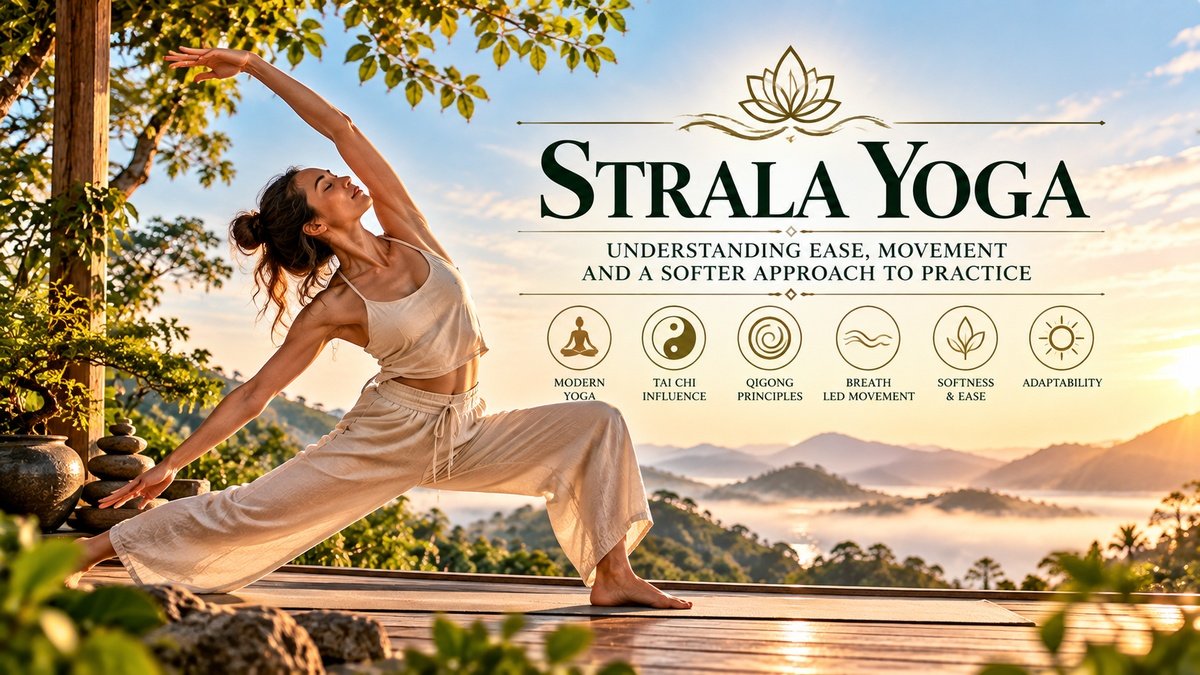
Strala Yoga begins with an unusually simple proposition: movement does not always need to become harder in order to become more useful.
Created by Tara Stiles and subsequently developed with Mike Taylor, Strala is a contemporary movement method that combines the posture vocabulary of yoga with principles influenced particularly by Tai Chi and Qigong.
Its language repeatedly returns to softness, ease and responsiveness.
Rather than trying to reproduce an ideal external posture, practitioners are encouraged to notice how they feel, move from their centre and allow the breath to guide movement.
That does not necessarily mean doing less.
A Strala practice can contain strength, balance, mobility and challenging movements. The distinction lies in how the practitioner approaches that challenge: with less unnecessary tension and less emphasis on forcing the body towards a predetermined shape.
Strala Yoga therefore represents an interesting development within modern yoga — one that shifts attention away from perfecting poses and towards the process of moving through them.
What Is Strala Yoga?
Strala Yoga is a contemporary movement-based approach created by Tara Stiles.
Over time, Mike Taylor became closely involved in developing the method, particularly through his background and interest in East Asian movement practices.
Today, Strala describes its approach as combining movement principles from Tai Chi with form vocabularies drawn from yoga, Tai Chi and Qigong.
The method emphasises moving with the breath, reducing unnecessary tension and responding to what the practitioner feels rather than forcing the body towards an externally prescribed position.
Consequently, Strala is not organised primarily around achieving increasingly advanced poses.
The posture provides a direction.
How someone moves towards, through and away from that posture becomes equally important.
Who Created Strala Yoga?
Tara Stiles created Strala through her own background in movement and yoga.
Before becoming internationally known as a yoga teacher, Stiles trained in classical ballet and dance. Her movement background later influenced the fluidity and freedom that became characteristic of Strala.
She began studying yoga during the 1990s and eventually developed an approach that moved away from rigidly reproducing poses.
Mike Taylor later became an important collaborator and co-founder within Strala.
His influence contributed principles associated with Tai Chi, Qigong and East Asian approaches to movement.
As Strala developed, the system therefore became more than Tara Stiles’s personal approach to yoga poses.
It evolved into a broader movement methodology centred upon softness, coordination, breath and ease.
Where Did the Name Strala Come From?
Strala’s own teaching has associated the name with ideas such as radiance, freedom and ease.
These themes reflect the method’s wider philosophy.
Instead of approaching practice through constant correction and striving, Strala encourages practitioners to create space, move naturally and become more responsive to their own experience.
For that reason, the name has become closely connected with Tara Stiles’s familiar phrase:
“Move what feels good.”
The phrase does not necessarily mean avoiding every difficult movement.
Rather, it expresses a preference for moving through challenge without creating more tension than the movement itself requires.
Is Strala Yoga a Traditional Indian Yoga Style?
No.
Strala Yoga is a modern movement method.
Its vocabulary includes postures familiar from contemporary yoga, but the method itself developed in the twenty-first-century international yoga environment.
Furthermore, Strala deliberately incorporates principles associated with East Asian movement traditions, particularly Tai Chi and Qigong.
It should therefore not be presented as an ancient Indian lineage or as a traditional yoga system transmitted unchanged across centuries.
That distinction does not diminish the practice.
Instead, it helps us understand what Strala actually represents: a contemporary synthesis shaped by modern yoga, dance and East Asian movement principles.
What Makes Strala Yoga Different?
One of Strala’s most recognisable characteristics is its emphasis on movement rather than the final pose.
Many modern yoga methods organise instruction around alignment within individual āsanas.
Strala asks a somewhat different question:
How are you moving?
A practitioner may explore how the whole body participates in a transition rather than isolating one joint or muscle unnecessarily.
Movement can continue subtly even while someone appears to remain within a pose.
The body therefore does not need to become rigid simply because it has arrived at a recognisable yoga shape.
This preference for continuity contributes to Strala’s characteristic fluid appearance.
Why Is Softness Important in Strala Yoga?
Softness has become one of Strala’s central principles.
However, softness does not simply mean relaxation or physical flexibility.
Within the method, it describes an approach to movement that reduces unnecessary tension.
Someone can perform a strong movement while remaining comparatively soft in areas that do not need to work intensely.
This creates an important distinction between effort and excess effort.
A challenging movement may genuinely require strength.
Strala does not necessarily ask the practitioner to remove that effort. Instead, it asks whether additional bracing, gripping or forcing is helping.
The practice therefore explores how strength and softness can coexist.
What Does “Move What Feels Good” Mean?
Tara Stiles has become closely associated with the phrase “Move what feels good.”
At first, this can sound as though Strala simply asks practitioners to do whatever feels pleasant.
The method intends something more nuanced.
Feeling becomes a source of information.
Instead of ignoring sensation in order to reproduce the teacher’s shape, practitioners are encouraged to notice their own experience and respond.
That response might mean moving differently, reducing a range of movement, pausing, exploring another direction or occasionally choosing not to continue.
However, sensation is not an infallible diagnostic system.
Something can feel unfamiliar without being harmful, while an apparently comfortable movement is not automatically appropriate in every circumstance.
Feeling can therefore inform practice without replacing judgement, teaching skill or relevant professional advice.
How Important Is Breath in Strala Yoga?
Breath provides one of the principal organising structures of Strala Yoga.
The method commonly encourages movement to begin with breathing rather than forcing the breath to match a predetermined physical rhythm.
Strala describes inhalation as creating space and expansion, while exhalation accompanies softening and movement into that available space.
This creates a continuous conversation between breath and movement.
Unlike a rigid breathing count, the process can adapt according to the individual and the movement taking place.
Breath also offers an accessible point of attention.
When unnecessary tension increases, breathing may become restricted or hurried. Noticing that change can encourage the practitioner to reconsider how much effort the movement actually requires.
For a broader exploration of yogic breathing traditions, see our article on Prāṇāyāma.
How Does Tai Chi Influence Strala Yoga?
Tai Chi has become a significant influence within Strala’s movement methodology.
Strala draws particularly upon ideas of whole-body coordination, softness, movement from the centre and using less unnecessary muscular force.
Rather than holding one part of the body rigid while another part moves, practitioners explore how movement can travel through the body as a coordinated whole.
This influence has become increasingly explicit within Strala teacher training.
Mike Taylor’s involvement has contributed substantially to this aspect of the method.
However, Strala Yoga should not simply be called Tai Chi.
Tai Chi has its own Chinese history, lineages, forms, martial dimensions and philosophical contexts.
Strala adapts selected movement principles within a contemporary system that also uses yoga postures and other movement vocabulary.
How Does Qigong Influence Strala Yoga?
Qigong provides another important East Asian influence within contemporary Strala.
The broad category of Qigong encompasses numerous Chinese practices involving movement, breathing, attention and ideas concerning qi.
Strala draws upon aspects of this movement culture alongside Tai Chi.
Again, historical distinction matters.
Strala is not a traditional Chinese Qigong lineage.
Instead, it integrates selected principles and movements into its own contemporary methodology.
Recognising that difference allows both Strala and the traditions influencing it to retain clearer identities.
Does Strala Yoga Focus on Alignment?
Strala does not generally organise practice around one idealised external alignment that every body must reproduce.
Instead, it places greater emphasis on movement, responsiveness and coordination.
This does not mean that physical organisation becomes irrelevant.
A practitioner still needs enough stability, awareness and control to move appropriately through a sequence.
However, Strala tends to avoid treating the pose as a static geometric object.
The method allows more variation in how someone inhabits a shape.
This creates space for individual proportions, mobility and movement preferences rather than assuming that every body should look identical in the same posture.
Does Strala Yoga Have Fixed Poses?
Strala uses many familiar yoga postures.
However, the method does not treat those forms as rigid destinations.
A pose can function as a recognisable part of the movement vocabulary while allowing the practitioner freedom in how they enter, explore and leave it.
Small movements may continue within the shape.
Someone might shift weight, soften a joint, alter the position of the arms or move slightly in response to breathing.
Consequently, the posture becomes less like a photograph and more like a temporary moment within continuous movement.
Does Strala Yoga Have a Fixed Sequence?
No.
Strala Yoga does not depend upon one compulsory sequence.
This distinguishes it from methods such as Ashtanga Yoga, where recurring series form an important part of the practice.
Strala classes can vary according to their purpose, duration and level of intensity.
The official method currently includes class formats such as Strong, Relax, Energize, Basics, Gentle and Core.
Each format emphasises somewhat different qualities while retaining the wider Strala approach to breathing and movement.
The method therefore has recognisable principles without requiring every class to reproduce the same choreography.
What Happens in a Strala Yoga Class?
A Strala class usually involves continuous exploration of breath and movement.
The teacher — traditionally called a Strala Guide within the method — offers directions while leaving room for individual response.
Rather than repeatedly correcting students towards one perfect shape, the guide encourages people to notice what they feel and make choices within the movement.
Sequences may include standing movements, balances, floor work, strengthening patterns, mobility and periods of quieter movement.
The exact structure varies according to the class format.
Throughout the practice, breath and ease provide recurring reference points.
The intention is not necessarily to make every movement easy. Instead, practitioners explore whether they can meet different levels of challenge without adding unnecessary struggle.
Why Does Strala Use the Word Guide Instead of Teacher?
The language reflects Strala’s approach to autonomy.
A guide provides direction without positioning themselves as the unquestionable authority over another person’s internal experience.
The practitioner remains responsible for noticing sensation and making decisions.
This shifts the teaching relationship away from simple imitation.
The guide can suggest a movement, while the person practising explores how that movement works in their own body.
Of course, terminology alone does not guarantee good teaching.
Professional competence, appropriate boundaries, clear instruction and respect for consent remain important regardless of whether someone uses the title teacher, instructor or guide.
What Are the Main Strala Yoga Class Types?
Strala currently presents several principal class formats.
Strong uses flowing movement to explore strength, balance and mobility.
Basics provides a simpler movement vocabulary and can support familiarity with the method.
Relax places greater emphasis on softer movement and reduced intensity.
Gentle combines accessible movement with strength and mobility.
Energize uses flowing movement with a more invigorating quality.
Core places additional emphasis on coordinated strength through the centre of the body.
These categories describe different directions rather than completely separate systems.
Breath, softness and responsive movement remain common themes across them.
Is Strala Yoga a Form of Vinyasa Yoga?
Strala can resemble Vinyasa Yoga because both may use continuous sequences of movements connected with breathing.
However, the teaching emphasis differs.
Many Vinyasa classes organise movement around recognisable transitions and sequences of āsanas.
Strala places unusually strong emphasis on natural movement, softness and the freedom to vary the route through those forms.
Its increasing incorporation of Tai Chi and Qigong principles also gives the method a movement vocabulary that extends beyond conventional Vinyasa.
Therefore, describing Strala simply as another Vinyasa style misses an important part of its contemporary identity.
How Is Strala Yoga Different from Forrest Yoga?
Both Strala Yoga and Forrest Yoga are contemporary named methods that give practitioners more freedom than a fixed-series system.
Yet their methodologies are quite different.
Forrest Yoga commonly uses strong abdominal work, deliberate holds, targeted sequencing and progressive preparation towards physically significant poses.
Strala generally places more emphasis on continuous movement, softness, whole-body coordination and using less unnecessary effort.
Both can include challenging physical work.
The difference lies less in whether challenge exists and more in how the method organises the experience of that challenge.
How Is Strala Yoga Different from Iyengar Yoga?
Iyengar Yoga developed a sophisticated methodology involving alignment, timing, sequencing and the use of props.
Strala approaches movement from another direction.
Rather than emphasising precise external positioning, it generally encourages practitioners to remain mobile and responsive.
This does not make one method more correct than the other.
They simply organise attention differently.
Iyengar Yoga may use detailed instruction to investigate a posture with considerable precision. Strala may use the same broad posture vocabulary while encouraging more movement within and around the shape.
The contrast illustrates how differently modern yoga methods can interpret āsana.
Is Strala Yoga Easy?
The emphasis on ease can make this question confusing.
Ease does not necessarily mean low physical intensity.
A Strala Strong class can include demanding balances, transitions and strengthening movements.
The method instead asks whether challenge can be approached without unnecessary tension.
Someone may therefore perform a physically difficult movement while exploring a comparatively softer way of organising the body.
This distinction between easy movement and moving with ease is central to understanding Strala.
The second can exist even when the task itself is challenging.
Is Strala Yoga Suitable for Beginners?
Strala’s adaptable philosophy can make it approachable for people who are new to yoga.
Its Basics and Gentle formats provide particularly accessible entry points.
However, the suitability of any individual class depends upon its content, pace and the person’s circumstances.
A beginner may need more explanation than an experienced practitioner even when the movements themselves appear simple.
Likewise, an experienced student may require adaptations because of fatigue, pregnancy, pain, mobility or another individual factor.
The important principle is that practice should remain responsive rather than forcing everyone through an identical movement range.
Does Strala Yoga Use Props?
Props can form part of Strala practice when they make movement more accessible or useful.
However, the method is not organised around an elaborate prop system in the way associated with Iyengar Yoga.
The wider principle remains adaptability.
A block, blanket, chair, wall or other support can alter the relationship between the person and the movement.
Using support does not make a practice less complete.
It can simply provide another route through the same exploration.
Does Strala Yoga Heal the Body?
Strala’s own materials frequently use the language of health and healing.
Some official descriptions make substantial claims about stress, pain, disease, neurology, genetics and other aspects of health.
Those claims form part of how Strala has historically explained its method.
However, they should not automatically be repeated as established clinical conclusions.
Movement, physical activity, relaxation practices and breathing can contribute to wellbeing in many ways. Their effects also depend upon the individual, the practice and the outcome being considered.
A yoga or movement class cannot responsibly guarantee that it will cure chronic pain, anxiety, depression, cancer, Alzheimer’s disease or another medical condition.
For Orenna, the more appropriate distinction is simple: Strala can be explored as a movement and wellbeing practice without presenting it as medical treatment.
Does Moving with Ease Activate the Relaxation Response?
Strala frequently uses the concept of the relaxation response to explain its approach.
Slow breathing, reduced unnecessary muscular tension and less threatening forms of movement can certainly influence how someone experiences a practice.
However, human physiology is more complex than a simple switch between stress and relaxation.
No movement method can guarantee one predetermined autonomic state for every person.
Context, health, environment, expectations and individual variation all influence physiological responses.
It is therefore more accurate to say that Strala deliberately creates conditions associated with ease and reduced unnecessary tension rather than claim that every practitioner enters one identical neurological state.
Is Strala Yoga Spiritual?
Strala does not require adherence to one religious doctrine.
Its teaching language tends to focus on feeling, connection, creativity, freedom and the way people move through everyday life.
Some practitioners may understand these themes spiritually.
Others may approach them simply as aspects of attention, movement and personal experience.
Strala therefore occupies a recognisably modern space in which yoga-related practice can carry personal or spiritual meaning without requiring one prescribed theological framework.
That modern orientation also distinguishes it from historical systems such as Rāja Yoga, Bhakti Yoga or Tantra Yoga, whose philosophies developed within very different religious and historical environments.
Is Strala Yoga Really Yoga?
This question often appears whenever a modern method substantially changes the conventions people associate with yoga.
Historically, however, yoga has never been one unchanging practice.
Different periods produced radically different understandings of what yoga meant, what it was for and how practitioners should undertake it.
Strala clearly belongs to the contemporary global yoga environment and uses a substantial vocabulary of modern yoga postures.
At the same time, it deliberately incorporates movement principles from outside Indian yoga traditions.
It is therefore most accurate to call Strala a modern yoga and movement method rather than claim either that it represents ancient yoga unchanged or that it has no relationship with yoga at all.
A Common Misunderstanding: Ease Does Not Mean Avoiding Challenge
Strala’s language of softness can easily be mistaken for a preference for effortless or purely gentle practice.
That misses an important distinction.
The method does not necessarily remove challenge.
Instead, it questions whether struggle itself should be treated as evidence that practice is working.
A demanding balance may still require substantial strength. A long sequence can still create fatigue. Learning an unfamiliar movement can still require concentration.
The practitioner simply does not need to add more tension than the task requires.
Strala’s proposition is therefore not that everything should be easy. It is that difficulty does not automatically become more valuable when we make it harder on ourselves.
An Orenna Perspective: When Less Effort Creates More Choice
Yoga culture often celebrates effort.
We recognise discipline, endurance and the ability to remain when something becomes difficult.
Those qualities can matter.
Yet effort can also become automatic.
We grip because we expect a pose to be difficult. We hold the breath because we want to succeed. We continue because stopping feels like failure.
Strala introduces a useful interruption to that pattern.
What happens if we remove the effort that is not actually helping?
The answer is not necessarily relaxation.
Sometimes less unnecessary tension reveals that more strength is available. At other times, it reveals another direction, a smaller movement or the possibility of stopping.
In each case, softness creates information.
Perhaps ease is not the opposite of effort. Perhaps it is what allows us to notice which effort is actually necessary.
References & Further Reading
Tara Stiles & Mike Taylor — Strala Yoga. Official Strala materials provide the primary source for the method’s contemporary principles, including softness, breath-led movement, adaptability and its integration of Tai Chi and Qigong influences.
Tara Stiles. Books and teaching materials by Strala’s creator provide useful primary-source insight into the development of her movement philosophy and the idea of “moving what feels good”.
Strala Yoga Teacher Training materials. Current training information documents the method’s emphasis on natural movement, moving from the centre, breath, softness, feeling and the incorporation of Tai Chi and Qigong principles.
Mark Singleton. Yoga Body: The Origins of Modern Posture Practice. Useful wider scholarship for understanding how contemporary posture-centred yoga methods developed within the global history of modern yoga.



