
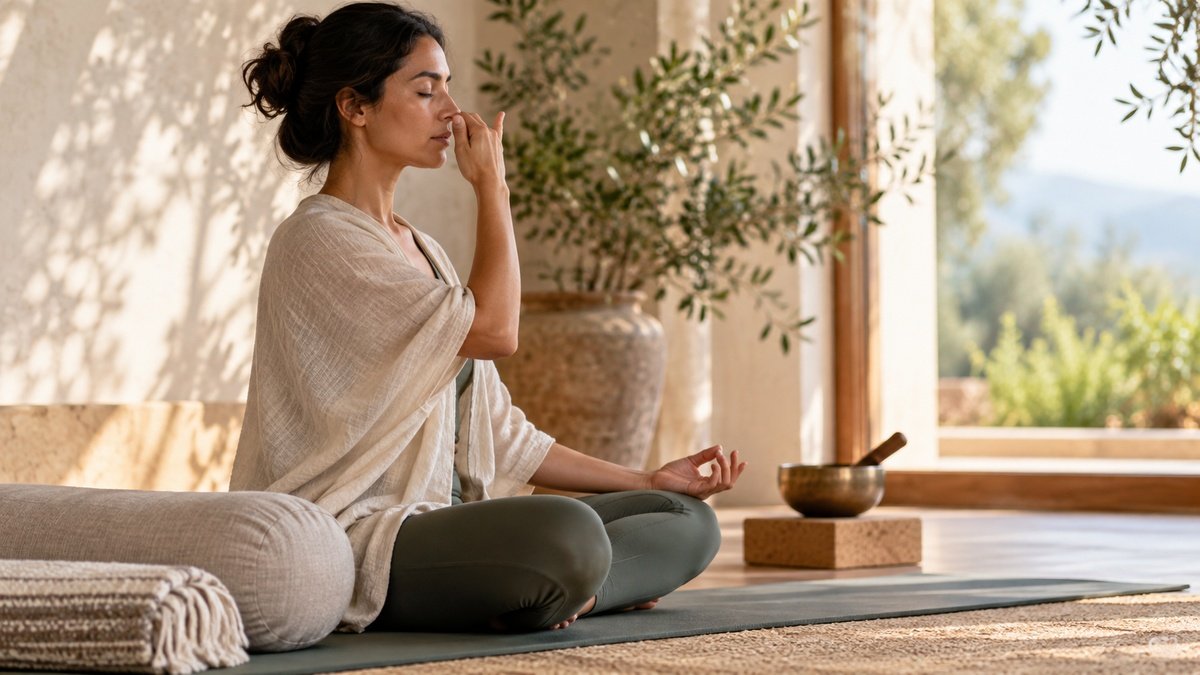
Pranayama is often introduced as a collection of breathing exercises. Yet within yoga, the practice has a much broader history. Across different periods and traditions, prāṇāyāma has involved deliberate ways of exploring breath, prāṇa, attention and the wider aims of yoga.
Some pranayama practices use slow, measured breathing. Others include pauses, breath retention, alternate-nostril patterns or more dynamic techniques. Their methods and purposes have also changed across different yoga traditions.
Understanding pranayama therefore involves more than learning when to inhale and exhale. It also invites us to explore where these practices came from, what prāṇa means and how historical yoga traditions relate to contemporary understandings of breathing.
What Is Pranayama?
The Sanskrit term prāṇāyāma is commonly translated as breath control or breath regulation. Other interpretations emphasise the regulation, restraint or extension of prāṇa.
No single English translation captures every historical meaning of the term. One useful starting point is therefore to distinguish between breathing and prāṇa.
Breathing is a physiological process that can be observed and measured. Prāṇa is a concept with a long and complex history within Indian philosophical, religious and yogic traditions.
The two became closely connected within many forms of yoga. However, they are not simply different names for the same concept.
Understanding Prāṇa
Prāṇa is an important concept in Indian thought, although its meaning varies according to text, period and tradition.
Depending on context, prāṇa can refer to breath, vitality, life-sustaining activity or particular forms of vital functioning. Some yogic traditions also describe different vāyus, often translated as vital winds, within their understanding of the person.
These ideas belong to particular philosophical and contemplative frameworks. Exploring them within those frameworks helps preserve their historical meaning.
Contemporary anatomy and physiology use a different framework for describing respiration. Both perspectives can be studied, but one does not automatically provide scientific confirmation of the other.
Prāṇa Is Not Simply Oxygen
Contemporary explanations sometimes describe prāṇa as oxygen. The comparison can sound intuitive because breathing brings oxygen into the lungs. Historically, however, the concepts come from different systems of knowledge.
Oxygen is a chemical element involved in measurable physiological processes. Prāṇa is a concept whose meanings developed within Indian philosophical and yogic thought.
Equating the two therefore removes an important distinction.
The same care applies to nāḍīs, vāyus and other elements of yogic subtle-body traditions. These concepts can be explored within their historical settings without presenting them as structures established by contemporary biomedical anatomy.
This distinction allows yoga philosophy and contemporary science to be discussed together while recognising that they developed through different systems of knowledge.
The Early History of Pranayama
Patañjali’s Yoga Sūtras contain one of the best-known discussions of pranayama. However, yogic engagement with breath predates the Yoga Sūtras.
Earlier Indian sources contain references to breath restraint and related practices. Ideas concerning breath and vital activity also developed within different ascetic and contemplative traditions.
Later yoga traditions continued to develop these practices in different directions. Consequently, pranayama cannot be reduced to one technique that remained unchanged throughout yoga history.
Like yoga more broadly, practices involving breath developed through continuity, variation and reinterpretation.
Pranayama in Patañjali’s Yoga Sūtras
Within Patañjali’s eight-limbed framework, pranayama is the fourth limb.
Yoga Sūtra II.29 presents the sequence:
Yama · Niyama · Āsana · Prāṇāyāma · Pratyāhāra · Dhāraṇā · Dhyāna · Samādhi
Prāṇāyāma therefore follows āsana and precedes pratyāhāra.
Yoga Sūtras II.49–II.53 develop the subject further. The text discusses inhalation, exhalation and their regulation or interruption, alongside considerations such as place, time and number.
The context is important. Here, pranayama forms part of a wider contemplative discipline. Its significance extends beyond using breathing as a contemporary relaxation practice.
Within Patañjali’s system, breath practice sits between āsana and the increasingly inward dimensions of the eight-limbed path.
Explore this framework further in Beyond Āsana: Understanding the Eight Limbs of Yoga.
Pranayama in Haṭha Yoga
Breath regulation became particularly prominent within traditions associated with Haṭha Yoga.
The balance between posture and breathing in many premodern yoga sources differs considerably from what someone might encounter in a contemporary posture-led yoga class. Breath regulation and retention could occupy a central place within practice.
Haṭha Yoga sources describe inhalation, exhalation and retention alongside practices involving mudrā, bandha and models of the subtle body.
Some texts connect these practices with nāḍīs, vital winds, kuṇḍalinī and other features of the yogic body.
These descriptions also vary between texts and traditions. There is no single subtle-body model that appears unchanged throughout the history of yoga.
Explore this wider history in Beyond the Pose: Understanding Haṭha Yoga and Its Origins.
What Is Kumbhaka?
Kumbhaka is commonly associated with deliberately pausing or retaining the breath.
Breath retention became significant within several yogic traditions, and some historical texts give the practice considerable importance.
Historical significance, however, does not make every technique suitable for every context.
Deliberate retention changes the usual rhythm of breathing and can create noticeable sensations. Practices also vary considerably in duration and intensity.
More intensive forms of retention therefore call for appropriate teaching and consideration of the individual circumstances in which they are being explored.
Lengthening a retention is not a requirement for meaningful yoga practice.
Is Pranayama Always Calming?
No single effect describes every form of pranayama.
Some techniques deliberately slow the breathing rhythm. Others use particular ratios, pauses, retentions or nostril patterns. Certain practices involve faster or more forceful respiratory activity.
These differences matter because breathing patterns can create different physiological and subjective experiences.
For example, research examining slow breathing cannot automatically tell us what happens during every pranayama technique described within yoga traditions.
Instead of asking what breath practice does as though every method were identical, it is more useful to ask which technique is being discussed, how it is being practised and in what context.
Pranayama and the Nervous System
Breathing interacts with cardiovascular and autonomic physiology in measurable ways.
Research into voluntary slow breathing has reported changes in measures including heart rate variability and respiratory sinus arrhythmia. Systematic reviews have also identified changes in vagally mediated heart rate variability during and following slow-breathing practices.
These findings make breathing an interesting area of scientific study. However, they do not demonstrate that every pranayama practice produces an identical response.
Breathing rate, technique, duration, experience, individual physiology and research methodology can all influence findings.
Heart rate variability also represents one physiological measurement. It does not provide a complete account of someone’s emotional or subjective experience.
For this reason, broad statements that pranayama simply “regulates the nervous system” can imply greater certainty than the evidence supports.
Does a Longer Exhalation Always Create Relaxation?
Longer exhalations frequently appear in contemporary yoga practices associated with relaxation.
There are physiological reasons to study relationships between respiration, heart rate and autonomic activity. Slow breathing can influence cardiovascular and autonomic measures, while respiration naturally interacts with changes in heart rate.
However, extending an exhalation does not guarantee a particular experience.
One practitioner may enjoy a particular breathing ratio. Another may find the same pattern uncomfortable or distracting. Someone else may prefer to observe breathing without deliberately changing it.
Each response provides information about the person’s experience of the practice.
A breathing technique can therefore be offered as an exploration rather than as a guaranteed route to relaxation.
A Bigger Breath Is Not Necessarily a Better Breath
“Take a deep breath” is a familiar instruction. Yet increasing the size of every inhalation is not necessary for every breathing practice.
Deliberately increasing ventilation can change carbon dioxide levels. Breathing substantially more than current physiological demand may also contribute to sensations such as light-headedness or tingling.
A gentle breathing exploration therefore does not need to begin by maximising the volume of each inhalation.
It can begin by noticing the breath that is already present.
From there, a particular rhythm may be introduced when appropriate, without requiring greater depth or longer duration.
Breath Awareness and Individual Choice
People experience attention to breathing in different ways.
For some, following the breath provides a useful focus. Others may prefer to notice movement, sound, contact with the floor or another aspect of present experience.
Yoga practice can make space for these different responses.
Breath awareness also does not require one particular posture. It can be explored while seated on a chair, resting with support, standing or in another position appropriate to the practice.
Keeping the eyes open is also an option. A practitioner may use a soft gaze or a visual point of reference instead.
Equally, attention does not have to remain with breathing throughout an entire practice.
Offering meaningful choices allows the practice to respond to the individual rather than asking the individual to conform to one prescribed experience.
Pranayama and Modern Breathwork
The contemporary term breathwork now describes a broad range of practices.
Some approaches draw from yoga traditions. Others have developed through meditation, physical training, contemporary wellness practices or other settings.
As a result, breathwork and pranayama are not automatically interchangeable terms.
Prāṇāyāma developed within Indian yoga traditions and carries historical, philosophical and technical contexts that extend beyond respiratory exercise alone.
Recognising that distinction does not diminish contemporary breathing practices. Instead, it allows different approaches to be described more accurately while acknowledging their different histories.
Breath, Attention and Meditation
Breathing can provide a focus for contemplative practice because it is continuously changing.
An inhalation begins, develops and ends. An exhalation follows. Sensations shift from moment to moment.
Attention may remain with that process, move elsewhere and return.
In this context, breathing does not necessarily need to change in order to become an object of attention.
This distinction between observing the breath and deliberately regulating it is useful. Breath awareness and pranayama can overlap, but they do not always describe the same practice.
Explore the relationship between attention and meditation in From Concentration to Meditation: Understanding Dhāraṇā, Dhyāna and Samādhi.
Is There One Correct Way to Breathe?
Yoga classes may include instructions such as breathing through the nose, noticing movement around the abdomen or extending an exhalation.
Each instruction can have a purpose within a particular practice. However, a contextual instruction does not need to become a universal rule.
Breathing changes with movement, speech, rest, physical activity, emotion, environment and individual circumstances. Different yogic techniques also intentionally use different respiratory patterns.
Consequently, one breathing pattern cannot define yoga practice for every person or every situation.
A particular technique can instead be understood in relation to its purpose, its context and the experience of the person exploring it.
Observation Before Intervention
Breathing happens without continuous conscious direction, while also being open to voluntary influence.
That relationship creates many possibilities for yoga practice.
Sometimes observation can come before deliberate change.
What does the breath feel like at this moment?
Where is movement noticeable?
Does the experience change when more physical support is introduced?
Would following the breath feel useful, or would another point of attention be more appropriate?
Questions such as these create space for exploration without assuming in advance what someone should experience.
The practitioner remains an active participant in the process.
The Orenna Perspective — Breath as Invitation
At Orenna, the breath does not need to perform.
The value of a breathing practice does not depend on producing the deepest inhalation, the slowest rhythm or the longest retention.
Instead, practice can begin with curiosity.
Before deliberately changing the breath, there can be an opportunity to notice it.
Perhaps breathing feels quiet. Perhaps it is more noticeable. Movement may be easy to sense in one area and subtler elsewhere. Attention to the breath may feel useful, or another focus may be preferred.
These are different experiences rather than measures of how well someone is practising.
When pranayama is introduced, the practice can respond to the individual, the context and the intention of the session.
A slower rhythm can be explored without requiring an exceptionally large breath. An exhalation can lengthen while remaining comfortable. A pause may remain brief, or it may not be introduced.
The practitioner can also return to their usual breathing pattern at any point.
This approach does not reduce pranayama to relaxation. Its history reveals something considerably broader: yoga traditions have worked with breath as part of wider systems of discipline, attention and contemplative practice.
Respecting that history does not require every technique described in historical sources to be used in every contemporary setting.
Practice can acknowledge tradition while remaining attentive to context, choice and individual experience.
The breath is already happening.
Yoga offers different ways to encounter it.
References & Further Reading
Bryant, Edwin F. The Yoga Sūtras of Patañjali. A translation and commentary providing context for prāṇāyāma within Patañjali’s wider system, including Yoga Sūtras II.49–II.53.
Mallinson, James & Singleton, Mark. Roots of Yoga. Penguin Classics, 2017. A sourcebook containing translated material from a wide range of premodern yoga traditions, including sources concerned with breath control and the yogic body.
Svātmārāma. Haṭhapradīpikā. An influential premodern Haṭha Yoga text in which breath regulation and retention occupy an important place.
Haṭha Yoga Project, SOAS University of London. Research and resources on premodern physical yoga, including historical material concerning breath control and the yogic body.
Zaccaro, Andrea et al. “How Breath-Control Can Change Your Life: A Systematic Review on Psycho-Physiological Correlates of Slow Breathing.” Frontiers in Human Neuroscience, 2018.
Laborde, Sylvain et al. “Effects of Voluntary Slow Breathing on Heart Rate and Heart Rate Variability: A Systematic Review and a Meta-Analysis.” Neuroscience & Biobehavioral Reviews, 2022.
The Orenna Journal explores yoga from historical, philosophical and contemporary perspectives. This article is for education and general information. It does not provide individual medical advice. Breathing practices vary in method and intensity, and individual circumstances can influence whether a particular practice is appropriate. More intensive techniques, including extended breath retention and forceful breathing, may require appropriate professional guidance.