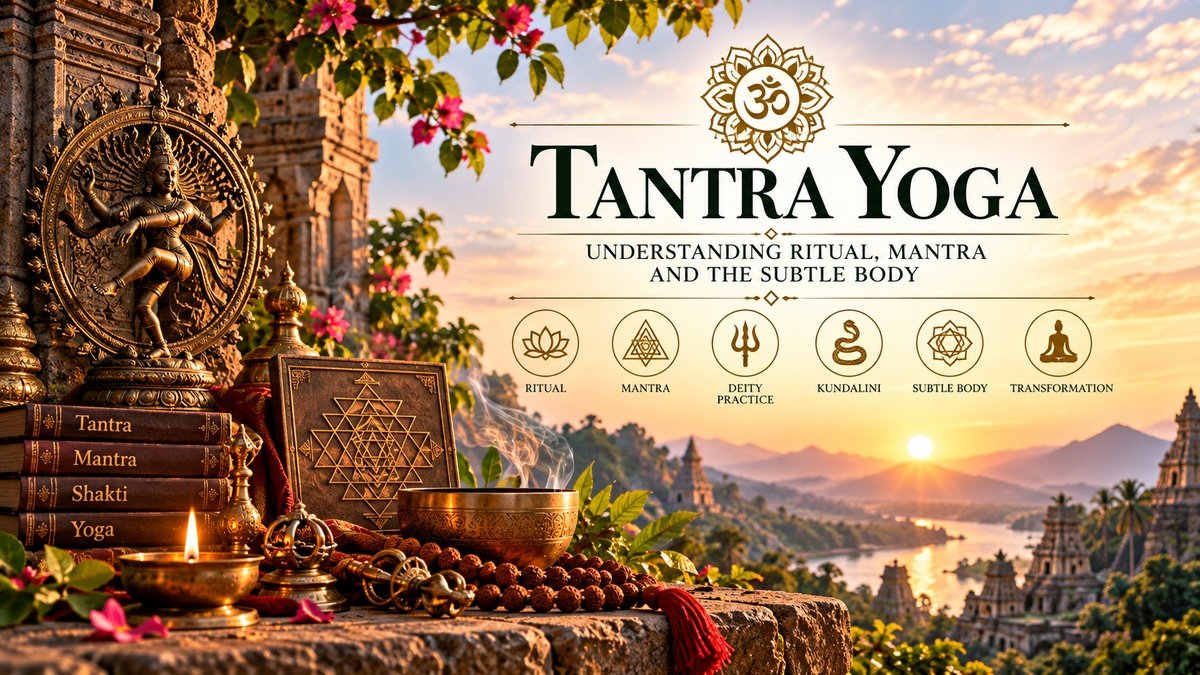
Tantra Yoga is difficult to define for one important reason: Tantra itself is not one single tradition, philosophy or technique.
Across the history of South Asia, traditions now described as Tantric developed within Hindu and Buddhist environments and produced extensive systems of ritual, mantra, meditation, deity practice and subtle-body practice.
Their influence on yoga was substantial.
Concepts now familiar in contemporary yoga — including cakras, kuṇḍalinī, mantras, subtle channels and the transformation of the body through practice — have important connections with Tantric traditions.
Yet modern culture frequently gives Tantra a much narrower meaning.
For some people, the word immediately suggests sexuality, intimacy or partnered practices. For others, Tantra means energy, chakras or the idea that everything in life can become spiritual.
Each of these associations requires context.
Historical Tantra was considerably more diverse, ritualised and philosophically complex than the modern category often called “Tantric sex”.
Understanding Tantra Yoga therefore requires us to move beyond both romanticisation and rejection and ask what Tantric traditions actually contributed to the history of yoga.
What Is Tantra Yoga?
Tantra Yoga is a broad modern expression for yogic practices and philosophies shaped by Tantric traditions.
It does not identify one universally standardised yoga system.
Historically, Tantra developed through multiple Hindu and Buddhist traditions with different scriptures, deities, rituals, philosophical positions and methods of practice.
Some traditions emphasised mantra and ritual. Others developed complex forms of meditation, visualisation or deity practice. Certain systems elaborated subtle-body models involving channels, centres and vital energies.
Later yogic traditions inherited and transformed many of these elements.
As a result, Tantra Yoga is better understood as part of a broad historical relationship between Tantra and yoga rather than as one ancient class format with a fixed sequence of techniques.
What Does Tantra Mean?
The Sanskrit word tantra has several meanings and does not translate neatly into one English word.
Depending upon context, it can refer to a system, framework, doctrine or text.
Importantly, historical traditions did not necessarily organise themselves under one universal religion called “Tantra”.
Modern scholarship uses the category to discuss related developments across several South Asian religious traditions.
These traditions share certain characteristics, but they remain diverse.
Therefore, statements beginning with “Tantra teaches…” require caution.
A particular Śaiva Tantra, Buddhist Tantra or Śākta tradition may teach something that another Tantric system understands differently.
There is no single Tantric doctrine capable of representing the entire historical field.
Where Did Tantra Come From?
Traditions identifiable as Tantric became increasingly visible in South Asia during the first millennium CE.
By the medieval period, Tantric forms of religion had become highly influential within several Hindu and Buddhist environments.
Śaiva traditions associated with Śiva played particularly important roles in the development and transmission of Hindu Tantra. Śākta traditions centred upon forms of the Goddess also developed extensive Tantric scriptures and practices.
Buddhist communities developed their own Tantric systems, which later became especially influential in Tibet and across Himalayan and Asian Buddhist traditions.
These histories interacted with one another rather than developing in complete isolation.
Ideas, ritual technologies and yogic techniques circulated across religious boundaries.
Consequently, Tantra cannot be reduced to one modern form of Hindu spirituality.
Is Tantra a Form of Hinduism?
Tantra has deeply influenced Hindu traditions, but Tantra itself is not exclusively Hindu.
Important Tantric developments occurred within both Hindu and Buddhist environments.
Within Hindu traditions, Tantra became particularly significant in forms of Śaivism and Śāktism, although Vaiṣṇava traditions also developed Tantric forms.
Buddhist Tantra developed its own scriptures, ritual systems, initiations and yogic practices.
Jain traditions also interacted with aspects of the wider Tantric environment.
For this reason, “Tantric” identifies a complex historical family of traditions rather than a synonym for Hinduism as a whole.
What Makes a Tradition Tantric?
Scholars continue to debate the precise boundaries of Tantra.
Nevertheless, several features recur across important Tantric traditions.
These can include initiation, mantra, ritual worship, deity visualisation, mandalas or yantras, specialised meditation, subtle-body practices and systems that understand the practitioner’s body as an important site of religious transformation.
Many traditions also depend upon transmission through a qualified teacher and a specific lineage.
However, no single feature appears identically everywhere.
Mantra, for example, predates Tantra and occurs widely outside specifically Tantric contexts.
Likewise, meditation is not uniquely Tantric.
What distinguishes a Tantric system is therefore the particular configuration of practices, scriptures, ritual structures and philosophical assumptions through which these elements operate.
Why Is Mantra So Important in Tantra Yoga?
Mantra occupies a central position in many Tantric traditions.
A mantra may represent or invoke a deity, structure meditation, accompany ritual or function within a larger system of initiation and practice.
Some Tantric traditions understand mantras as manifestations of divine power rather than merely words describing something sacred.
This gives sound a role that extends beyond ordinary linguistic meaning.
As explored in our article on Mantra Yoga, Tantric traditions also developed extensive use of bīja or seed mantras.
These compact syllabic forms can operate within larger systems connecting deity, sound, visualisation and the subtle body.
Their significance depends upon the tradition that gives them context.
What Is Tantric Initiation?
Initiation, commonly called dīkṣā, has historically played an important role within many Tantric traditions.
A teacher initiates the practitioner into a particular system of practice, ritual or mantra.
This process can establish access to teachings and practices that the tradition does not treat as universally public.
Initiation therefore does more than provide information.
Within traditional frameworks, it may transform the practitioner’s ritual status and establish a formal relationship with a lineage, deity or system of practice.
Not every modern practice described as Tantra retains these structures.
That difference does not automatically make contemporary adaptations illegitimate, but it does mean they should not be presented as though they reproduce historical Tantric practice unchanged.
What Is Deity Practice in Tantra?
Deities occupy central positions within many Tantric traditions.
Practice may involve mantra, visualisation, ritual offerings, contemplation and identification with a particular divine form.
Rather than treating the deity merely as an external object of worship, some Tantric systems use sophisticated contemplative methods through which practitioners transform how they understand themselves and their relationship with the divine.
Different traditions interpret this process differently.
Śaiva traditions may organise practice around forms of Śiva. Śākta traditions place forms of the Goddess or Śakti at the centre, while Buddhist Tantra works with its own extensive families of enlightened figures and mandalas.
Modern discussions of Tantra sometimes remove these deities entirely and retain only concepts such as “energy”.
That can make historical Tantra appear much more secular than it actually was.
What Is Shakti?
Śakti can mean power, capacity or energy and carries profound theological significance within several Hindu traditions.
In Śākta traditions, Śakti is not simply a vague personal energy.
She can represent divine power itself and appear through numerous forms of the Goddess.
Some Tantric philosophies understand the universe as an expression of divine consciousness and power rather than as something completely separate from the sacred.
This theological context matters when contemporary yoga uses the word shakti to mean vitality, feminine energy or empowerment.
Those modern meanings may draw inspiration from Tantric vocabulary, but they do not exhaust its historical significance.
What Is the Tantric Subtle Body?
Tantric traditions developed influential models of what scholars commonly call the subtle body.
These systems may describe networks of channels, vital energies, centres, knots and other structures used within ritual and yogic practice.
Sanskrit terminology can include nāḍī for channels and cakra for centres or wheels.
However, there was never one universal subtle-body map.
Different texts describe different numbers and arrangements of cakras, channels, deities, mantras and associated elements.
These systems also changed historically.
Therefore, the familiar seven-chakra diagram found throughout contemporary wellness culture should not be projected backwards as though every Tantric tradition used exactly that model.
Nor should subtle-body structures be presented as anatomical organs established by contemporary medicine.
What Are Chakras?
Cakra literally carries meanings associated with a wheel or circle.
Within certain Tantric subtle-body systems, cakras become centres used in visualisation and yogic practice.
Texts may associate them with deities, mantras, elements, lotus petals and other symbolic structures.
The number varies.
Some systems describe five or six principal centres. Others organise the subtle body differently.
The modern seven-chakra system combines elements from particular historical traditions with later interpretations and global developments.
For that reason, saying “Tantra teaches that humans have seven chakras” makes a diverse history appear falsely uniform.
A more accurate statement is that some Tantric traditions developed influential chakra systems, several of which contributed to later yoga traditions.
What Is Kundalini?
Kuṇḍalinī became an important concept within particular Tantric and later yogic traditions.
Texts describe it through different symbolic and technical frameworks, often as a latent power associated with the subtle body.
In some systems, yogic practice aims to awaken or move kuṇḍalinī through the body’s subtle channels and centres.
However, the concept does not appear identically across all Tantric traditions.
Nor should kuṇḍalinī automatically be interpreted as measurable electrical energy travelling through the spinal cord.
That language combines traditional subtle-body imagery with modern physiological terminology in ways historical texts themselves did not.
Our separate exploration of Kundalini Yoga examines the distinction between older kuṇḍalinī traditions and the modern yoga system commonly known by that name.
Are Chakras and Kundalini the Same Thing?
No.
Cakras describe centres within particular subtle-body systems.
Kuṇḍalinī refers to a form of power or process understood through certain Tantric and yogic frameworks.
Some traditions connect the two by describing kuṇḍalinī moving through a central channel and interacting with a series of cakras.
Yet this arrangement represents a particular model rather than the definition of Tantra itself.
Other Tantric practices may place far greater emphasis on mantra, ritual, deity visualisation or other contemplative methods.
Therefore, neither chakras nor kuṇḍalinī should become shorthand for the entire Tantric tradition.
Is Tantra Yoga About Sex?
No — but saying that historical Tantra had nothing to do with sexuality would also be inaccurate.
This distinction is essential.
Some historical Tantric traditions included transgressive sexual rites. Certain Kaula traditions provide particularly important examples.
However, those practices existed within highly specific ritual, initiatory and religious contexts.
They were not equivalent to contemporary workshops on intimacy, relationships or sexual technique.
Moreover, sexual rites do not define the whole of Tantra.
Large bodies of Tantric practice concern mantra, initiation, worship, visualisation, meditation, ritual, pilgrimage, subtle-body practices and liberation.
Modern “Tantric sex” therefore represents a much later development whose relationship with premodern South Asian Tantra requires careful qualification.
What Is Neo-Tantra?
Neo-Tantra is a broad term commonly used for modern movements that reinterpret Tantra, often with particular emphasis on sexuality, intimacy, relationships, embodiment and personal transformation.
These movements developed through modern encounters between South Asian religious ideas, Western esotericism, psychology, counterculture and changing attitudes towards sexuality.
Neo-Tantra can therefore differ substantially from premodern Tantric traditions.
That distinction does not require dismissing every modern practice.
It does require accurate naming.
A contemporary intimacy practice inspired by Tantra should not automatically be presented as an unchanged ancient Indian ritual.
Calling it a modern or Neo-Tantric development provides considerably clearer historical context.
Did Tantra Reject Conventional Religion?
Some Tantric traditions deliberately worked with practices, substances or ritual situations considered transgressive within particular social and religious contexts.
However, describing Tantra simply as rebellion against religion creates another modern stereotype.
Tantric traditions also developed highly structured rituals, scriptures, hierarchies, initiations and institutions.
Many became integrated into mainstream forms of South Asian religious life.
Indeed, Tantric influence eventually became deeply embedded within temple worship and devotional traditions in several regions.
Tantra could therefore challenge certain boundaries while simultaneously creating sophisticated religious systems of its own.
What Are the Five Ms of Tantra?
Discussions of Tantra sometimes introduce the five Ms, or pañcamakāra.
The traditional list refers to substances or practices whose Sanskrit names begin with the letter m:
Madya — wine or alcohol
Māṃsa — meat
Matsya — fish
Mudrā — a term interpreted differently in this ritual context
Maithuna — sexual union
Certain Tantric traditions incorporated these elements into transgressive ritual systems.
Other traditions interpreted them symbolically, substituted alternatives or rejected such practices.
The five Ms therefore should not become a checklist defining all Tantra.
They illustrate one important dimension of particular Tantric traditions and the ways some practitioners deliberately crossed conventional ritual boundaries.
What Are Yantras and Mandalas?
Tantric traditions often organise sacred space through visual forms.
A maṇḍala can represent an ordered sacred environment populated by deities and symbolic structures.
A yantra is a geometric ritual diagram used particularly within Hindu traditions.
One of the best-known examples is the Śrī Yantra or Śrīcakra, associated with Śrīvidyā traditions of Goddess worship.
These diagrams are not merely decorative patterns.
Within their traditional contexts, practitioners may use them in ritual, contemplation, worship and visualisation.
Modern yoga culture often reproduces mandalas and yantras aesthetically. Their visual beauty is undeniable, but their historical function reaches far beyond decoration.
How Did Tantra Influence Hatha Yoga?
The relationship between Tantra and Haṭha Yoga is one of the most important developments in the history of physical yoga.
Medieval yogic traditions inherited and transformed techniques that had developed within Tantric environments.
These included practices concerned with the body, breath, vital energies and subtle physiology.
Research into early Haṭha Yoga has also demonstrated important Buddhist and Śaiva connections in the transmission and adaptation of physical yogic methods.
Over time, Haṭha Yoga developed distinctive systems of its own.
Therefore, Haṭha Yoga should not simply be called “Tantra Yoga”.
Nevertheless, separating the two completely would obscure the historical environments from which important Haṭha techniques emerged.
How Does Tantra Yoga Relate to Mantra Yoga?
The overlap is substantial.
Tantric traditions developed some of the most elaborate mantra systems in South Asian religious history.
Mantras could accompany initiation, deity worship, meditation, visualisation and subtle-body practice.
However, Mantra Yoga is not synonymous with Tantra.
Mantra has a history extending back to the Vedic traditions and appears in numerous non-Tantric settings.
Likewise, Tantra contains many dimensions beyond mantra.
The relationship is therefore one of significant historical overlap rather than equivalence.
How Does Tantra Yoga Relate to Raja Yoga?
Tantric yoga and Rāja Yoga developed through different historical frameworks, although later yoga traditions sometimes brought their methods together.
Patañjali’s Classical Yoga emphasises the distinction between puruṣa and prakṛti and ultimately points towards kaivalya.
Tantric traditions can operate through very different metaphysical systems.
Some non-dual Śaiva traditions, for example, understand consciousness and manifestation through theological frameworks that differ significantly from Patañjali’s dualism.
Moreover, Tantric practices may deliberately use mantra, deity, ritual, visualisation and the body as means of transformation.
Later yogic traditions could combine elements from these different sources, but their philosophical origins should not disappear into one generic system.
How Does Tantra Yoga Relate to Jñana Yoga?
Some Tantric traditions place profound importance on liberating knowledge.
However, this does not make Tantra identical to Jñāna Yoga as interpreted through Advaita Vedānta.
Non-dual Śaiva traditions and Advaita Vedānta can both use language that modern readers describe as “non-dual”.
Nevertheless, they do not necessarily mean the same thing by it.
Their understandings of consciousness, manifestation, divine power and liberation differ in important ways.
Using the single word “non-duality” without examining those differences can conceal more than it explains.
Is Tantra Yoga a Physical Yoga Practice?
Not primarily in the modern sense of a posture-based yoga class.
Historical Tantric practice could involve the body extensively, but this does not mean practitioners followed a modern sequence of standing postures, balances and stretches.
The body could become a site of ritual, visualisation, mantra, breath practice and subtle transformation.
Later Haṭha traditions developed increasingly elaborate physical techniques.
Modern yoga classes advertised as “Tantra Yoga” may combine āsana with mantra, meditation, breath or subtle-body imagery.
Such classes represent contemporary interpretations rather than one standard historical Tantric sequence.
Does Tantra Teach That Everything Is Sacred?
This phrase captures something attractive about certain modern interpretations of Tantra, but it is too broad to function as a historical definition.
Some Tantric philosophies do challenge sharp distinctions between sacred and ordinary existence.
Non-dual Śaiva traditions, for example, can understand manifestation itself in relation to divine consciousness and power.
Yet Tantra also contains elaborate systems of ritual purity, initiation, sacred space, mantra and disciplined practice.
Therefore, “everything is sacred” may work as a modern interpretive summary within particular philosophical contexts.
It should not replace the complexity of the traditions themselves.
Does Tantra Promise the Awakening of Energy?
Modern descriptions frequently present Tantra as a method for “activating energy”.
Historical Tantric and yogic systems certainly contain sophisticated concepts of power, subtle physiology and transformation.
However, terms such as Śakti, prāṇa and kuṇḍalinī belong to particular philosophical and ritual frameworks.
They should not automatically become synonyms for measurable neurological or electrical processes.
Likewise, no responsible practice can guarantee that a particular exercise will produce a predetermined “energy awakening”.
Individual experiences vary, while traditional interpretations of those experiences also differ.
Historical understanding allows these concepts to remain meaningful without requiring unsupported physiological claims.
Can Tantra Yoga Be Practised Today?
Yes, but the phrase can describe very different practices.
Someone may study historical Tantric philosophy, practise a mantra within a living lineage, engage with deity practice or explore a modern yoga method influenced by Tantric concepts.
Another person may encounter Neo-Tantric workshops focused on intimacy and relationships.
These should not automatically be treated as the same activity.
For contemporary practitioners, useful questions include:
What tradition does the practice come from?
Is it historical, lineage-based or a modern adaptation?
What does the teacher mean by “Tantra”?
Does the practice involve mantra, ritual, meditation, sexuality or something else?
Are claims about history and health clearly distinguished from spiritual interpretation?
Those questions create considerably more clarity than the label Tantra alone.
A Common Misunderstanding: Tantra Yoga Is Not Simply Sexual Yoga
The most persistent modern misunderstanding reduces Tantra to sexuality.
Historical evidence does not support that reduction.
Some Tantric traditions incorporated sexual ritual, and removing that fact entirely would produce another inaccurate history.
Yet Tantra also encompasses vast traditions of mantra, initiation, worship, meditation, deity practice, visualisation, ritual and subtle-body techniques.
The better distinction is therefore not:
“Tantra has nothing to do with sex.”
It is:
“Sexual practices existed within some Tantric traditions, but sexuality does not define Tantra as a whole.”
That distinction allows historical complexity to replace both sensationalism and sanitisation.
An Orenna Perspective: When the Body Becomes Part of the Question
Many approaches to spiritual life begin by asking how we might move beyond ordinary experience.
Tantric traditions often complicate that movement.
The body, sound, imagination, ritual and the material world do not necessarily disappear from practice. Instead, particular traditions reorganise them within sophisticated religious systems.
This does not mean that every desire becomes spiritual simply because we call it Tantra.
Nor does it mean that historical Tantra offers a convenient ancient justification for whatever a modern practitioner already wishes to believe.
Its challenge is more interesting than that.
Tantra demonstrates that traditions concerned with liberation did not always approach embodiment in the same way.
Some developed methods that worked deliberately through the body, language, ritual and imagination rather than treating them only as obstacles to transcend.
Perhaps Tantra’s most useful question for modern yoga is not how to escape embodied experience, but what becomes possible when embodiment itself enters the discipline of practice.
References & Further Reading
André Padoux. The Hindu Tantric World: An Overview. A concise scholarly introduction to the history, concepts and practices of Hindu Tantric traditions.
André Padoux. Vāc: The Concept of the Word in Selected Hindu Tantras. An important study of language, mantra and sacred sound in Tantric traditions.
Alexis Sanderson. Studies of Śaivism and the development of Tantric traditions. His scholarship has been particularly influential in reconstructing the history of medieval Śaiva Tantra.
David Gordon White. Kiss of the Yoginī: “Tantric Sex” in its South Asian Contexts. A major study of sexualised ritual within particular medieval Tantric traditions and its difference from modern Western “Tantric sex”.
David Gordon White. The Alchemical Body: Siddha Traditions in Medieval India. A study of medieval Siddha traditions, Tantra, alchemy and the historical environments connected with later physical yoga.
James Mallinson & Mark Singleton. Roots of Yoga. A sourcebook of translated texts documenting the diversity of premodern yoga, including mantra, subtle-body practice, mudrā and meditation.
Jason Birch. Research on the development of Haṭha and Rājayoga and the transmission of physical yoga techniques from Tantric environments into later yoga traditions.