


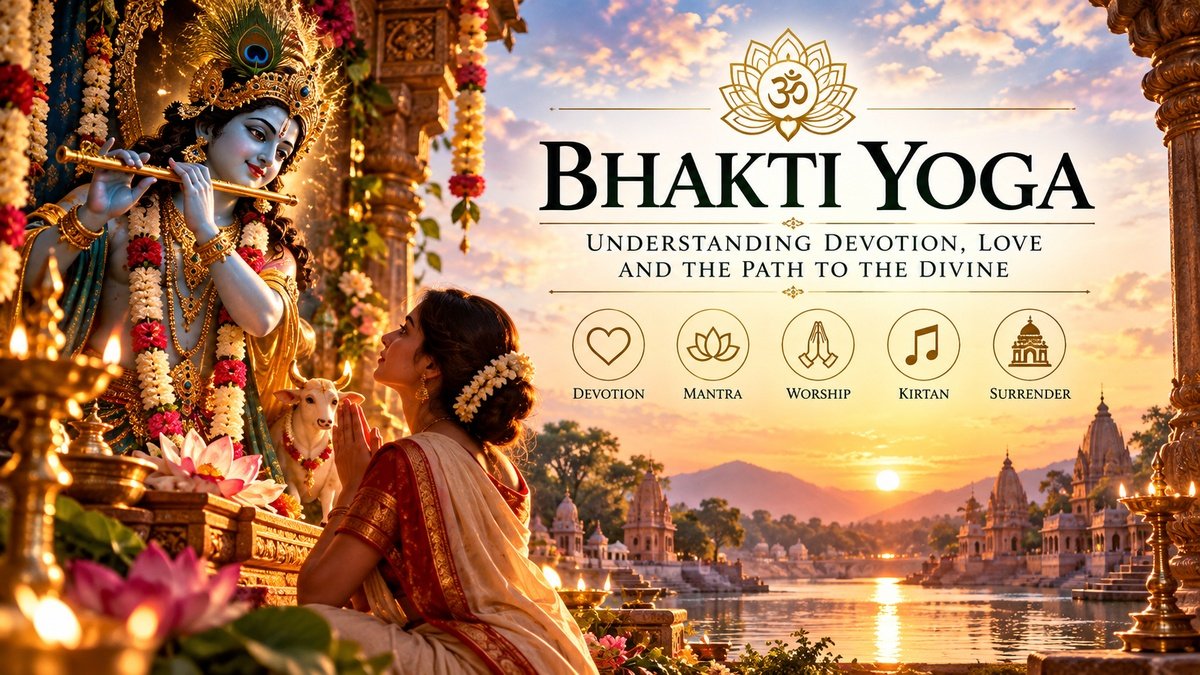
Bhakti Yoga begins with relationship.
Rather than approaching yoga primarily through posture, philosophical analysis or disciplined action, Bhakti places devotion at the centre of spiritual life.
But devotion can mean many things.
It may appear as prayer, remembrance, mantra, ritual worship, singing, pilgrimage, service or the offering of everyday actions. At times, it is quiet and contemplative; elsewhere, it becomes collective and exuberant.
Most importantly, Bhakti Yoga involves an orientation towards the Divine.
That makes the familiar description of Bhakti as “the yoga of love” both useful and incomplete.
What kind of love is meant? Who or what is loved? What is the relationship between devotee and deity? Does devotion require belief in a personal God? Why do Krishna, Rāma, Śiva and the Goddess appear in different devotional traditions? And how did chanting and kīrtan become so closely associated with modern presentations of Bhakti Yoga?
To understand Bhakti Yoga, therefore, we need to look beyond a single technique and enter a much larger history of devotion in Indian religious and yogic traditions.
What Is Bhakti Yoga?
Bhakti Yoga is commonly described as the path of devotion.
The Sanskrit term bhakti carries meanings associated with devotion, participation, attachment, loyalty and loving relationship.
Within Hindu devotional traditions, practitioners direct that relationship towards the Divine.
However, there is no single form of Bhakti Yoga practised identically across all traditions.
A devotee may orient practice towards Krishna, Rāma, Viṣṇu, Śiva, Devī or another manifestation of the Divine.
Different theological traditions also understand the relationship between the human person and ultimate reality differently.
Consequently, Bhakti Yoga is better understood as a broad devotional orientation than as one universally standardised technique.
Its defining question is not simply What do I practise?
It is also towards whom — or towards what understanding of the Divine — is the practice directed?
What Does Bhakti Mean?
The Sanskrit noun bhakti derives from the verbal root bhaj.
Its semantic field includes ideas such as sharing, participating, belonging, honouring and devotion.
Over time, bhakti became particularly important as a term for devotional relationship with a deity.
For this reason, translating it simply as “love” can remove important religious context.
Bhakti certainly can involve profound love.
Yet it may also involve worship, surrender, remembrance, reverence, service and sustained orientation towards the Divine.
The term therefore describes more than an emotional state.
Bhakti can become a way of organising spiritual life around relationship.
Where Does Bhakti Yoga Come From?
Bhakti Yoga does not have one founder.
Its history developed across centuries of Indian religious life.
Early forms of devotion appear in Sanskrit literature before the fully developed devotional traditions of the medieval period.
The Bhagavad Gītā, composed within the larger Mahābhārata, provides one of the most influential early formulations of devotion as a path to liberation.
Later texts, including the Bhāgavata Purāṇa, gave increasingly elaborate expression to devotion, particularly towards Krishna and Viṣṇu.
Meanwhile, devotional traditions developed across numerous regions and languages.
Poet-saints, temple traditions, philosophical schools and communities all contributed distinctive forms of worship, poetry, music and theology.
Bhakti therefore did not emerge at one moment and then spread unchanged across India.
Its history is plural, and that plurality remains essential for understanding Bhakti Yoga today.
What Does the Bhagavad Gita Teach About Bhakti Yoga?
The Bhagavad Gītā is one of the most important sources for understanding Bhakti Yoga.
Its dialogue begins with Arjuna’s crisis on the battlefield and develops through teachings concerning knowledge, action, meditation, duty, the self and liberation.
As the text progresses, however, Krishna’s identity becomes increasingly significant.
He is not merely Arjuna’s adviser.
Within the theological vision of the Gītā, Krishna reveals himself as the supreme Divine reality.
Devotion to Krishna consequently becomes an important path.
Chapter 12 explicitly addresses bhakti-yoga, although devotion appears throughout other parts of the text as well.
The practitioner remembers Krishna, directs mind and understanding towards him, performs actions for him and relinquishes attachment to their fruits.
Bhakti therefore becomes deeply interconnected with the Karma Yoga explored in the previous Journal article.
Who Is Krishna in Bhakti Yoga?
Krishna occupies a central position in many Bhakti traditions, particularly those associated with Vaiṣṇavism.
Within the Bhagavad Gītā, Krishna teaches Arjuna and reveals his divine nature.
Other texts develop different dimensions of Krishna devotion.
The Bhāgavata Purāṇa, for example, became enormously influential in traditions celebrating Krishna’s life, divine play and relationships with his devotees.
However, Bhakti Yoga should not be reduced exclusively to Krishna devotion.
Other traditions direct devotion towards Rāma, Viṣṇu, Śiva, forms of the Goddess and other deities.
The theology behind these practices can differ substantially.
Therefore, saying that Bhakti Yoga means “worshipping Krishna” describes an important expression of bhakti, but not the whole tradition.
Is Bhakti Yoga Only a Vaishnava Tradition?
No.
Vaiṣṇava traditions have produced some of the most internationally visible forms of Bhakti Yoga, particularly through devotion to Krishna, Rāma and Viṣṇu.
Nevertheless, powerful devotional traditions also developed around Śiva and forms of the Goddess.
South Indian Śaiva poet-saints, for example, composed intensely devotional poetry addressed to Śiva.
Śākta traditions likewise developed devotional relationships with Devī in her many forms.
Consequently, the category of bhakti crosses several major Hindu theological traditions.
These traditions do not necessarily share one deity or one philosophy.
Rather, they share the importance of devotional orientation towards the Divine.
What Is the Bhakti Movement?
The expression Bhakti movement commonly describes the flourishing of devotional traditions across different regions of India, particularly during the medieval and early modern periods.
However, the singular word movement can be misleading.
No single central organisation directed all Indian bhakti traditions.
Instead, numerous devotional communities emerged within different linguistic, regional and theological environments.
In South India, the Tamil Āḻvārs composed devotional poetry associated with Viṣṇu, while the Nāyaṉmārs celebrated Śiva.
Later devotional figures appeared across northern, western and eastern India.
These poets and teachers represented widely differing understandings of God, ritual, caste, community and liberation.
It is therefore more historically precise to speak of multiple bhakti traditions and movements rather than imagine one uniform movement spreading unchanged across the subcontinent.
Who Were the Alvars and Nayanmars?
The Āḻvārs and Nāyaṉmārs were influential Tamil devotional poet-saints associated respectively with Vaiṣṇava and Śaiva traditions.
Their poetry contributed significantly to the development of South Indian devotional religion.
Rather than limiting religious expression to Sanskrit philosophical discourse, these traditions produced powerful devotional compositions in Tamil.
The poems express longing, praise, surrender, intimacy, grief, joy and intense attachment to the Divine.
They also show why Bhakti cannot be understood solely as abstract philosophy.
Poetry, song, pilgrimage, temple culture and embodied religious life became important vehicles of devotion.
Later bhakti traditions would similarly flourish through regional languages throughout India.
What Is the Bhagavata Purana?
The Bhāgavata Purāṇa, also known as the Śrīmad Bhāgavatam, became one of the most influential Sanskrit texts for Vaiṣṇava devotion.
Its narratives and theology celebrate devotion to Viṣṇu and especially Krishna.
Among its most influential material are accounts of Krishna’s childhood and youth and his relationships with the inhabitants of Vraja.
The devotion of the gopīs, the cowherd women associated with Krishna, became particularly significant in later Krishna traditions.
Their longing for Krishna could represent an intense form of devotion in which the Divine becomes the central object of love.
Later theologians interpreted these narratives in sophisticated ways.
Consequently, we should not reduce them simply to romantic stories detached from their devotional and theological contexts.
What Is the Narada Bhakti Sutra?
The Nārada Bhakti Sūtra is a Sanskrit devotional text organised as a collection of concise aphorisms concerning bhakti.
Its precise date remains uncertain.
The text describes devotion as an exceptional form of love directed towards the Divine and explores its characteristics, cultivation and effects.
Because of its concise structure, later teachers have frequently used it as a practical and philosophical source for discussing Bhakti Yoga.
However, it should not be treated as the single founding scripture of all bhakti traditions.
Bhakti had already developed through multiple textual and lived traditions.
The Nārada Bhakti Sūtra represents one influential articulation within that much larger history.
What Are the Nine Forms of Bhakti?
A well-known devotional classification appears in the Bhāgavata Purāṇa and identifies nine forms of bhakti.
Tradition expresses them as:
Śravaṇa — hearing about the Divine
Kīrtana — praising or chanting
Smaraṇa — remembrance
Pāda-sevana — service at the Divine feet
Arcana — worship
Vandana — reverence or prayer
Dāsya — service
Sakhya — friendship
Ātma-nivedana — self-offering or surrender
This framework illustrates the breadth of devotional practice.
Bhakti can involve listening, singing, remembering, serving, worshipping, praying, friendship and surrender.
Nevertheless, practitioners should not interpret these nine forms as a universal compulsory sequence through which everyone must progress.
They constitute one influential devotional classification.
What Is Kirtan?
Kīrtan has become one of the most visible expressions of Bhakti Yoga in contemporary global yoga culture.
Broadly, kīrtana concerns praising, reciting or singing the names and qualities of the Divine.
Many contemporary forms use call-and-response chanting accompanied by instruments.
However, kīrtan did not originate as a modern yoga-studio relaxation technique.
It belongs to devotional religious traditions in which singing can function as worship, remembrance and participation in relationship with the Divine.
Different communities have developed distinctive musical and theological forms of kīrtan.
Therefore, a contemporary chant evening and a traditional Vaiṣṇava devotional gathering may share certain practices without necessarily carrying identical meanings or contexts.
What Is the Difference Between Kirtan and Mantra?
Mantra and kīrtan can overlap, but they are not synonyms.
A mantra is a sacred verbal formula, sound, phrase or utterance used within particular religious and contemplative traditions.
Practitioners may repeat a mantra quietly, recite it mentally or chant it aloud.
Kīrtan, by contrast, commonly involves musical praise or chanting, often collectively.
A mantra can appear within kīrtan.
Yet not every mantra practice is kīrtan, and not every devotional song functions as a mantra.
Keeping these categories distinct helps preserve the specific histories and functions of practices that contemporary yoga culture sometimes groups together simply as “chanting”.
What Is Puja?
Pūjā refers broadly to ritual worship.
Depending on the tradition, practitioners may offer flowers, light, incense, food or water while using mantra and gestures of reverence before an image or another representation of a deity.
Within devotional practice, pūjā can express hospitality, honour, love and relationship with the Divine.
We should not understand the image or mūrti simply through the Western category of a decorative statue.
Different Hindu traditions have sophisticated theological understandings of divine presence and sacred images.
For practitioners, therefore, pūjā can be far more than symbolic decoration.
It can become an enacted relationship between devotee and deity.
Does Bhakti Yoga Require a Personal God?
Bhakti is most characteristically associated with devotion towards a personal form of the Divine.
This makes relationship possible in particularly vivid ways.
The devotee may approach the Divine as lord, beloved, friend, parent, child or through another relational form.
However, Hindu philosophical traditions differ considerably in how they understand the relationship between personal deity and ultimate reality.
Some devotional schools maintain a lasting distinction between the individual soul and God.
Other traditions understand distinction and unity differently, while some combine devotion with non-dual philosophical frameworks.
Consequently, there is no single Bhakti answer to the metaphysical question of whether devotee and Divine are ultimately separate.
Can the Divine Be Loved in Different Relationships?
Yes, and some devotional traditions developed this idea in particularly sophisticated ways.
The devotee may approach the Divine through different relational attitudes or bhāvas.
For one practitioner, the relationship may resemble service to the Divine.
Elsewhere, devotion may emphasise friendship, parental affection or the symbolism of lover and beloved.
These relationships allow theological ideas to become emotionally and imaginatively immediate.
Instead of knowing the Divine only as an abstract metaphysical principle, the devotee enters a lived relationship.
Different schools classify these devotional moods differently, so no single list applies universally across Bhakti traditions.
What Is Surrender in Bhakti Yoga?
Surrender is an important theme in many Bhakti traditions.
The devotee relinquishes the idea of complete self-sufficiency and places trust in the Divine.
In the Bhagavad Gītā, this theme reaches a particularly powerful expression towards the conclusion of Krishna’s teaching.
However, spiritual surrender requires careful interpretation in contemporary settings.
Surrender to the Divine is not surrender of consent, personal boundaries or critical judgement to another human being.
No teacher, organisation or spiritual community should use devotional language to demand unquestioning personal obedience.
This distinction becomes particularly important in traditions that recognise a guru, the traditional Sanskrit term for a spiritual teacher or guide.
Bhakti may involve profound trust, but spiritual devotion does not erase ethical responsibility.
What Is the Role of the Traditional Spiritual Teacher in Bhakti?
Many Bhakti traditions give considerable importance to a traditional spiritual teacher, often described by the Sanskrit term guru.
Depending on the tradition, this teacher may transmit teachings, initiate mantra, interpret scripture and guide devotional practice.
Some traditions also direct profound devotion towards the teacher, whom they may understand through particular theological ideas concerning divine grace and spiritual transmission.
These understandings vary considerably between traditions.
For that reason, we should not assume that every contemporary yoga teacher occupies the same religious or spiritual role.
Reverence should not eliminate accountability either.
Where traditions invest teachers with significant devotional authority, clear ethical boundaries remain especially important.
Is Bhakti Yoga the Same as Hare Krishna?
No.
The Hare Krishna movement, formally known as the International Society for Krishna Consciousness or ISKCON, represents one modern organisation within a much larger history of Krishna devotion.
ISKCON emerged from the Gauḍīya Vaiṣṇava tradition. A.C. Bhaktivedanta Swami Prabhupāda established the international organisation in New York in 1966.
Gauḍīya Vaiṣṇavism itself developed centuries earlier and is strongly associated with Caitanya, the Bengali devotional figure of the late fifteenth and early sixteenth centuries.
Chanting the names of Krishna, particularly the Hare Krishna mantra, occupies a central place in this tradition.
ISKCON therefore provides one highly visible modern expression of Bhakti Yoga.
However, Bhakti encompasses many traditions that predate it and many that have no organisational relationship with ISKCON.
How Did Swami Vivekananda Present Bhakti Yoga?
Swami Vivekananda played an important role in presenting Bhakti Yoga to English-speaking audiences during the late nineteenth century.
Collections of his lectures and writings appeared under the title Bhakti-Yoga.
Vivekananda presented devotion as one of several major paths of yoga alongside approaches such as Karma, Jñāna and Rāja Yoga.
This classification became extremely influential in modern global understandings of yoga.
However, it can also create the impression that Indian yoga has always existed as a neat menu of separate paths.
Historical traditions are less tidy.
The Bhagavad Gītā, for example, continually connects action, knowledge and devotion rather than treating them as completely independent systems.
Vivekananda’s presentation is therefore historically important while also belonging to a specifically modern interpretation of yoga.
How Does Bhakti Yoga Relate to Karma Yoga?
Bhakti and Karma Yoga can become closely connected.
Karma Yoga asks how action can occur without possessive attachment to its fruits.
Bhakti introduces another possibility: the practitioner can offer the action and its fruits to the Divine.
In this way, ordinary action can acquire a devotional orientation.
Service can likewise become devotion when the practitioner understands it as service to God or as an offering.
The distinction between paths therefore becomes less rigid.
Action can become devotion, while devotion can shape action.
The Bhagavad Gītā repeatedly demonstrates this integration.
How Does Bhakti Yoga Relate to Jnana Yoga?
Bhakti is often contrasted with Jñāna Yoga, the path associated with knowledge and discernment.
The contrast can be useful, but it should not become absolute.
Some traditions emphasise knowledge of ultimate reality, whereas others give greater emphasis to loving relationship with the Divine.
Yet devotional traditions also contain sophisticated theology and philosophy.
Likewise, philosophical traditions may include prayer, worship and devotion.
Knowledge and devotion can therefore interact rather than simply compete.
The precise relationship depends upon the philosophical school in question.
Does Bhakti Yoga Involve Asana?
Bhakti Yoga does not require a characteristic āsana sequence.
There is no Bhakti equivalent of the Primary Series in Ashtanga Yoga or a standard collection of postures that defines devotional practice.
A practitioner may certainly practise āsana.
However, performing postures does not by itself constitute Bhakti Yoga.
Its central orientation is devotional rather than postural.
Prayer, worship, chanting, remembrance, service or mantra may occupy a much more important place than physical practice.
Once again, this reminds us that yoga historically encompasses considerably more than āsana.
Can Bhakti Yoga Be Secular?
Individual practices associated with Bhakti can certainly appear in secular environments.
Someone may enjoy Sanskrit chanting musically, participate in kīrtan socially or use repetition as a contemplative practice without adopting the theology of a particular Hindu tradition.
However, that does not make the historical tradition itself secular.
Bhakti developed through explicitly religious relationships with deities, sacred narratives, temples, scriptures, spiritual teachers and communities.
Removing every reference to the Divine may produce a meaningful contemporary practice, but it also changes what bhakti historically means.
Therefore, an inclusive presentation does not require pretending that the tradition has no theology.
We can distinguish participation from belief while still describing the tradition accurately.
Is Bhakti Yoga About Emotion?
Emotion can play a powerful role in Bhakti Yoga.
Devotional poetry and song frequently express longing, joy, grief, surrender, intimacy and love.
Yet Bhakti should not be reduced to emotional intensity.
A practitioner may cultivate devotion through regular remembrance, ritual, service or disciplined repetition even when dramatic emotion is absent.
Likewise, experiencing strong emotion during chanting does not automatically establish spiritual attainment.
Emotional experience and theological interpretation remain related but distinct questions.
This distinction is particularly useful in contemporary wellness environments, where people may sometimes give intense emotional experiences exaggerated spiritual explanations.
Is Bhakti Yoga About Unconditional Love?
Contemporary descriptions frequently call Bhakti the path of unconditional love.
The phrase captures something of the radical devotional orientation found in many traditions.
However, it can also become vague.
Bhakti texts and communities developed specific relationships between devotee and Divine, supported by theology, ritual, narrative and disciplined practice.
They were not simply teaching a generic psychological state of loving everybody equally.
Moreover, spiritual language about unconditional love should never require people to abandon boundaries or remain within harmful relationships.
Devotion towards the Divine and interpersonal consent belong to different categories.
Bhakti can challenge self-centredness without requiring indiscriminate trust in other human beings.
A Common Misunderstanding: Bhakti Yoga Is Not Simply Positive Emotion
Love sounds immediately accessible.
For that reason, Bhakti Yoga can easily become translated into a modern language of kindness, positivity and opening the heart.
Those qualities may have value, but historically they do not adequately define the tradition.
Bhakti is devotional.
It involves relationship with the Divine and has produced theology, poetry, ritual, pilgrimage, mantra, temple traditions, music, philosophy and communities of practice.
Its devotional language can include longing as well as joy, discipline as well as spontaneity, and surrender as well as celebration.
Bhakti Yoga is not simply about feeling more love. It asks what happens when devotion becomes an organising principle of spiritual life.
An Orenna Perspective: When Practice Becomes Relationship
Much of contemporary yoga uses the language of individual experience.
We speak about the body, the breath, personal practice, wellbeing and progress.
Bhakti introduces a radically different grammar: practice becomes relational.
The question is no longer only what yoga does for the practitioner. Instead, Bhakti asks what the practitioner can offer.
Attention, action, song, food, flowers and remembrance may all become offerings. Even the fruits of practice can form part of that devotional orientation.
For someone outside a devotional tradition, this language may feel unfamiliar.
Yet we do not need to convert it immediately into secular psychology to make it understandable.
Instead, we can allow Bhakti to reveal something about the extraordinary range of meanings that the word yoga has carried.
Bhakti Yoga reminds us that practice has not always been organised around improving the self. Sometimes its centre is the relationship through which the self learns to offer itself.
References & Further Reading
Bhagavad Gītā. Particularly Chapters 7–12 and 18 for the developing relationship between knowledge, action, devotion, surrender and Krishna.
Bhāgavata Purāṇa. A foundational source for later Vaiṣṇava devotion, particularly traditions centred on Krishna.
Nārada Bhakti Sūtra. An influential aphoristic text devoted to the nature and cultivation of bhakti.
Sargeant, Winthrop. The Bhagavad Gītā. A detailed translation useful for examining Sanskrit terminology alongside English renderings.
Malinar, Angelika. The Bhagavadgītā: Doctrines and Contexts. A scholarly examination of the philosophical and religious contexts of the Gītā.
Hawley, John Stratton. A Storm of Songs: India and the Idea of the Bhakti Movement. An important scholarly examination of bhakti and the historical construction of the idea of a single “Bhakti movement”.
Vivekananda, Swami. Bhakti-Yoga. An influential modern presentation of devotion as one of the principal paths of yoga.
Hardy, Friedhelm. Viraha-Bhakti: The Early History of Kṛṣṇa Devotion in South India. A major scholarly study of the development of Krishna devotion and the significance of separation and longing within bhakti.