

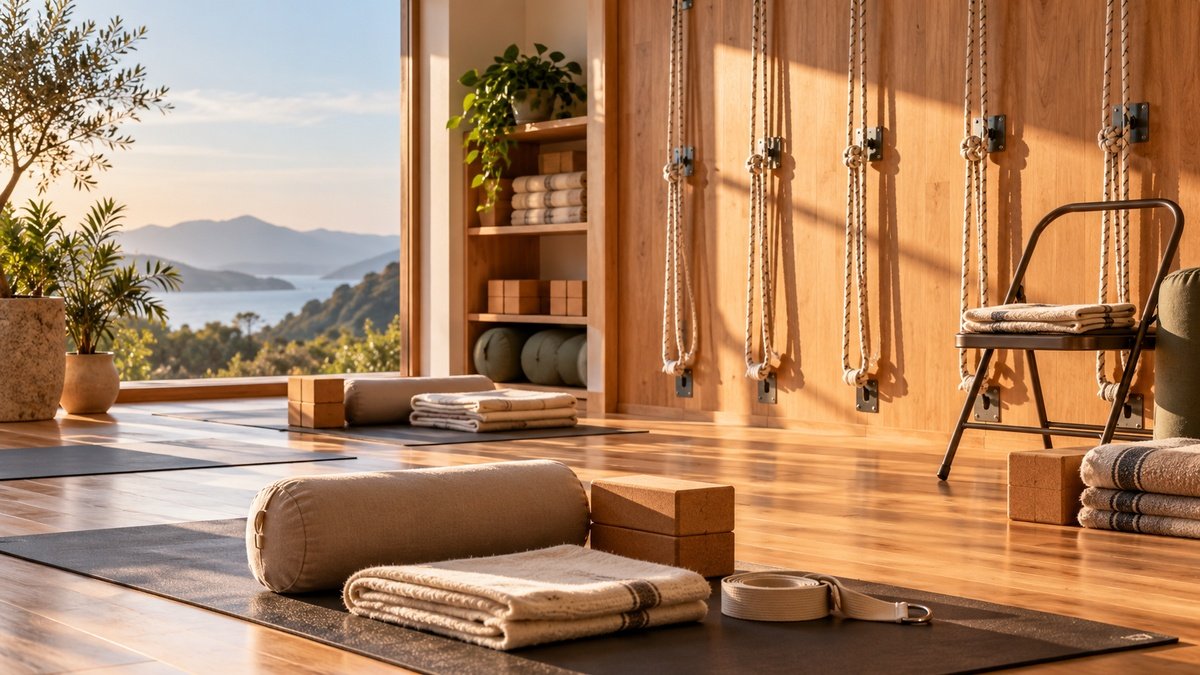
Blocks, belts, blankets, bolsters, chairs and ropes are now familiar objects in yoga studios around the world. Within Iyengar Yoga, however, these supports belong to something larger than a collection of useful equipment.
They form part of a method characterised by careful observation, progressive learning, precise instruction and sustained investigation of āsana and prāṇāyāma.
Developed through the teaching and practice of B.K.S. Iyengar, the method became one of the most influential approaches to modern yoga. Its influence can now be seen far beyond classes carrying the Iyengar name.
Yet describing Iyengar Yoga simply as yoga with props misses much of what distinguishes it.
So what is Iyengar Yoga? Who was B.K.S. Iyengar? Why does the method pay such close attention to alignment? What are the props actually for? And what happens when precision becomes a means of inquiry rather than an attempt to create a perfect-looking pose?
What Is Iyengar Yoga?
Iyengar Yoga is a method of yoga developed by B.K.S. Iyengar through decades of practice, teaching and investigation.
It is particularly recognised for detailed instruction in āsana, careful sequencing, progressive learning and the use of props when appropriate. Prāṇāyāma also forms an important part of the method, although teachers generally introduce it progressively after students have developed a foundation in āsana.
A typical class may spend considerable time examining a relatively small number of postures rather than moving continuously from one pose to another.
The teacher might direct attention towards the position of the feet, the distribution of weight, the organisation of the limbs, the action of particular parts of the body or the relationship between several actions at once.
These details are not intended simply to produce an attractive external shape.
They provide a framework through which the practitioner can observe more carefully.
Who Was B.K.S. Iyengar?
Bellur Krishnamachar Sundararaja Iyengar, widely known as B.K.S. Iyengar, was one of the most influential yoga teachers of the twentieth and early twenty-first centuries.
Born in Karnataka, India, in 1918, he began studying yoga as a teenager under T. Krishnamacharya, who was also his brother-in-law.
Krishnamacharya occupies an important position in the history of several influential forms of twentieth-century yoga. His students included figures who later developed substantially different approaches to teaching and practice.
Iyengar’s own path eventually took him to Pune, where he taught, practised and refined his approach over many decades.
Rather than treating his method as something created fully formed at one particular moment, it is more accurate to understand it as the result of a long process of experimentation, observation and teaching.
Where Did Iyengar Yoga Develop?
Pune in Maharashtra, India, became the principal centre of B.K.S. Iyengar’s teaching.
In 1975, the Ramamani Iyengar Memorial Yoga Institute, commonly abbreviated to RIMYI, opened in Pune. Iyengar dedicated the institute to the memory of his wife, Ramamani Iyengar.
The institute subsequently became the international home of Iyengar Yoga.
B.K.S. Iyengar taught there alongside members of his family, including his daughter Geeta Iyengar and son Prashant Iyengar. Their teaching contributed significantly to the continuing development and interpretation of the method.
Today, RIMYI remains central to the Iyengar tradition and its international teaching community.
When Did Iyengar Yoga Become Internationally Known?
B.K.S. Iyengar taught yoga for much of the twentieth century, but several developments helped his work reach an increasingly international audience.
One important relationship was with the violinist Yehudi Menuhin, who studied with Iyengar and helped introduce him to students beyond India.
Iyengar subsequently taught internationally and became increasingly influential in European and North American yoga communities.
Publication also played an important role.
His book Light on Yoga, first published in 1966, presented detailed descriptions and photographs of a large repertoire of āsanas alongside material on yoga practice and philosophy.
The book became internationally influential and helped establish Iyengar’s approach to posture within modern yoga culture.
Later works included Light on Prāṇāyāma, Light on the Yoga Sūtras of Patañjali and Light on Life.
Why Is Alignment Important in Iyengar Yoga?
Few words are associated with Iyengar Yoga as strongly as alignment.
Yet alignment can easily be misunderstood.
It does not simply mean forcing every body into one geometrically identical posture.
Within the method, detailed positioning and specific actions provide ways of examining relationships within an āsana. A teacher may ask a student to observe where weight travels, how one action influences another or how changing the position of a limb affects the posture as a whole.
Consequently, alignment involves both external organisation and internal observation.
Precision gives the practitioner something specific to investigate.
That distinction matters because the pursuit of an idealised visual shape can turn alignment into conformity. Careful teaching instead considers the individual practitioner, the purpose of the posture and the actions being explored.
Precision does not have to mean making every body look the same.
Why Does Iyengar Yoga Use Props?
Props are one of the most recognisable features of Iyengar Yoga.
Blocks, belts, blankets, bolsters, chairs, walls and ropes may all appear within practice.
However, describing props merely as devices for people who cannot perform a posture independently misunderstands their purpose.
A prop can change distance. It can provide height, stability or resistance. It may receive some of the body’s weight, make a particular action easier to observe or allow a practitioner to remain in a position under different conditions.
For example, a block beneath the hand in a standing posture changes the relationship between the body and the floor. A belt can maintain a particular distance between parts of the body. Blankets can alter height and contact with the ground. A chair can provide support while also creating entirely new possibilities for investigating an āsana.
The prop therefore changes the conditions in which practice occurs.
Sometimes it makes a posture more accessible. At other times, it makes an action more precise or even more demanding.
In Iyengar Yoga, a prop is not necessarily a shortcut. It can be an instrument of investigation.
What Are Yoga Ropes?
Ropes provide one particularly distinctive example of support within Iyengar Yoga.
Studios may have rope systems attached securely to walls so practitioners can work with suspension, traction, resistance or support in particular āsanas.
Different configurations change how the body relates to gravity and to the posture.
This work is sometimes informally called Yoga Kurunta or rope yoga within the Iyengar tradition.
Importantly, wall ropes are not the same apparatus as the fabric hammock used in Aerial Yoga.
The two practices may both use external support and suspension, but their equipment, teaching traditions and methods are different.
The comparison nevertheless reveals something interesting: changing the body’s relationship with gravity can alter how an āsana is perceived and explored.
What Does Sequencing Mean in Iyengar Yoga?
Iyengar Yoga is not defined by one fixed sequence that every practitioner repeats in every class.
Instead, teachers organise āsanas deliberately.
The order of postures may change according to the purpose of the class, the students’ experience and the material being explored.
A sequence might emphasise standing postures, forward extensions, twists, backbends or another family of āsanas. Teachers can also use preparatory actions to establish understanding before introducing a more complex posture.
Sequence therefore becomes part of the teaching method rather than merely an order in which poses happen.
This distinguishes Iyengar Yoga from methods such as modern Ashtanga Yoga, where recurring predetermined sequences form a central part of the practice.
What Happens in an Iyengar Yoga Class?
A class generally begins with a particular teaching focus rather than an expectation that students will move continuously.
The teacher demonstrates postures and provides detailed verbal instructions. Students practise, observe and respond to those instructions while the teacher watches how the group works.
The class may pause while the teacher demonstrates another action or clarifies something that has emerged during practice.
Props can appear whenever they serve the purpose of the lesson.
Teachers may also adapt the way a student approaches an āsana according to individual requirements and their own level of training.
As a result, an Iyengar class can feel investigative. A posture may be repeated several times, with each repetition directing attention towards something different.
The aim is not simply to complete a list of poses.
The process of learning how to practise is itself part of the practice.
When Is Prāṇāyāma Introduced?
Prāṇāyāma forms an important part of Iyengar Yoga, but teachers generally introduce formal practice progressively.
Students first develop a foundation in āsana. As experience develops, teachers gradually introduce the observation and regulation of breathing appropriate to the student’s level.
This progression reflects the method’s broader emphasis on preparation.
Rather than treating advanced techniques as experiences to collect quickly, Iyengar Yoga uses graded learning to establish the conditions for subsequent practice.
Prāṇāyāma is therefore not simply breathing added to a sequence of postures.
It has its own techniques, progression and place within the wider discipline of yoga.
Is Iyengar Yoga Slow?
Sometimes, but slow yoga is not an adequate definition of the method.
A class may hold postures long enough to investigate detailed actions, and the teacher may interrupt movement to demonstrate or explain.
That can create a different rhythm from a continuously flowing Vinyasa class.
However, Iyengar practice can also be physically demanding, dynamic and vigorous.
Standing postures, repeated actions, backbends and other sequences may require substantial strength, coordination and attention.
The distinguishing feature is therefore not simply speed.
Method, precision, progression and observation matter more than whether the class appears fast or slow.
Is Iyengar Yoga Restorative Yoga?
No, although Iyengar Yoga has had an important influence on contemporary restorative practice.
B.K.S. Iyengar developed extensive ways of supporting the body with bolsters, blankets, blocks, belts, chairs, walls and other props. Some supported postures may be held for substantial periods and can look similar to what people now recognise as Restorative Yoga.
However, Iyengar Yoga and Restorative Yoga are not synonymous.
Iyengar practice encompasses a much wider system of āsana, prāṇāyāma, philosophy, sequencing and progressive study. It may include vigorous standing poses, inversions, backbends and demanding work alongside supported practice.
Judith Hanson Lasater, who studied Iyengar Yoga, later became one of the major teachers associated with the development and popularisation of contemporary Restorative Yoga.
There is therefore an important historical relationship between the traditions without making them the same method.
Who Can Practise Iyengar Yoga?
The method uses progressive teaching and adaptation to accommodate practitioners with different levels of experience and different bodies.
A beginner does not need to arrive knowing how to perform complex āsanas.
Instead, introductory teaching establishes foundational actions and postures. Greater complexity develops progressively as the practitioner acquires experience.
Props can help teachers change the conditions of a posture when appropriate, but adaptation does not mean giving someone a lesser version of yoga.
It may provide a more appropriate way to investigate the intended action.
Individual circumstances still matter. A teacher’s training, experience and certification level also determine the situations they are qualified to address.
How Are Iyengar Yoga Teachers Trained?
The name Iyengar Yoga refers to a defined teaching tradition rather than a generic description that any yoga teacher can adopt.
In the UK, teachers train through the certification structure overseen by Iyengar Yoga (UK) in connection with the wider Iyengar tradition.
The pathway requires substantial experience as a student before teacher training begins. Prospective teachers study regularly with certified teachers and subsequently undertake a structured period of mentorship before assessment.
Qualified teachers continue their study and professional development after certification.
This distinguishes learning from Iyengar’s work from being qualified to present oneself professionally as an Iyengar Yoga teacher.
The distinction protects both the integrity of the method and clarity for students.
Is Iyengar Yoga Only About the Body?
The visual precision of Iyengar āsana can make the method appear predominantly physical.
That interpretation is incomplete.
B.K.S. Iyengar situated his teaching within the broader philosophical tradition of yoga and wrote extensively about Patañjali’s Yoga Sūtras.
The physical body becomes one field in which attention can be cultivated and refined.
From this perspective, detailed work in āsana is not necessarily separate from concentration or awareness. The practitioner learns to observe increasingly subtle relationships while remaining engaged with the posture.
This does not mean that every physical instruction should automatically be equated with a particular limb of Patañjali’s system.
Rather, it shows why reducing Iyengar Yoga to good alignment leaves out much of the method’s intended philosophical context.
How Is Iyengar Yoga Different from Vinyasa or Ashtanga Yoga?
The differences become particularly clear when we consider how a class is organised.
In Vinyasa Yoga, teachers commonly use flowing transitions to connect postures into changing sequences.
Modern Ashtanga Yoga, by contrast, centres on established sequences that practitioners learn and repeat.
Iyengar Yoga does not depend on continuous flow or one universally repeated sequence.
Instead, the teacher can select, organise and repeat postures according to the particular subject being investigated.
None of these structures is inherently more advanced than another. They simply organise learning differently.
Why Has Iyengar Yoga Been So Influential?
Its influence extends beyond people who formally practise Iyengar Yoga.
Props provide perhaps the clearest example. Blocks, belts, bolsters, blankets and chairs now appear across many contemporary yoga environments.
Detailed attention to alignment has also become part of the vocabulary of modern yoga teaching, even within methods that differ substantially from Iyengar’s own.
His books contributed further to this influence by documenting large numbers of āsanas and presenting detailed approaches to practice for an international readership.
As ideas travel, however, they also change.
A block used in a contemporary Vinyasa class does not make that class Iyengar Yoga. Likewise, detailed anatomical instruction does not automatically represent the Iyengar method.
Influence and identity are not the same thing.
A Common Misunderstanding: Props Are Not Evidence of Inability
One persistent assumption in yoga is that an accomplished practitioner should eventually stop needing support.
Under that logic, a block belongs to the beginner, while the advanced practitioner performs the posture without one.
Iyengar Yoga complicates that hierarchy.
An experienced practitioner may deliberately use a prop because it changes the posture in a useful way. The support may clarify an action, alter orientation, permit sustained observation or expose something that would otherwise remain difficult to perceive.
Removing the prop is therefore not always progression.
Sometimes progression means understanding more precisely why a particular support is useful.
Adaptation and sophistication are not opposites.
An Orenna Perspective: Support as a Form of Inquiry
A yoga prop is often described in terms of what it helps someone achieve.
Perhaps there is another question worth asking: what does it help us notice?
A block changes our relationship with distance. A blanket alters height and contact. A belt creates a boundary or connection. A wall provides resistance and orientation. A bolster changes how the body receives support.
None of these objects needs to make a posture more impressive.
Their value may lie in making experience more observable.
This is one of the enduring contributions of Iyengar’s approach. Support does not necessarily remove the work of practice. Used thoughtfully, it can make that work more specific.
A prop can change the posture, but it can also change the question we are asking within it.
References & Further Reading
Ramamani Iyengar Memorial Yoga Institute (RIMYI). The institute in Pune is the home of Iyengar Yoga and was established by B.K.S. Iyengar in 1975. Visit RIMYI.
Iyengar Yoga (UK). The UK organisation provides information about the Iyengar method, certified teaching, teacher training and the progressive use of āsana and prāṇāyāma. Explore Iyengar Yoga UK.
Iyengar, B.K.S. (1966). Light on Yoga. A major twentieth-century presentation of āsana, practice and yoga philosophy that became internationally influential.
Iyengar, B.K.S. (1981). Light on Prāṇāyāma. A detailed presentation of prāṇāyāma within Iyengar’s approach to yoga practice.
Iyengar, B.K.S. (1993). Light on the Yoga Sūtras of Patañjali. Iyengar’s interpretation and commentary on Patañjali’s philosophical text.