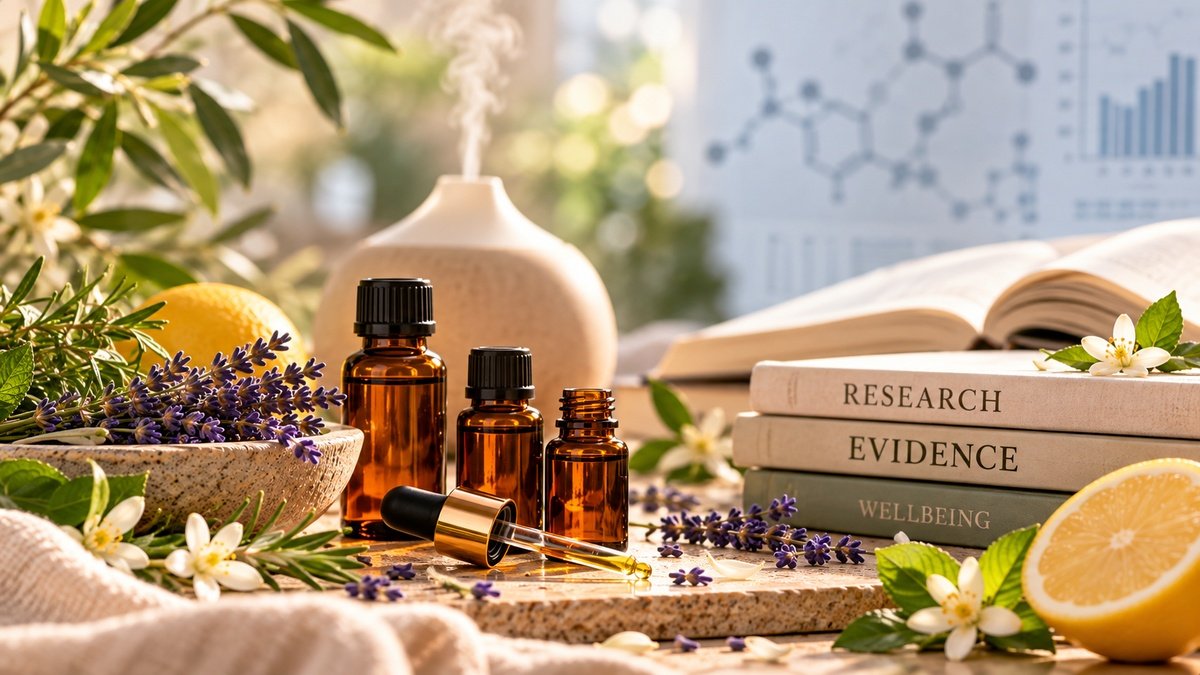


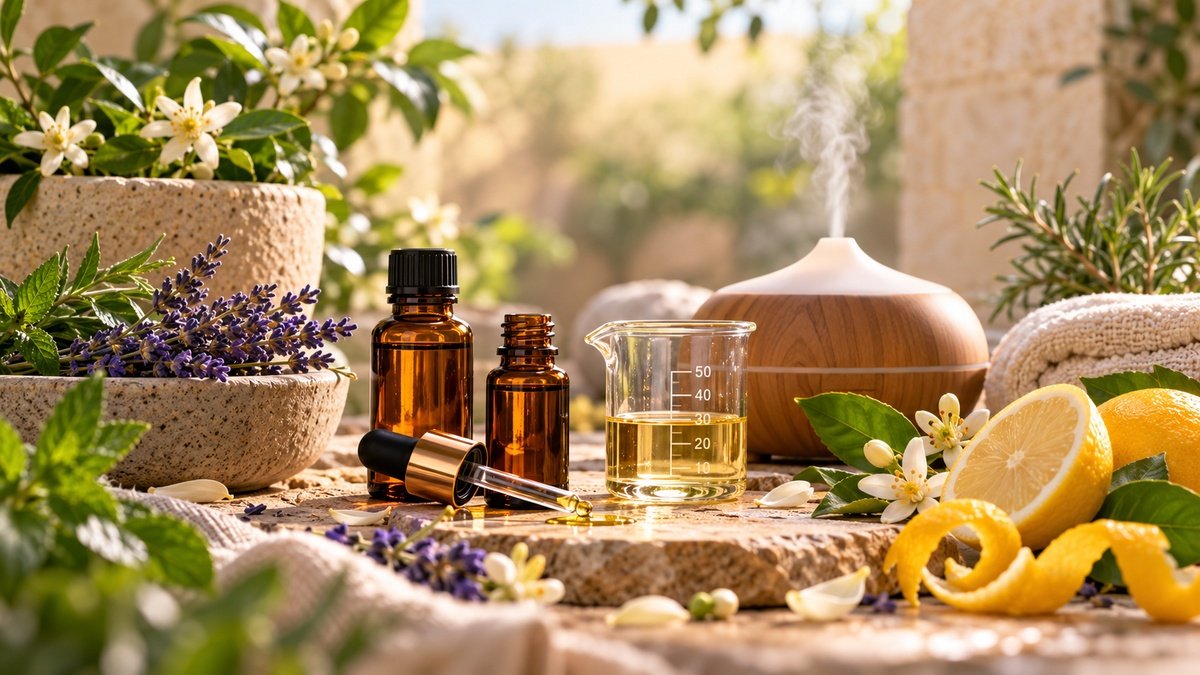
A drop of essential oil may look insignificant.
Yet inside that drop sits a concentrated mixture of volatile plant compounds.
That concentration gives essential oils much of their distinctive character — and explains why aromatherapy safety deserves more consideration than the familiar reassurance that a product is “natural”.
Plants naturally produce chemicals that interact with their environment and other organisms. Extracting and concentrating some of those compounds does not automatically make them dangerous. Equally, botanical origin does not guarantee harmlessness.
Responsible use depends on more practical questions.
Which oil are you using? At what concentration? How will you use it? How much will you use? Has the product deteriorated or oxidised? Who will encounter it? Is that particular route of exposure appropriate?
Responsible aromatherapy begins with questions like these rather than with the assumption that a pleasant fragrance must also be a harmless one.
Why Aromatherapy Safety Matters
Essential oils are concentrated aromatic materials obtained from plants.
As explored in our guide to essential oils, they contain complex mixtures of volatile chemical constituents. Botanical species, plant material, growing conditions, extraction methods and storage can all influence their composition.
Those compounds create an oil’s characteristic aroma. They also determine many of its chemical properties.
Some constituents can irritate the skin, while others can contribute to allergic sensitisation. Certain expressed citrus oils also contain compounds associated with phototoxic reactions when skin encounters ultraviolet radiation after application.
Other considerations depend on dose, route of exposure and individual circumstances.
We therefore do not need to fear essential oils or assume that they are inherently safe. A more useful approach respects both concentration and context.
Natural Does Not Mean Harmless
Natural describes origin. It does not establish safety.
Nature contains substances ranging from nutritious foods to powerful irritants and toxins. Risk depends on the substance, concentration, exposure and circumstances.
The same principle applies to botanical extracts.
An essential oil may originate in a familiar herb, fruit or flower while containing volatile compounds at concentrations very different from those we encounter when smelling or handling the intact plant.
Lavender essential oil is not simply lavender flowers in a smaller bottle. Likewise, lemon essential oil differs from handling a lemon, while peppermint essential oil creates a different exposure from drinking peppermint tea.
Extraction changes concentration.
Understanding that distinction forms a fundamental part of aromatherapy safety.
The Dose Matters
Discussions about essential oils sometimes drift towards two extremes.
One treats them as dangerous substances that people should rarely use. The other assumes that botanical origin makes meaningful adverse effects unlikely.
Neither position adequately considers dose.
For example, encountering a tiny quantity of an aromatic constituent in the air differs from repeatedly applying concentrated oil to the skin. A properly diluted preparation applied to a small area also creates a different exposure from applying it across much of the body.
Frequency matters as well. Occasional use and repeated exposure are not equivalent.
Route, concentration, frequency and duration can all influence risk.
For this reason, universal instructions such as “use three drops” provide less information than they first appear to offer.
Three drops in what volume? Which essential oil? For what purpose? Through which route?
Without that context, the number tells us very little.
Why Dilution Matters for Skin Application
People often describe the direct application of undiluted essential oil to the skin as using the oil neat.
Routine neat application increases exposure to concentrated aromatic compounds. For that reason, responsible topical use does not generally treat neat application as the default approach.
Dilution reduces the concentration that reaches the skin.
A carrier material — commonly a vegetable oil or an appropriately formulated cosmetic base — distributes the essential oil through a larger volume. This approach can reduce exposure while retaining the aroma and allowing topical application.
However, dilution does not provide a universal guarantee of safety.
The appropriate concentration depends on factors such as the essential oil, intended use, application area, frequency and individual circumstances.
What Does a 1% Dilution Actually Mean?
Percentage-based dilution offers greater precision than relying entirely on drops.
A 1% concentration means that essential oil represents approximately one part in a hundred within the finished formulation. At 2%, essential oil represents approximately two parts in a hundred.
Informal aromatherapy instructions often convert these percentages into numbers of drops. However, that introduces uncertainty because a drop is not a standard unit of volume.
Drop size varies with the liquid, bottle, dropper design and other conditions.
For casual small-scale preparation, drop calculations may offer an approximation. When accurate formulation matters, measurement by weight provides greater precision.
Carrier Oils Are Not Essential Oils
The word oil can make these materials sound chemically similar. They are not.
Carrier oils such as jojoba, sunflower, grapeseed or sweet almond consist predominantly of non-volatile lipid materials. Essential oils, by contrast, consist mainly of volatile aromatic compounds.
This difference allows carrier oils to act as vehicles for diluted topical preparations.
However, carrier oils have their own characteristics, storage requirements and suitability considerations. Botanical source and individual allergy history may also matter when choosing one.
Consequently, the safety of a finished preparation depends on all of its ingredients rather than on the essential oil alone.
Essential Oils Do Not Simply Dissolve in Water
One persistent misunderstanding in aromatherapy involves adding essential oil directly to water.
Essential oils do not freely dissolve in plain water. Instead, droplets may float on the surface or remain unevenly dispersed.
Therefore, adding a few drops to a bath, spray or mist does not automatically create an evenly diluted preparation simply because plenty of water is present.
Proper formulations may require suitable solubilisers, emulsifiers or other formulation systems, depending on the intended product.
This difference also explains why a genuine hydrosol is not equivalent to water with essential oil added to it.
Distillation creates hydrosols through a different process and gives them a different chemical profile.
Skin Irritation and Essential Oils
Skin irritation and allergic sensitisation are related concerns, but they are not the same process.
An irritant reaction can occur when a substance damages or inflames the skin at the point of contact. Signs may include redness, burning, discomfort or inflammation.
The likelihood of irritation can depend on both the substance and its concentration. Greater exposure to a concentrated material generally requires greater caution.
If a topical aromatic product causes significant burning, discomfort or another unexpected reaction, continuing to apply it because the body is supposedly “detoxifying” is not a responsible interpretation.
An adverse reaction provides a reason to stop the exposure and respond appropriately.
What Is Allergic Sensitisation?
Allergic contact dermatitis involves an immune response to a substance after sensitisation develops.
Repeated exposure can contribute to the picture.
Someone may previously have used a product without obvious difficulty and later develop sensitivity to one of its constituents.
For this reason, the statement “I have used it for years and nothing happened” cannot establish universal safety.
Oxidation adds another consideration because oxidation products from certain constituents can increase sensitisation concerns.
Careful storage therefore does more than preserve fragrance quality. It also forms part of responsible aromatic practice.
What Happens When Essential Oils Oxidise?
Essential oils change over time.
Oxygen, heat and light can contribute to chemical degradation and oxidation. Every time someone opens a bottle, more air can enter the container.
Certain constituents are particularly susceptible to oxidative change.
Discussions about oxidation often focus on citrus and coniferous oils, although appropriate storage matters across essential oils more generally.
An oxidised oil may smell noticeably different from a fresh product. More importantly, chemical change may alter its safety profile.
For that reason, an old essential oil should not automatically be treated as equivalent to a freshly opened bottle merely because it still smells aromatic.
How Should Essential Oils Be Stored?
Appropriate storage helps slow deterioration.
Manufacturers commonly package essential oils in dark glass because coloured glass can reduce light exposure. Keeping bottles tightly closed also limits unnecessary contact with air.
Heat and direct sunlight can accelerate deterioration, so a cool, stable storage environment generally makes sense.
The amount of air inside a partly empty bottle can also become relevant over time because it increases the oxygen available to interact with the oil.
Manufacturers may provide specific shelf-life and storage guidance. Following those recommendations is more useful than assuming every essential oil remains unchanged indefinitely.
Recording the date when you open a bottle can also make stock management easier.
What Is Phototoxicity?
Phototoxicity is an important but frequently misunderstood aspect of aromatherapy safety.
Certain substances can increase the skin’s vulnerability to ultraviolet radiation after topical exposure.
Some expressed citrus oils contain naturally occurring compounds known as furanocoumarins. When sufficient amounts remain on the skin, subsequent exposure to ultraviolet radiation can contribute to a phototoxic reaction.
Such reactions can resemble severe sunburn and may involve redness, blistering or pigmentation changes.
However, not every citrus oil carries the same phototoxic potential.
Botanical species, chemical composition and extraction method all matter. Expressed and distilled versions of an aromatic material can differ in their concentrations of relevant compounds.
Therefore, saying that every citrus oil is phototoxic is too broad. Claiming that natural citrus oils cannot cause photosensitivity is equally inappropriate.
The specific product needs to be identified.
Is Diffusing Essential Oils Completely Safe?
Diffusion avoids direct skin application, but exposure still matters.
A diffuser releases volatile aromatic compounds into shared air. The amount people encounter depends on factors including the quantity used, room size, ventilation, diffusion method and duration.
Continuous diffusion in a small enclosed room creates a very different environment from brief, low-level use in a large, well-ventilated space.
People also vary considerably in their tolerance of fragrance.
Strong aromas may contribute to headache, nausea or respiratory discomfort for some people. Others may simply dislike the fragrance.
More scent does not necessarily create a more effective or luxurious environment.
Often, it simply increases exposure.
Why Ventilation Matters
Aromatic compounds leave the diffuser and enter the surrounding air.
Ventilation influences how those compounds accumulate and disperse. Fresh-air exchange can therefore contribute to sensible environmental management when fragrance is used indoors.
Intermittent use may also make more sense than assuming that an aroma must remain continuously detectable throughout an experience.
As discussed in Scent, Memory and Mood, olfactory adaptation means that continued exposure can make an aroma seem less noticeable over time.
Someone who has become accustomed to the fragrance may then add more because it appears to have faded. A person entering the room later may experience the same environment as overwhelmingly scented.
Subtlety can therefore be an important part of responsible aromatic use.
Essential Oils Around Babies and Children
Children are not simply smaller adults.
Age, body size, developmental stage, route of exposure and the chemistry of the particular essential oil all require consideration.
Adult dilution practices should therefore not automatically transfer to babies or young children.
Certain essential oils or constituents require particular caution in paediatric contexts. Generic online lists of “child-safe oils” may overlook concentration, age and route of exposure.
Parents and carers should instead use product-specific, age-appropriate information from credible professional sources where essential oils are being considered.
Secure storage matters too. Concentrated oils should remain out of children’s reach to reduce the risk of accidental ingestion or spillage.
Aromatherapy During Pregnancy
Pregnancy often appears in discussions about essential-oil safety, sometimes alongside extensive lists of oils described as universally safe or completely prohibited.
The subject requires more nuance.
Pregnancy changes the context in which exposure needs consideration, while evidence does not cover every essential oil or constituent equally well.
Route, concentration, stage of pregnancy and individual circumstances can all influence what is appropriate.
For this reason, pregnancy is not a suitable setting for casual therapeutic prescribing based on internet charts.
Someone who is pregnant and wants to use concentrated aromatic products can seek individual guidance from an appropriately qualified healthcare professional or practitioner working within a relevant professional scope.
An unscented environment should always remain a complete option.
Medical Conditions and Medication
Essential-oil discussions sometimes produce extensive lists claiming that particular oils are either beneficial or prohibited for specific medical conditions.
These lists can mislead when they ignore route, dose, evidence quality and individual circumstances.
Essential oils should not replace prescribed medical treatment.
Similarly, a yoga teacher, wellness practitioner or other non-clinical professional should not move beyond their competence by prescribing aromatic products to treat disease.
Where a genuine concern exists about a health condition, medication, allergy or possible interaction, referral to an appropriately qualified professional is more responsible than improvising a therapeutic recommendation.
Essential Oils and Respiratory Sensitivity
People with asthma, fragrance sensitivity or other respiratory concerns may respond differently to airborne aromatic products.
For example, it would be inappropriate to assume that eucalyptus, peppermint or another strongly aromatic oil will automatically “open the airways” or improve breathing.
Some people may instead find fragrance uncomfortable or irritating.
A wellness environment should therefore avoid making respiratory treatment claims and provide an unscented option whenever fragrance is discretionary.
Significant breathing difficulty requires appropriate medical attention rather than an aromatherapy adjustment.
What About Pets?
Using essential oils around animals requires species-specific consideration.
Different animals metabolise substances differently. Body size, respiratory systems, grooming behaviours and proximity to treated surfaces can also change exposure.
Cats, dogs, birds and other animals are therefore not interchangeable.
An aroma that seems modest to a person may also create a very different sensory experience for an animal with a highly developed sense of smell.
Where uncertainty exists about a particular oil or exposure, veterinary guidance provides the appropriate source of advice.
Animals should also have the opportunity to leave a scented environment rather than remaining confined beside a diffuser.
Why Ingestion Requires Particular Caution
Some wellness practices add essential oils to water, drinks, capsules or food.
Internal use creates a substantially different exposure from smelling a botanical aroma.
Concentrated essential oils can contact mucous membranes and enter the body through the gastrointestinal system.
Furthermore, adding a drop to a glass of water does not distribute it uniformly because essential oils do not freely dissolve in water.
The fact that a corresponding plant is edible does not establish that its concentrated essential oil is suitable for casual ingestion.
A lemon, for example, is not chemically equivalent to a bottle of concentrated lemon essential oil.
Routine self-prescribed ingestion should therefore not be treated as an ordinary extension of environmental aromatherapy.
Are “Therapeutic Grade” Essential Oils Safer?
The phrase therapeutic grade appears frequently in essential-oil marketing.
It can sound like an independently regulated classification that demonstrates a particular standard of purity, clinical effectiveness or safety.
However, no single universal independent grading system awards all essential oils an official “therapeutic grade” status.
Companies may use the term within their own quality or marketing frameworks.
This does not make quality irrelevant.
Botanical identity, sourcing, extraction, storage, traceability and appropriate chemical analysis can all provide useful information about a product.
A marketing phrase, however, should not replace those details.
Does Purity Mean an Oil Cannot Cause a Reaction?
No.
A genuine, unadulterated essential oil can still contain naturally occurring constituents capable of causing irritation, sensitisation or other adverse effects under particular conditions.
Purity answers one question: does the material appropriately correspond to what it claims to be?
Safety answers another: how should that material be handled and used under specific circumstances?
These questions should remain separate.
Adulteration creates obvious quality concerns, but even a pure product still requires responsible handling.
Patch Testing Has Limits
Consumers sometimes hear that performing a patch test proves an essential oil or cosmetic preparation is safe for them.
A small-area test may provide some information about immediate local tolerance to a finished product. However, a negative result cannot guarantee that someone will never experience irritation or sensitisation later.
It also cannot establish safety for higher concentrations, larger application areas, repeated exposure or a different route of use.
Home testing should therefore not be treated as a definitive allergy assessment.
What If Essential Oil Gets in the Eyes?
Eyes and other sensitive tissues require particular care.
Concentrated essential oils should not come into deliberate contact with the eyes.
If accidental exposure causes significant irritation, follow appropriate first-aid guidance and seek medical or poison-information advice where necessary.
The same principle applies to accidental ingestion or substantial unintended exposure.
When a genuine poisoning or injury concern exists, professional medical guidance should take priority over general online aromatherapy advice.
Aromatherapy Safety in Shared Wellness Spaces
Professional environments introduce another consideration: one person’s aromatic preference becomes another person’s environmental exposure.
Diffusing an essential oil throughout a yoga studio, meditation space or wellness room affects everyone who enters.
Some guests may enjoy the fragrance, while others may dislike it, associate it with an unpleasant memory or simply prefer not to inhale scented products.
A guest may also have sensitivities or circumstances that the practitioner does not know about.
Consent therefore belongs within aromatherapy safety.
Asking about fragrance preference before introducing an aroma offers a simple but meaningful way to respect individual choice.
Why Orenna Uses Aroma as an Option
At Orenna, aroma is one possible element of the environment rather than a compulsory part of an experience.
A guest may prefer a light botanical mist, another aromatic option or no fragrance at all.
When aroma forms part of the environment, subtlety takes priority over saturating the room.
This is one reason hydrosols and floral waters can provide an interesting sensory alternative to continuously diffusing concentrated essential oils.
Of course, this does not mean every hydrosol suits every person.
Instead, it means considering the material, concentration and method of use rather than assuming that a stronger fragrance creates a better experience.
An Orenna Perspective: Less Can Be More
Luxury is sometimes confused with abundance: more fragrance, more ingredients and more sensory stimulation.
A considered environment can move in the opposite direction.
Sometimes a subtle aroma is enough. At other times, silence may suit the experience better than music, while an unscented room may feel preferable to fragrance.
A guest might choose a botanical aroma because they enjoy it or because it carries personal meaning — not because a chart assigns that fragrance to a particular emotional state.
Responsible sensory practice leaves room for all of these possibilities.
It also recognises professional boundaries.
Aroma can contribute to atmosphere without becoming a treatment prescription.
The aim is not maximum exposure. It is appropriate choice.
A Practical Aromatherapy Safety Guide
Know the botanical material. A common name alone may not identify the exact species or product.
Consider the route of exposure. Inhalation, topical application and ingestion create different forms of exposure.
Respect concentration. Essential oils are concentrated materials, and more is not automatically better.
Use appropriate topical dilution. One concentration does not necessarily suit every essential oil, person or application.
Remember that water alone does not disperse essential oils. Oil and water do not automatically form a uniform preparation.
Check phototoxicity where relevant. Particular citrus oils and extraction methods require specific consideration.
Store oils carefully. Limit unnecessary exposure to heat, light and oxygen.
Pay attention to age and oxidation. An older aromatic product may not have the same chemical profile as a fresh one.
Consider the individual. Age, pregnancy, sensitivities, health circumstances and other factors can alter what is appropriate.
Take particular care around animals. Different species can respond differently to the same exposure.
Do not treat ingestion casually. Internal use represents a different and potentially greater form of exposure.
Respect shared air. Ask before introducing fragrance into someone else’s environment.
Stay within professional scope. Aromatic products should not become a route to diagnosing or treating medical conditions without appropriate professional qualifications.
Continue Exploring Aromatherapy
This article forms part of The Orenna Journal’s exploration of scent, botanical materials and contemporary aromatherapy.
Begin with Aromatherapy: Understanding Scent, Essential Oils and Modern Practice, explore the history of aromatherapy, learn what is actually inside essential oils, discover hydrosols and floral waters, and explore the relationship between scent and memory.
One important question remains.
Beyond fragrance preference, tradition and personal experience, what does scientific research actually tell us about aromatherapy?
In the next article, we examine whether aromatherapy works. We will look at research into outcomes such as anxiety, sleep, pain and nausea while distinguishing promising findings from claims that extend beyond what current evidence can establish.
References & Further Reading
Tisserand, Robert & Young, Rodney. Essential Oil Safety: A Guide for Health Care Professionals. A major reference work covering essential-oil chemistry, dermal limits, phototoxicity, oxidation, contraindications and exposure.
National Center for Complementary and Integrative Health. Consumer information on aromatherapy and essential oils provides evidence-based context for research, use and safety considerations.
European Medicines Agency. Herbal medicinal product monographs and assessments provide regulatory and safety context for selected aromatic botanical materials.
European Commission. Cosmetic-product regulation and guidance provide context for fragrance allergens, formulation, product safety and cosmetic exposure.
International Federation of Aromatherapists. Professional guidance provides additional context for responsible aromatherapy practice, training and safety.
Royal Botanic Gardens, Kew. Botanical databases provide authoritative information on plant taxonomy and help distinguish the botanical species behind common essential-oil names.
PubChem, National Library of Medicine. Chemical records provide information about the properties and safety data of individual constituents found within essential oils.