


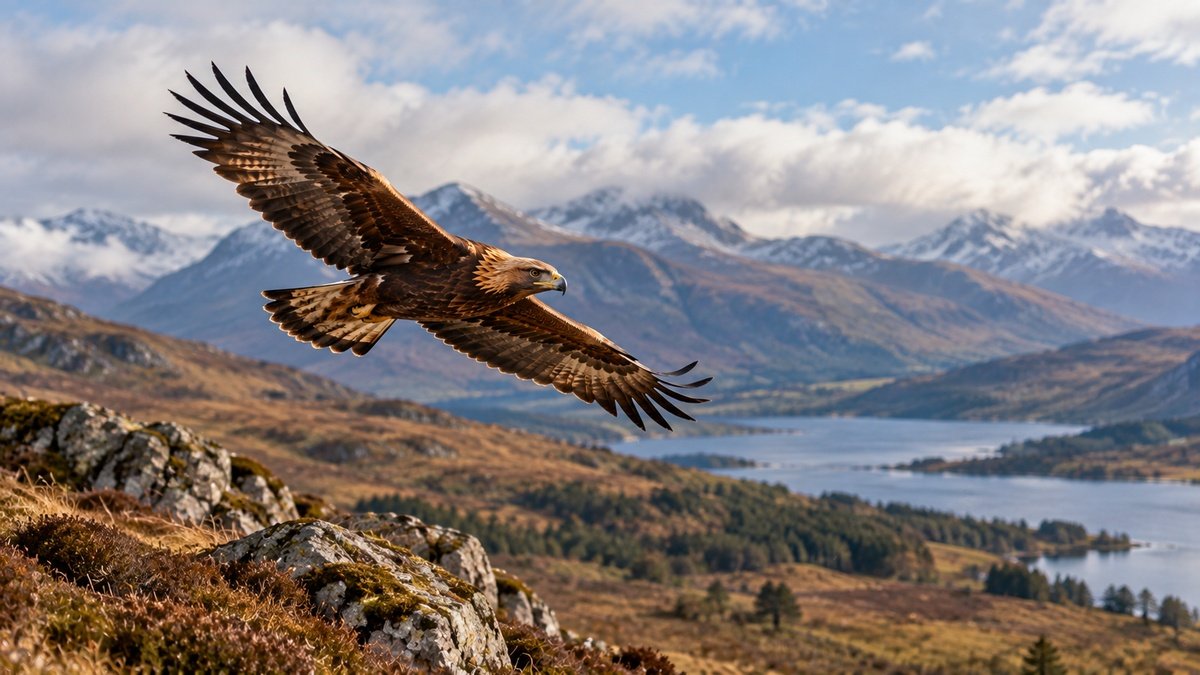
Golden eagles in Scotland are often encountered first as movement in the sky. A distant shape circles above a ridge, disappears against a mountain and then becomes visible again as it crosses an open glen.
For a moment, attention moves upward.
Yet understanding a golden eagle eventually brings our attention back to the landscape beneath it. The bird depends upon places to nest, extensive areas in which to find food, suitable prey and environmental conditions that allow a territory to support it over time.
Consequently, a golden eagle is never simply an object moving through an empty sky.
Its presence connects mountain, moorland, woodland, prey, weather and human land use across a much larger area than the bird itself.
Golden Eagles in Scotland
The golden eagle, Aquila chrysaetos, is one of Scotland’s largest birds of prey and one of the most recognisable species associated with the country’s uplands.
Scotland supports the UK’s golden eagle breeding population. Although the Highlands and Islands remain particularly important, golden eagles also occur in other upland parts of Scotland.
NatureScot’s most recent published national survey figure comes from 2015, when researchers recorded 508 breeding pairs. That represented an increase from the previous national survey in 2003 and took the population above the national target used for favourable conservation status.
However, a national total does not tell the whole story.
NatureScot notes that golden eagles have not fully recovered at a regional level. Different parts of Scotland continue to face different pressures, including illegal persecution, habitat condition, prey availability and the recruitment of young birds into available territories.
Therefore, the story of golden eagles in Scotland includes both recovery and continuing conservation challenges.
Recognising a Golden Eagle
From a distance, identifying a large bird of prey is not always straightforward.
Adult golden eagles are predominantly dark brown, with lighter golden-brown feathers around the head and neck. Their long, broad wings create an imposing silhouette, particularly when a bird is soaring high above open ground.
Size alone, however, can be difficult to judge when there is nothing nearby for comparison.
Buzzards are considerably smaller but may still appear large when seen alone in the sky. Scotland is also home to white-tailed eagles, another very large eagle species with a different body shape and, in adults, a distinctive pale tail.
Consequently, identification often depends on several features rather than one impression of size.
Sometimes the most useful first response is simply to watch carefully.
Why Do Golden Eagles Soar?
One of the characteristic ways people encounter golden eagles is while they are soaring.
Large wings allow an eagle to use rising air and currents around hillsides to remain airborne with relatively little continuous flapping. In suitable conditions, a bird can therefore cover substantial areas while conserving energy.
However, a soaring eagle is not necessarily hunting at that particular moment.
It may be travelling through its territory, gaining height, observing the landscape or moving between areas. Courtship and territorial behaviour can also involve conspicuous aerial displays.
Weather and topography influence how air moves across a landscape. As a result, the mountains beneath an eagle can help shape the conditions through which it flies.
The sky and the land are not separate parts of its habitat.
What Do Golden Eagles Eat?
Golden eagles are predators, but their diet is varied.
NatureScot identifies medium-sized birds and mammals among their live prey. Hares, rabbits and grouse can be important food sources, although diet varies according to location and what is available.
Golden eagles can also eat carrion.
Deer provide a useful example of why this distinction matters. NatureScot notes that golden eagles very rarely tackle adult deer. Some may take young deer alive, while much of the deer consumed during winter is carrion.
Therefore, finding deer remains associated with an eagle does not automatically show that the eagle killed the animal.
This connects naturally with our exploration of red deer in Scotland. Different species can become connected through predation, scavenging, vegetation, habitat and land management in ways that are not always visible from a single encounter.
Where Do Golden Eagles Nest?
Golden eagle nests are known as eyries.
In Scotland, eyries are commonly situated on crags and cliffs, often in places that provide separation from frequent human disturbance. Golden eagles can also nest in trees.
A territory may contain more than one potential nest site. Furthermore, some eyries are used repeatedly and enlarged over many years as material is added.
Nesting sites require particular care because breeding golden eagles can be sensitive to disturbance. Activities that appear distant to a person may still affect a bird, especially during sensitive stages of the breeding cycle.
For that reason, responsible observation does not involve searching closely around suspected nest sites.
A distant eagle in open sky can provide an extraordinary encounter without anyone needing to locate where it nests.
A Golden Eagle’s Territory Is Larger Than the Bird We See
A golden eagle may occupy only a tiny part of our field of vision, yet the landscape supporting it can be extensive.
A territory needs more than a suitable nest.
There must also be sufficient opportunities to find food. Open areas can provide hunting habitat, while woodland and other habitats can support prey species. Crags may offer nesting locations, and different parts of the territory may serve different purposes throughout the year.
Consequently, protecting one cliff while allowing the surrounding habitat to become unsuitable would not necessarily protect the ecological system upon which the eagle depends.
NatureScot’s conservation work therefore considers habitat quality and prey availability alongside direct protection of the birds themselves.
The eagle we notice overhead is only the visible part of a much larger relationship.
Golden Eagles and Highland Peatlands
Some of the open landscapes associated with golden eagles include moorland and peatland.
These habitats can support animals that form part of upland food webs. However, open ground should not be treated as one uniform habitat simply because it contains relatively few trees.
Our article on Highland peatlands explored how bogs can contain complex ecological communities beneath landscapes that may initially appear visually simple.
Golden eagle conservation provides another reason to consider the quality and function of open habitats rather than judging them only by appearance.
At the same time, not every open Highland landscape is valuable for the same ecological reasons. Habitat condition, vegetation, prey populations, hydrology and land management all matter.
The right habitat depends on the place.
Golden Eagles and Highland Woodland
Golden eagles are strongly associated with open upland landscapes, yet woodland can also form part of the wider ecological picture.
Forests can support potential prey and provide materials used in nest construction. In some circumstances, trees may also contain eagle nests.
However, woodland expansion requires ecological context. Planting trees across every open landscape would not automatically improve habitat for every species.
Our exploration of the Caledonian Forest considered the importance of native woodland recovery. Meanwhile, peatland restoration may require protecting open, waterlogged bog from inappropriate tree establishment.
Golden eagles reinforce the same principle.
Conservation is not simply about maximising one type of habitat everywhere. Instead, it involves understanding which ecological relationships a particular landscape can support.
Weather Shapes the Sky Above the Highlands
Weather continually changes the conditions through which golden eagles move.
Wind interacts with ridges and slopes, while sunlight changes visibility across the landscape. Cloud can conceal a mountain within minutes, and rain can alter both visibility and the experience of anyone watching from below.
These changing conditions are part of Highland ecology rather than simply a backdrop to it.
Our article on Highland weather explored how rain, wind, cloud and mist continually reshape our experience of place. For a flying animal, atmospheric conditions also influence movement through that place.
Nevertheless, weather alone cannot tell us exactly what an individual eagle will do. Wildlife behaviour emerges from many interacting factors.
Observation therefore benefits from curiosity without assuming that every movement has one simple explanation.
A History of Persecution
The history of golden eagles in Scotland also includes a long period of human persecution.
Golden eagles were historically killed because they were perceived to conflict with some human uses of upland landscapes. This contributed to reductions in their range and population.
Today, golden eagles and their nests receive legal protection. Nevertheless, NatureScot states that illegal persecution still occurs in some parts of Scotland.
Research using satellite-tracked golden eagles has also identified illegal persecution as an important factor restricting the species’ distribution.
It is therefore possible for the national population to improve while particular regions remain below their ecological potential.
That distinction matters. Conservation status at the scale of Scotland does not mean that pressures have disappeared from every landscape.
Recovery Is Not the Same Everywhere
NatureScot’s 2015 national survey recorded more than 500 breeding pairs, an important milestone for golden eagle conservation in Scotland.
However, regional patterns remain uneven.
NatureScot identifies continuing persecution in parts of the eastern Highlands. In some western Highland areas, habitat quality and insufficient live prey can constrain populations. Historically, low recruitment of young birds has also affected recovery farther south.
More recent conservation work in southern Scotland has strengthened the population there through translocation and habitat-focused initiatives.
Consequently, describing the golden eagle simply as either recovered or endangered across all of Scotland would conceal important regional differences.
The more informative question is: What is happening to eagles in this landscape?
Golden Eagles Do Not Live Outside Human History
A golden eagle crossing an apparently empty glen can create a powerful impression of wilderness.
Yet the landscape beneath it may carry centuries of human influence.
Grazing, burning, woodland loss, forestry, sporting management, roads, settlements and conservation have all shaped different parts of the Scottish uplands.
The same principle appeared in our articles on red deer, the Caledonian Forest and Gaelic place names.
What appears natural and what has been shaped by people are not always separate categories.
Golden eagles are wild birds. However, the opportunities available to them can still be affected by decisions people make about land, wildlife and habitat.
Seeing Golden Eagles in Scotland Responsibly
Watching golden eagles in Scotland is an experience best approached with distance and patience.
Binoculars can reveal far more than attempting to move closer to a bird. A distant viewpoint also allows an eagle to continue its behaviour with less risk of disturbance.
Particular care is necessary around breeding territories. Golden eagles can be sensitive to human activity near nesting areas, and disturbance during breeding can have serious consequences.
Therefore, people should follow local access guidance and avoid deliberately searching for, approaching or publicising precise nest locations.
If an eagle remains distant, that does not diminish the encounter.
Distance is part of observing a wild animal on its own terms.
You Do Not Need to Climb a Mountain to See an Eagle
Images of golden eagles often place the observer high in remote mountain country.
For people who enjoy and can access mountain terrain, watching wildlife there can be memorable. Nevertheless, strenuous walking is not a requirement for meaningful wildlife observation.
Depending on location and circumstances, eagles may sometimes be observed from glens, lower-level paths, roads, designated viewpoints and visitor locations.
Mobility, health, balance, sensory preferences, transport, weather, work, caring responsibilities and available time can all influence how someone accesses the Highlands.
One person may spend hours walking into the hills. Another may notice an eagle from an accessible viewpoint. The distance travelled does not determine the ecological reality of the bird or the significance of noticing it.
The eagle does not become more wild because we have walked farther to see it.
A Common Misunderstanding: Golden Eagles Belong Only to Remote Wilderness
The golden eagle has become strongly associated with the idea of remote Scottish wilderness.
That image contains part of the truth. Golden eagles require extensive landscapes, and many territories occur in upland areas with relatively low levels of settlement.
However, describing these places as landscapes untouched by people can erase their history.
Highland environments have been shaped by grazing, woodland change, sporting estates, agriculture, forestry, infrastructure and conservation. Some of those influences have reduced opportunities for eagles, while other management interventions aim to improve habitat and protect populations.
Furthermore, golden eagles do not need a landscape to be culturally imagined as wilderness before they can use it.
They need ecological conditions capable of supporting their lives.
That difference shifts attention from how wild a landscape looks to how it actually functions.
The Orenna Perspective — Look Up, Then Look Beneath
At Orenna, the most interesting part of seeing a golden eagle may begin after the first moment of recognition.
Initially, attention moves upward.
We notice the wings, the height, the circling movement and the enormous space around the bird.
Then understanding begins to bring attention downward again.
Beneath the eagle lies the territory that makes its presence possible: slopes and crags, open ground, woodland, water, prey, vegetation and the changing conditions of Highland weather.
Human decisions are present there too.
Land can provide food and nesting opportunities or lose them. People can disturb wildlife or give it space. Conservation can protect habitats, while other forms of land use can alter them.
Understanding golden eagles in Scotland therefore turns one bird into a way of seeing a much larger landscape.
The eagle remains extraordinary. However, it no longer appears separate from everything below it.
Sometimes one movement in the sky reveals the scale of the landscape below.
References & Further Reading
NatureScot. Golden Eagle. Information on golden eagle diet, nesting, population status, persecution and conservation in Scotland.
NatureScot. A Conservation Framework for the Golden Eagle. Research examining the conservation status of golden eagles and the factors affecting populations across Scotland.
NatureScot. Analyses of the Fates of Satellite-Tracked Golden Eagles in Scotland. Research examining movements, mortality and the influence of illegal persecution on Scotland’s golden eagle population.
NatureScot. Disturbance Distances Review. A review of evidence concerning the sensitivity of golden eagles and other bird species to human disturbance.
Forestry and Land Scotland. Golden Eagle Wildlife Guide. An introduction to golden eagle habitat, nesting, diet and responsible wildlife observation in Scotland.
The Orenna Journal explores yoga, well-being, philosophy and place from historical, evidence-informed and contemporary perspectives. Wildlife populations, habitat conditions and conservation priorities can change over time and differ between locations. This article provides a general introduction to golden eagles in Scotland rather than wildlife-management or site-specific access advice.



