


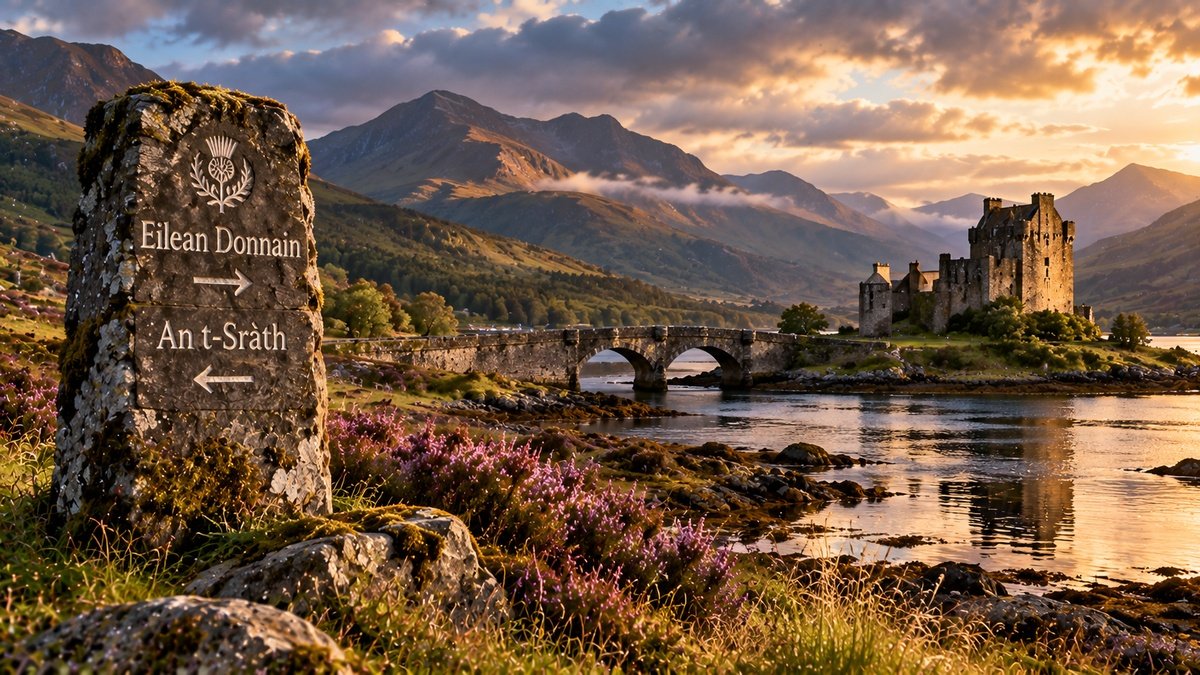
Gaelic place names are woven throughout the Scottish Highlands. They appear on road signs and maps, in the names of mountains, rivers, lochs, glens, settlements and stretches of coastline. Some are immediately recognisable as Gaelic. Others have travelled through different spellings and languages for so long that their origins are less obvious.
A place name can seem like a simple label: a practical way of distinguishing one location from another.
Look more closely, however, and names can preserve something more.
They may contain references to water, landform, vegetation, settlement, animals, people or events. They can also preserve traces of languages spoken within a landscape across different periods of its history.
This does not mean every name offers a straightforward description of what we see today. Place names change. Pronunciation changes. Spellings become adapted, translated or reinterpreted, and the landscape itself changes around them.
Understanding Gaelic place names therefore involves more than translating individual words.
It involves listening for the histories carried within the names of places.
Gaelic Place Names Are Part of the Landscape
Across the Highlands, Gaelic survives visibly within the geography.
Names associated with mountains, valleys, watercourses, settlements and coastal features can contain Gaelic elements that describe or distinguish aspects of place.
That makes place names particularly interesting.
Language is usually heard or read in sentences. In the landscape, however, individual words and older linguistic forms can remain attached to locations for generations.
Some names have remained recognisable over very long periods. Others survive in forms that have changed substantially.
Ainmean-Àite na h-Alba, the national advisory partnership for Gaelic place names, maintains an authoritative database of Gaelic forms and researches their linguistic and historical development.
Its work demonstrates an important principle: place names are evidence that needs to be interpreted carefully, not simply vocabulary waiting to be translated.
What Can a Place Name Preserve?
A place name may preserve information about a physical feature.
Water is especially prominent. Names can refer to lochs, burns, rivers, pools, waterfalls, river mouths or places where waterways meet.
Other names refer to hills, mountains, valleys, passes, headlands, plains, woodland, bogs or other characteristics of terrain.
But landscape vocabulary is only part of the story.
Names may also contain references to people, occupations, settlements, animals, plants, buildings or historical associations.
A name can therefore sit at the meeting point between physical geography and human history.
The landscape provides the place.
People provide the act of naming it.
Reading the Landscape Through Gaelic Place Names
Several Gaelic landscape words appear repeatedly within Scottish place names.
Beinn, for example, is associated with a mountain or prominent hill and appears in the anglicised form Ben in many familiar mountain names.
Gleann refers to a glen or valley and is familiar in English through the word glen.
Loch hardly requires introduction in Scotland. The word is used for inland bodies of water and also appears in the term sea loch for marine inlets.
Allt commonly refers to a burn or stream, while inbhir is associated with the mouth of a river or a confluence.
Recognising these recurring elements can make a map of the Highlands look different.
What first appears to be a collection of unfamiliar proper nouns can begin to reveal repeated relationships with mountains, valleys and water.
Yet recognising one element is not the same as knowing the history of the whole name.
That distinction is essential.
Inverness Is Already Telling Us Something
Orenna is based in Inverness, a name with its own relationship to water.
The Gaelic name is Inbhir Nis.
Ainmean-Àite na h-Alba gives its meaning as “the mouth of the River Ness.” The element inbhir means a river mouth and appears in other Scottish place names associated with rivers and confluences.
The English form Inverness therefore still carries an echo of the Gaelic name, even though its spelling has changed.
Historical records show different written forms over the centuries, including Invirnyss, Innernis and Innerness.
The modern spelling is not a frozen original. It belongs to a history of pronunciation, recording and linguistic change.
That makes Inverness particularly relevant to the wider story explored in Where Land Meets Water: Lochs, Rivers and the Highland Landscape.
Here, water is present not only in the geography.
It is present in the name.
Names Can Describe Very Particular Features
Gaelic landscape vocabulary can be remarkably specific.
Ainmean-Àite na h-Alba’s work on the north-west Highlands records names containing words for burns, bog streams, pools, river mouths and streams connecting lochs.
That specificity matters because a landscape that appears broad and undifferentiated to someone unfamiliar with it may contain many locally significant features.
A wet hollow is not necessarily the same as a pool. A burn is not a loch. A river mouth is not simply “water”.
Language can distinguish between them.
In some cases, a name may even provide clues about terrain. AÀA’s guide to north-west Highland place names notes, for example, that fèith can refer to a bog stream and, by extension, boggy ground.
Such names remind us that landscapes were not merely viewed from a distance.
They were travelled through, worked within, inhabited and described.
Gaelic Is Not the Only Language in Highland Place Names
It would be misleading to imagine the linguistic history of the Highlands as entirely Gaelic.
Scottish place names reflect multiple languages and historical periods.
Depending on location, names may contain elements associated with Gaelic, Norse, Pictish or Brittonic languages, Scots, English or combinations that developed through contact between languages.
Sometimes different linguistic layers can exist within the history of a single name.
Ainmean-Àite na h-Alba provides a useful example in Dingwall. Its English name derives from an Old Norse name associated with an assembly field, while the Gaelic form, Inbhir Pheofharain, refers to the confluence of the River Peffery. The river name itself has been identified as being of Brittonic origin.
One place can therefore carry more than one linguistic history.
That complexity is more informative than trying to make every Highland name fit a single origin story.
Gaelic Place Names Have Changed Over Time
Place names are often extremely old, but old does not mean unchanged.
A name can move between spoken and written forms. People who speak another language may record unfamiliar sounds using their own spelling conventions. Maps, administrative documents and signs can establish particular written versions.
Pronunciation may continue changing alongside spelling.
In some cases, the English and Gaelic forms remain recognisably related. In others, the relationship is less obvious. Some places even have English and Gaelic names with substantially different linguistic origins.
This means the form encountered on a modern road sign is one point within a much longer history.
It should not automatically be treated as a direct transcription of the earliest name used for that location.
When Translation Becomes Too Simple
Once we begin recognising Gaelic words in place names, it is tempting to translate everything ourselves.
That can produce convincing but inaccurate explanations.
A modern spelling may conceal an older form. A word may have changed meaning. Part of a name may originate in another language. Historical pronunciation may differ from what the modern written form suggests.
There is also the problem of folk etymology: an unfamiliar old name can gradually become interpreted as familiar words simply because those words sound similar.
Historic Environment Scotland’s discussion of early Scottish place names gives striking examples of names whose interpretation changed over centuries, sometimes incorporating elements from more than one language.
For that reason, reliable place-name research draws on historical spellings, linguistic evidence, local knowledge, early maps, documents and comparison with related names.
A translation can be useful.
An etymology requires evidence.
A Name May Preserve a Landscape That Has Changed
Place names can sometimes outlast the feature or activity that helped produce them.
Woodland can disappear or regenerate. Settlement patterns change. Rivers alter course. Land use changes. Buildings are replaced. Routes that once mattered may become difficult to recognise.
The name may remain.
This makes place names potentially valuable historical evidence, although they still need careful interpretation.
A name associated with woodland does not prove that the present landscape should contain woodland. Nor does a reference to an animal demonstrate that the species remains there today.
Instead, the name can prompt another question:
Why was this place described this way?
That question moves attention beyond the landscape as it appears now and towards the different relationships people may have had with it over time.
A Name Can Outlive the Language Around It
One of the most striking qualities of place names is their persistence.
A language can become less widely spoken in an area while names derived from that language remain on maps, road signs and in everyday speech.
That persistence should not encourage us to treat Scottish Gaelic only as a language of the past.
Gaelic remains a living language, spoken, learned, taught, written and used in contemporary Scotland.
At the same time, place names can provide visible evidence of the language’s historical geographical presence.
Those two ideas belong together.
A Gaelic name can be historically significant without becoming a museum object.
Whose Landscape Are We Naming?
Tourism often presents place names as charming additions to scenery.
A Gaelic word can become another picturesque feature beside a castle, mountain or loch.
But names did not emerge simply to make landscapes interesting to later visitors.
They developed through human relationships with places.
People needed to distinguish one river from another, one hill from the next, one settlement from another community. Names could also carry stories, associations, ownership, memory and local knowledge.
Seeing Gaelic place names only as attractive fragments of heritage risks separating language from the people who used and continue to use it.
A landscape is not culturally empty until someone arrives to admire it.
It may already be deeply named.
Pronunciation Without Perfection
Encountering unfamiliar Gaelic spelling can make pronunciation feel intimidating.
Curiosity does not require immediate fluency.
Listening to Gaelic speakers and authoritative pronunciation resources can help people become more familiar with sounds that English spelling conventions do not represent in the same way.
Ainmean-Àite na h-Alba’s place-name database includes audio for many entries, allowing users to hear Gaelic forms rather than relying only on written approximations.
That is particularly useful because forcing Gaelic pronunciation into English-looking phonetic spellings can lose distinctions present in the language.
Learning can begin simply: hear the name, notice its form, try it, listen again and allow familiarity to develop.
Respect does not require pretending to know more than we do.
Gaelic Place Names Can Change What We Notice
Learning even a small amount of landscape vocabulary can alter how we look at a map.
A name containing an element associated with a river mouth may encourage us to look at how waterways meet. A mountain name may draw attention to a shape or feature that previously went unnoticed.
This does not mean a name provides a complete explanation of the landscape.
Rather, language offers another way of paying attention to place.
The relationship connects with the broader question explored in Why Place Matters: Nature, Attention and the Experience of Being Outdoors.
There, attention begins with what we encounter through landscape and sensory experience.
Place names add another layer.
We can notice not only what a place looks like, but also what people have called it.
Weather, Water, Light — and Language
The Highlands articles in The Orenna Journal have explored landscape through several different lenses.
The Changing Light of the Highlands considered how season and illumination alter what becomes visible.
Where Land Meets Water explored lochs, rivers and the relationship between water and place.
Weather Is Part of the Place examined how rain, wind, cloud and mist continually reshape experience.
Gaelic place names introduce something different.
Light, water and weather help us consider what the landscape is doing.
Language helps us ask how people have understood and described it.
A Common Misunderstanding: Every Gaelic Place Name Has a Simple Translation
One of the easiest mistakes to make is assuming that every Gaelic place name can be translated neatly into a short English phrase.
Sometimes a meaning is well established.
In other cases, the evidence is less certain.
Names can contain very old linguistic material. Different scholars may have considered competing interpretations. Written forms may preserve attempts to represent sounds from another language, and later speakers may reinterpret unfamiliar elements.
Even apparently familiar words need context.
For this reason, responsible interpretation distinguishes between an established etymology, a probable interpretation and speculation.
Not knowing is sometimes the most accurate answer.
Uncertainty does not make the name less interesting.
The Orenna Perspective — A Place Has More Than a View
At Orenna, a landscape is not only something we look at. It is also something people have named, inhabited, remembered and understood.
That distinction matters in the Highlands.
It is easy to encounter this region through images: mountains, lochs, waterfalls, woodland and dramatic skies.
Those visual experiences are real, but they are not the whole place.
The landscape also contains language.
A name such as Inbhir Nis connects geography with human description. Other names preserve references that may reach into different periods, communities and languages.
We do not need to become place-name scholars before we can notice that.
Sometimes the first step is simply to become curious about the name on the sign.
What language does it come from?
What did it once describe?
Has its form changed?
What might the name reveal that the view alone cannot?
Once those questions begin, a landscape becomes more than scenery.
It becomes a place with a language and a history.
References & Further Reading
Ainmean-Àite na h-Alba (AÀA). Gaelic Place-names of Scotland. The national advisory partnership for Gaelic place names, providing authoritative Gaelic forms and a searchable place-name database.
Ainmean-Àite na h-Alba. Place-Names of Inverness and Surrounding Area. Research into the Gaelic and historical place names of Inverness and neighbouring areas, including Inbhir Nis.
Ainmean-Àite na h-Alba. Gaelic in the Landscape: Place-names in the North-West Highlands. An introduction to Gaelic landscape terminology and the geographical information preserved within Highland place names.
Historic Environment Scotland. Early Gaelic Names in Scotland. Examples illustrating the long history and linguistic complexity of Scottish place names.
Historic Environment Scotland. Gaelic Dictionary. Gaelic–English terminology relating to Scotland’s historic environment.
Watson, William J. The History of the Celtic Place-Names of Scotland. Originally published 1926. A foundational work in the study of Celtic place names in Scotland.
The Orenna Journal explores yoga, well-being, philosophy and place from historical, evidence-informed and contemporary perspectives. Place-name etymology is a specialist field, and interpretations can change as linguistic and historical evidence develops. Where a particular etymology matters, authoritative place-name research should be consulted rather than relying on literal translation from modern spellings.



