


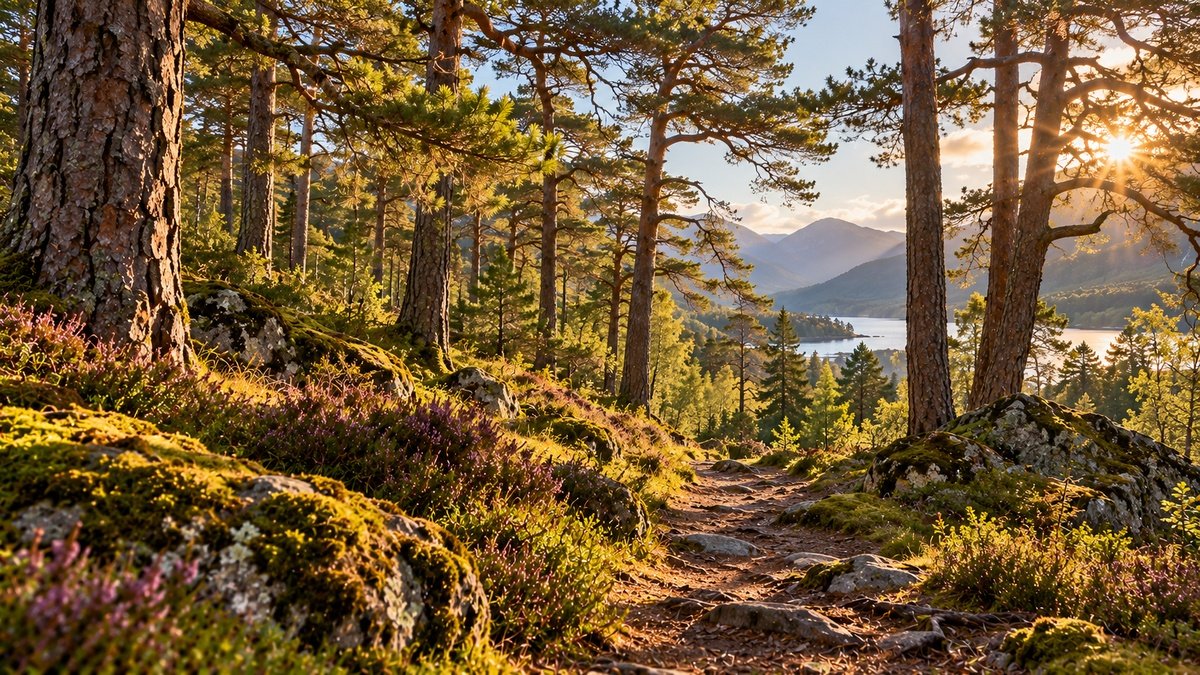
The Caledonian Forest occupies a distinctive place in the story of the Scottish Highlands. Scots pines rising above heather, moss and blaeberry have become some of the most recognisable images of Highland woodland.
Yet the story is more complicated than an image of an ancient forest surviving unchanged from the distant past.
Today’s Caledonian pinewoods are remnants of a much more extensive post-glacial woodland landscape. They have changed through climate, grazing, browsing, timber use, agriculture and other forms of land management. Some surviving pinewoods have expanded in recent decades, while others continue to face pressures that limit regeneration.
They are also more than collections of pine trees.
Birch, rowan, juniper and other woody species may grow among the pines. Heather, blaeberry and mosses cover the ground. Fungi inhabit soil and decaying wood. Insects use old trees and deadwood. Birds and mammals move through a habitat structured by living trees, fallen trunks, open spaces, wet hollows and changing light.
To explore the Caledonian Forest is therefore to explore a landscape that is ancient in its ecological connections but continually changing in its present form.
What Is the Caledonian Forest?
The term Caledonian Forest is commonly used for the native pinewood landscape associated with the Scottish Highlands and descended from the forests that developed after the last Ice Age.
Today, however, we should not imagine one enormous, continuous forest stretching untouched across the Highlands.
NatureScot describes the surviving Caledonian pinewoods as Scotland’s only native coniferous forests. What remains occurs in separate areas rather than as one unbroken woodland.
Some of the best-known surviving native pinewoods can be found in places including Glen Affric, Abernethy, Glenmore, Glen Tanar, Beinn Eighe and Invereshie and Inshriach.
Each woodland has its own combination of climate, soils, topography, vegetation and management history.
That variation matters.
The Caledonian Forest is better understood as a native woodland ecosystem with regional differences than as one uniform type of forest repeated across the Highlands.
Scots Pine and the Caledonian Forest
Scots pine, Pinus sylvestris, is the defining tree of Caledonian pinewood.
Mature trees can develop irregular crowns and deeply textured bark. Older pines may stand above a more open woodland floor of heather, blaeberry and other acid-tolerant vegetation.
Yet a Caledonian pinewood does not have to consist exclusively of Scots pine.
NatureScot notes a broad difference between some eastern and western pinewoods. Scots pine may dominate strongly in the colder and drier east, while pinewoods in the milder, wetter west can support more varied tree canopies that include species such as birch, rowan, alder, willow, holly and hazel.
Even within one woodland, conditions can change over short distances.
A dry slope, wet hollow, burn edge and exposed opening may each support a different combination of vegetation.
The forest is therefore not one repeated arrangement of trees.
It is a mosaic.
A Forest Is More Than Trees
Woodland can easily be measured by what stands upright.
But a functioning forest includes much more than its living trees.
Roots interact with soils and fungi. Fallen branches and trunks decay. Mosses and lichens colonise surfaces. Invertebrates occupy bark, soil, deadwood and water. Birds use different layers of vegetation for feeding, nesting and shelter.
Even a dead tree can remain ecologically active for years.
NatureScot highlights the importance of old and decaying pinewood trees for specialist insects and fungi. Rot holes, fallen timber and standing deadwood can provide habitats that a visually tidy woodland may lack.
This changes the way we might look at a forest.
A fallen trunk is not necessarily waste.
A gap in the canopy is not necessarily an absence.
Irregularity can be part of the structure of woodland life.
Was Scotland Once Completely Covered by Forest?
The history of the Caledonian Forest is sometimes told as a simple before-and-after story.
First, Scotland was entirely covered by a vast forest. Then people removed it.
The real history is more complex.
Following the retreat of the ice around 11,000 years ago, trees recolonised Scotland over time. NatureScot describes birch as an early dominant tree, followed by species including hazel, pine and oak.
Woodland eventually became extensive across much of the country, but that does not mean every mountain summit, peatland, wetland, exposed coast or other habitat supported closed forest.
Climate, altitude, exposure, drainage, soils and natural disturbance all influence where trees can establish.
Human activity subsequently became another major influence.
Rather than imagining one continuous blanket of trees, it is more useful to think about a changing mosaic of woodland and open habitats whose proportions shifted through time.
Why Did the Caledonian Forest Decline?
There is no single explanation for the decline of native woodland in Scotland.
NatureScot’s history of Scottish woodland describes a long process involving both environmental change and human land use.
As farming developed, people cleared woodland and changed the way land was used. Later centuries brought further exploitation for timber, charcoal and other resources.
Grazing and browsing also influenced whether young trees could replace older generations.
This last point is particularly important because woodland can disappear without every mature tree being deliberately cut down.
If seedlings repeatedly fail to survive, old trees may remain visible for decades while the woodland gradually loses its ability to replace itself.
NatureScot notes that some isolated old pines standing within heather moorland may represent remnants of formerly more extensive woodland where burning and grazing prevented successful regeneration.
The history is therefore not simply a story of trees being present or absent.
It is also a story about whether new generations can establish.
Browsing Can Change What Happens Next
Young trees are particularly vulnerable to browsing.
Deer are a natural part of Highland ecosystems, but the number of browsing animals in relation to available habitat can influence woodland regeneration.
Where browsing pressure remains high, pine, birch, rowan and other seedlings may struggle to grow beyond the height at which they can be repeatedly eaten.
Where pressure is reduced sufficiently, natural regeneration may become much more visible.
NatureScot reports that reductions in deer numbers have allowed seedlings to develop and pinewood to expand in parts of Strathspey.
This does not make deer an ecological villain.
Herbivores belong within ecosystems too.
The management question concerns the relationship between browsing pressure, habitat condition, woodland objectives and the wider landscape.
The Highlands Are Not Naturally One Landscape
If woodland has declined dramatically, it can be tempting to conclude that every open Highland landscape should become forest.
That would replace one oversimplification with another.
The Highlands contain many ecologically important open habitats, including peatlands, wetlands, montane habitats, heathlands and grasslands.
Some open areas reflect centuries of grazing, burning or woodland clearance. Others are strongly influenced by soils, altitude, water, exposure and climate.
Peat-forming habitats, for example, have their own ecological processes and should not automatically be regarded as empty land waiting for trees.
Understanding a landscape therefore requires attention to the habitat already present, its history and the conditions that support it.
More trees can be appropriate in many places.
That does not mean trees belong everywhere.
Wildlife of the Caledonian Forest
The Caledonian Forest supports species associated closely with native pinewood habitats.
NatureScot identifies birds including capercaillie, black grouse and Scottish crossbill among characteristic pinewood wildlife.
Red squirrels and pine martens are also associated with Highland woodland, while fungi, lichens and invertebrates occupy ecological niches that may be much less visible to a passing visitor.
The ground flora can include blaeberry, crowberry, bell heather, twinflower and other plants adapted to the conditions found within native pinewoods.
Not every species occurs in every forest.
Habitat condition, geography, climate, woodland structure and connectivity all influence what may be present.
For that reason, a list of iconic species should not become a checklist that determines whether a woodland experience was worthwhile.
Much of forest ecology happens without being immediately visible.
Ancient Does Not Mean Untouched
The word ancient can easily suggest a place without human influence.
That interpretation does not fit the history of many Scottish woodlands.
NatureScot notes that almost all surviving fragments of native woodland in Scotland have been modified by human activity at some point.
People have used woodland for timber, fuel, grazing, shelter and other purposes. Management decisions have altered woodland structure. Settlements and routes developed around forested landscapes.
At Dell Woods in Abernethy, for example, NatureScot describes a woodland whose present ecology reflects both continuity with native Caledonian pinewood and a long history as a working forest.
Human history and ecological value are therefore not necessarily opposites.
A woodland can carry both.
Restoring the Caledonian Forest
Conservation organisations and land managers are working in different parts of the Highlands to protect, regenerate and expand native pinewoods.
The methods vary according to place.
Some projects focus strongly on natural regeneration by reducing browsing pressure and allowing existing trees to produce the next generation.
Elsewhere, planting may supplement natural regeneration, particularly where seed sources are limited or woodland fragments have become isolated.
Management can also include removing invasive or non-native species, restoring associated peatlands, protecting veteran trees and retaining deadwood.
Forestry and Land Scotland has also collected seed from Caledonian pinewoods as a safeguard for their genetic resources as woodland faces pressures that include browsing, tree disease and a changing climate.
Restoration therefore does not necessarily mean recreating a photograph of how people imagine the forest once looked.
It can mean supporting ecological processes that allow a more resilient woodland to continue developing.
Restoration and Rewilding Are Not Exactly the Same Thing
The words restoration and rewilding increasingly appear in conversations about Highland landscapes.
They can overlap, but they do not always describe identical approaches.
Ecological restoration generally focuses on assisting the recovery of ecosystems that have been degraded, damaged or altered.
Rewilding often places particular emphasis on restoring ecological processes, reducing intensive human control and allowing ecosystems greater capacity to develop dynamically.
In practice, individual projects differ considerably in their aims and methods.
Questions about deer management, tree planting, natural regeneration, species reintroductions, livelihoods, land ownership and access can involve ecological evidence alongside social, economic and cultural considerations.
Using one appealing word does not remove those questions.
What matters is what a particular project is trying to restore, why, and how its actions relate to the ecology and communities of that place.
Walking Into Woodland Changes the Experience of Place
A pinewood creates a very different spatial experience from an open glen or loch shore.
The horizon may disappear behind trunks and branches.
Light becomes filtered through the canopy. Wind may be heard above before it is felt at ground level. Needles, moss, roots, stones and fallen branches change the texture beneath our feet or wheels.
Sound can shift too.
Bird calls, moving branches, water and footsteps may become more noticeable when a distant view is replaced by a closer environment.
For some people, that enclosure can feel comfortable or absorbing. Others may prefer open views, clearer sightlines or brighter environments.
Neither response needs correcting.
Our relationship with woodland depends partly on sensory preference, familiarity, accessibility, weather, previous experience and the conditions on a particular day.
As explored in Why Place Matters: Nature, Attention and the Experience of Being Outdoors, natural environments do not produce one universal human response.
Light Behaves Differently Among the Pines
Woodland changes light as much as it changes space.
A dense canopy can soften direct sunlight. Open sections allow stronger illumination to reach the woodland floor. Low-angle light can catch trunks while leaving the ground in shadow.
Season changes this relationship again.
Evergreen Scots pine retains its needles while neighbouring deciduous trees change through leaf emergence, summer canopy, autumn colour and winter branches.
Cloud, mist, rain and snow add further variation.
This connects directly with The Changing Light of the Highlands: Season, Landscape and Attention.
Highland light does not simply fall onto a landscape.
Vegetation shapes how that light reaches us.
Weather Enters the Forest Too
Woodland can offer some shelter from wind and rain, but a forest does not exist outside the weather.
Heavy rain changes burns and paths. Wind moves crowns and branches. Frost changes the ground. Snow alters access and visibility. Prolonged wet conditions affect soils and surfaces.
Storms can also bring down trees and branches, creating both practical hazards and new ecological structures.
The relationship between woodland and weather therefore includes both experience and ecology.
Our article on Highland weather explored why changing conditions belong to the landscape rather than interrupting it.
The same principle applies among the pines.
You Do Not Need to Walk Deep Into a Forest to Notice Woodland
Woodland experiences are sometimes presented through long walks into remote landscapes.
That is one way to encounter a forest, not the only way.
People may experience native woodland from an accessible path, roadside, visitor centre, viewpoint, picnic area or short route. Others may spend much longer travelling through it.
Weather, mobility, health, sensory preferences, transport, time, work and caring responsibilities can all affect what is practical or enjoyable.
A brief encounter does not become meaningless because someone else walked farther.
Nor does appreciation of woodland require identifying every tree, bird, fungus or lichen.
Knowledge can deepen attention.
It does not need to become an entry requirement.
A Common Misunderstanding: The Caledonian Forest Is an Untouched Wilderness
The surviving pinewoods have ancient ecological continuity, but describing them simply as untouched wilderness can hide part of their history.
People have lived in, travelled through, worked within, named and managed Highland woodland for generations.
Some surviving forests contain visible evidence of timber production and other land uses. Their present structures can reflect both ecological processes and past management.
This connects with our exploration of Gaelic place names and the Highland landscape.
A landscape can be ecologically important without being culturally empty.
Recognising human history does not diminish the value of native woodland.
It gives us a fuller account of the place.
The Caledonian Forest Is Still Changing
We sometimes value ancient landscapes by imagining that their ideal condition is permanence.
Forests do not work that way.
Trees germinate, grow, age and die. Storms create openings. Deadwood accumulates and decomposes. Vegetation colonises gaps. Animals browse seedlings. Diseases affect particular species. Climate influences which plants can establish and where.
Human decisions continue shaping those processes too.
Conservation does not require freezing a woodland at one moment in time.
Instead, it can involve protecting ecological continuity while allowing the woodland to keep changing.
This echoes the geological perspective explored in A Landscape in Motion: The Great Glen and the Making of the Highlands.
The timescales are very different.
The underlying idea remains useful: landscape is not a finished object.
The Orenna Perspective — Ancient and Changing Can Coexist
At Orenna, a landscape does not need to remain unchanged in order to carry its history.
The Caledonian Forest makes that particularly clear.
Some living pines connect directly with generations of trees that occupied Highland landscapes long before the roads, signs and settlements familiar today.
Yet the woodland around them has never stopped changing.
Climate changed.
People used and managed the land.
Animals browsed young growth.
Trees fell and regenerated.
Some woodland disappeared. Other areas are expanding again.
To value the forest, we do not need to imagine an untouched landscape preserved outside time.
We can recognise continuity and change together.
That perspective alters what we notice when we stand among the pines.
An old tree is no longer simply an impressive object.
A seedling becomes part of what happens next.
A fallen trunk remains part of the forest.
An opening in the canopy becomes another stage in a changing woodland.
The Caledonian Forest carries its past precisely while continuing to become something new.
References & Further Reading
NatureScot. Caledonian Pinewood. An overview of the ecology, distribution, characteristic species, decline and regeneration of Scotland’s native pinewoods.
NatureScot. History of Scotland’s Woodlands. An introduction to post-glacial woodland development, historic woodland decline, land use and the changing extent of woodland in Scotland.
NatureScot. Woodland Habitats. An overview of Scotland’s varied native woodland types and the influence of climate, soils, geology, topography and human activity.
NatureScot. The Story of Dell Woods, Abernethy National Nature Reserve. A detailed example of Caledonian pinewood ecology, woodland management, bog habitats and the long relationship between people and forest.
Forestry and Land Scotland. Collecting Cones From Our Caledonian Pinewoods. Information about Scots pine seed collection, genetic conservation and pressures affecting pinewood regeneration.
The Orenna Journal explores yoga, well-being, philosophy and place from historical, evidence-informed and contemporary perspectives. Woodland ecology and restoration are complex and vary considerably between sites. This article provides an introduction to the Caledonian Forest rather than prescribing a particular approach to land management or ecological restoration.



