


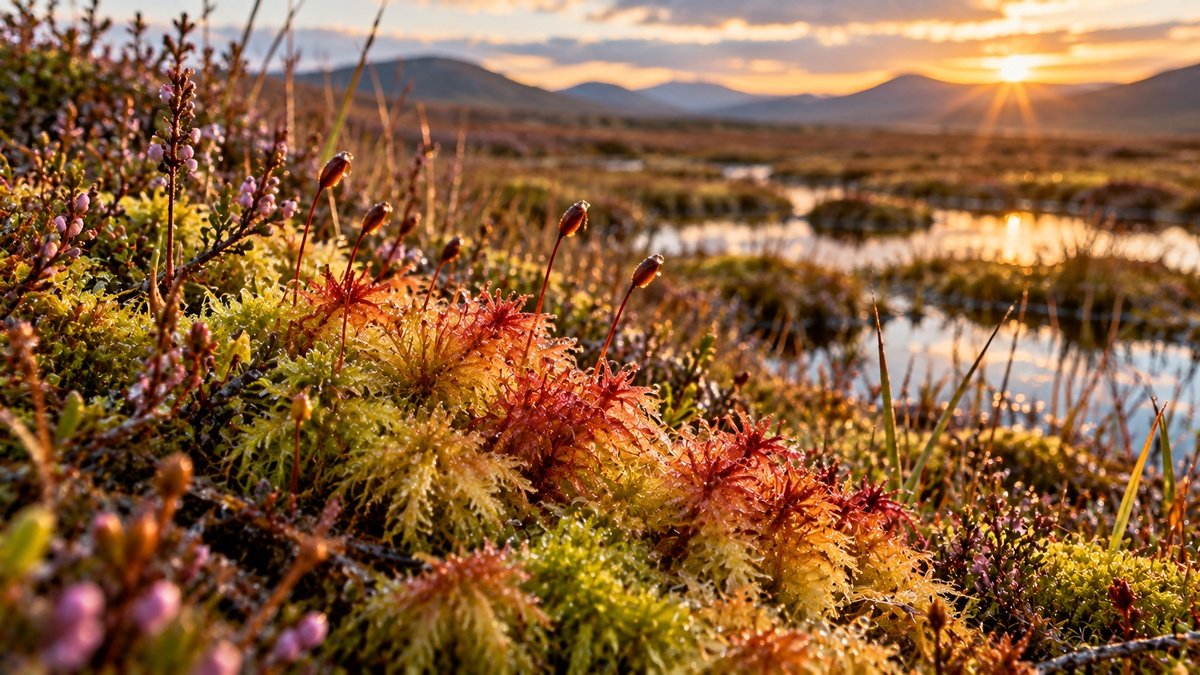
Highland peatlands can be easy to overlook. Beside mountains, forests and lochs, an expanse of bog may initially appear quiet or visually simple. There may be no dramatic summit, dense canopy or obvious landmark demanding attention.
Look more closely, however, and the landscape becomes considerably more complex. Water gathers between mosses and sedges, while pools reflect a changing sky. Heather grows beside cotton grasses, and beneath the vegetation lies something that cannot be understood from the surface alone: layer upon layer of partially decomposed plant material accumulated over very long periods of time.
This is peat.
Across parts of the Scottish Highlands, peat has developed into extensive landscapes whose ecology depends on a close relationship between plants, water and slow decomposition. Consequently, these landscapes challenge a familiar assumption about the Highlands: more trees are not automatically better in every place.
Sometimes an open, waterlogged landscape is not an absence of something else. Instead, it is the habitat itself.
What Are Highland Peatlands?
Peatlands are landscapes where peat forms at the surface and becomes a fundamental part of the ecosystem. Peat itself consists largely of partially decomposed organic material, particularly plant remains.
Normally, dead vegetation is broken down by organisms and environmental processes. In persistently waterlogged conditions, however, decomposition can become much slower. As a result, plant material can accumulate faster than it fully decomposes.
Over time, that material builds into peat. The process is slow; therefore, a peatland represents not simply what is growing there now, but also the accumulation of many earlier generations of vegetation beneath the living surface.
This relationship between present and past gives Highland peatlands one of their most distinctive characteristics. In effect, the landscape grows partly through what it retains.
Water Helps Create the Landscape
Water is fundamental to peat formation. Where the ground remains sufficiently wet, waterlogged conditions slow the processes through which organic material would otherwise decompose more completely.
As peat accumulates, it can also hold substantial quantities of water. Consequently, water, vegetation and peat become closely connected within the functioning of the habitat.
This is one reason drainage can alter a peatland so substantially. Changing the movement or level of water does not simply make the surface drier; it can also change the ecological processes that allow peat to continue forming.
Blanket Bog and Highland Peatlands
Scotland contains several types of peatland habitat, including blanket bog, raised bog, fen and bog woodland. For the northern and western Highlands, blanket bog is particularly significant.
Blanket bog develops under cool, wet conditions where drainage is poor enough for peat to accumulate across broad areas of ground. Rather than remaining confined to a single hollow or basin, peat can extend across gently sloping terrain and appear to cover the underlying landscape like a blanket.
According to NatureScot, blanket bog occurs only in a limited number of parts of the world with cool, wet and generally oceanic climates. Scotland’s Atlantic position, rainfall, landforms, rocks and soils help create conditions in which extensive areas of blanket bog have developed.
Therefore, Highland peatlands form part of a habitat with international as well as local significance.
The Flow Country: Peatland on an Extraordinary Scale
One of the most remarkable peatland landscapes lies across Caithness and Sutherland in the far north of mainland Scotland. It is known as The Flow Country.
The word flow in this context refers to wet peatland rather than flowing water. Across this landscape, extensive blanket bog contains pools, hummocks, ridges and areas of wet vegetation.
In 2024, UNESCO inscribed The Flow Country on the World Heritage List for its natural significance. UNESCO describes it as the world’s most outstanding example of a blanket-bog ecosystem, while the inscribed property extends across almost 190,000 hectares of northern mainland Scotland.
Moreover, peat has accumulated within this landscape for approximately 9,000 years. In some locations, deposits reach depths greater than eight metres.
Those dimensions make it difficult to think of peat simply as a thin layer of dark material beneath our feet. Here, peat forms a fundamental part of the landscape itself.
Sphagnum: Small Plants With a Large Role
Among the plants associated with many bogs are Sphagnum mosses. Depending on species and conditions, they may form cushions, hummocks or wetter carpets across the bog surface.
Importantly, Sphagnum can retain large quantities of water within its structure and contributes to the wet, acidic conditions associated with many bog ecosystems. As older plant material becomes incorporated into waterlogged ground and decomposes only slowly, it can contribute to peat formation.
Nevertheless, peatlands are not made from Sphagnum alone. Cotton grasses, sedges, heathers and other plants can also form part of these habitats. In addition, vegetation differs according to hydrology, nutrient conditions, geography and peatland type.
What may initially appear to be a relatively uniform bog can therefore contain considerable ecological variation.
A Landscape That Holds Time
A mature tree makes some aspects of its age visible through height, form and growth rings. Peatland carries time differently.
At the surface, new vegetation continues to grow. Meanwhile, older organic material becomes incorporated into the accumulating peat below. Layer after layer can therefore preserve evidence of earlier environmental conditions.
For example, pollen and plant remains preserved within peat can help researchers investigate changes in vegetation and aspects of past environments. Consequently, the peat beneath a contemporary landscape can contain evidence from periods long before the present vegetation developed.
However, this does not mean that every layer functions like a perfectly ordered historical book. Interpreting environmental records requires specialist sampling, dating and analysis.
Even with that qualification, the principle remains remarkable: a landscape that may appear visually quiet at the surface can contain an extraordinary depth of ecological time below it.
Highland Peatlands and Carbon
Highland peatlands also matter because of the carbon stored within accumulated organic material.
Plants take carbon dioxide from the atmosphere as they grow. When their remains enter waterlogged peat-forming conditions, some of that carbon can remain stored within accumulating peat rather than returning rapidly to the atmosphere through complete decomposition.
Repeated over centuries and millennia, this process can create very large stores of carbon. Scottish Government soil information estimates that peat soils cover more than 20% of Scotland and hold around 1.6 billion tonnes of carbon.
However, it is important to distinguish a carbon store from a claim that every peatland continuously absorbs large quantities of carbon. The greenhouse-gas balance of an individual peatland depends on its condition and ecological processes.
When peatlands are drained, eroded or otherwise degraded, previously stored carbon can become more vulnerable to loss. In addition, degraded peatlands can become net sources of greenhouse gases.
Therefore, the climate significance of peatlands lies partly in protecting the substantial carbon stores already accumulated beneath the surface.
When Peatlands Are Damaged
A peatland depends heavily on its hydrology. Activities that change water movement can therefore alter the habitat considerably.
Historically, peatlands have been drained for different forms of land use. Some areas have also been affected by peat cutting, erosion, burning, grazing pressure, infrastructure or forestry established on deep peat.
The effects vary according to the site and the type, intensity and duration of disturbance. Importantly, damage does not always produce an immediately dramatic visual change.
For example, a drainage channel may appear relatively small compared with the surrounding landscape while still altering how water moves through the peat. Once the peat surface becomes drier, vegetation can change and exposed peat may become more vulnerable to erosion.
As a result, understanding peatland condition requires more than looking for an obviously damaged landscape.
Why Planting Trees Is Not Always the Answer
Our article on the Caledonian Forest explored the ecological importance of native Highland woodland. Peatlands reveal another part of that story.
A tree is not environmentally beneficial simply because it is a tree, regardless of where it is planted. Establishing woodland on functioning deep peat can disturb an existing peatland habitat while also altering its hydrology and carbon balance.
Consequently, current Scottish land-management guidance restricts new woodland creation on deep peat. In addition, some areas planted with commercial forestry in earlier decades may now be considered for restoration to open peatland.
This does not create a competition between forests and bogs. Native woodland can be ecologically valuable, and healthy peatland can be ecologically valuable too.
Instead of asking simply, Would more trees be good?, a more useful question is: What habitat belongs here, and what ecological processes are already taking place?
The right habitat depends on the place.
Restoring Highland Peatlands
Peatland restoration usually focuses on recovering conditions that allow peatland processes to function more effectively. Because water is fundamental, restoration often involves changing how water moves through a damaged site.
For example, drainage channels may be blocked or modified, while areas of bare and eroding peat may be stabilised. Artificial ridges and furrows associated with former forestry can sometimes be reprofiled. In suitable locations, trees previously planted on deep peat may also be removed as part of forest-to-bog restoration.
Rewetting can raise the water table and create conditions in which characteristic bog vegetation can recover. However, restoration is not simply a matter of adding water.
Different sites have different hydrology, vegetation, topography, histories and degrees of degradation. Therefore, restoration requires assessment and methods appropriate to the particular landscape.
Scotland’s Peatland ACTION programme supports restoration projects across the country through a partnership involving NatureScot and other public bodies. Ultimately, the aim is not to manufacture an idealised bog overnight, but to support conditions in which peatland ecosystems can recover their function over time.
Peatlands Are Also Human Landscapes
Ecological importance does not mean that Highland peatlands exist outside human history. People have lived alongside and used these landscapes for generations.
For example, peat has been cut and dried for fuel, while animals have grazed across peatland landscapes. Routes, settlements and working practices have also developed around wet ground.
Today, peatlands may intersect with crofting, farming, sporting management, forestry, renewable-energy infrastructure, conservation and tourism. These relationships can involve different priorities and perspectives.
Therefore, understanding peatland means recognising both ecological processes and people’s relationships with land. Restoration takes place within lived and working landscapes rather than on an empty ecological map.
A Landscape That Can Look Empty
Woodland fills our field of vision with trunks, branches and layers of vegetation, while mountains create obvious vertical scale. Peatlands can work differently.
Their scale often extends horizontally. From a distance, low vegetation, water and sky may dominate the view. Consequently, there may initially appear to be comparatively little to see.
Closer attention changes that impression. Mosses differ in texture and colour, cotton grasses move in the wind, and small pools interrupt the vegetation. Meanwhile, heather changes through the seasons and water reflects clouds and light.
At another scale, what looked uniform becomes patterned.
This connects with the wider question explored in Why Place Matters: Nature, Attention and the Experience of Being Outdoors. A place does not have to compete for our attention in order to contain detail.
Water, Weather and Highland Peatlands
Highland peatlands make the relationship between landscape and weather particularly visible. Rain does not simply fall onto the scenery; it becomes part of the hydrology that sustains wetland conditions.
Dry periods can change surface conditions, while heavy rainfall alters pools and water levels. Frost can transform the texture of wet ground, and wind moves grasses while rippling exposed water.
Cloud also changes how the landscape appears. Under diffuse grey light, water and vegetation may seem visually continuous. By contrast, a break in the cloud can suddenly reveal differences in colour, reflection and surface texture.
As explored in our articles on Highland weather and Highland light, changing conditions are not separate from the landscape. Instead, they help shape how that landscape is experienced.
Experiencing Peatland Does Not Require Crossing It
Peatland can be wet, uneven and physically difficult to cross. In addition, some areas contain deep water, hidden channels, unstable ground or sensitive vegetation.
Walking directly across bog is therefore neither necessary nor always appropriate. Instead, people may experience peatland from roads, designated paths, boardwalks, viewpoints, visitor facilities and other accessible locations.
What is suitable will differ according to the site, weather, access arrangements and individual circumstances. Mobility, health, balance, sensory preferences, confidence, transport, available time, work and caring responsibilities can all shape how someone encounters a landscape.
Importantly, going farther does not make someone’s attention more meaningful. A landscape can be noticed without being conquered.
A Common Misunderstanding: Peatland Is Wasteland
Open bog has sometimes been described as empty, barren or unproductive land. However, those words reflect particular ideas about what land should look like and what it should produce.
Ecologically, peatland is not an incomplete forest or unused space. Instead, it is a habitat with its own vegetation, hydrology, wildlife and ecological processes.
Its importance can also be difficult to judge visually because much of the accumulated peat lies below the surface. At the same time, describing peatland only through carbon or biodiversity would create another simplification.
These landscapes also carry histories of work, fuel, grazing, settlement, language and land use. Similarly, as our exploration of Gaelic place names and the Highland landscape demonstrates, ecological landscapes can also carry cultural histories.
Peatlands are therefore neither empty wilderness nor merely a resource. They are landscapes with several stories at once.
The Orenna Perspective — Value Does Not Depend on Spectacle
At Orenna, a landscape does not have to be dramatic to be significant.
Highland peatlands make that idea tangible. A mountain reveals itself through height, a forest surrounds us with trees, and a loch reflects the sky. Peatland, however, may ask for a different kind of attention.
Its scale can be low and horizontal, while its changes may happen slowly. Moreover, much of its history lies beneath the visible surface.
What appears still continues to develop. What appears empty can contain water, vegetation, wildlife, stored carbon and layers of environmental history. Similarly, what appears ordinary may have taken thousands of years to form.
Nevertheless, this does not mean everyone must find a peatland beautiful, peaceful or restorative. People experience landscapes differently, and attention does not require a prescribed emotional response.
Instead, understanding can change what becomes available to notice. A patch of moss becomes part of peat formation; a pool becomes part of the hydrology; a drainage channel becomes evidence that landscapes can be altered; and a restored area becomes part of what happens next.
Sometimes the deepest part of a landscape is the part we cannot see from the surface.
References & Further Reading
NatureScot. Blanket Bog. An introduction to the formation, distribution and ecological characteristics of blanket bog in Scotland.
NatureScot. Restoring Scotland’s Peatlands. Information on peatland condition, greenhouse-gas emissions, rewetting and peatland restoration.
UNESCO World Heritage Centre. The Flow Country. World Heritage information on the internationally important blanket-bog landscape of Caithness and Sutherland, inscribed on the World Heritage List in 2024.
Scottish Government — Scotland’s Soils. Peatland Restoration. Information on Scotland’s peat soils, carbon storage, degraded peat and restoration planning.
Scottish Government. Peatland ACTION Five Year Partnership Plan 2025–2030. Scotland’s current partnership framework for supporting and expanding peatland restoration.
Forestry and Land Scotland. Peatland Restoration. Information on rewetting, forest-to-bog restoration and practical approaches to restoring damaged peatlands.
The Orenna Journal explores yoga, well-being, philosophy and place from historical, evidence-informed and contemporary perspectives. Peatland ecology, carbon accounting and restoration are complex and site-specific. This article provides an introduction to Highland peatlands rather than land-management or environmental advice.



