


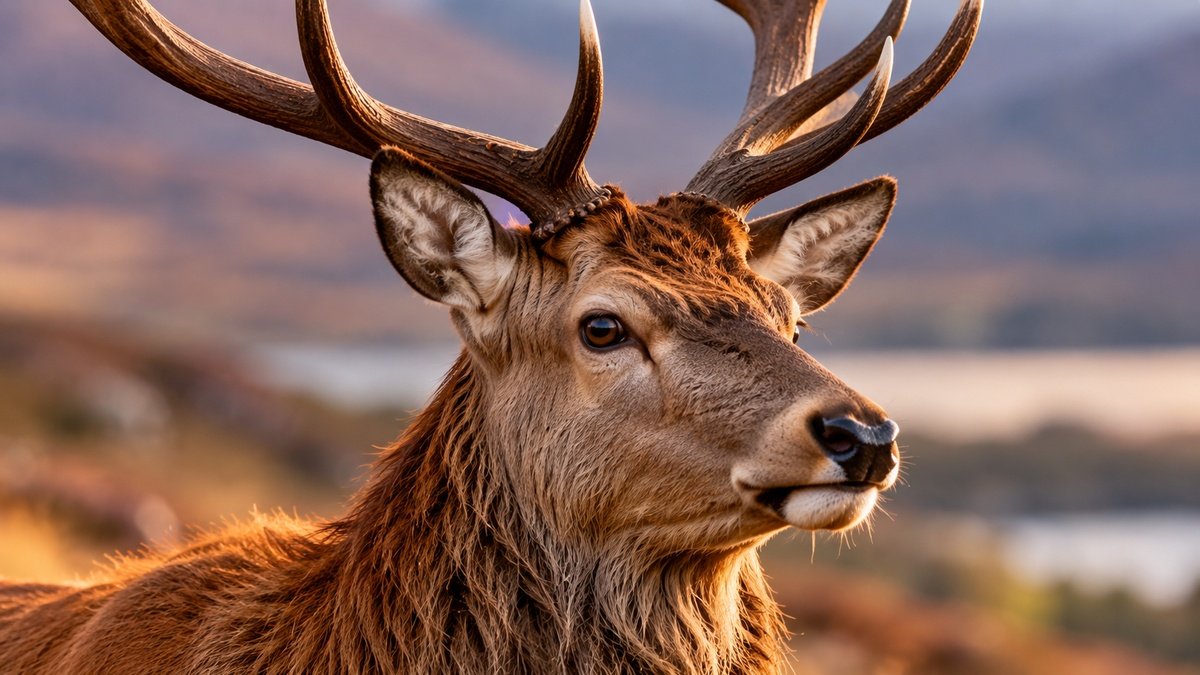
Red deer in Scotland are closely associated with the Highland landscape. A stag standing against an open hillside has become one of the most familiar images of wild Scotland, appearing in photography, art, tourism and popular ideas about the Highlands.
Yet red deer are more than symbols.
They are large herbivores living within landscapes that they also help to change. By grazing, browsing and moving across the land, deer interact with woodland, moorland, peatland and other habitats. At the same time, their populations are influenced by climate, food, land management and human decisions.
Consequently, the relationship between deer and the Highlands is more complicated than either a romantic image of untouched wilderness or a simple story of ecological damage.
Red deer belong to Scotland’s natural heritage. However, belonging to an ecosystem does not mean having no impact upon it.
Red Deer in Scotland
Red deer, Cervus elaphus, are native to Scotland. Together with roe deer, they are one of Scotland’s two native deer species.
They are also Scotland’s largest wild land mammal.
Although particularly associated with the Highlands, red deer occur across much of Scotland. Their habitats can include woodland, moorland and mountainous country, extending from coastal areas to high ground.
According to NatureScot, red deer graze on grasses, sedges and heathers and also browse woody vegetation. What they eat, however, varies with habitat, season and what is available.
Adult males are known as stags, while adult females are hinds. Young deer are generally called calves.
For much of the year, adult stags and hinds commonly occupy different groups and areas. During the autumn breeding season, however, their behaviour changes considerably.
The Autumn Rut
Autumn brings one of the most conspicuous periods in the annual life of red deer: the rut.
During this breeding season, mature stags compete for access to groups of hinds. Their deep roars can carry across glens and hillsides, while displays of size, posture and strength may help establish dominance.
Physical contests can also occur between rival stags. Nevertheless, not every encounter develops into direct fighting.
Antlers play an important role during this period. Male red deer grow and shed them in a recurring annual cycle rather than retaining the same antlers throughout life.
The rut can be impressive to observe from a suitable distance. However, rutting stags are large wild animals whose behaviour can be less predictable during the breeding season. Giving deer space protects both people and wildlife.
What Do Red Deer Eat?
Red deer are herbivores, but that does not mean they eat one particular kind of vegetation.
Depending on habitat and season, their diet can include grasses, sedges, heathers and woody plants. In woodland environments, deer may also browse shoots and leaves from young trees and shrubs.
Browsing is therefore part of the ecological relationship between deer and vegetation.
At suitable levels, grazing and browsing can contribute to varied vegetation structure. NatureScot notes that deer at appropriate densities can help maintain some plant communities and create opportunities for seedling regeneration.
However, the effect changes when browsing or grazing becomes too intensive for vegetation to recover.
The ecological question is therefore not simply whether deer browse. Instead, it is how much browsing occurs, for how long, and within what kind of habitat.
Red Deer Help Shape the Highland Landscape
Large herbivores do not simply occupy landscapes. Through feeding, movement and trampling, they participate in shaping them.
For example, grazing can influence the height and composition of vegetation. Browsing can affect which shrubs and young trees establish. Meanwhile, movement across the ground can create paths and disturb vegetation.
At appropriate levels, some of these effects can contribute positively to habitat diversity. NatureScot therefore recognises deer as an important part of Scotland’s biodiversity rather than treating their presence itself as ecological damage.
Nevertheless, intensity matters. If large numbers of deer repeatedly graze, browse or trample the same habitat, vegetation may not have sufficient opportunity to recover. Consequently, an ecological process that belongs within the landscape can become a significant pressure upon it.
When Browsing Changes the Forest
The relationship between deer and woodland makes this particularly visible.
Young trees must survive long enough to grow beyond their most vulnerable stages if woodland is to regenerate naturally. Where browsing pressure remains high, however, seedlings and saplings may repeatedly lose new growth.
As a result, mature trees can remain standing while relatively few young trees develop beneath them.
This connects directly with our exploration of the Caledonian Forest. Native pinewoods require more than the survival of existing old Scots pines. New generations also need opportunities to establish.
Scottish Forestry identifies browsing of young trees as one of the reasons deer management may be necessary in woodland. High levels of grazing and trampling can also affect woodland ground vegetation and regeneration.
However, this does not make an individual deer a problem. The relevant relationship involves deer numbers, vegetation, habitat condition, available food and management objectives across a particular landscape.
Why Deer Numbers Matter
Scotland’s wild deer currently have no natural predators capable of regulating their populations at landscape scale.
Historically, large predators including wolves disappeared from Scotland following prolonged human persecution. However, today’s deer populations cannot be explained by predator loss alone.
Land use also matters. Food availability, woodland cover, open hill management, forestry, agriculture, sporting interests and deer-management practices can all influence where deer live and how populations develop.
Consequently, the number of deer that a particular habitat can support without unacceptable impacts is not one universal figure for every part of Scotland.
NatureScot and Scottish Forestry therefore emphasise active management where deer numbers or impacts conflict with woodland regeneration, habitat condition, agriculture, public safety or deer welfare.
In other words, deer management is not simply about counting animals. It also involves observing what is happening to the landscape.
Red Deer and Highland Peatlands
The relationship between deer and Highland peatlands follows a similar principle.
Deer are a natural part of Scottish upland ecosystems. At appropriate densities, their presence is compatible with peatland habitats.
However, excessive grazing and trampling can damage sensitive bog vegetation. High herbivore pressure can break surface vegetation and contribute to areas of exposed peat, particularly where other pressures are also present.
The effects are not identical everywhere. Instead, they depend on factors such as deer density, peat condition, vegetation, hydrology and where animals concentrate their activity.
This is particularly relevant where peatland restoration is underway. If grazing and trampling pressures remain too high, recovering vegetation may struggle to establish successfully.
Once again, context matters more than a simple label of good or bad.
Why Are Red Deer Managed?
Wild deer in Scotland are actively managed for several reasons.
NatureScot identifies habitat protection, forestry, agriculture, public safety and deer welfare among the considerations involved. Deer also have economic and cultural significance, while venison provides a source of food.
Where deer numbers are high in relation to available habitat, animals themselves can also face poorer conditions. For example, limited food during difficult winters can create welfare concerns.
Management can include monitoring deer numbers and habitat impacts, protecting sensitive areas, using fencing where appropriate and controlling populations through regulated culling.
Importantly, decisions should consider evidence from the particular landscape rather than assuming that the same deer density or intervention is appropriate everywhere.
NatureScot assesses deer impacts by examining whether grazing, browsing and trampling are causing adverse changes to habitats or other important features. Therefore, impact as well as population size informs management.
Red Deer in Scotland as a Highland Icon
Ecology is only one part of the relationship between red deer and the Highlands. The stag has also become a powerful cultural image.
Antlers silhouetted against mountains, deer crossing misty glens and stags standing on open moorland appear repeatedly in representations of Scotland. Over time, such imagery has helped connect red deer with ideas of remoteness, wildness and Highland identity.
There is nothing inherently wrong with appreciating that image. However, the photograph rarely tells the whole ecological or historical story.
The open hillside behind a stag may itself reflect centuries of grazing, burning, woodland change and land management. Similarly, the number and distribution of deer within that landscape may reflect both ecological conditions and human decisions.
The animal may be wild while the landscape around it has a long history of human influence.
Wildlife Does Not Exist Outside Human History
It is tempting to imagine wildlife and people as occupying separate worlds. In the Highlands, however, those worlds have long overlapped.
Deer have been hunted for food and sport. Estates have managed land partly around deer populations. Forestry and agriculture have altered habitats, while roads and settlements have changed how animals and people move through the landscape.
Today, conservation and habitat-restoration objectives add further relationships. Consequently, present-day red deer populations cannot be understood only as a surviving fragment of a landscape untouched by people.
This echoes a theme running through our articles on the Caledonian Forest, Highland peatlands and Gaelic place names: ecological landscapes also carry human histories.
Seeing Red Deer in Scotland Responsibly
Seeing red deer in Scotland can be memorable, but a meaningful wildlife encounter does not require getting close.
Binoculars or a camera lens can allow observation from a greater distance. Where designated paths or viewing areas are available, using them can also reduce unnecessary disturbance.
Extra care is appropriate during sensitive periods. During the rut, for example, stags may be particularly active and competitive. Hinds with young calves also need sufficient space.
Dogs should be kept under appropriate control around wildlife and livestock, following local access guidance. Likewise, deer should not be approached or encouraged closer for photographs.
Roads create another important point of contact. Deer may cross unexpectedly, particularly where woodland, moorland or feeding areas lie nearby. Drivers should therefore pay attention to local warning signs and conditions.
Respectful observation begins with allowing a wild animal to remain wild.
You Do Not Need a Remote Hill to Encounter Wildlife
Images of Highland wildlife often emphasise remote mountains and long walks across open country.
Those experiences can be meaningful for people who enjoy and can access them. Nevertheless, they are not the only valid way to observe wildlife.
Depending on location and circumstances, deer may be seen from accessible viewpoints, visitor facilities, wildlife-watching locations, or roadsides where stopping is safe.
Mobility, health, balance, sensory preferences, weather, transport, work, caring responsibilities and available time can all influence how someone experiences the Highlands.
Consequently, travelling farther or walking higher does not make one person’s wildlife encounter more authentic than another’s.
Attention is not measured in kilometres.
A Common Misunderstanding: Deer Are Either Good or Bad for the Highlands
Discussions about deer can easily become divided between two simplified positions.
One presents red deer as an unquestioned symbol of natural Highland wilderness. The other treats deer primarily as a source of ecological damage.
Neither position captures the whole relationship.
Red deer are native animals and an established part of Highland ecosystems. Their grazing and browsing are natural ecological processes. At appropriate levels, those processes can contribute to habitat structure and diversity.
However, high browsing, grazing or trampling pressure can prevent woodland regeneration and affect sensitive habitats.
The more useful question is therefore not, Are deer good or bad?
Instead, we can ask: What is happening in this habitat, under these conditions, with this number of animals?
That question leaves room for evidence, context and change.
The Orenna Perspective — Belonging Does Not Mean Having No Impact
At Orenna, to belong to a landscape is also to participate in changing it.
Red deer make that relationship particularly visible.
A deer eats vegetation and influences what grows next. A tree changes light, shelter and soil around it. Water changes peat, rivers and lochs. Meanwhile, people manage land, build roads, restore habitats and make decisions about what landscapes may become.
None of these elements exists entirely in isolation.
Understanding red deer in Scotland therefore asks us to move beyond the image of a stag standing against a mountain. The animal remains remarkable, but the relationships around it become visible too.
We can notice the vegetation it eats, the woodland trying to regenerate, the peat beneath its feet, the weather shaping its environment and the human history embedded in the land.
That wider view does not make the deer less interesting. Instead, it places the animal back within the landscape to which it belongs.
A living landscape is not made from separate pieces. It is made from relationships.
References & Further Reading
NatureScot. Deer. An overview of Scotland’s deer species and their ecological roles and impacts on woodland, peatland and other habitats.
NatureScot. Deer in Scotland. Information on Scotland’s deer species, deer management and their relationship with natural and cultural landscapes.
NatureScot. Deer Management in Scotland — Frequently Asked Questions. Further information about red deer ecology, distribution, behaviour and management.
NatureScot. Deer Impacts. Guidance on assessing grazing, browsing and trampling impacts on habitats.
Scottish Forestry. Managing Deer. Information about deer, woodland impacts, public safety, welfare and sustainable deer management in Scotland.
NatureScot — Peatland ACTION. What’s the Connection Between Peat and Deer Management? An exploration of the relationship between deer pressure and peatland restoration.
The Orenna Journal explores yoga, well-being, philosophy and place from historical, evidence-informed and contemporary perspectives. Deer populations, habitat impacts and management requirements vary between locations. This article provides a general introduction to red deer in Scotland rather than wildlife-management or land-management advice.



