
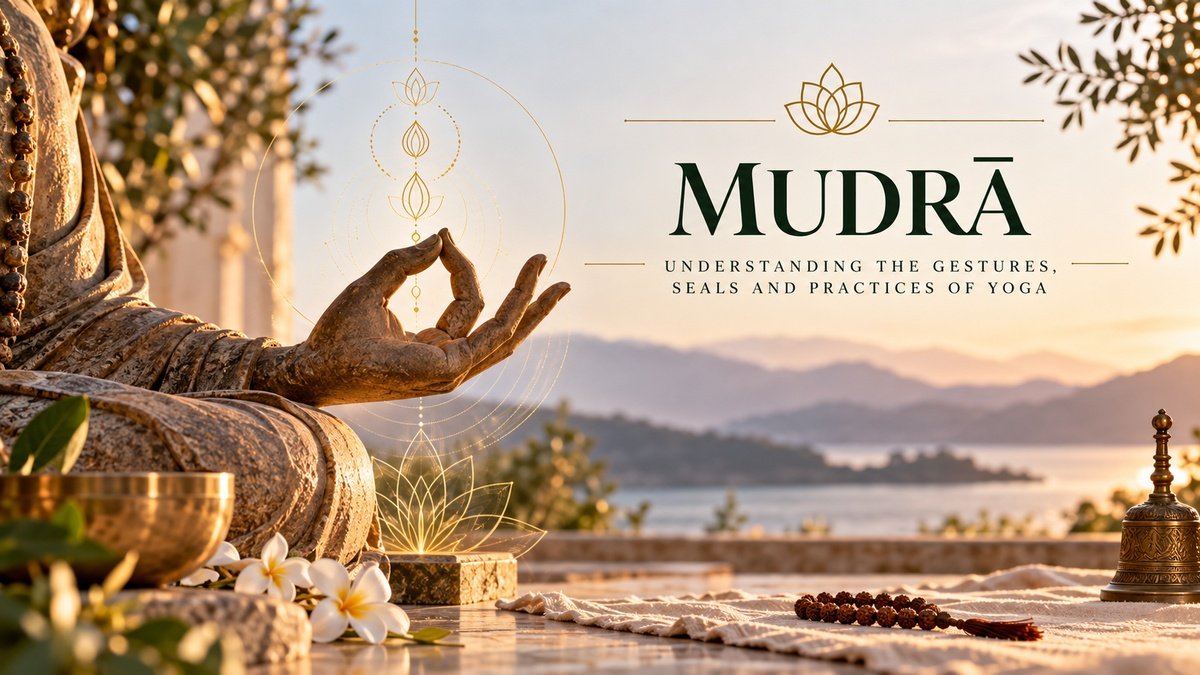
Mudra is one of those yoga words that can appear deceptively simple.
In a contemporary class, a teacher might ask students to bring the palms together, touch the thumb and index finger, or rest the hands in a particular position during meditation.
These gestures may be described as mudrās.
Yet the historical territory behind the word is considerably larger.
Across South Asian religious, ritual and yogic traditions, mudrā has referred to different kinds of gestures, seals and practices. Some involve the hands. Others involve the whole body, breath, tongue, muscular actions or specialised techniques associated with meditation and the subtle body.
There is therefore no single movement that defines mudrā — and no single historical tradition owns every practice carrying the name.
To understand mudrā, we first need to look beyond the hands.
What Does Mudrā Mean?
The Sanskrit word mudrā can carry meanings associated with a seal, sign, mark or gesture, depending on its context.
That range of meanings matters.
Translating mudrā simply as “hand gesture” makes sense for some practices, but it cannot explain the entire historical category.
In one context, a mudrā may communicate symbolic or ritual meaning through the hands.
Elsewhere, the word can describe a specialised yogic practice involving several parts of the body.
Different traditions also developed their own classifications and interpretations. Consequently, the meaning of a particular mudrā depends partly on where, when and within which tradition we encounter it.
Is a Mudrā Simply a Hand Gesture?
No — although hand gestures are now among the most recognisable forms of Mudra.
Images of meditation frequently show hands arranged into deliberate shapes. Modern yoga books and websites may also present collections of finger positions, each carrying a name, symbolic interpretation or proposed benefit.
These practices belong to an important part of the mudrā landscape, often discussed under terms such as hasta mudrā, with hasta meaning hand.
However, reducing every mudrā to a finger position creates a significant historical misunderstanding.
Medieval Haṭha Yoga texts use the term for practices such as Mahāmudrā, Khecarī Mudrā and Viparītakaraṇī.
These are not simply symbolic arrangements of the fingers.
Depending on the practice and textual tradition, they may involve posture, breath, the tongue, muscular actions, bodily inversions or other specialised techniques.
This gives us our first important distinction:
The mudrā of a contemporary yoga class and the mudrā of a medieval Haṭha Yoga text are not necessarily the same kind of practice.
Where Do Mudrās Come From?
Mudrās do not have one simple origin story.
The term and the practices associated with it appear across a broad range of South Asian religious and contemplative environments.
We encounter gestures and mudrās in Hindu traditions, Buddhist traditions and Jain contexts, as well as in ritual, Tantra, meditation, yoga, religious imagery and Indian performance traditions.
These traditions developed over long periods and did not necessarily use mudrā in precisely the same way.
For that reason, searching for a single person who “invented mudrā” creates the wrong kind of historical question.
It is more useful to investigate how different forms of mudrā developed, what they meant within particular traditions and how those meanings changed over time.
We explore that history separately in More Than Hand Gestures: The History and Meaning of Mudrā.
Who Uses Mudrās?
There is no single group of mudrā practitioners.
Across different periods and traditions, ritual specialists, yogins, meditators and religious practitioners have used forms of mudrā.
Mudrās also appear in sacred imagery, where the position of a figure’s hands can communicate aspects of identity, teaching, protection, meditation or other religious meanings.
Buddhist iconography provides familiar examples. Images of Buddhas and bodhisattvas may display distinctive hand gestures with particular symbolic associations.
Hindu religious imagery likewise contains meaningful gestures and bodily positions.
Indian classical dance traditions also developed sophisticated systems of hand gesture. However, we should not assume that every gesture used in dance, ritual, iconography and yoga represents the same system simply because the hands can look similar.
Context matters.
Why Are Mudrās Practised?
The answer depends on the tradition.
A mudrā can carry symbolic meaning, form part of ritual activity, accompany meditation or mantra, or participate in a larger yogic practice.
In some Tantric contexts, mudrā belongs within complex systems involving ritual, visualisation, mantra and deity practice.
In some forms of Haṭha Yoga, mudrās appear within practices concerned with breath, bindu, prāṇa and the subtle body.
Contemporary yoga may use hand mudrās more simply during meditation, breathing practices or periods of stillness.
These purposes should not be collapsed into a single universal explanation.
There is no historically responsible formula in which every mudrā exists for precisely the same reason.
What Are the Main Types of Mudrā?
There is no universal classification that covers every tradition and historical period.
Nevertheless, several broad distinctions can help contemporary readers navigate the subject.
Hand mudrās use deliberate configurations of the hands and fingers. These are among the forms most familiar in contemporary yoga and meditation.
Ritual and symbolic mudrās can communicate meaning or function within particular religious and ceremonial settings.
Yogic mudrās, especially those described in medieval Haṭha Yoga literature, may involve the whole body and work alongside techniques such as prāṇāyāma and bandha.
Some traditions also connect mudrā with mantra, meditation, visualisation and subtle-body practice.
These categories overlap. They are useful orientation points rather than a universal taxonomy.
What Are Hasta Mudrās?
Hasta means hand in Sanskrit.
Hasta mudrās therefore provide the clearest route into the hand gestures that many people now associate with yoga.
Some use the entire hand, while others create particular relationships between the fingers and thumb.
Yet appearance alone does not tell us everything about a gesture.
The same or similar hand configuration can receive different names, meanings or interpretations according to context.
This is one reason simple internet charts can become misleading when they imply that every finger position has one fixed meaning throughout Indian history.
Our dedicated guide, Hasta Mudrās: Understanding the Hand Gestures of Yoga, explores this category in greater depth.
Which Mudrās Might I Recognise?
Even someone unfamiliar with the word mudrā may already recognise several gestures.
Añjali Mudrā, with the palms brought together, is widely encountered in contemporary yoga.
Jñāna Mudrā and Chin Mudrā are commonly associated with seated practice and meditation, although terminology and interpretation can vary.
Dhyāna Mudrā appears in meditative contexts, while Abhaya Mudrā has an important history within religious iconography and commonly carries associations with reassurance or fearlessness.
These examples already reveal an important point: not every familiar mudrā comes from precisely the same historical environment.
Rather than assigning each gesture a one-line definition, our later guide will examine its name, configuration, context, symbolism and contemporary interpretation.
Continue to The Meaning Behind Familiar Yoga Mudrās.
What Does Mudrā Mean in Haṭha Yoga?
This is where the subject becomes particularly interesting.
Premodern Haṭha Yoga literature can use mudrā for practices that look very different from the hand gestures of a contemporary meditation class.
The Haṭhapradīpikā, for example, discusses a group of mudrās and related techniques that includes practices such as Mahāmudrā, Mahābandha, Mahāvedha, Khecarī and Viparītakaraṇī.
Other texts organise and classify practices differently.
Some techniques involve posture. Others involve breath retention, the tongue, bodily locks or specialised actions.
Traditional explanations may connect them with bindu, prāṇa, kuṇḍalinī, liberation or other aims understood within particular yogic systems.
This history makes one thing clear:
mudrā has never meant only “make a shape with your fingers”.
Because these practices deserve considerably more context than a gateway article can provide, we examine them separately in Beyond the Hands: Mudrā in Haṭha Yoga.
Are Mudrā and Bandha the Same Thing?
Not exactly — but the historical relationship is more complicated than modern categories sometimes suggest.
Contemporary yoga education often places mudrā and bandha into separate boxes.
Mudrās become gestures. Bandhas become “locks”.
Premodern texts do not always organise their techniques according to these neat modern divisions.
Practices that contemporary teachers may describe as bandhas can appear within wider discussions or lists of mudrās in Haṭha Yoga literature.
Rather than forcing every historical source into one modern taxonomy, it is more accurate to ask how a particular text classifies and explains the practice.
What Is the Connection Between Mudrā and Tantra?
Mudrā also has important histories within Tantric traditions.
However, Tantra itself is not one homogeneous system, and the role of mudrā varies across traditions.
In some contexts, mudrās participate in ritual systems alongside mantra, visualisation, deity practice and other specialised methods.
Tantric traditions also contributed significantly to the historical environments from which later yogic subtle-body systems developed.
This does not mean every contemporary yoga hand gesture should simply be labelled “Tantric”.
Historical relationships need to be established rather than assumed.
What Is the Connection Between Mudrā and Mantra?
Mudrā and mantra can appear together, particularly within ritual and contemplative traditions.
A mantra uses sound, language or sacred utterance. A mudrā may contribute a gestural or bodily component.
Within a larger practice, these elements can work alongside visualisation, attention or ritual action.
Yet neither concept can be reduced to the other.
A person can practise mantra without performing a hand mudrā, and many mudrās do not require mantra.
What Is the Connection Between Mudrā and Prāṇa?
This question requires careful language.
Traditional yoga sources can understand certain mudrās through models involving prāṇa, nāḍīs, cakras, bindu or kuṇḍalinī.
These concepts belong to subtle-body frameworks that developed in particular South Asian traditions.
They should not automatically be translated into modern biomedical structures.
Prāṇa, for example, is not simply another Sanskrit word for oxygen. Nāḍīs are not established anatomical nerves or blood vessels, and cakras should not be presented as measurable endocrine structures.
Understanding traditional explanations does not require us to disguise them as modern physiology.
We will explore this distinction fully in Mudrā, Prāṇa and the Subtle Body.
Do the Fingers Represent the Five Elements?
Many contemporary mudrā charts assign an element to each finger.
A common version associates the thumb with fire, the index finger with air, the middle finger with space or ether, the ring finger with earth and the little finger with water.
The chart may then claim that touching particular fingers changes the balance of those elements and produces specific physical or psychological effects.
Such explanations have become highly visible in modern yoga and wellness culture.
However, we should not automatically present one modern correspondence chart as a single, universal system used unchanged throughout the history of Indian mudrā practice.
Indian traditions contain extensive elemental theories, but their relationship with specific mudrās requires historical context.
This is precisely where distinguishing traditional frameworks, later interpretations and modern therapeutic claims becomes important.
Do Mudrās Redirect Energy?
Traditional sources and contemporary teachers may describe mudrās as influencing or directing prāṇa.
Within a traditional yogic framework, that language has its own conceptual meaning.
Problems arise when we convert it without qualification into claims about electricity, nerves, electromagnetic circuits or other measurable physiological mechanisms.
A traditional subtle-body explanation and a modern scientific explanation are not automatically interchangeable.
We can study what a tradition says a practice does without presenting that explanation as experimentally demonstrated human physiology.
Can Mudrās Improve Health?
This is another area where contemporary claims can become much stronger than the available evidence.
Online descriptions may claim that particular mudrās treat digestive disorders, regulate hormones, cure insomnia, reduce blood pressure, improve eyesight or correct specific diseases.
Claims of that kind require appropriate evidence.
Some research has explored mudrā-related practices, meditation and associated interventions. However, evidence for a particular hand configuration should not be confused with evidence for an entire meditation, breathing or yoga programme in which that gesture happened to appear.
Nor should traditional therapeutic explanations automatically become modern medical guarantees.
This question deserves its own investigation rather than a dismissive yes or an uncritical yes.
We examine it in Do Mudrās Really Work? Tradition, Modern Claims and Evidence.
How Many Mudrās Are There?
There is no universally authoritative number.
Different texts, traditions and modern systems enumerate mudrās differently.
A Buddhist ritual collection, a medieval Haṭha Yoga text, an Indian dance tradition and a contemporary yoga manual may each organise gestures and practices according to different purposes.
Lists such as “the 24 mudrās”, “the 10 mudrās” or “the 108 mudrās” therefore require context.
The existence of one numbered collection does not establish that every tradition recognises the same list.
Are Mudrās Religious?
Some mudrās have explicitly religious, ritual or devotional contexts.
Others now circulate within yoga and meditation settings where practitioners may approach them contemplatively rather than devotionally.
The same gesture can also acquire different meanings as it travels between contexts.
It is therefore difficult to classify every mudrā as either wholly religious or wholly secular.
A more useful question is:
What does this particular mudrā mean in the tradition from which I am taking it?
That question encourages context rather than assumption.
Can You Practise Mudrā Without Accepting Its Traditional Metaphysics?
Many contemporary practitioners do.
Someone may use a simple hand position as part of meditation or breath awareness without interpreting prāṇa, cakras or subtle anatomy literally.
Others practise within religious or yogic traditions in which those concepts remain fundamental.
Neither approach requires us to rewrite the history.
A secular practitioner can acknowledge the traditional context of a practice without pretending to hold beliefs they do not hold.
Likewise, explaining traditional metaphysics respectfully does not require presenting those metaphysical claims as biomedical facts.
How Are Mudrās Used in Modern Yoga?
Contemporary yoga uses mudrās in many ways.
A teacher may introduce a hand gesture during meditation, prāṇāyāma, chanting or a period of stillness.
Some modern schools integrate mudrā more systematically. Others use only a small number of familiar gestures.
Modern teaching also brings together practices from different historical sources.
This does not automatically make contemporary practice illegitimate. Yoga has never remained culturally or historically motionless.
However, responsible teaching benefits from distinguishing between historical tradition and modern synthesis.
“This mudrā is used in my teaching tradition” is different from “all yogis have practised this mudrā for thousands of years”.
How Should a Beginner Approach Mudrā?
There is no need to begin by memorising dozens of gestures and their supposed benefits.
A more useful starting point is context.
Learn the name of the practice. Understand what the hands or body are doing. Ask where the mudrā comes from, how a particular tradition interprets it and whether the explanation is symbolic, religious, yogic, therapeutic or modern.
Simple hand mudrās can often be explored comfortably without turning them into tests of flexibility or endurance.
Specialised Haṭha Yoga mudrās are different.
Some historical practices involve breath retention, unusual tongue positions, strong abdominal or pelvic actions, inversion or other techniques that should not be treated as casual hand gestures simply because the same word mudrā appears in their name.
Where Should I Explore Next?
This article is the starting point for The Orenna Journal Mudrā Series.
To understand where these practices came from, continue to More Than Hand Gestures: The History and Meaning of Mudrā.
For the hand gestures commonly encountered in yoga and meditation, explore Hasta Mudrās: Understanding the Hand Gestures of Yoga.
To discover why medieval yoga texts describe whole-body practices as mudrās, continue to Beyond the Hands: Mudrā in Haṭha Yoga.
For the traditional language of prāṇa, nāḍī, cakra, bindu and kuṇḍalinī, read Mudrā, Prāṇa and the Subtle Body.
For individual gestures and their meanings, explore The Meaning Behind Familiar Yoga Mudrās.
And for a closer examination of elemental correspondences, therapeutic claims and scientific evidence, continue to Do Mudrās Really Work? Tradition, Modern Claims and Evidence.
An Orenna Perspective: A Gesture Is Not Just Its Shape
From the outside, a mudrā can appear remarkably small.
Two palms meet.
A finger touches a thumb.
The hands become still.
Yet the visible shape may be only the surface of the practice.
Behind it can sit histories of ritual, meditation, philosophy, symbolism and yoga. In another tradition, the word mudrā may lead us away from the hands entirely and towards breath, the body and sophisticated models of yogic transformation.
Perhaps this is why mudrā deserves more than a chart of hand positions and promised benefits.
Before asking what a mudrā does, we might first ask what the gesture meant, who practised it, and within which understanding of yoga it made sense.
References & Further Reading
James Mallinson and Mark Singleton. Roots of Yoga. A major sourcebook for understanding premodern yoga practices and textual traditions, including Haṭha Yoga techniques associated with mudrā.
Svātmārāma. Haṭhapradīpikā. An influential medieval Haṭha Yoga text containing important discussions of mudrā and related practices.
James Mallinson. Scholarship on the history and development of Haṭha Yoga provides essential context for understanding how mudrā functioned within premodern yogic practice.
Jason Birch. Research into premodern Haṭha and Rājayoga traditions provides further historical context for the development and classification of yogic techniques.
Haṭha Yoga Project, SOAS University of London. Academic research into the history, texts and practices of Haṭha Yoga.