


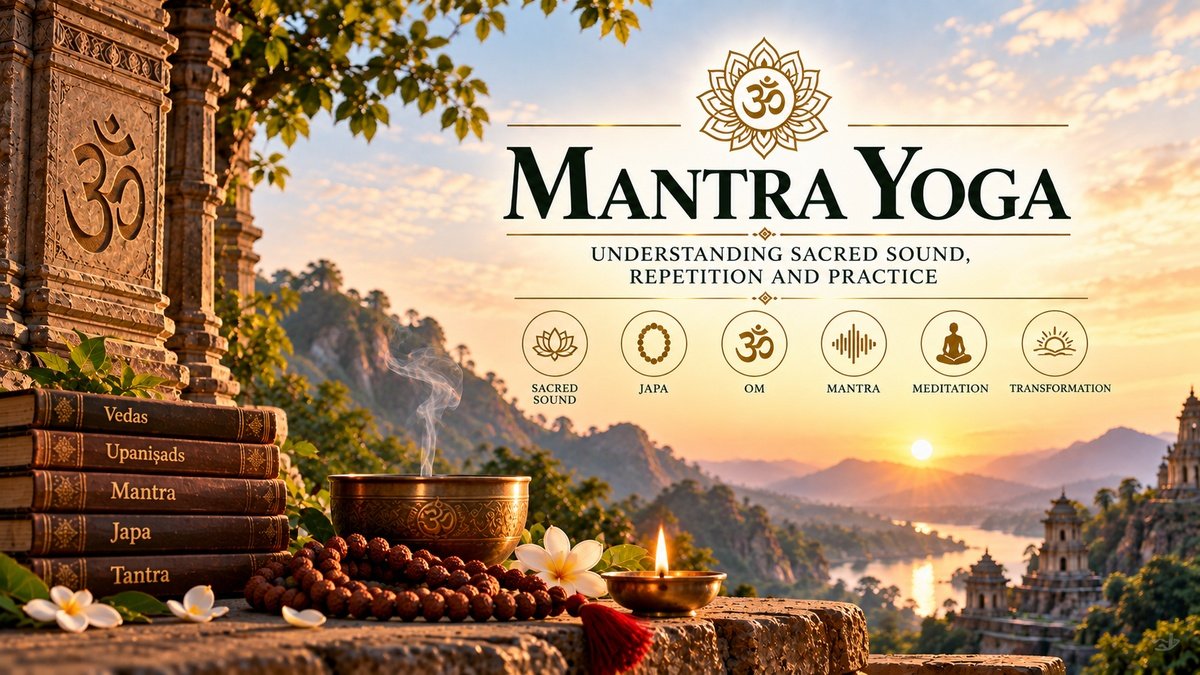
Mantra Yoga places one of the oldest elements of Indian religious practice at the centre of yoga: mantra.
Today, mantra appears in many settings. A yoga class might begin with Oṃ, while a meditation practice may use repeated words or syllables. Kīrtan can involve the collective singing of divine names, and other traditions prescribe specific mantras received from a teacher.
These practices are related, but they are not identical.
Nor does mantra simply mean a positive affirmation repeated until the mind becomes calm.
Its history reaches back to the Vedic traditions of ancient India, where communities transmitted sacred utterances with extraordinary precision as part of ritual practice. Later Upaniṣadic, yogic, devotional and Tantric traditions developed different understandings of mantra, its purpose and its methods.
As a result, Mantra Yoga is better understood as a family of approaches in which disciplined engagement with mantra becomes a significant means of concentration, devotion, contemplation or spiritual transformation.
What Is Mantra Yoga?
Mantra Yoga refers broadly to yogic practice organised around the use of mantra.
Practice can include audible recitation, quiet repetition, mental repetition or contemplative attention to sound. In other contexts, a mantra forms part of a larger ritual or meditative discipline.
However, there is no single universal Mantra Yoga method shared unchanged by every Indian tradition.
Different communities understand mantras through different philosophical and theological frameworks.
Some mantras invoke a deity, whereas others consist of sacred syllables. Some originate in Vedic texts; others belong to later Śaiva, Śākta, Vaiṣṇava, Buddhist or other traditions.
Consequently, asking what Mantra Yoga is leads immediately to another question:
What exactly is a mantra?
What Does Mantra Mean?
The Sanskrit word mantra has a much richer history than the modern expression “my mantra”.
In everyday English, people sometimes use mantra to mean a slogan, motto or frequently repeated phrase.
That is not an adequate definition of mantra within Indian traditions.
Historically, mantras are sacred or ritually significant utterances whose words, syllables, sounds and transmission can carry particular religious or contemplative importance.
The category itself is diverse.
A mantra may take the form of a verse, formula, divine name, invocation or syllable. Furthermore, its significance may depend not only upon semantic meaning but also upon sound, pronunciation, ritual setting, lineage and the tradition in which it functions.
For this reason, translating mantra simply as “affirmation” removes much of its historical and religious context.
Where Did Mantra Come From?
Mantra has roots deep within the Vedic traditions of ancient India.
The Vedas preserve some of the earliest surviving Sanskrit religious literature and contain hymns, verses and ritual formulas transmitted through highly developed oral traditions.
Within this environment, sound mattered profoundly.
Vedic specialists developed remarkable systems of oral transmission that preserved pronunciation, accent, rhythm and wording across generations.
Yet mantra did not remain confined to the Vedic ritual world.
Its meanings and applications expanded considerably across the history of Indian religions. Upaniṣadic traditions explored contemplative dimensions of sacred utterance, while later Hindu traditions developed extensive mantra systems connected with particular deities and ritual practices. Buddhist and Jain traditions also established important cultures of mantra and recitation.
Therefore, mantra belongs to a much larger historical landscape than modern postural yoga.
Is Mantra Always Sanskrit?
No.
Sanskrit occupies an enormously important place in the history of mantra, particularly within Vedic, Brahmanical, Hindu and Buddhist traditions.
Yet mantra and sacred recitation have also travelled through numerous linguistic and cultural environments.
For example, Buddhist mantra traditions moved across Central, East and Southeast Asia. Practices subsequently developed within Tibetan, Chinese, Japanese and other linguistic contexts.
Likewise, devotional traditions throughout South Asia have used Sanskrit alongside regional languages.
It is therefore more accurate to understand Sanskrit as historically central to many mantra traditions rather than claim that every legitimate mantra must exist only in Sanskrit.
Why Is Sound Important in Mantra Yoga?
In many mantra traditions, sound is more than a vehicle for communicating dictionary meaning.
The sonic form of a mantra can itself matter.
Pronunciation, rhythm, repetition and the relationship between sound and attention may therefore become integral to practice.
Some traditions go considerably further and attribute sacred, cosmological or transformative significance to particular sounds.
We should understand those claims within their respective religious and philosophical frameworks rather than convert them automatically into modern scientific statements.
For example, contemporary descriptions sometimes claim that specific mantra frequencies directly “reprogramme cells”, “raise vibration” or produce predetermined neurological states.
Such language should not be confused with the historical philosophies through which mantra traditions understood sacred sound.
A tradition can regard sound as spiritually powerful without turning that belief into a biomedical claim.
What Is Om?
Oṃ — also written Aum — is perhaps the most internationally recognisable sacred syllable associated with Indian traditions.
Its importance predates modern yoga by many centuries.
Oṃ appears prominently in the Upaniṣads. Different texts explore its relationship with sacred knowledge, consciousness, the Vedas, Brahman and contemplative practice.
The Māṇḍūkya Upaniṣad, for example, develops an especially influential contemplation of Oṃ in relation to states of consciousness and Ātman.
However, no single explanation exhausts its history.
Different Hindu, Buddhist and Jain traditions have incorporated Oṃ into their own ritual and philosophical systems.
Consequently, describing Oṃ simply as “the universal sound of the universe” presents one modern spiritual interpretation as though it were a complete historical definition.
What Does Patanjali Say About Om?
Oṃ also appears in Patañjali’s Yoga Sūtras.
Within that text, Patañjali introduces Īśvara, a special puruṣa untouched by afflictions, actions and their consequences.
Yoga Sūtra I.27 identifies Oṃ — praṇava — as the expression or designation of Īśvara.
The following sūtra connects repetition of Oṃ with contemplation of its meaning.
This becomes significant when we consider Rāja Yoga.
Patañjali’s contemplative system does not consist solely of silent observation of thoughts. Mantric repetition and devotion to Īśvara also appear within its repertoire of practice.
At the same time, Patañjali’s treatment of Oṃ represents one particular yogic context rather than a universal explanation of every mantra tradition.
What Is Japa?
Japa is the repeated recitation of a mantra, divine name or sacred formula.
It represents one of the practices most closely associated with Mantra Yoga.
Depending upon the tradition, a practitioner may repeat the mantra aloud, quietly or mentally.
Rather than treating repetition as meaningless duplication, japa uses recurrence deliberately.
Attention repeatedly returns to the mantra, creating a practice that may involve concentration, remembrance, devotion and disciplined continuity.
For some practitioners, the semantic meaning remains central. In other contexts, the mantra’s sonic form, ritual status or relationship with a deity may carry equal or greater importance.
Japa should consequently be understood within the tradition that gives the mantra its function.
Why Are Mantras Repeated 108 Times?
The number 108 has considerable symbolic importance across several Indian religious traditions.
As a result, mālās used for japa commonly contain 108 counting beads. Many also include an additional larger or distinctive bead that marks the completion of a cycle.
However, not every mantra practice requires exactly 108 repetitions.
Traditions may prescribe different numbers according to the mantra, ritual, lineage or purpose of the practice.
Modern explanations also offer numerous symbolic interpretations for 108.
Some derive from religious cosmology, textual traditions or numerical symbolism. Others represent modern attempts to connect the number with astronomy, anatomy or mathematics.
We should not assume that all these explanations share the same historical origin.
What we can say more securely is that 108 became a highly significant ritual number within multiple South Asian traditions.
What Is a Mala?
A mālā is a string of beads used in devotional and contemplative practices, particularly for counting repetitions.
During japa, the practitioner can move from bead to bead while repeating the mantra.
This gives the practice a tactile structure.
The beads provide a physical record of progression, so attention does not need to remain occupied with mentally counting every repetition.
Mālās vary in materials, numbers of beads and religious associations.
Seeds, wood, stone and other materials may carry particular meanings within specific traditions.
Therefore, the contemporary use of a mālā as jewellery represents only one aspect of an object with a much longer ritual history.
What Is a Bija Mantra?
Bīja means seed.
A bīja mantra is therefore often described as a “seed mantra”.
These compact syllabic forms acquire particular ritual and symbolic significance within Tantric traditions.
Examples commonly encountered include syllables such as hrīṃ, śrīṃ and klīṃ.
Ordinary lexical translation cannot always capture their significance.
Instead, bīja mantras operate within larger systems connecting sound, deity, ritual, visualisation and subtle-body practices.
Modern yoga culture sometimes assigns individual bīja sounds directly to a standard seven-chakra diagram.
That presentation can be useful within the particular system being taught, but it should not be mistaken for one universal arrangement shared by every historical Tantric tradition.
Is Mantra Yoga Connected with the Chakras?
In some traditions, yes.
Tantric systems can connect mantra with subtle-body concepts including cakras, channels, deities, visualisation and ritual practice.
However, there has never been only one chakra system.
Historical traditions describe different numbers of centres, locations, associated deities and relationships between sound and the subtle body.
The familiar modern diagram of seven coloured chakras arranged from the base of the spine to the crown represents one influential modern synthesis rather than a universal map found unchanged throughout Indian history.
Likewise, contemporary medicine has not established cakras as anatomical structures.
They belong to particular subtle-body models whose meaning depends upon the traditions in which they developed.
Is Mantra Yoga the Same as Kirtan?
No.
Kīrtan usually refers to forms of devotional singing, recitation or praise, often practised collectively.
It has particularly important histories within Bhakti Yoga and devotional traditions.
Mantras, divine names or sacred phrases may appear within kīrtan, but kīrtan has its own musical, communal and devotional character.
By contrast, japa may involve individual repetition of a mantra without melody.
Mantra Yoga is broader still and can include practices of repetition and contemplation that do not resemble congregational singing at all.
Mantra is not automatically kīrtan, and kīrtan is not the whole of Mantra Yoga.
Is Mantra the Same as an Affirmation?
No, although both can involve repeated language.
An affirmation is generally a statement that someone repeats to reinforce an intention, attitude or desired perspective.
A mantra belongs to a different historical and religious category.
Traditional mantras may derive from sacred texts, invoke deities, consist of syllables without straightforward lexical translation or require particular modes of transmission and practice.
This does not prevent contemporary practitioners from creating meaningful repeated phrases in their own language.
However, calling every repeated positive sentence a traditional mantra can erase an important distinction.
A modern affirmation and a traditional mantra may both use repetition while operating through very different histories and assumptions.
Does a Mantra Need to Have a Meaning?
That depends upon what we mean by meaning.
Some mantras contain words and sentences that can be translated.
Others include bīja syllables whose ritual significance cannot be reduced to a simple dictionary definition.
Moreover, even a mantra with a translatable semantic meaning may carry additional significance through its sound, textual origin, deity association or ritual use.
Consequently, mantra sits at an interesting intersection between language and sound.
Understanding the words can matter greatly. Yet linguistic translation does not necessarily exhaust what a tradition understands the mantra to be.
Does Pronunciation Matter?
Within many traditions, pronunciation matters considerably.
Vedic recitation demonstrates this especially clearly because phonetic precision and accent formed part of an exceptionally rigorous oral transmission system.
Other mantra traditions may place different levels of emphasis on exact pronunciation.
Context therefore matters.
For someone encountering a Sanskrit mantra in contemporary yoga, learning an informed pronunciation can demonstrate care towards both the practice and the language from which it comes.
At the same time, fear of making an imperfect sound need not turn mantra into a performance test.
A responsible teacher can explain where precision is essential, where variation exists and when a practice belongs to a tradition requiring more specific instruction.
Does Mantra Require Initiation?
Some mantra practices do; others do not.
Within certain traditions, a teacher formally transmits a mantra through initiation, often called dīkṣā.
The mantra then belongs to a broader relationship involving instruction, lineage, ritual and practice.
Other sacred recitations circulate publicly and do not require the same form of initiation.
Therefore, there is no responsible universal rule that every mantra is secret or that every mantra is freely interchangeable.
The relevant tradition determines the context.
This distinction resembles an issue encountered in Kriya Yoga, where the manner in which someone learns a practice can itself form part of its meaning.
Can Mantra Be Practised Silently?
Yes.
Mantra practice does not necessarily require continuous audible chanting.
Different traditions distinguish between modes of repetition that can include audible recitation, quieter articulation and mental repetition.
Silent japa can place particular emphasis on sustained attention because the mantra continues without external vocal sound.
Nevertheless, traditions differ in how they understand the relative status of these methods.
It is therefore better to recognise audible and mental repetition as established modes of mantra practice rather than declare one universally superior to the other.
Is Mantra Yoga a Form of Meditation?
Mantra can certainly function as a method of meditation.
Repeated sound or mental recitation provides an object around which attention can organise itself.
When attention wanders, the practitioner returns to the mantra.
However, defining Mantra Yoga solely as a concentration technique can remove dimensions that matter within traditional contexts.
A mantra may simultaneously function as prayer, invocation, remembrance, ritual speech, devotion or contemplative practice.
Its purpose depends upon the tradition.
Modern meditation can therefore make use of mantra, but mantra cannot be reduced historically to a neutral attention exercise.
How Does Mantra Yoga Relate to Bhakti Yoga?
Mantra and Bhakti Yoga frequently intersect.
Repeating the name of a deity can become an act of devotion and remembrance.
Vaiṣṇava traditions provide prominent examples, including practices centred upon the names of Krishna and Rāma.
Śaiva and Śākta traditions likewise possess extensive mantra cultures.
Yet Mantra Yoga and Bhakti Yoga remain distinguishable categories.
Not every mantra functions primarily through devotional relationship, and Bhakti includes many practices beyond mantra repetition.
The two paths can overlap without becoming synonymous.
How Does Mantra Yoga Relate to Raja Yoga?
The relationship is closer than modern classifications sometimes suggest.
As we explored in our article on Rāja Yoga, Patañjali includes repetition and contemplation of Oṃ within the Yoga Sūtras.
Mantra can therefore participate directly in a contemplative discipline concerned with concentration and samādhi.
Later classifications sometimes separate Rāja Yoga as the path of meditation and Mantra Yoga as the path of sacred sound.
Historically, practice does not always respect such clean boundaries.
Mantra itself can become meditation.
How Does Mantra Yoga Relate to Kundalini and Tantra?
Mantra plays major roles within many Tantric traditions.
These systems can integrate sound with deity practice, visualisation, ritual, subtle-body techniques, breath and meditation.
As a result, mantra also appears within practices later associated with Kundalini Yoga.
However, Tantra, mantra and kuṇḍalinī should not be treated as interchangeable words.
Tantric traditions are historically diverse. Mantra forms only one important dimension of many of them, while kuṇḍalinī represents a particular subtle-body concept developed within specific traditions.
Likewise, the modern system commonly called Kundalini Yoga has its own twentieth-century history and should not be projected unchanged into medieval Tantra.
Does Mantra Yoga Have a Set Asana Sequence?
No.
Mantra Yoga does not require a defining sequence of physical postures.
Āsana may accompany mantra practice in contemporary yoga settings, but postural sequencing does not define the tradition.
This makes Mantra Yoga fundamentally different from modern systems such as Ashtanga Yoga or posture-centred forms of Vinyasa Yoga.
A practitioner can engage deeply with mantra while performing little or no elaborate āsana practice.
Once again, yoga’s history extends far beyond the organisation of physical postures.
Does Mantra Have Proven Healing Frequencies?
Claims about mantra require a careful distinction between traditional interpretation and modern scientific evidence.
Researchers have explored chanting, repetitive prayer, vocalisation, breathing and meditation in relation to various psychological and physiological measures.
Such research can be interesting, but it does not establish every traditional or contemporary claim made about sacred sound.
In particular, available evidence does not justify presenting claims that a particular mantra frequency reliably heals organs, changes DNA, balances hormones or produces a predetermined state as established facts.
Traditional mantra practice does not need speculative biomedical explanations in order to possess cultural, contemplative or spiritual significance.
Its historical meanings deserve to be understood on their own terms.
Can Anyone Practise Mantra Yoga?
Many people can explore accessible forms of mantra practice.
However, not every mantra belongs to an unrestricted public practice.
Some traditions use initiation, specific ritual procedures or teacher-guided transmission. Others make particular chants and sacred names widely available.
For contemporary practitioners, context provides a useful starting point.
What tradition does the mantra come from?
What does it mean?
How is it pronounced?
How has the tradition used it?
Does the practice require instruction or initiation?
Those questions allow curiosity to coexist with respect.
A Common Misunderstanding: Mantra Yoga Is Not Positive Thinking
Modern wellness language can transform mantra into something very different from its historical forms.
A phrase such as “I am strong”, “I am abundant” or “everything is working for me” may function as a personal affirmation.
That can be meaningful.
However, it is not automatically equivalent to a Vedic mantra, a Tantric bīja, devotional nāma-japa or another traditional form of sacred recitation.
The difference is not that one is inherently better than the other.
Instead, the distinction is historical and conceptual.
An affirmation generally begins with the message we want to repeat. A traditional mantra begins within a cultural, textual, ritual or devotional context that gives the utterance its particular significance.
Recognising that distinction allows both practices to retain their own integrity.
An Orenna Perspective: When Repetition Becomes Practice
Repetition can appear almost opposite to discovery.
We often associate learning with acquiring something new: another idea, another technique, another experience.
Mantra asks something different.
It returns to the same sound, the same words and the same sequence.
Yet the practitioner never returns from precisely the same moment.
Attention wanders and comes back. Meaning becomes clearer or less certain. Sound shifts from something performed into something observed. At other times, repetition reveals nothing dramatic at all.
That ordinary continuity may itself matter.
Traditional explanations of mantra reach far beyond attention alone, and those traditions deserve to retain their own theological and philosophical meanings.
Still, mantra offers a useful challenge to a culture organised around constant novelty.
Perhaps repetition does not always ask us to discover something new. Sometimes it asks whether we can remain present long enough to hear differently what has been there all along.
References & Further Reading
The Ṛgveda. One of the earliest surviving Vedic collections and an essential source for understanding the ancient ritual and poetic environment from which later mantra traditions developed.
The Upaniṣads. Particularly important for later contemplative interpretations of Oṃ and the relationship between sacred utterance, knowledge and ultimate reality.
The Māṇḍūkya Upaniṣad. A concise and influential exploration of Oṃ, Ātman and states of consciousness.
Patañjali. Yoga Sūtras, particularly I.23–29, for Īśvara, Oṃ, repetition and contemplation.
André Padoux. Vāc: The Concept of the Word in Selected Hindu Tantras. An important scholarly study of language and sacred sound within Tantric traditions.
Frits Staal. Rules Without Meaning: Ritual, Mantras and the Human Sciences. An influential and debated scholarly examination of Vedic ritual and mantra.
Guy L. Beck. Sonic Theology: Hinduism and Sacred Sound. A study of the religious significance of sound within Hindu traditions.
James Mallinson & Mark Singleton. Roots of Yoga. A sourcebook presenting translated materials from diverse yoga traditions, useful for locating mantra within the broader history of yogic practice.