

A mudrā is sometimes described as a way of sealing prāṇa.
Other explanations describe mudrā as redirecting energy through the body. Some traditions also connect mudrā with guiding prāṇa towards the central channel or with practices involving kuṇḍalinī.
These explanations are common, but they are easy to misunderstand.
If we translate prāṇa simply as “oxygen”, identify nāḍīs as “nerves”, equate cakras with endocrine glands and describe kuṇḍalinī as electricity travelling up the spine, we quietly convert an older yogic model into modern anatomy.
That translation may sound scientific. Historically and conceptually, however, it creates problems.
To understand Mudra and Prana, we first need to understand the kind of body in which these concepts operate.
It is not simply the anatomical body described by contemporary medicine.
Scholars commonly use the term subtle body when discussing these interconnected yogic and Tantric models.
What Does Prāṇa Mean?
Prāṇa is one of the most important — and frequently simplified — terms in modern yoga.
English translations often render it as “life force”, “vital energy” or simply “energy”. These expressions can provide useful shorthand, but none captures every use of the Sanskrit term across Indian traditions.
Prāṇa has longstanding associations with life, vitality and breath. Depending on the source, the term may refer to breath itself, a vital function or one component within a more elaborate system of vital processes.
Many yoga traditions therefore connect prāṇa closely with breathing. However, the two concepts are not necessarily identical.
This distinction becomes particularly important when discussing prāṇāyāma.
Changing the breath unquestionably changes respiration. A traditional yoga system may additionally interpret that practice through the concept of prāṇa.
These explanations operate at different levels and should not automatically be treated as interchangeable.
Is Prāṇa the Same as Oxygen?
No.
Oxygen is a chemical element involved in measurable physiological processes. Prāṇa belongs to historical Indian conceptual systems and cannot simply be reduced to oxygen uptake.
Breathing certainly affects oxygen and carbon dioxide exchange. Yet that biomedical fact does not demonstrate that every traditional statement about prāṇa describes respiratory physiology.
Likewise, calling prāṇa “bioelectricity” or “electromagnetic energy” creates a modern scientific equivalence that traditional yoga texts themselves did not establish.
A more careful approach keeps these vocabularies distinct.
When discussing physiology, we can describe respiration physiologically. When examining yogic traditions, we can explore prāṇa within the frameworks that use the concept.
What Is the Subtle Body?
The phrase subtle body provides a convenient English expression for a range of ideas found across Indian religious and yogic traditions.
However, no single subtle-body map appears unchanged across every tradition.
Different sources describe different structures, numbers and relationships. Depending on the system, descriptions may include nāḍīs, cakras, prāṇa, bindu, internal winds or vital functions, mantras, deities and kuṇḍalinī.
Such concepts can organise contemplative experience and yogic practice. They may also express broader religious and cosmological ideas about the relationship between body and cosmos.
For this reason, it is misleading to imagine the subtle body simply as an invisible anatomical system waiting for medical technology to discover it.
What Are Nāḍīs?
Nāḍīs are channels described within various Indian subtle-body systems.
Yoga literature may describe prāṇa or other vital processes moving through these channels.
Contemporary explanations sometimes identify nāḍīs with nerves, blood vessels, fascial pathways or meridians. Individual teachers may use these comparisons metaphorically, but established anatomy does not treat them as equivalent structures.
Historical sources also disagree about the number of nāḍīs.
Some texts describe very large numbers before identifying a smaller group as particularly important. Others organise the subtle body differently.
Even within traditional literature, therefore, we do not find one universally standardised map.
What Are Iḍā, Piṅgalā and Suṣumṇā?
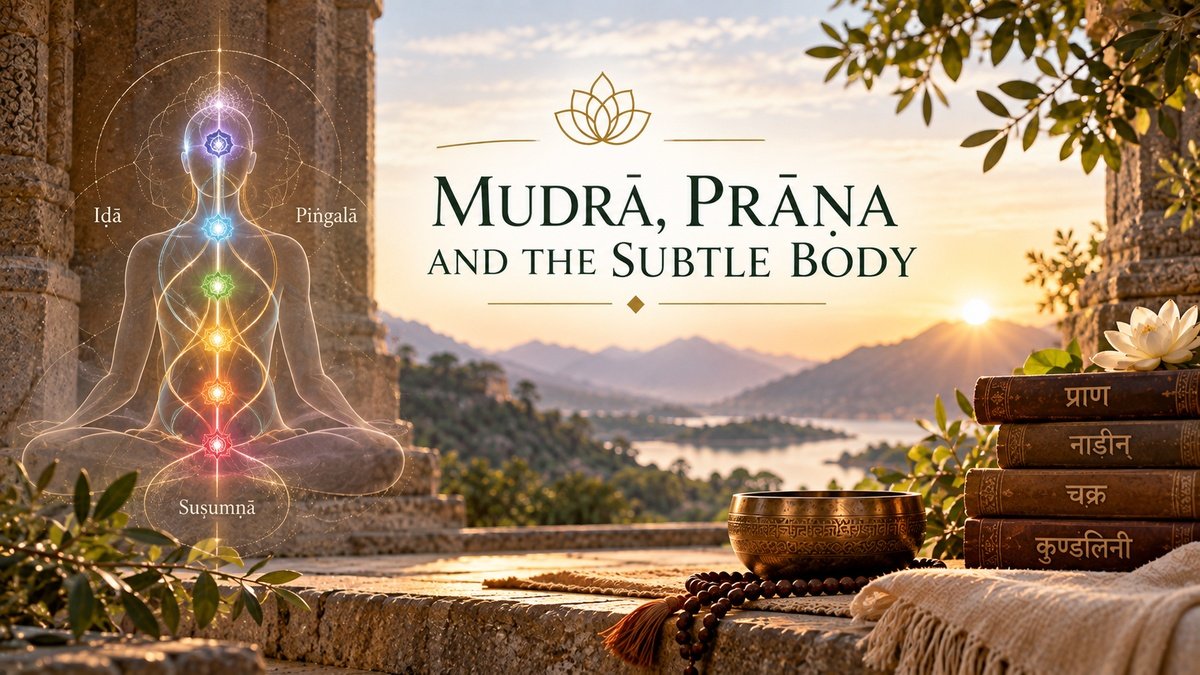
Three nāḍīs became particularly prominent in many later explanations of yoga: Iḍā, Piṅgalā and Suṣumṇā.
Many systems describe Suṣumṇā as a central channel. They present Iḍā and Piṅgalā in relation to it, although their symbolic and functional associations can differ between sources.
Contemporary illustrations frequently depict Iḍā and Piṅgalā spiralling symmetrically around the spine and intersecting at seven chakras.
That diagram has become extremely influential in modern yoga.
Nevertheless, it does not represent the one universal map used throughout yoga’s history. Historical texts and subtle-body systems show considerably more diversity.
Are Nāḍīs the Nervous System?
No established biomedical evidence identifies nāḍīs as anatomical nerves.
The comparison can appear persuasive because both models use ideas of pathways and transmission. Similar language, however, does not establish anatomical identity.
The nervous system contains observable biological structures such as the brain, spinal cord and peripheral nerves.
Nāḍīs belong to yogic and Tantric subtle-body models.
Keeping these categories distinct does not diminish the traditional model. Instead, it prevents us from presenting one knowledge system as though it were secretly describing another.
What Are Cakras?
Cakra carries meanings associated with a wheel or circle.
Within Tantric and yogic traditions, cakras can form part of subtle-body systems used in ritual, meditation and internal yogic practice.
Today, the most familiar model presents seven chakras arranged vertically from the lower body to the crown of the head. Its popularity can make it appear to be the ancient chakra system.
Historical traditions, however, describe different numbers and configurations of cakras.
Some systems contain five or six centres; others contain more. Their names, locations, associated deities, mantras, elements and functions can also differ.
Therefore, no single universal chakra map underlies every form of yoga and Tantra.
Are Chakras Endocrine Glands?
Modern yoga literature sometimes places chakras alongside endocrine glands. A chart might pair particular chakras with the thyroid, pituitary or adrenal glands, for example.
These correspondences belong to modern interpretive frameworks rather than straightforward translations of premodern Tantric anatomy.
Endocrine glands are physical structures that produce and release hormones. Cakras belong to subtle-body systems with ritual, contemplative and cosmological dimensions.
A teacher may choose to explore symbolic parallels between them.
That differs substantially from claiming that a chakra is an endocrine gland or that performing a particular mudrā regulates a specific gland.
What Is Kuṇḍalinī?
Kuṇḍalinī appears in particular Tantric and yogic traditions as an important component of subtle-body practice.
Traditions frequently represent it as coiled and associate it with the lower region of the subtle body.
Within some systems, yogic practices seek to awaken or raise kuṇḍalinī through the central channel. Cakras may form part of this process, which the tradition can connect with profound spiritual transformation and liberation.
Yet historical sources do not give kuṇḍalinī one identical meaning.
Traditional descriptions also do not establish that electrical current physically travels through the spinal cord during these practices.
This distinction matters when comparing historical kuṇḍalinī traditions with the modern system commonly called Kundalini Yoga.
The two belong to a much wider history of ideas, but they are not interchangeable categories.
What Are the Five Vāyus?
Some yoga and Indian medical traditions organise prāṇa through several functional divisions called vāyus, or winds.
A widely known fivefold model includes:
Prāṇa-vāyu
Apāna-vāyu
Samāna-vāyu
Udāna-vāyu
Vyāna-vāyu
Traditional systems use these terms to organise vital functions in different ways.
Contemporary yoga sometimes maps them directly onto respiration, digestion, circulation and other physiological processes. Such comparisons may help students form an initial conceptual picture, but they can also obscure the differences between traditional vital-body theory and modern physiology.
Within Haṭha Yoga, the relationship between prāṇa and apāna becomes especially significant because some practices describe bringing these vital forces together.
What Does Mudra and Prana Have to Do with Each Other?
Here, the historical meaning of mudrā becomes clearer.
As explored in Beyond the Hands: Mudrā in Haṭha Yoga, many premodern mudrās involve considerably more than the fingers.
They can combine bodily position, pressure, breath retention and actions related to bandha.
Within traditional subtle-body models, practitioners understood these techniques as influencing prāṇa and other internal processes.
This context helps explain the language of sealing, containing, directing and reversing.
The word mudrā therefore takes on a wider significance.
In these traditions, the “seal” is not merely decorative. It forms part of a method for working with processes considered important to yogic transformation.
How Can a Mudrā Be Said to ‘Seal’ Energy?
The English word seal can suggest closing a container so that something cannot escape.
That metaphor can sometimes help, although it does not explain every historical use of mudrā.
Haṭha Yoga literature includes concerns about preserving substances or forces regarded as vital, preventing their loss and reversing processes associated with decline.
Other mudrās participate in practices that seek to direct vital processes towards the central channel.
“Sealing” therefore does not describe one identical action performed by every mudrā. Instead, it belongs to a broader family of traditional explanations.
Nor does the metaphor establish that practitioners physically trap a measurable form of invisible energy inside the body.
What Is Bindu?
Bindu literally means a point or drop, although its significance varies considerably across Indian traditions.
Some Haṭha Yoga sources use bindu for a vital substance whose preservation holds particular importance.
Historical theories of bindu can intersect with ideas about semen, reproductive substances, vitality, immortality and the internal dynamics of the yogic body.
Some inversions and mudrās were traditionally interpreted in relation to preserving these substances or reversing their movement.
This context matters because modern postural yoga often removes such theories when adapting older techniques for contemporary practice.
We can understand the historical model without treating its physiology as biomedical fact.
Why Is the Central Channel So Important?
In several Haṭha and Tantric systems, the central channel occupies a privileged position.
These systems may describe ordinary vital activity as moving through other channels, while advanced yogic practice seeks a different internal configuration.
Prāṇa entering the central channel can therefore mark an important transition within the logic of the practice.
Mudrā, bandha and prāṇāyāma may all contribute to this process.
This relationship helps explain why premodern Haṭha Yoga literature connects these practices so closely.
Rather than representing unrelated techniques assembled for variety, they could operate together within one theory of yogic transformation.
Is the Subtle Body Imaginary?
Choosing only between “literal anatomy” and “meaningless imagination” creates a false opposition.
Subtle-body systems have provided meaningful frameworks for religious, contemplative and embodied practice. Practitioners may experience those frameworks as profoundly real.
Historians can study how these systems developed, how they differ and what practitioners did with them without identifying nāḍīs as anatomical tubes or chakras as physical organs.
Likewise, contemporary practitioners can engage with subtle-body imagery contemplatively or symbolically without claiming that medicine has verified every component.
Respect for a traditional model does not require false equivalence with science.
Why Might People Feel Sensations During Mudrā Practice?
People may notice warmth, tingling, pressure, pulsation or other sensations while practising yoga and meditation.
Those sensations are real experiences. Their presence, however, does not establish one particular explanation for their cause.
Holding the hands or body in an unfamiliar position changes muscular activity and sensory input. Remaining still can increase awareness of sensations that normally pass unnoticed. Breathing patterns, attention and expectation may also influence what someone experiences.
A practitioner working within a traditional yoga framework may interpret these sensations through prāṇa.
Another person may simply observe them without assigning a subtle-body explanation.
Neither approach requires us to claim that tingling proves the movement of a measurable yogic energy.
Can Hasta Mudrās Redirect Prāṇa?
Some contemporary yoga systems explain Hasta Mudrās in precisely these terms.
Teachers may describe particular finger combinations as completing circuits, balancing elements or redirecting prāṇa.
We should attribute these explanations to the traditions or modern systems that teach them rather than present them as universally established mechanisms.
The historical category of mudrā extends far beyond hand gestures. Therefore, explanations attached to contemporary finger mudrās cannot automatically be projected backwards onto medieval Haṭha Yoga.
This is another reason source literacy matters.
Instead of asking only, “What does this mudrā do?”, we can also ask:
“Who says that it does this, and within which model?”
Does Science Prove the Subtle Body?
Scientific research can investigate measurable effects associated with practices such as breathing, meditation and movement.
However, evidence concerning one measurable effect does not automatically validate the entire metaphysical or subtle-physiological framework that historically explains a practice.
For example, researchers might identify changes in respiratory variables during a breathing technique.
That finding tells us something about respiration. By itself, it does not demonstrate that Suṣumṇā exists as a physical channel.
Similarly, evidence that meditation can influence aspects of attention does not establish a particular chakra model.
Different explanatory systems may sometimes address the same practice without becoming interchangeable.
Can We Practise with These Ideas Without Believing Them Literally?
Yes.
One practitioner might use the language of prāṇa within a traditional yoga framework. Another might approach the same material historically. Someone else may use subtle-body imagery as a contemplative map without making claims about physical anatomy.
These approaches do not need to become identical in order to remain thoughtful.
The important distinction lies between saying:
“This tradition understands the practice in this way.”
and:
“Modern science has proved that this is literally what happens inside the body.”
The first statement can accurately represent a tradition.
The second requires scientific evidence. Translating Sanskrit concepts into scientific vocabulary cannot provide that evidence on its own.
Where Does This Leave Modern Mudrā Practice?
It leaves us with more possibilities rather than fewer.
A mudrā can carry traditional meaning, provide a point of attention or participate in meditation and ritual. Within a particular yoga system, practitioners may also interpret it through prāṇa and the subtle body.
At the same time, we can remain careful when encountering claims that a gesture opens a chakra, balances a gland, creates an electrical circuit or treats a medical condition.
The history of Mudrā is already rich and complex without retrofitting it with scientific certainty.
What Comes Next?
Our Mudrā Series began with the wider meaning of mudrā before examining its history, hand gestures and Haṭha Yoga practices.
We can now return to the gestures readers are most likely to recognise.
In The Meaning Behind Familiar Yoga Mudrās, we will examine individual mudrās more closely: their names, symbolism, historical contexts and meanings commonly attached to them today.
Only after establishing that context will we address another question in detail:
Do mudrās really work?
An Orenna Perspective: A Map Does Not Have to Be Anatomy
Human beings have long developed maps for experiences that can be difficult to describe.
Some maps are anatomical. Others are philosophical, contemplative, symbolic or religious.
The subtle body belongs to a long history of Indian attempts to understand and transform embodied experience through particular conceptual worlds.
We lose something when we dismiss those worlds simply because they are not modern anatomy.
Yet we also lose something when we try to make them credible only by relabelling them as nerves, glands or electricity.
A more careful position exists between those extremes.
We can learn the map, investigate its history and understand what practitioners have done with it.
At the same time, we can remain clear about what kind of map we are examining.
Tradition does not need to become anatomy in order to deserve careful attention.
References & Further Reading
James Mallinson and Mark Singleton. Roots of Yoga. Penguin Classics. A major sourcebook for understanding premodern yoga practices and concepts including prāṇa, nāḍīs, mudrā, kuṇḍalinī and subtle physiology.
James Mallinson. Research on the development of Haṭha Yoga and its relationship with earlier ascetic and Tantric traditions provides important historical context for subtle-body practices.
Jason Birch. Scholarship on premodern Haṭha and Rājayoga traditions contributes to our understanding of yogic techniques, textual development and subtle-body terminology.
Geoffrey Samuel. The Origins of Yoga and Tantra. Cambridge University Press. Provides broader historical context for the development of yogic and Tantric traditions in South Asia.
David Gordon White. The Alchemical Body: Siddha Traditions in Medieval India. University of Chicago Press. An influential scholarly study of medieval Indian traditions involving the yogic body, substances and transformation.
Haṭha Yoga Project, SOAS University of London. Academic research into the history of physical yoga practices and the textual traditions through which Haṭha Yoga developed.