


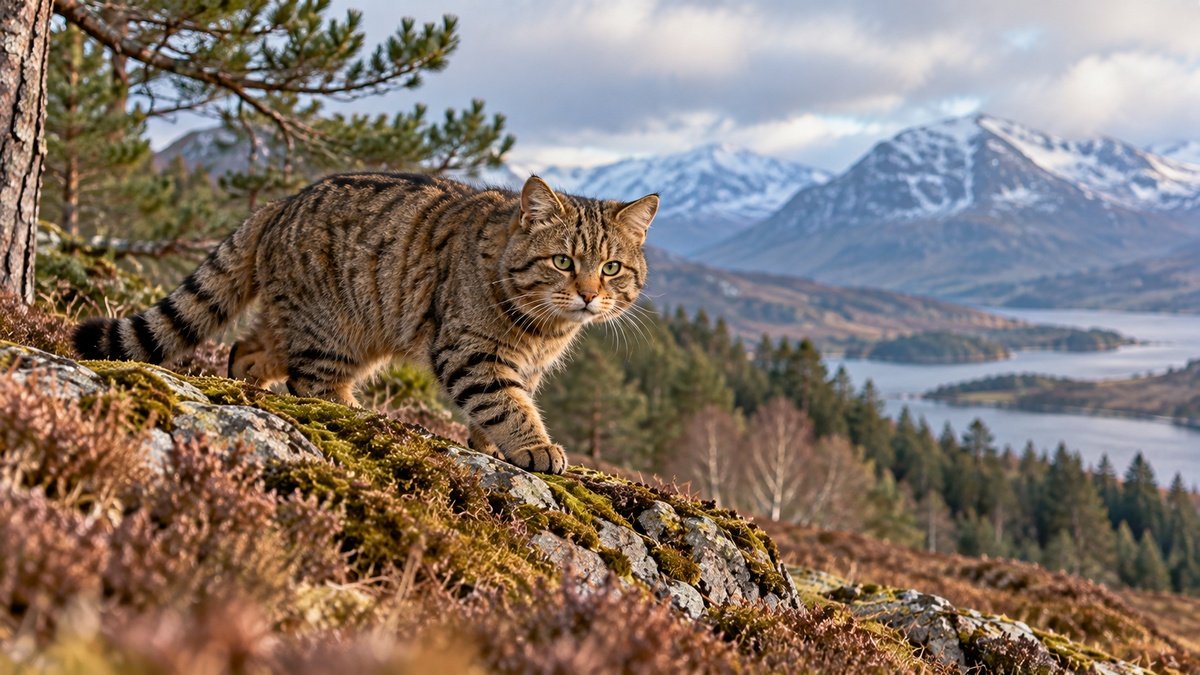
The Scottish wildcat occupies an unusual place in the Highland landscape. It is one of Scotland’s most recognisable wild animals, yet very few people will ever encounter one.
That contrast feels appropriate for an animal whose life depends partly upon remaining difficult to see.
Wildcats move through woodland, scrub, rough grassland and the edges between different habitats. They hunt mostly out of sight, find shelter within the landscape and generally avoid close contact with people.
However, the story of the Scottish wildcat is no longer simply the story of an elusive animal surviving in remote places.
After centuries of persecution, habitat change and, more recently, extensive hybridisation with domestic cats, the wildcat population in Scotland reached a point where conservationists concluded that it was no longer viable as a standalone population.
Today, conservation has entered a different phase. Wildcats bred specifically for conservation are being released into the Scottish landscape, while researchers monitor how they survive, move and reproduce.
Understanding the Scottish wildcat therefore means looking at more than the animal itself. It means considering habitat, genetics, domestic cat ownership, roads, land management, conservation science and the complicated question of what it takes to restore a species after it has almost disappeared.
What Is a Scottish Wildcat?
The Scottish wildcat belongs to the species Felis silvestris, the European wildcat.
NatureScot describes it as Britain’s only native member of the cat family still found in the wild. Historically, wildcats occurred much more widely across Britain. Over time, however, their distribution contracted until they survived only in parts of Scotland.
The name Scottish wildcat can sometimes create the impression that Scotland contains a completely separate species or universally accepted subspecies. Current taxonomy instead places Scotland’s animals within the European wildcat species.
Nevertheless, Scotland’s wildcats have considerable ecological and cultural significance. Their long isolation, subsequent decline and extensive contact with domestic cats have also created an unusually complex conservation situation.
In Scotland, the wildcat is legally protected and remains one of the country’s most threatened mammals.
A Wildcat Is Not Simply a Wild-Looking Domestic Cat
At first glance, a Scottish wildcat can resemble a large tabby cat.
That resemblance is understandable because wildcats and domestic cats are closely related. However, they are not simply different lifestyles of the same animal.
The European wildcat and the domestic cat have different evolutionary histories, although they can interbreed and produce fertile offspring.
Typical wildcat features can include a broad head, a robust appearance, striped fur and a thick, blunt-ended tail marked with dark rings. Yet appearance alone becomes complicated in Scotland because generations of hybridisation have produced animals with mixtures of wildcat and domestic-cat ancestry.
Consequently, identifying a Scottish wildcat is more complex than looking for a cat that appears unusually large, striped or wild.
Conservation programmes use carefully developed morphological and genetic approaches rather than relying on one visible characteristic.
Where Does the Scottish Wildcat Live?
The popular image of a Scottish wildcat often places it deep inside an ancient forest.
Woodland can certainly provide important shelter and denning opportunities. However, wildcats are not animals of dense forest alone.
Research in Scotland has associated them with a mosaic of habitats, including coniferous and broadleaved woodland, scrub, rough grassland, moorland margins and other areas that combine shelter with opportunities to hunt.
Edges can be particularly important. Woodland margins, scrub and vegetation beside streams may provide cover for movement, while more open areas can offer hunting opportunities.
This makes the landscape around the animal as important as any single habitat label.
Our exploration of the Caledonian Forest considered native woodland as a network of ecological relationships rather than simply a collection of trees. The Scottish wildcat reinforces that idea. Woodland matters, but so do the spaces beside it and the connections between different habitats.
What Does a Scottish Wildcat Eat?
Wildcats are carnivorous hunters.
Small mammals form an important part of their diet, particularly rabbits and rodents where these are available. They may also take birds and other prey.
As with other predators, diet varies according to habitat, season and local prey availability.
This relationship with prey helps explain why habitat cannot be understood only as somewhere for an animal to hide.
A landscape must also support the ecological relationships that allow an animal to feed, reproduce and move through its territory.
Therefore, protecting an individual wildcat without considering the surrounding ecosystem would address only part of what the animal needs.
Why Did Wildcats Decline in Scotland?
There is no single explanation for the decline of the Scottish wildcat.
Historically, persecution played an important role. Wildcats were killed as predators, particularly where people considered them a threat to game or livestock.
At the same time, Britain’s landscapes changed. Woodland loss, fragmentation, agriculture, roads, settlements and other changes altered the habitats through which wildcats could live and move.
By the time legal protection and organised conservation efforts developed, another problem had become particularly significant: hybridisation with domestic cats.
NatureScot’s 2019 conservation review concluded that Scotland’s remaining wildcat population was too small, too fragmented and too extensively hybridised to remain viable as a standalone population.
That conclusion marked an important change in the conservation story.
Protecting the remaining animals would no longer be enough.
Understanding Hybridisation
Hybridisation occurs when wildcats and domestic cats interbreed.
Because their offspring can reproduce, domestic-cat ancestry can continue through subsequent generations. Over time, repeated interbreeding can make the genetic distinction between the populations increasingly difficult to maintain.
The new Scotland’s Wildcat Strategy 2025–2045 identifies this process as the principal threat to the restoration of wildcats in Scotland.
However, describing hybridisation as an ecological problem should not become a moral judgement about domestic or feral cats.
Domestic cats did not create conservation policy, fragment habitats or decide how people should manage cat populations. Many live as valued companion animals, while feral cats exist within circumstances shaped substantially by human activity.
The conservation question is therefore practical rather than moral: how can contact and interbreeding between domestic cats and wildcats be reduced sufficiently for a viable wildcat population to develop?
Domestic Cats Are Part of the Conservation Story
Wildcat restoration cannot happen entirely within wildlife reserves.
Domestic cat ownership forms part of the wider conservation landscape because free-roaming, unneutered cats can potentially reproduce with wildcats.
For this reason, Scotland’s new national strategy includes increased microchipping, neutering and vaccination of pet cats among its priorities.
Vaccination also matters because disease transmission represents another potential pressure where domestic, feral and wild-living cats overlap.
Importantly, this approach creates a role for communities rather than treating conservation as something performed only by wildlife specialists in remote landscapes.
Responsible domestic cat care and wildcat conservation can form part of the same relationship between people and place.
When Protecting a Species Is No Longer Enough
Traditional wildlife conservation often brings to mind the protection of animals that already live in a landscape.
The Scottish wildcat now requires something more interventionist.
After experts concluded that the remaining population was no longer viable on its own, conservation increasingly had to consider how a functional population could be rebuilt.
That work includes conservation breeding, genetic assessment, veterinary care, carefully planned releases, monitoring, habitat management and measures designed to reduce future hybridisation.
In other words, conservation has moved from trying only to prevent disappearance towards actively supporting restoration.
The distinction is significant.
Keeping a species from vanishing and rebuilding a population capable of persisting across a landscape are related goals, but they are not the same task.
Returning Wildcats to the Cairngorms
The Saving Wildcats partnership has placed the Cairngorms at the centre of Britain’s first large-scale conservation breeding and release programme for wildcats.
Wildcats bred for conservation have been released into carefully selected areas within the Cairngorms landscape and then monitored after release.
By 2026, the partnership reported that 46 wildcats had been released in total. At least nine released females produced litters during the spring and summer of 2024 and 2025.
Those births are important because releasing animals is not, by itself, the ultimate measure of restoration.
A developing population must survive, establish territories and reproduce. Eventually, future generations also need to continue those processes without depending indefinitely on repeated releases.
For that reason, conservationists monitor released animals and use what they learn to inform subsequent decisions.
Reintroduction Is a Process, Not a Moment
A photograph of an animal leaving a release enclosure can make reintroduction look like a single dramatic event.
In reality, that moment sits within a much longer process.
Before release, conservation teams need to consider genetics, health, behaviour and the suitability of potential release areas. Afterwards, monitoring can reveal where animals move, whether they survive, how they use different habitats and whether they reproduce.
Meanwhile, work with land managers, communities and domestic cat owners continues around them.
Future translocations also require careful planning rather than simply releasing wildcats wherever suitable-looking woodland exists.
Restoration therefore unfolds across years and, potentially, generations.
Scotland’s Wildcat Strategy 2025–2045
On 22 September 2026, a new national strategy established a long-term framework for restoring wildcats in Scotland.
More than 25 organisations contributed to its development across conservation, land management, academia and animal welfare.
The ambition extends beyond maintaining a small population in one part of the Highlands. Instead, the strategy aims for wildcats to become thriving and expanding populations in Scotland by 2045.
Its priorities include restoring and reconnecting habitat, reducing hybridisation, supporting responsible domestic cat management and planning future conservation translocations into additional areas.
The strategy also recognises that people live and work within landscapes where wildcats may recover.
Consequently, long-term restoration requires coexistence rather than imagining that wildlife can simply be separated from human communities.
A Landscape Needs More Than One Species
The return of the Scottish wildcat cannot be separated from the condition of the wider landscape.
Woodland provides shelter, yet open habitats can provide hunting opportunities. Dense vegetation can offer cover, while connected habitat can allow animals to move through larger areas.
Prey populations matter too.
Roads can interrupt movement and create collision risks. Meanwhile, human activity may influence where animals can travel without repeated disturbance.
Therefore, restoring one species can reveal questions about the entire landscape around it.
The same pattern appears elsewhere in The Orenna Journal. Our articles on red squirrels in Scotland and golden eagles in Scotland explore very different animals, yet both ultimately lead back to habitat, ecological relationships and human decisions.
A species cannot be restored independently of the place that must support it.
The Scottish Wildcat and a Changing Highland Landscape
It can be tempting to imagine wildcat restoration as returning an animal to an unchanged version of the Highlands.
No such static landscape exists.
The Highlands have continually changed through climate, ecology and human activity. Woodland has expanded and contracted. Land has been grazed, farmed, burned, planted and managed for different purposes. Roads and settlements have altered movement through the landscape, while conservation has introduced new priorities.
Our articles on the Great Glen, Highland peatlands and the Caledonian Forest approach the Highlands in the same way: not as scenery frozen in time, but as landscapes shaped by continuing processes.
Wildcat restoration is now one of those processes.
The aim is not to recreate an imaginary untouched past. Instead, conservation asks whether a functioning wildcat population can once again become part of Scotland’s living landscapes.
Seeing a Scottish Wildcat Is Not the Measure of the Experience
The Scottish wildcat is naturally elusive, and most people will never see one living freely in the landscape.
That does not make engagement with its story inaccessible.
People can learn about wildcats through conservation organisations, visitor and education programmes, wildlife interpretation, research updates and responsible observation opportunities where these are provided.
Equally, someone does not need to undertake a long or physically demanding journey through remote terrain to develop an understanding of the species.
Mobility, health, balance, sensory preferences, transport, weather, work, caring responsibilities and available time can all influence how people encounter the Highlands.
For some, engagement may happen outdoors. For others, a visitor facility, accessible route, conservation camera, photograph or research story may provide the connection.
None of these requires approaching a wild animal.
Indeed, allowing an elusive species to remain elusive can itself be part of responsible wildlife appreciation.
If You Think You Have Seen a Wildcat
A possible wildcat sighting can be exciting. However, approaching or following the animal is unnecessary.
From a suitable distance, a photograph may help specialists assess a sighting if taking one does not require disturbing the animal.
Because hybridisation has made visual identification particularly difficult, an unfamiliar striped cat should not automatically be labelled a wildcat based on appearance alone.
NatureScot directs members of the public to established mammal-recording channels for reporting sightings.
Most importantly, wild animals should have space to continue what they were doing before we noticed them.
A Common Misunderstanding: Conservation Means Finding the Last Pure Wildcats
The history of hybridisation can encourage a simple story: somewhere in the Highlands, a hidden population of completely untouched Scottish wildcats only needs to be found and protected.
The evidence has made conservation more complicated than that.
NatureScot’s conservation review found extensive hybridisation among wild-living cats and concluded that the remaining population could not be conserved successfully as a standalone population.
As a result, modern restoration combines genetic understanding with conservation breeding, releases and management of future contact between wildcats and domestic cats.
This does not make the Scottish wildcat less meaningful.
Instead, it shows how conservation changes when biology refuses to fit into simple categories.
Wildlife restoration sometimes requires working with the landscape that exists now rather than searching for a perfectly preserved version of the past.
The Orenna Perspective — A Landscape Can Remember What Is Missing
Absence can become surprisingly difficult to notice.
When an animal disappears gradually, the landscape continues. Trees grow. Rivers move. Seasons change. People travel through the same glens and watch the same mountains.
Eventually, what is missing can begin to feel as though it was never there.
The story of the Scottish wildcat challenges that assumption.
Its restoration asks us to see the Highland landscape not only as it appears today, but also as a place shaped by ecological losses, human decisions and the possibility of change.
That does not require romanticising the past. Nor does it mean assuming that every historical ecological condition can or should be recreated exactly.
Instead, restoration creates a different question:
What relationships could this landscape support again?
The answer involves more than wildcats. It includes woodland and open ground, prey and shelter, domestic cats and human communities, roads and land management, scientific monitoring and decisions that will continue long after an individual animal is released.
Perhaps that is why the Scottish wildcat is such a compelling part of the contemporary Highland story.
Its future depends not upon separating one animal from everything around it, but upon rebuilding relationships across a living landscape.
Sometimes restoring a landscape begins by recognising what has quietly disappeared from it.
References & Further Reading
NatureScot. Wildcats. Current information on the Scottish wildcat, its protected status and conservation in Scotland.
NatureScot. Scotland’s Wildcat Strategy 2025–2045. Scotland’s long-term framework for restoring viable and expanding wildcat populations.
NatureScot. Conservation of the Wildcat (Felis silvestris) in Scotland. IUCN Cat Specialist Group review of the conservation status, hybridisation and viability of Scotland’s wildcat population.
Saving Wildcats. Wildcat Conservation in Scotland. Information on conservation breeding, releases, reproduction and the continuing restoration programme.
The Orenna Journal explores yoga, well-being, philosophy and place from historical, evidence-informed and contemporary perspectives. Wildlife populations, conservation programmes and management priorities can change over time. This article provides a general introduction to the Scottish wildcat and its conservation rather than site-specific wildlife or land-management advice.



