


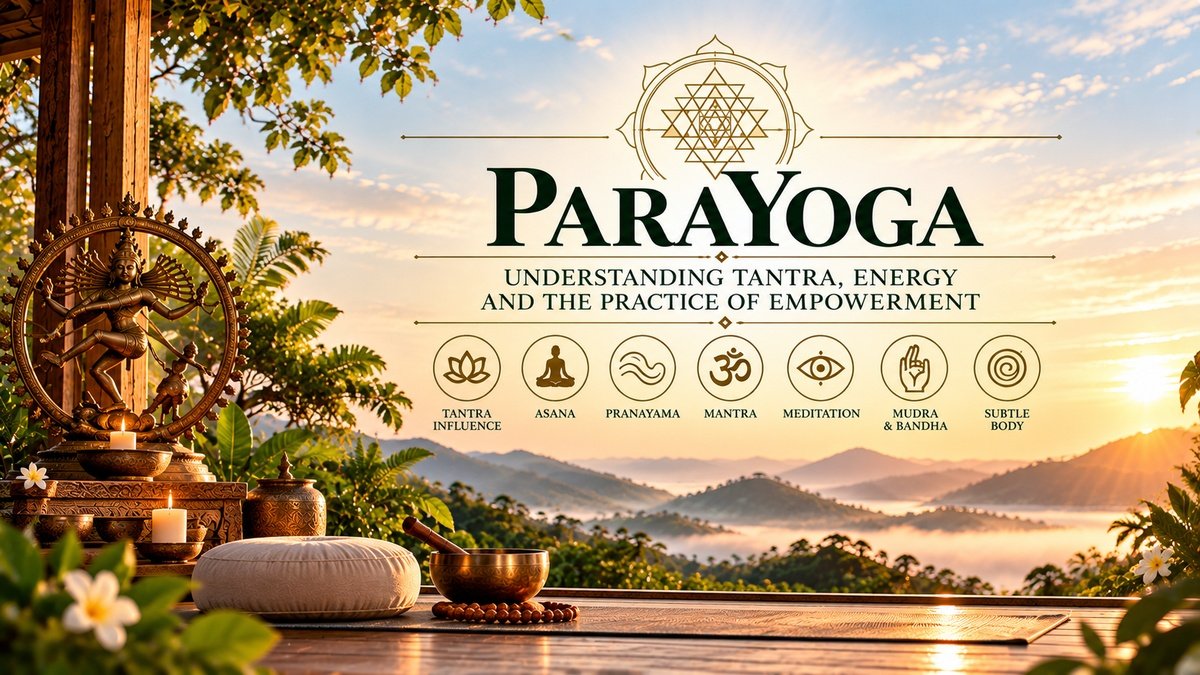
ParaYoga approaches yoga through a question that extends beyond the posture itself: what is a particular practice intended to accomplish?
A sequence might emphasise steadiness. Another may work with concentration, breath, meditation or a particular concept drawn from the subtle-body traditions of yoga.
Founded by American yoga teacher Rod Stryker, ParaYoga is a contemporary system informed particularly by teachings associated with Tantra, Haṭha Yoga and Śrī Vidyā.
Its practice can include āsana, prāṇāyāma, meditation, mantra, mudrā, bandha, visualisation and techniques concerned with prāṇa and the subtle body.
This makes ParaYoga different from modern yoga methods organised principally around a characteristic physical sequence.
The pose remains important, but it becomes one instrument within a considerably larger repertoire.
What Is ParaYoga?
ParaYoga is a modern system of yoga developed by Rod Stryker.
It combines physical practice with breathing, meditation and techniques drawn from the Tantric and Haṭha Yoga traditions that influenced Stryker’s teaching.
Rather than treating every yoga practice as though it should produce the same experience, ParaYoga places considerable importance on purposeful selection.
The practitioner first considers the intended direction of practice.
From there, different techniques can be organised to support that intention.
Consequently, two ParaYoga practices may look quite different while remaining part of the same methodology.
Who Is Rod Stryker?
Rod Stryker is an American yoga and meditation teacher and the founder of ParaYoga.
He began studying yoga as a young man and subsequently spent decades training within several strands of yoga and Tantra.
A particularly important teacher in his development was Pandit Rajmani Tigunait, a teacher within the Himalayan tradition and long-standing spiritual head of the Himalayan Institute.
Stryker’s work also reflects teachings associated with Śrī Vidyā, Tantra and the broader Haṭha Yoga tradition.
Over time, he organised these influences into the system now known as ParaYoga.
Therefore, ParaYoga should be distinguished from the older traditions from which it draws.
Rod Stryker did not create Tantra, Haṭha Yoga or Śrī Vidyā. He developed a modern teaching system that interprets and combines practices informed by them.
What Does the Name ParaYoga Mean?
The Sanskrit term para can carry meanings associated with what is beyond, higher, supreme or transcendent, depending upon context.
Within Rod Stryker’s system, the name points towards a yoga concerned with more than physical form alone.
That does not mean ParaYoga represents a historically ancient school bearing this particular name.
ParaYoga is the name of Stryker’s modern system.
The Sanskrit-derived terminology expresses its philosophical orientation rather than establishing an ancient institutional lineage called ParaYoga.
Is ParaYoga an Ancient Yoga Tradition?
No.
The traditions that influence ParaYoga have much older histories, but ParaYoga itself is contemporary.
Tantric traditions developed across South Asia over many centuries. Haṭha Yoga emerged within medieval Indian religious and yogic environments, while Śrī Vidyā represents a sophisticated Goddess-oriented Tantric tradition with its own ritual, theological and contemplative history.
ParaYoga draws selectively from this larger inheritance.
Historical precision therefore requires two statements to remain true at the same time:
ParaYoga contains practices and concepts with premodern South Asian histories.
ParaYoga, as a named integrated teaching system, is modern.
Confusing those two levels can make a contemporary synthesis appear far older than it actually is.
How Does Tantra Influence ParaYoga?
Tantra provides one of the most important philosophical and practical contexts for understanding ParaYoga.
Yet Tantra itself is not one single practice.
Historical Tantric traditions developed diverse ritual systems, philosophies, deity practices, mantras, visualisations and subtle-body models across Hindu and Buddhist environments.
ParaYoga draws particularly upon interpretations of Tantra that understand embodied life as a potential field of spiritual practice rather than something that must simply be rejected.
Its methodology also incorporates techniques strongly associated with later Tantric and Haṭha traditions, including mantra, visualisation, mudrā, bandha and subtle-body practice.
However, ParaYoga should not be treated as synonymous with Tantra as a whole.
It represents one modern interpretation of a much larger historical landscape.
What Is Śrī Vidyā?
Śrī Vidyā is an important South Asian Tantric tradition centred upon the Goddess, particularly in forms associated with Tripurasundarī or Lalitā.
Its traditions include sophisticated relationships among mantra, ritual, visualisation, cosmology and sacred diagrams.
One of its most recognisable visual forms is the Śrīcakra or Śrī Yantra, an intricate arrangement of interpenetrating triangles used within particular ritual and contemplative contexts.
Modern yoga sometimes removes the Śrī Yantra from this religious history and presents it simply as a symbol of balance or “sacred geometry”.
Its traditional significance is considerably richer.
Śrī Vidyā forms part of the background through which ParaYoga understands aspects of Tantra, mantra and meditation.
However, practising ParaYoga should not automatically be equated with becoming an initiated practitioner of every traditional Śrī Vidyā ritual system.
How Does Hatha Yoga Influence ParaYoga?
Haṭha Yoga provides another important foundation.
Premodern Haṭha traditions developed practices involving posture, breath control, mudrā, bandha and the manipulation or direction of vital processes understood through traditional subtle-body frameworks.
Modern yoga often reduces Haṭha to a slower physical class.
Historically, however, Haṭha Yoga included considerably more than āsana.
This broader understanding helps explain ParaYoga.
Posture can prepare for breathing. Breathing can prepare for concentration. Mudrā or bandha may alter the organisation of a practice. Meditation may become its culmination.
The techniques work together rather than existing as unrelated exercises.
What Happens in a ParaYoga Practice?
There is no single ParaYoga class that represents every expression of the method.
A practice may begin with centring or attention to breathing.
Āsana can then prepare the body and attention for subsequent techniques.
Depending upon the purpose of the session, the teacher may introduce prāṇāyāma, mantra, mudrā, bandha, visualisation or meditation.
Another class may remain more physically focused.
The sequence therefore depends upon the intended outcome and the practitioner.
This makes ParaYoga less a fixed choreography than a method for organising yogic tools deliberately.
Does ParaYoga Have a Fixed Sequence?
No.
ParaYoga does not depend upon one compulsory sequence of postures.
This distinguishes it from Ashtanga Yoga, where recurring series form an important part of the method.
Instead, ParaYoga sequences according to intention.
A teacher may choose particular movements because they prepare for a breathing technique, meditation or another component of practice.
Likewise, the order of techniques can change according to the desired direction.
The underlying question is therefore not simply, “Which pose comes next?”
It is, “Why does this practice come next?”
Why Is Sequencing Important in ParaYoga?
Sequencing determines how different techniques relate to one another.
A posture does not produce exactly the same experience in every context.
Its place within a sequence, the way someone breathes, the length of time involved and what follows can all change the overall practice.
ParaYoga therefore treats sequence as part of the method rather than merely arranging attractive combinations of poses.
This also requires teachers to make choices.
More techniques do not automatically create a more sophisticated practice.
Sometimes the most coherent sequence contains fewer elements because each one serves a clear purpose.
Why Is Pranayama Important in ParaYoga?
Prāṇāyāma occupies an important position within ParaYoga.
This reflects the broader Haṭha and Tantric traditions from which the method draws.
Breathing practices may appear after āsana or as a substantial practice in their own right.
Different techniques involve different patterns of inhalation, exhalation, pauses or other forms of breath regulation.
Traditional yoga interprets these practices through the concept of prāṇa.
Prāṇa should not simply be translated as oxygen.
Within Indian philosophical and yogic traditions, the term belongs to broader models of vitality and embodied life.
Modern physiology can investigate what happens during particular breathing techniques, but physiological measurement and traditional prāṇic theory remain different explanatory frameworks.
What Does ParaYoga Mean by Energy?
The language of energy appears frequently in contemporary yoga, but it can refer to several different things.
Someone may use the word casually to describe feeling alert or tired.
Physics uses energy as a precisely defined measurable quantity.
Traditional yoga, meanwhile, uses concepts such as prāṇa, śakti and kuṇḍalinī within particular philosophical and subtle-body frameworks.
These meanings should not be collapsed into one another.
When ParaYoga discusses prāṇa or subtle energy, it draws substantially upon traditional yogic models.
Those models can be studied and practised within their historical frameworks without claiming that prāṇa is identical to electricity, nerve impulses or another measurable biomedical substance.
What Is the Subtle Body in ParaYoga?
ParaYoga works with concepts associated with the subtle body.
Indian traditions developed numerous models describing dimensions of embodied experience beyond the gross physical body.
Depending upon the text and tradition, these models may include nāḍīs, cakras, prāṇa, bindu, kuṇḍalinī and other concepts.
No single subtle-body map represents every yoga tradition.
Historical systems differ in the number, location, symbolism and purpose of chakras and related structures.
Therefore, the familiar modern image of seven rainbow-coloured chakras should not be projected backwards as the universal anatomy of ancient yoga.
Nor should chakras be presented as anatomical organs.
They belong to traditional contemplative, ritual and yogic systems rather than conventional biomedical anatomy.
Does ParaYoga Work with Chakras?
Yes, concepts associated with chakras can appear within ParaYoga teaching.
However, their interpretation requires context.
Cakra literally carries meanings associated with a wheel or circle, while Tantric and yogic traditions developed diverse systems of subtle centres.
Particular practices may use mantra, visualisation, attention or breathing in relation to these centres.
Yet there is no need to claim that a chakra becomes physically “blocked” like a blood vessel.
Similarly, opening a chakra should not be presented as a scientifically measured biomedical event.
The language makes most sense within the subtle-body frameworks that produced it.
What Role Does Kundalini Have in ParaYoga?
Kuṇḍalinī forms part of the wider Tantric and Haṭha landscape informing ParaYoga.
Historical traditions describe kuṇḍalinī in different ways, often in relation to subtle-body practice and spiritual transformation.
ParaYoga can therefore engage with kuṇḍalinī-related concepts without becoming identical to the modern system commonly called Kundalini Yoga.
The distinction is important.
Kuṇḍalinī is an older South Asian concept.
“Kundalini Yoga” can also refer to specific modern systems that organise their practices differently.
Furthermore, kuṇḍalinī should not simply be described as measurable electrical energy travelling through the spinal cord.
That converts a traditional subtle-body concept into an unsupported biomedical claim.
How Does ParaYoga Use Mantra?
Mantra provides another important component of ParaYoga.
Depending upon the practice, a mantra may support concentration, meditation, contemplation or another ritual or spiritual purpose.
Mantra has a much longer history than ParaYoga.
Vedic traditions developed highly sophisticated systems of sacred recitation, while later Hindu, Buddhist and Jain traditions used mantras in numerous contexts.
Tantric traditions expanded particular forms of mantra practice considerably.
ParaYoga therefore inherits mantra from a much larger historical world.
The practice should not be reduced to repeating a positive affirmation.
Traditional mantra can involve sound, meaning, pronunciation, deity, lineage and ritual context in ways that differ substantially from modern motivational phrases.
What Are Mudra and Bandha?
Mudrā and bandha are important categories within later Haṭha and Tantric yoga traditions.
The term mudrā can refer to seals, gestures or embodied techniques, depending upon context.
Modern yoga frequently associates mudrā primarily with hand gestures. Historically, however, the category is considerably broader.
Bandha refers to techniques often translated as locks or binds.
Haṭha Yoga texts describe practices such as mūla bandha, uḍḍīyāna bandha and jālandhara bandha within systems concerned with breath and vital processes.
ParaYoga incorporates these categories within its larger practice methodology.
Again, their historical meanings should not automatically be reduced to ordinary muscular contractions.
Why Is Meditation Central to ParaYoga?
Physical practice does not necessarily represent the endpoint of ParaYoga.
Āsana and breathing can instead prepare the practitioner for meditation.
This relationship has substantial historical precedent.
Many premodern yoga systems gave meditation a considerably more central role than the modern global yoga studio sometimes does.
ParaYoga deliberately restores contemplative practice to a prominent position.
Depending upon the session, meditation may involve breath, mantra, visualisation, internal attention or another method.
The precise technique matters because meditation itself is not one universal practice.
What Is Yoga Nidra in ParaYoga?
Rod Stryker is also widely associated with the contemporary teaching of Yoga Nidra.
The term has a complex history and has been interpreted differently across premodern texts and modern yoga systems.
In contemporary practice, Yoga Nidra commonly describes a structured form of guided practice undertaken while the body rests, often in a lying position.
Stryker’s approach places Yoga Nidra within a wider framework of meditation, intention and Tantric-informed practice.
However, modern Yoga Nidra methods should not automatically be treated as identical to every historical use of the Sanskrit term yoganidrā.
The contemporary guided format represents part of Yoga Nidra’s modern development.
What Does ParaYoga Mean by Empowerment?
The language of empowerment appears prominently within ParaYoga.
Here, the term does not simply mean confidence or motivational thinking.
Within the method, yoga becomes a way of developing greater capacity to work skilfully with one’s life, attention and internal resources.
Tantric traditions provide part of the philosophical background for this orientation.
Instead of understanding spiritual practice exclusively as withdrawal from embodied existence, some Tantric traditions developed methods that worked directly with embodiment, perception, ritual and worldly life.
ParaYoga interprets this inheritance through a modern framework concerned with purposeful practice and personal development.
That modern language should nevertheless remain distinct from guaranteed psychological or medical outcomes.
Is ParaYoga a Form of Vinyasa Yoga?
No, although a ParaYoga sequence may contain flowing movement.
Vinyasa Yoga commonly describes contemporary classes organised around sequences of postures connected through movement and breath.
ParaYoga uses a broader toolkit.
Movement may prepare for prāṇāyāma. Prāṇāyāma may lead towards meditation. Mantra, mudrā or visualisation may form part of the same practice.
As a result, continuous physical flow does not define the method.
ParaYoga is better understood through the relationship among its techniques and the purpose for which they have been selected.
How Is ParaYoga Different from Ashtanga Yoga?
Ashtanga Yoga organises its modern physical method around recurring sequences.
ParaYoga does not.
Its sequences can change substantially according to intention and context.
Moreover, ParaYoga may devote significant time to techniques beyond posture, including mantra, breathing and meditation.
Both methods can involve sophisticated sequencing.
However, they use sequence differently.
In modern Ashtanga, learning and repeating the established series forms an important part of the methodology. In ParaYoga, selecting and organising different tools according to purpose becomes central.
How Is ParaYoga Different from Kundalini Yoga?
Both systems may use breathing, mantra, meditation and subtle-body concepts.
Nevertheless, ParaYoga and Kundalini Yoga are not the same system.
ParaYoga developed through Rod Stryker’s particular synthesis of Haṭha, Tantra and Śrī Vidyā-informed teachings.
The modern tradition commonly known as Kundalini Yoga developed through a different twentieth-century history and teaching structure.
Furthermore, kuṇḍalinī itself belongs to a much older history than either contemporary method.
Shared terminology therefore does not establish identical lineage or practice.
How Is ParaYoga Different from Tantra Yoga?
This distinction depends partly upon what we mean by Tantra Yoga.
Tantra refers to a vast historical family of South Asian traditions rather than one standard modern yoga style.
ParaYoga is much more specific.
It is a contemporary system created by a known modern teacher and informed by particular interpretations of Tantric and Haṭha teachings.
Therefore:
Tantra is part of the historical and philosophical landscape from which ParaYoga draws.
ParaYoga is not another name for Tantra itself.
Is ParaYoga Suitable for Beginners?
It can be.
ParaYoga does not require every practitioner to perform highly complex postures.
Indeed, its emphasis on choosing techniques according to purpose can support substantial adaptation.
However, some breathing practices, retentions, bandhas, inversions or subtle-body techniques require more preparation and individual consideration than others.
A beginner therefore does not need to undertake every available ParaYoga technique immediately.
Progressive teaching matters.
The sophistication of a practice lies not in how many techniques it contains but in whether those techniques are appropriate for the person and context.
Does ParaYoga Heal or Balance the Chakras?
Language concerning healing, balancing energy and working with chakras appears across many contemporary yoga environments.
ParaYoga’s Tantric and subtle-body orientation provides a traditional framework in which concepts such as prāṇa and chakras can carry genuine philosophical significance.
However, these ideas should not be converted automatically into medical claims.
A chakra is not a biomedical organ that a yoga teacher can diagnose as blocked.
Likewise, a sequence cannot guarantee treatment of a medical or psychological condition by manipulating invisible energy.
Practitioners may find subtle-body frameworks meaningful for meditation, contemplation and their experience of practice.
That experiential and traditional significance can be respected without presenting it as established clinical anatomy.
A Common Misunderstanding: ParaYoga Is Not Simply “Energy Yoga”
Because ParaYoga discusses prāṇa, chakras, Tantra and kuṇḍalinī, it can easily be reduced to the vague category of “energy work”.
That description misses much of its methodology.
ParaYoga also involves sequence design, posture, breathing, meditation, philosophical study and deliberate selection among different practices.
Its traditional vocabulary belongs to specific historical systems rather than a generic idea that everything is vibration.
Understanding that context makes the method more precise rather than less spiritual.
ParaYoga is better understood as an integrated modern method that uses multiple yogic tools according to purpose.
An Orenna Perspective: Practice Begins with Purpose
It is easy to collect yoga techniques.
Another posture. Another breathing exercise. Another meditation. Another mantra.
More does not necessarily create depth.
ParaYoga offers a useful question before accumulation begins:
What is this practice for?
Once that question becomes clear, selection changes.
A technique no longer needs to appear simply because it is impressive, traditional or familiar. It needs a reason to be there.
The same principle can change the way we understand personalisation.
A personalised practice is not merely a standard sequence with several poses exchanged. Its architecture can change according to the person, intention, circumstances and time available.
Sometimes movement becomes central. At another moment, breath may matter more. Occasionally, the most coherent progression leads towards stillness.
Perhaps an integrated practice is not the one that contains the greatest number of tools. It is the one in which each tool knows why it is there.
References & Further Reading
Rod Stryker. The Four Desires: Creating a Life of Purpose, Happiness, Prosperity, and Freedom. A primary source for understanding Stryker’s contemporary interpretation of yoga, Tantra, purpose and practice.
ParaYoga. Official teaching and training materials provide primary-source information about Rod Stryker’s methodology, lineage influences and integration of āsana, prāṇāyāma, meditation, mantra and Tantric-informed practices.
Pandit Rajmani Tigunait. Works on Tantra, Śrī Vidyā and the Himalayan tradition provide important context for teachings that influenced Rod Stryker.
James Mallinson & Mark Singleton. Roots of Yoga. A major scholarly source for understanding the historical development of āsana, prāṇāyāma, mudrā, meditation and subtle-body practices across premodern yoga traditions.
André Padoux. The Hindu Tantric World. Provides broader scholarly context for the diversity, history and practices of Hindu Tantric traditions.
Jason Birch and the Haṭha Yoga Project. Research into premodern Haṭha Yoga provides important historical context for the development of breath, mudrā, bandha and subtle-body practices later encountered in modern yoga.



