


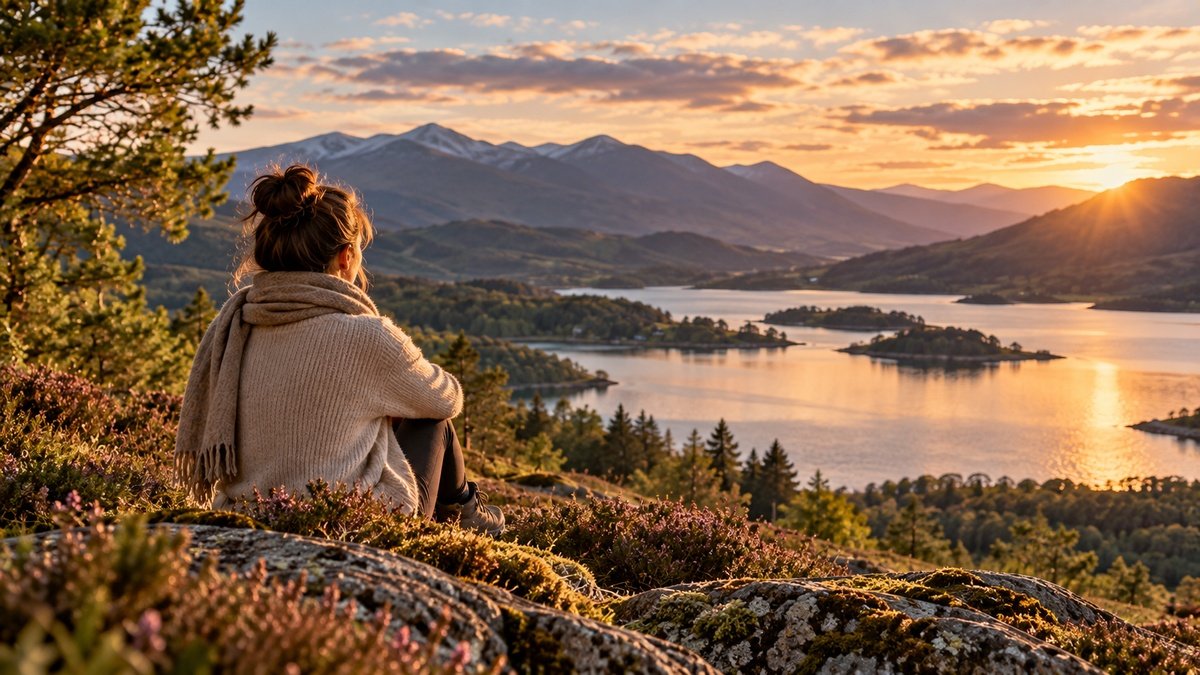
Nature and wellbeing are often connected through a familiar idea: spend time outdoors and you will feel better. A walk through woodland, time beside water or a view across an open landscape can certainly feel restorative. Yet our relationship with place is more complex than a simple prescription to “get outside”.
Natural environments differ enormously, and so do the people experiencing them. Weather, sound, light, temperature, accessibility, familiarity, memory and personal preference can all influence what being somewhere feels like.
Research increasingly explores relationships between natural environments and different aspects of health and well-being. However, that evidence does not mean that every natural setting produces the same response or that everyone needs wilderness in order to benefit from contact with the natural world.
Perhaps a more interesting question is not simply whether nature is “good for us”, but how place becomes part of human experience.
What Do We Mean by Nature and Wellbeing?
The phrase nature and wellbeing covers a surprisingly broad territory.
Research may examine access to green spaces, time spent outdoors, exposure to trees or vegetation, proximity to water, physical activity in natural environments, social interaction, biodiversity or a person’s sense of connection with nature.
These are related ideas, but they are not interchangeable.
A neighbourhood park differs from a remote woodland. Looking across water differs from swimming in it. Walking with friends differs from sitting alone beneath a tree. Even two visits to the same place can feel different because weather, company, purpose and personal circumstances have changed.
For this reason, nature and wellbeing are better understood as a relationship shaped by many factors rather than a single predictable effect.
Why Does Place Matter?
A place is more than its appearance.
We encounter environments through sound, temperature, movement, texture, smell, light and spatial relationships. We also bring our own histories, expectations and associations with us.
A shoreline may feel expansive to one person and exposed to another. Woodland can offer shelter and visual richness, while someone else may prefer an open landscape with a distant horizon.
Familiarity matters too. A landscape connected with home, childhood, community or repeated visits may carry meanings that cannot be reduced to its physical characteristics.
Place, therefore, involves both environment and relationship.
The landscape is present, but our experience of it is never entirely separate from who we are, what we notice and the circumstances in which we encounter it.
Nature and Wellbeing: What Does the Research Suggest?
A substantial body of research has investigated relationships between green and blue spaces and health and well-being.
The World Health Organization describes potential benefits associated with access to natural environments, including opportunities for physical activity, social interaction and relaxation. Research has also examined relationships with mental well-being, environmental quality and broader public-health outcomes.
However, association does not mean that every visit to a natural environment will produce a particular response.
The evidence also varies according to what researchers measure, the type of environment involved, how exposure is defined and the populations being studied.
Importantly, reviews of green and blue spaces have not identified one universal environmental characteristic that works best for everyone in every context.
That uncertainty is useful. It encourages us to move away from the idea that nature acts like a standardised intervention and towards a more nuanced understanding of environment, access and individual experience.
What Happens to Attention Outdoors?
One influential explanation for the appeal of natural environments comes from Attention Restoration Theory, developed by Rachel and Stephen Kaplan.
The theory proposes that some environments may engage attention in ways that place fewer demands on deliberate, directed concentration. Natural features can attract attention without necessarily requiring the same sustained effort as certain goal-directed tasks.
You might notice light moving across water, clouds changing shape, leaves shifting in the wind or the changing sound of a stream without deliberately deciding to concentrate on them.
This idea has influenced decades of research into restorative environments.
It is still a theoretical framework rather than a universal explanation for what happens whenever someone enters nature. Research continues to examine which aspects of natural environments matter, under what circumstances and for whom.
Nevertheless, the theory offers an interesting way to consider why certain places may invite a different quality of attention.
Nature Is a Sensory Environment
Being outdoors involves much more than looking at scenery.
Wind moves across the skin. Water creates changing patterns of sound. Light shifts as clouds pass. Vegetation introduces texture, movement and scent. Temperature changes from sunlight to shade.
These experiences create a sensory landscape.
Yet sensory richness is not automatically soothing. Birdsong may feel pleasant to one person while another notices the wind more strongly. Bright sunlight can feel welcome or uncomfortable. A busy beach and a quiet woodland offer very different combinations of sensory information.
Even environments commonly described as peaceful contain movement, sound and change.
This is one reason personal preference matters when discussing nature and wellbeing. There is no single sensory recipe for a restorative outdoor experience.
The relationship between sensory experience and attention also connects with the ideas explored in Turning Attention Inward: Understanding Pratyāhāra in Yoga.
Nature Does Not Have to Mean Wilderness
Images of nature and wellbeing often feature dramatic landscapes: mountains, forests, waterfalls and remote coastlines.
These places can be extraordinary, but contact with nature does not begin only where towns and cities end.
A local park, garden, tree-lined street, riverbank or patch of woodland can provide contact with vegetation, weather, seasonal change and other features of the natural environment.
Green space can exist close to home. Blue space can include rivers, canals, ponds, lochs and coastal environments. A window may even provide visual contact with trees, sky or changing weather when going outdoors is not practical.
This broader understanding matters because access to remote landscapes is not equal.
Transport, time, work, caring responsibilities, mobility, finances, location and the accessibility of paths or facilities can all shape which environments are available to someone.
A meaningful relationship with the natural world should not require access to wilderness.
Does Nature Automatically Make Us Feel Better?
No environment can guarantee a particular emotional state.
Research may identify patterns across groups of people, but population-level findings do not determine how one individual will experience one particular place.
An outdoor setting may feel spacious, interesting or enjoyable. On another occasion, the same environment may feel cold, noisy, exposed or simply unremarkable.
Context matters.
Weather, accessibility, safety, company, familiarity and the purpose of the visit can all change the experience. So can what happened before arriving.
This does not contradict research linking natural environments with well-being. Instead, it helps us interpret that research appropriately.
Evidence about potential benefits should not become a promise about how every person ought to feel.
The Highlands: More Than a Beautiful Backdrop
For Orenna, questions about place have particular relevance because the studio sits within the Scottish Highlands.
The Highlands are often represented through spectacular images: mountains reflected in still water, empty roads, ancient woodland and wide skies.
Those views form part of the landscape, but living within a place reveals something more dynamic.
Light changes dramatically across the year. Water appears as lochs, rivers, burns, rain and coastline. Woodland can feel enclosed before opening suddenly onto distant hills. Mist can remove a view that seemed enormous the previous day.
Wind changes how a familiar path sounds. Frost alters texture underfoot. Long summer evenings and short winter days create very different relationships with light and time.
The landscape is not a static photograph.
It is continually changing, and experiencing it means encountering some of that change.
Weather Is Part of Place
Well-being imagery often presents nature under ideal conditions: soft sunlight, comfortable temperatures and barely moving air.
Actual landscapes include weather.
In the Highlands, conditions can change quickly. Rain may arrive across a loch, cloud can obscure hills and wind can transform an otherwise familiar environment.
These conditions do not need to be romanticised. Cold, rain or strong wind can create practical challenges, and appropriate clothing, planning and safety matter.
At the same time, weather contributes to the character of place rather than merely interrupting an ideal version of it.
Rain changes sound. Mist changes distance. Snow changes light. Wind makes movement visible in trees and water.
Experiencing a landscape across different conditions can reveal that place is something changing rather than something fixed.
Nature and Wellbeing Do Not Require a Particular Activity
Time outdoors does not need to become another programme to complete.
Walking is one way to experience a place, but it is not the only one. Someone may sit beside water, spend time in a garden, pause on a bench, watch changing light or simply notice the weather while moving through an ordinary day.
Nor does an outdoor experience need to become a mindfulness exercise in order to count.
There is no requirement to identify five sounds, breathe in a particular way or concentrate continuously on the surroundings.
Those practices may be meaningful when chosen. They do not need to become rules for how to experience nature correctly.
This reflects the distinction explored in Rest Without Stillness: Does Rest Always Mean Doing Nothing?. An unhurried walk can sometimes offer a change in demand without needing to become complete stillness.
You Do Not Have to Love Being Outdoors
Nature should not become another well-being prescription.
People have different relationships with outdoor environments. Someone may enjoy woodland but dislike exposed hills. Another person may prefer a garden to a long walk. Wind, insects, uneven ground, temperature, crowds or unpredictable weather may influence whether a particular environment feels appealing.
Access also matters.
A route described as an “easy nature walk” may involve surfaces, gradients, distances or facilities that make it unsuitable for some visitors. Accessible outdoor design can therefore influence who can comfortably use and enjoy a place.
None of this makes someone’s relationship with nature less meaningful.
Connection with place can take many forms, including very ordinary and local ones.
From Looking to Noticing
There is a difference between seeing a landscape and beginning to notice it.
A familiar tree changes across the year. Water rarely holds exactly the same surface. The direction of light shifts. A place that seemed silent begins to reveal layers of sound.
Noticing does not require intense concentration.
Attention can move naturally. Something catches the eye, then disappears. A sound becomes noticeable before another replaces it.
In this sense, being outdoors can offer opportunities to encounter attention differently without turning the landscape into a technique.
The place does not need to perform for us, and we do not need to perform our attention for the place.
Bringing Awareness of Place Indoors
Thinking about place also changes how we understand indoor environments.
A room has its own sensory landscape: temperature, light, sound, texture, scent, spatial arrangement and the physical objects within it.
These elements do not determine how someone will feel, but they participate in the experience.
This is particularly relevant within restorative practice. Physical support, lighting, warmth, sound and sensory choice can reduce some avoidable demands without promising a particular internal state.
As explored in More Than a Modification: Why Yoga Props Matter, support has a purpose when it changes something useful for the person practising.
The same principle can extend to the wider environment.
A Common Misunderstanding: Nature Is a Treatment
Research into nature and wellbeing can easily become simplified into therapeutic language.
A forest may be described as healing. A walk may be presented as a treatment for stress. A view of water may be said to regulate the nervous system.
These statements go beyond what we can responsibly conclude from the simple fact that someone has spent time outdoors.
Natural environments can provide opportunities for movement, social connection, sensory engagement, recreation and experiences that people may value. Research also identifies associations between access to green and blue spaces and several aspects of health and well-being.
That does not turn nature into a universal medical or psychological treatment.
Persistent physical or psychological concerns deserve appropriate professional assessment rather than an assumption that more time outdoors will resolve them.
The Orenna Perspective — Place Is Part of the Experience
At Orenna, place does not determine how we feel. It becomes part of what we experience.
This principle applies both inside and outside the studio.
Indoors, light, temperature, sound, aroma, texture and physical support can be considered thoughtfully while leaving room for personal choice.
Outside, the environment offers its own changing combination of weather, sound, light, movement and space.
Neither environment needs to manufacture a particular response.
What matters is the relationship between the person and the conditions around them.
Here in the Highlands, that relationship is particularly visible because the landscape rarely stays visually or sensorially unchanged for long.
The water moves. Weather arrives and passes. Light changes across the seasons. Familiar places reveal different details depending on when and how we encounter them.
Perhaps this is one of the most interesting things about place: we do not simply observe it from the outside.
For a while, we are part of it.
References & Further Reading
World Health Organization Regional Office for Europe. Assessing the Value of Urban Green and Blue Spaces for Health and Well-being. WHO, 2023. An overview of evidence and approaches used to understand the potential health, social and environmental value of green and blue spaces.
World Health Organization Regional Office for Europe. Green and Blue Spaces and Mental Health: New Evidence and Perspectives for Action. WHO, 2021. A review of evidence concerning green and blue spaces and mental health, including the variation between environments and research findings.
World Health Organization Regional Office for Europe. Nature, Biodiversity and Health: An Overview of Interconnections. WHO, 2021. An overview of relationships between natural environments, ecosystems, human health and well-being.
Kaplan, Rachel & Kaplan, Stephen. The Experience of Nature: A Psychological Perspective. Cambridge University Press, 1989. An influential work in environmental psychology associated with the development of Attention Restoration Theory.
The Orenna Journal explores yoga, well-being, philosophy and place from historical, evidence-informed and contemporary perspectives. This article provides educational and general information rather than medical or psychological advice. Research can identify relationships between natural environments and health or well-being across populations, but it cannot predict how every individual will experience a particular place.



