


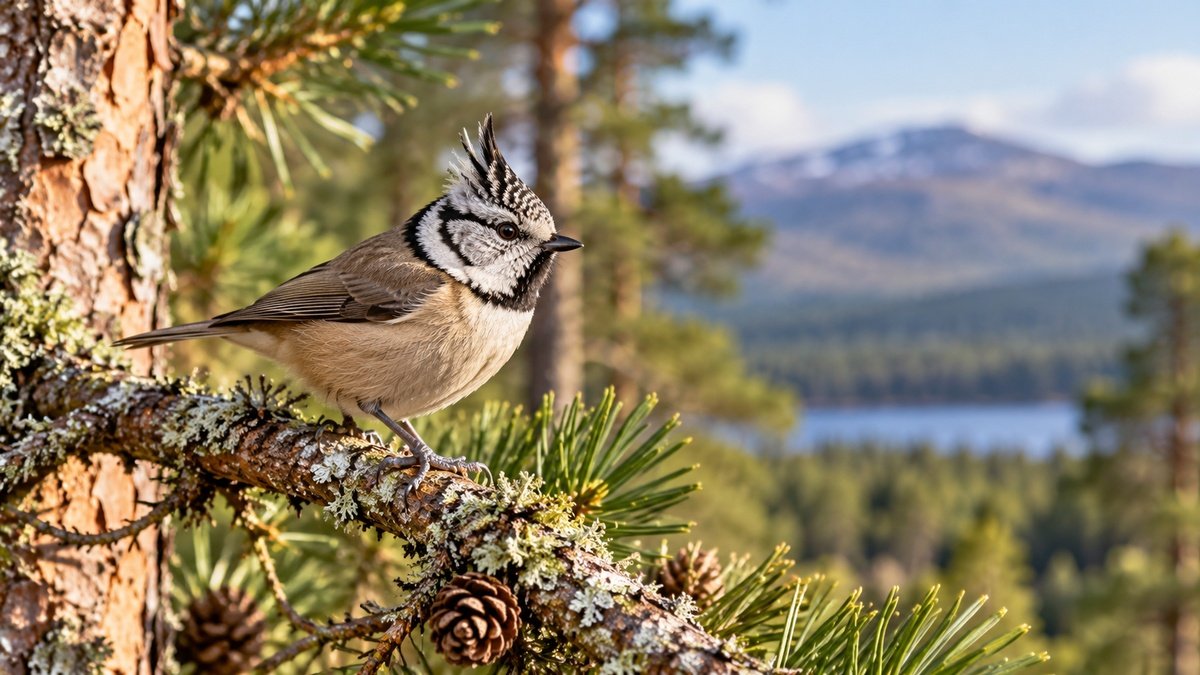
Crested tits in Scotland are small birds with a remarkably particular relationship with place. In Britain, they are closely associated with the pinewoods of northern Scotland, where their pointed crests, patterned faces and distinctive calls can occasionally reveal them among the branches.
They are easy to overlook.
A crested tit does not dominate a Highland landscape in the way a red deer might. It does not circle above mountains like a golden eagle or command attention like a displaying capercaillie.
Instead, it moves through the smaller spaces of the forest.
Branches, pine needles, insects, seeds, old stumps and decaying wood all become part of its world.
Looking closely at this small bird therefore reveals something much larger: a forest is shaped not only by its tallest living trees, but also by the quieter structures between and beneath them.
Crested Tits in Scotland
The crested tit belongs to the species Lophophanes cristatus, which occurs across parts of Europe.
Scotland has its own recognised subspecies, Lophophanes cristatus scoticus.
Within Britain, crested tits are resident birds strongly associated with the pinewoods of northern Scotland. Their core distribution includes the Caledonian pinewoods of Strathspey, although they also occur in some other pinewoods and plantations farther north and west.
Unlike strongly migratory birds, adult crested tits tend to remain comparatively close to their established woodland areas throughout the year.
That close relationship with pinewoods makes them particularly interesting.
To understand where the bird lives, we also need to understand what makes one woodland different from another.
A Small Bird With an Unmistakable Crest
The feature that gives the crested tit its English name is immediately distinctive.
Dark-and-pale feathers rise into a pointed crest above the head. A contrasting facial pattern surrounds the eye and continues around the cheek and throat.
The rest of the bird is more subdued, with brownish upperparts and paler underparts that sit naturally among bark, branches and woodland vegetation.
Its call can sometimes reveal the bird before its appearance does.
During winter, crested tits may also join mixed groups of woodland birds moving through the forest in search of food.
For someone walking through pinewood, noticing the bird may therefore begin with listening rather than looking.
Why Pinewoods Matter
In Scotland, crested tits are strongly associated with Scots pine woodland.
However, saying that a bird lives in pinewoods tells only part of the story.
A woodland contains far more than its dominant tree species.
There may be mature trees and young regeneration, standing deadwood and fallen timber, dense patches and open areas. Birch, rowan and juniper can grow among Scots pine. Beneath them may be blaeberry, heather, mosses, lichens, fungi and an enormous diversity of invertebrate life.
Our earlier article on the Caledonian Forest explored this wider ecological community.
The crested tit gives us another way to examine it.
For a small woodland bird, the details within the forest can matter as much as the forest’s overall size.
A Dead Tree Is Not Necessarily an Empty Tree
A dead tree can appear to mark the end of something.
Its leaves have gone. Growth has stopped. Branches may fall and the wood gradually begins to soften.
Ecologically, however, another process has begun.
Dead and decaying wood provides habitat for many organisms, including fungi and invertebrates. As decomposition progresses, the structure of the wood changes and new opportunities appear.
For crested tits, soft dead wood can provide something particularly important: a place to nest.
NatureScot records females excavating nest holes in old pine stumps. Unlike a bird that depends entirely on an existing cavity, the crested tit can work into sufficiently soft material to create a nesting space.
Something that looks lifeless to us can therefore remain structurally important to another species.
Making a Nest in Soft Wood
Nest excavation is one of the most interesting aspects of crested tit behaviour.
The female can excavate a cavity within sufficiently decayed wood, including old pine stumps.
This does not mean that every dead tree becomes suitable nesting habitat. The condition, softness, position and surrounding woodland all matter.
Nevertheless, the behaviour demonstrates why removing deadwood simply because it appears untidy can alter woodland habitat.
Modern conservation forestry often recognises deadwood as an ecological resource rather than waste.
NatureScot notes that old and dead trees and rotting wood within Caledonian pinewoods support specialist insects, while the increasing deadwood at Abernethy contributes to the overall richness of the forest.
For the crested tit, that broader woodland process can become somewhere to raise the next generation.
What Do Crested Tits Eat?
Crested tits feed largely on small invertebrates, including insects and spiders.
Outside the breeding season, plant material such as conifer seeds can also form part of their diet.
This seasonal flexibility connects the bird with several layers of the woodland ecosystem.
An insect feeding among vegetation may later become food for a bird. Pine cones provide seeds. Bark and branches offer places to search. The forest floor and lower branches can also become feeding areas.
Crested tits are also known to cache food.
They may store items such as pine seeds and invertebrate food for later use, an especially useful behaviour when food availability changes through the colder months.
The woodland is therefore not simply somewhere the bird shelters.
It is a changing network of food, nesting material, cavities, cover and movement.
Winter Changes the Forest
A Highland pinewood in January presents different conditions from the same woodland in June.
Temperatures fall, daylight shortens and the availability of invertebrate food changes. Snow and ice may alter where birds can forage.
Crested tits remain within their Scottish range throughout the year rather than leaving for a distant wintering area.
During winter, they can join mixed-species flocks moving through woodland alongside other small birds.
Stored food can also contribute to survival when resources become less immediately available.
Our exploration of Highland weather considered weather as an active part of the experience of landscape.
For a resident woodland bird, seasonal change is more than atmosphere. It continually alters the conditions in which feeding, shelter and survival take place.
Crested Tits Do Not Need an Untouched Forest
The association between crested tits and Caledonian pinewoods can encourage another simplification: that the birds survive only in woodland untouched by people.
Highland woodland history is more complicated.
Native pinewoods have been shaped by centuries of felling, grazing, regeneration and land management. NatureScot notes that almost every part of Dell Woods at Abernethy has been felled for timber at some point in its history.
Crested tits also occur in some Scots pine plantations.
However, research reviewed by NatureScot has found substantially higher winter densities in ancient native pinewoods than in planted pinewoods.
Therefore, the useful distinction is not simply between ‘natural’ and ‘human’.
Woodland structure, age, continuity, deadwood, vegetation and management history can all influence the habitat that exists today.
A Common Misunderstanding: Caledonian Pinewood Means Only Scots Pine
Scots pine is the defining tree of Caledonian pinewood, but a functioning pinewood ecosystem contains much more than pine.
At places such as Abernethy, broadleaved trees including birch and rowan occur alongside pine. Juniper contributes another layer of vegetation, while bog woodland, wet areas and open spaces create further variation.
Below the trees, mosses, lichens, fungi and flowering plants occupy different niches.
Deadwood adds another dimension.
Invertebrates use these habitats, birds feed upon those invertebrates, fungi participate in decomposition, and new trees establish among older ones.
Calling all of this simply ‘pine trees’ would be like describing a loch only as water.
The dominant feature may give the habitat its name, but relationships create the ecosystem.
Crested Tits and a Changing Highland Forest
The history of crested tits in Scotland also reflects changes in woodland cover.
NatureScot’s review describes the species as likely having been more widespread when ancient native pinewood covered a greater area of the Highlands.
As those forests were reduced and fragmented, the bird’s distribution also contracted.
Later, twentieth-century pine planting created additional woodland habitat, and the species expanded into some of those areas.
This creates a more nuanced story than simple decline.
Woodland loss affected the species historically, while subsequent forestry created habitat in some places. At the same time, native pinewoods can support particularly valuable conditions for these woodland specialists.
The history of the bird and the history of the forest are therefore closely connected.
How Many Crested Tits Are There in Scotland?
Population numbers for small woodland birds are not obtained by counting every individual.
NatureScot’s published review cites an estimated British population of around 1,000–2,000 breeding pairs, all in Scotland, alongside an older estimate of approximately 5,600–7,900 individuals in winter.
These figures require context.
They are estimates derived from earlier source data and should not be interpreted as a precise count of the number of crested tits alive in Scotland today.
For a geographically restricted species, distribution can be just as informative as a single population number.
In Britain, the crested tit remains overwhelmingly a bird of northern Scottish pinewoods.
Protected Does Not Necessarily Mean Declining
Crested tits receive legal protection, including listing under Schedule 1 of the Wildlife and Countryside Act.
It would be easy to assume that this automatically means the species is undergoing the same type of severe decline as the capercaillie in Scotland.
The two situations are different.
NatureScot’s evidence review describes historical range expansion by crested tits following twentieth-century pine planting, whereas capercaillie conservation currently involves an exceptionally small and vulnerable national population.
Legal protection, rarity, geographical restriction and population trend are related concepts, but they are not interchangeable.
A species can have a restricted distribution without every available measure showing continuing decline.
Understanding conservation therefore requires more than attaching one label to an animal.
One Forest, Different Requirements
Crested tits share Highland pinewoods with many other animals.
Our article on red squirrels in Scotland explored another species closely associated with these forests.
Capercaillie may use woodland ground vegetation, mature trees, clearings and other structures. Red squirrels depend heavily on trees and the food resources they provide. Crested tits use still another combination of branches, invertebrates, seeds and nesting cavities.
They can occupy the same broad landscape without experiencing it in exactly the same way.
This is why biodiversity cannot be reduced to maximising one feature.
A structurally varied forest can provide different opportunities for different species.
Seeing Crested Tits Responsibly
Crested tits can sometimes be encountered on established routes through Highland pinewoods.
Places such as Dell Woods at Abernethy have public trails where visitors may hear or see woodland birds while remaining within an established access network.
However, encountering wildlife should not become a reason to approach nests, alter vegetation or leave appropriate routes simply to obtain a photograph.
During the breeding season, nesting birds require particular consideration.
Listening can sometimes be as useful as looking. A call moving through the trees may provide enough of an encounter without following the bird more closely.
Distance does not make an observation less meaningful.
A Small Bird Does Not Require a Large Adventure
Highland wildlife is sometimes presented through images of long walks, remote glens and physically demanding journeys.
Those experiences can be meaningful for people who enjoy and can undertake them, but they are not the only way to encounter nature.
Some pinewoods have established trails close to communities and visitor facilities. Dell Woods, for example, begins near Nethy Bridge and includes routes of different lengths and surfaces.
Other people may engage with woodland birds through accessible viewpoints, bird feeders where appropriate, recordings, conservation cameras, photographs, books or educational resources.
Mobility, health, balance, sensory preferences, transport, weather, available time, work and caring responsibilities can all influence how someone experiences a landscape.
None of those circumstances determines the depth of someone’s curiosity about the natural world.
A small bird does not require a large adventure.
Not Seeing the Bird Is Still Part of the Experience
Even within suitable pinewood, there is no guarantee of seeing a crested tit.
Wild animals are not exhibits arranged around a visitor’s arrival.
A walk may instead reveal pine cones opened by feeding animals, moss spreading over an old stump, fungi emerging from deadwood or the movement of another bird through the canopy.
The absence of the species someone hoped to see does not make the woodland empty.
In fact, looking for one animal can sometimes teach us to notice the wider habitat even when that animal remains hidden.
Our exploration of nature and wellbeing considered this relationship with outdoor places more broadly: attention can take different forms, and people’s experiences of nature are individual.
The Orenna Perspective — Learning to Notice What Is Small
A Highland pine forest naturally draws the eye upwards.
Scots pines rise above us. Their branches frame the sky. Beyond them, mountains may appear between gaps in the woodland.
The scale can be impressive.
Then something much smaller moves between the branches.
A crested tit shifts our attention.
Suddenly, an old stump is no longer simply the remains of a tree. A pine cone is food. A spider is part of another animal’s survival. A decaying branch can contribute to a living system.
The story of crested tits in Scotland is therefore not only about a distinctive little bird.
It is also about scale.
The largest features of a landscape are not necessarily the only ones that matter. Sometimes ecological significance exists in a cavity, beneath a piece of bark or among branches that most of us would walk past without noticing.
Learning about the forest can change what we consider worth seeing.
Sometimes understanding a landscape begins not by looking farther, but by noticing what was already close enough to miss.
References & Further Reading
NatureScot. Crested Tit. Current species information on Scotland’s crested tit, its pinewood association and nesting behaviour.
NatureScot. Caledonian Pinewood. An introduction to Scotland’s native pinewood habitat, associated species and the ecological importance of old and dead wood.
NatureScot. The Story of Dell Woods, Abernethy NNR. Woodland history, ecology and information about specialist pinewood wildlife including crested tits.
NatureScot. Disturbance Distances Review. Includes population, distribution, habitat, feeding and nesting information for crested tits.
RSPB. Crested Tit. Identification, distribution and conservation information.
The Orenna Journal explores yoga, well-being, philosophy and place from historical, evidence-informed and contemporary perspectives. Wildlife populations and distributions can change over time. When visiting woodland, follow current access guidance and avoid disturbing nesting birds or other sensitive wildlife.



