


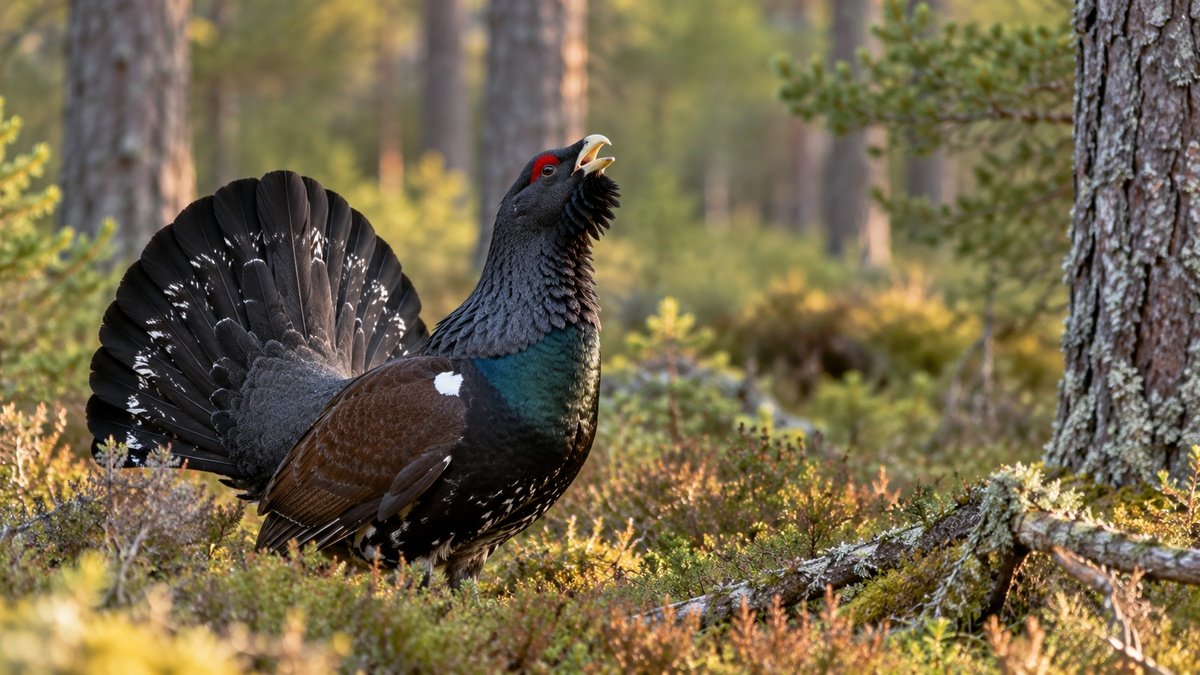
Capercaillie in Scotland are closely associated with the pinewoods of the Highlands. Large, distinctive and surprisingly elusive, these woodland grouse have become one of the most recognisable symbols of Scotland’s remaining native pine forests.
Yet their story is more complicated than the image of an ancient bird surviving unchanged within an ancient forest.
Capercaillie disappeared from Scotland historically and were later reintroduced. Today, their population is again small and vulnerable, concentrated mainly within the pinewoods of the Cairngorms.
Their conservation also reveals something important about woodland itself.
A forest is not simply a collection of trees.
For capercaillie, the spaces between trees matter. Ground vegetation matters. Food matters. Weather, disturbance, connectivity and the structure of the woodland can matter too.
To understand the bird, therefore, we need to look more closely at the forest around it.
Capercaillie in Scotland
The capercaillie, Tetrao urogallus, is the world’s largest grouse species.
Males are considerably larger and darker than females. An adult male can weigh around 4 kilograms, while females are typically much smaller and have mottled brown plumage that provides effective camouflage within woodland vegetation.
The difference between the sexes can be striking enough that someone unfamiliar with the species might initially assume they were looking at two different birds.
Although capercaillie occur across parts of northern and central Europe, their British distribution is now restricted to Scotland.
Here, they are particularly associated with pinewoods in and around the Cairngorms, where most of the remaining Scottish population occurs.
That population is vulnerable.
The most recent national winter survey, undertaken in 2021/22, produced an estimate of approximately 532 birds, with considerable statistical uncertainty around that figure. It represented a substantial decline from the previous national estimate.
Importantly, this is the latest national estimate rather than a count of every individual bird alive in Scotland today.
The Horse of the Forest
The name itself carries a connection with woodland.
NatureScot gives the Scottish Gaelic name as capall-coille, meaning horse of the forest.
For a bird, the comparison begins to make sense when an adult male is considered at full scale.
Capercaillie are substantial birds. Males can appear particularly imposing during courtship, when the tail is spread into a broad fan and the body is held in an elaborate display posture.
Nevertheless, their size does not make them easy to encounter.
They live within woodland environments where vegetation, distance and behaviour can keep them out of sight. More importantly, their rarity and sensitivity to disturbance mean that deliberately trying to find them is not appropriate.
A Forest Is More Than Trees
It is tempting to describe an animal’s habitat with a simple label.
Capercaillie live in forests. Therefore, it might seem reasonable to conclude that more trees automatically mean more suitable habitat.
The ecology is more specific.
Capercaillie can use both native pinewoods and some managed conifer forests. However, suitable habitat depends upon the structure and condition of the woodland rather than the presence of trees alone.
Mature trees can provide food and roosting opportunities. Clearings can form part of courtship areas. Meanwhile, the vegetation beneath the canopy can provide food, cover and important habitat for females and chicks.
Our earlier exploration of the Caledonian Forest considered woodland as a changing ecological system rather than a static collection of ancient trees.
Capercaillie make that idea tangible.
Two forests containing similar numbers of trees may function very differently for the birds living within them.
Blaeberry Beneath the Pines
One small plant helps illustrate the importance of the forest floor.
Blaeberry, also known as bilberry, can form part of the ground vegetation within Scottish pinewoods.
Its importance to capercaillie extends beyond the berries themselves.
Blaeberry provides food and habitat for insects. Those invertebrates can be particularly important for young chicks, which require protein-rich food during their early development.
As the birds mature, their diet changes. Adult capercaillie eat plant material including berries, shoots and stems, while pine needles provide an important winter food source.
Therefore, what appears to us as vegetation beneath the trees may form a significant part of the habitat on which the birds depend.
The forest floor is not empty space between trunks.
What Is a Capercaillie Lek?
Perhaps the best-known capercaillie behaviour occurs during the breeding season.
Male capercaillie gather at traditional display areas known as leks.
There, males perform elaborate courtship displays. They adopt distinctive postures, fan their tails and produce a sequence of unusual sounds while competing for opportunities to mate.
Females visit these areas and select mates.
The lek is therefore not a nest or a permanent home. It is a place associated with courtship and reproduction.
Some lek sites can be used repeatedly across years, which makes disturbance around them particularly significant.
Why We Should Not Go Looking for a Lek
The spectacle of capercaillie courtship can make a lek sound like something to seek out.
For this species, the responsible approach is the opposite.
Capercaillie are rare and highly sensitive to disturbance. NatureScot notes that displaying males at leks receive specific legal protection from disturbance, alongside protections applying to nests, eggs and chicks.
The RSPB consequently advises people not to go searching for capercaillie.
For The Orenna Journal, we will not identify lek locations or provide instructions for finding breeding birds.
Wildlife observation does not require access to every intimate part of an animal’s life.
Sometimes understanding when not to approach is part of understanding the species itself.
Females, Nests and Chicks
The dramatic appearance of displaying males can dominate descriptions of capercaillie.
However, the less conspicuous stages of reproduction are fundamental to whether the population can persist.
Females nest on the ground. Their mottled plumage helps them blend into woodland vegetation, while chicks begin life within an environment where food, shelter, weather and predation can all influence survival.
Young chicks initially depend heavily on invertebrates. Consequently, woodland conditions that support suitable ground vegetation and abundant insect life can be particularly valuable.
Weather matters as well.
Cold, wet conditions during the period when chicks are small can reduce survival. This is one reason why conservation cannot focus only on the number of adult birds present in a forest.
A population needs successful reproduction as well as surviving adults.
A Common Misunderstanding: Capercaillie Never Disappeared From Scotland
The close association between capercaillie and Scotland’s ancient pinewoods can create the impression of an uninterrupted history.
That is not what happened.
Capercaillie became extinct in Britain, with the Scottish population disappearing historically. Birds were subsequently reintroduced to Scotland during the nineteenth century using stock from continental Europe.
The population present today therefore descends from reintroduced birds.
This does not make the capercaillie somehow less meaningful within Scottish ecology.
Instead, its history shows why words such as native, extinct, reintroduced and restored describe different aspects of a species’ relationship with a place.
A species can belong to the ecological history of a landscape, disappear from it and later be deliberately returned.
How Many Capercaillie Remain in Scotland?
The most recent national population survey was carried out during winter 2021/22.
It estimated approximately 532 capercaillie in Scotland, with a 95% confidence interval of 227–810 birds.
That uncertainty is important.
Wildlife population estimates are not the same as counting every animal individually. Researchers use systematic surveys and statistical methods to estimate populations that cannot be completely observed.
The central estimate of 532 represented a decline of around 52% from the 2015/16 estimate of 1,114 birds.
It was also the lowest national estimate since the survey series began in the early 1990s.
Because 532 comes from the 2021/22 survey, it should not be interpreted as an exact count of the population in 2026.
Instead, it remains the latest national estimate available and provides important evidence of the scale of the conservation challenge.
There Is No Single Cause of the Decline
The decline of capercaillie in Scotland cannot be explained by one pressure alone.
Current conservation evidence identifies several interacting challenges.
These include habitat loss and fragmentation, the condition of woodland habitat, disturbance, predation, collisions with fencing, climate-related pressures and low breeding success.
Small and increasingly isolated populations can create additional difficulties. NatureScot’s genetic assessment currently classifies the genetic health risk of the Scottish population as serious.
However, recognising multiple pressures does not mean that every factor has the same importance in every forest or every year.
Conservation decisions need evidence from the places where capercaillie remain.
Predation Is Part of a More Complicated Story
Eggs and chicks can be taken by predators, and research has identified predation as one factor affecting capercaillie breeding success.
Foxes, crows and pine martens have all featured in Scottish research and conservation discussions.
Yet identifying predation as an ecological pressure should not be translated into describing another native species as inherently harmful.
Predator-prey relationships are normal components of ecosystems.
The conservation question is more specific: how does predation affect a very small capercaillie population within landscapes already shaped by habitat fragmentation, woodland management, human activity and other pressures?
NatureScot continues to research these relationships, including the interaction between pine martens and capercaillie.
The issue therefore requires evidence, monitoring and context rather than simple categories of ‘good’ and ‘bad’ wildlife.
When a Fence Becomes Part of the Habitat
A deer fence may seem unrelated to bird conservation.
For capercaillie, however, fences can become significant features within the landscape.
Birds flying through woodland may collide with fencing, sometimes resulting in injury or death.
At the same time, the reason a fence exists may relate to another ecological challenge: managing deer browsing so that woodland can regenerate.
This creates a useful example of why conservation decisions are rarely as simple as removing one apparently undesirable feature.
Where fences are required, marking can make them more visible to flying birds. Elsewhere, unnecessary fences can be removed.
The appropriate response depends on the purpose of the fence, the surrounding habitat and the risks within that particular site.
Capercaillie, Deer and Woodland Regeneration
Our earlier article on red deer in Scotland explored the relationship between deer, people and Highland vegetation.
That relationship appears again in capercaillie conservation.
Deer are natural components of Scottish ecosystems. However, where browsing pressure becomes high, young trees and woodland ground vegetation can struggle to regenerate.
That can influence the structure of habitat available to many woodland species, including capercaillie.
Again, the useful question is not whether deer are ‘good’ or ‘bad’.
The ecological question concerns density, browsing pressure, woodland condition and the objectives for a particular landscape.
Capercaillie conservation therefore intersects with wider decisions about how Highland woodland is managed.
Disturbance Can Change How Habitat Functions
A woodland can contain suitable vegetation and still become less useful to wildlife if animals cannot use it without repeated disturbance.
For capercaillie, recreational activity can become particularly significant where popular routes overlap with important habitat.
This does not mean that people should be excluded from Highland forests as a general principle.
Instead, thoughtful visitor management can help recreation and conservation coexist. Depending on the location and season, that may involve keeping to paths, respecting temporary requests or diversions, keeping dogs under appropriate control and leaving sensitive areas undisturbed.
The principle is straightforward.
Access to nature and responsibility towards wildlife do not have to be opposing ideas.
Signs of Hope Do Not Erase the Wider Risk
Conservation stories can easily become either entirely pessimistic or prematurely celebratory.
The current picture for capercaillie contains both concern and evidence that targeted action can make a difference.
At RSPB Abernethy, 30 lekking males were recorded in 2025, compared with 20 in 2021 — an increase of 50% at that particular site.
That is encouraging local evidence.
However, one site’s improvement should not be treated as proof that the Scottish population as a whole has recovered.
The most recent national survey still describes a population that had undergone substantial decline and remained concentrated within a small number of areas.
Local progress and national vulnerability can therefore be true at the same time.
The Capercaillie Emergency Plan
Scotland is currently working under a Capercaillie Emergency Plan for 2025–2030.
NatureScot identifies actions including woodland expansion and improvement, reducing the effects of predation, removing fences, reducing disturbance, improving monitoring and assessing whether reinforcement of the population may be feasible.
The breadth of those actions is revealing.
There is no single intervention labelled ‘save the capercaillie’.
Instead, conservation involves habitat, people, other animals, infrastructure, monitoring and long-term decisions about woodland.
That complexity reflects the ecology of the bird itself.
You Do Not Need to See a Capercaillie to Understand It
Wildlife writing often treats seeing the animal as the ultimate experience.
With capercaillie, that expectation deserves reconsideration.
Because the remaining population is small and disturbance can affect the birds, choosing not to search for them can itself be a responsible way of engaging with their story.
People can learn about capercaillie through conservation organisations, interpretation, responsibly produced wildlife photography, research, films and educational resources.
Where public woodland access is appropriate, simply experiencing the wider pinewood can also reveal much about the environment on which the species depends.
That experience does not need to involve a remote or physically demanding route.
Mobility, health, sensory preferences, transport, weather, work, caring responsibilities and available time can shape how each person encounters the Highlands. Accessible paths, visitor facilities, interpretation and digital resources can all provide meaningful ways to explore woodland ecology.
Understanding wildlife does not require disturbing it.
Look at the Forest Instead
If the bird remains unseen, the woodland still offers something to notice.
Look at how densely the trees grow.
Notice where sunlight reaches the ground, where blaeberry grows beneath the canopy and where younger trees are beginning to establish.
Elsewhere, fallen wood, wet areas, open ground and mature trees create further variation.
Our article on red squirrels in Scotland explored another animal whose life is closely connected with woodland. Yet the two species do not use the forest in exactly the same way.
That difference matters.
There is no single arrangement called ‘good habitat’ that works identically for every woodland species.
Biodiversity emerges partly from variation — different structures, resources and conditions supporting different forms of life.
The Orenna Perspective — A Forest Is More Than Its Trees
From a distance, woodland can look deceptively simple.
We see trees.
Move closer and the forest begins to separate into layers.
There is the canopy above, the trunks between, the vegetation below and the soil beneath that. Light reaches some places and not others. Water gathers in hollows. Old trees stand beside younger growth. Insects move among leaves and stems.
A capercaillie depends upon parts of this complexity.
The bird therefore asks us to look beyond the presence or absence of trees and consider the relationships that make woodland function as habitat.
Its story also complicates the idea of restoration.
Capercaillie were returned to Scotland in the nineteenth century. Yet bringing a species back and creating the conditions in which a population can persist are not the same thing.
The future of capercaillie in Scotland now depends on decisions extending far beyond the bird itself — decisions about woodland, recreation, fencing, herbivores, predators, climate, monitoring and how people share landscapes with other species.
Perhaps that is one of the most useful things this elusive bird can reveal.
A landscape is not restored simply because something has returned to it.
Sometimes restoring a landscape is not simply about bringing something back, but understanding what it needs in order to remain.
References & Further Reading
NatureScot. Capercaillie. Species information, ecology, protection and conservation context for capercaillie in Scotland.
NatureScot. Genetic Scorecard Indicator — Western Capercaillie. Current information on population genetics, pressures and the Capercaillie Emergency Plan 2025–2030.
RSPB Scotland. Capercaillie Biodiversity Action Plan. Population estimates, habitat pressures and conservation work in Scotland.
RSPB. Capercaillie. Identification, ecology, conservation status and guidance on avoiding disturbance.
NatureScot. The Predator–Prey Relationship Between Pine Marten and Capercaillie. Research examining a complex component of current capercaillie conservation.
The Orenna Journal explores yoga, well-being, philosophy and place from historical, evidence-informed and contemporary perspectives. Capercaillie are rare, vulnerable to disturbance and legally protected. This article intentionally does not identify lek, nest or other sensitive locations. Current local guidance should always take precedence when visiting woodland where protected wildlife may be present.



