


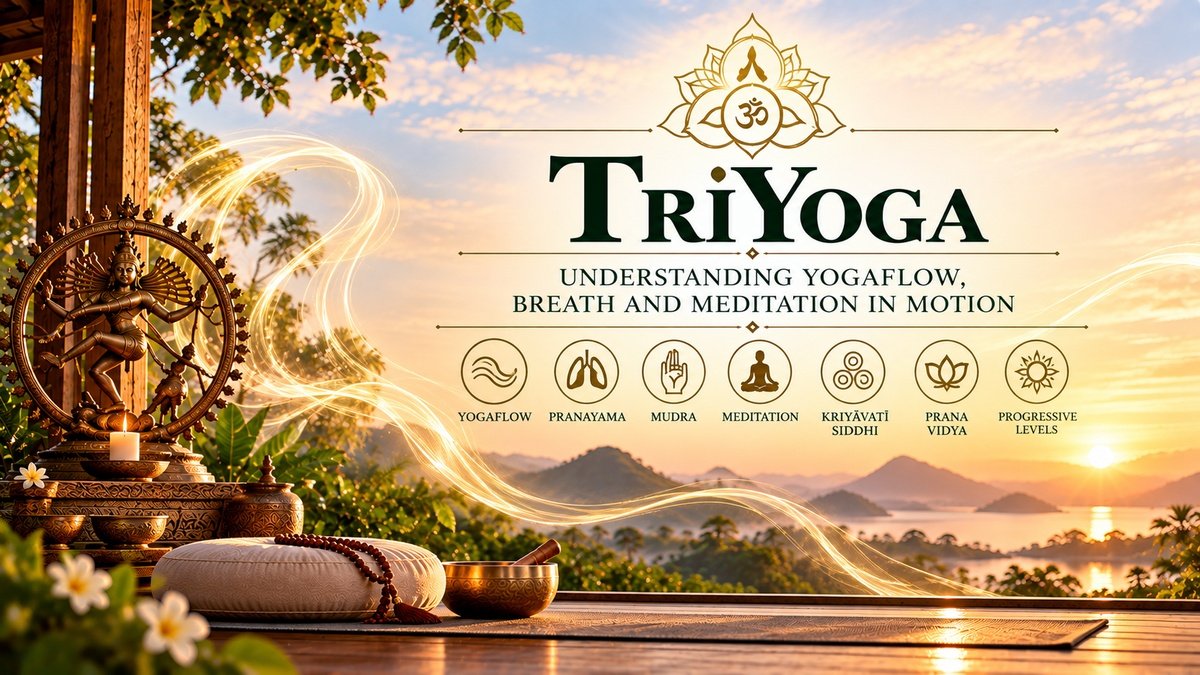
TriYoga can look remarkably fluid.
The spine moves in waves. One posture passes into another without abrupt interruption. Breath establishes rhythm, while the hands may form mudrās as movement gradually gives way to stillness.
Yet fluidity is only one part of the method.
Founded by Yogini Kaliji, also known as Kali Ray, TriYoga is a contemporary yoga system built around a carefully organised integration of posture, breath and focus.
Its central movement practice is known as Yogaflow®, which brings together āsana, prāṇāyāma and mudrā through both dynamic movement and sustained postures.
Alongside this physical practice, TriYoga includes Prana Vidya: breathing practices, concentration and meditation.
The result is a system in which movement is not necessarily the destination.
Instead, TriYoga uses movement, breath and attention progressively, with meditation occupying an important place within the wider practice.
What Is TriYoga?
TriYoga is a modern yoga method founded by Yogini Kaliji.
The system combines several dimensions of yoga rather than defining itself solely through physical posture.
Its movement methodology, Yogaflow, integrates āsana, prāṇāyāma and mudrā. Prana Vidya expands the practice through breathing sequences, concentration techniques and meditation.
TriYoga also incorporates yoga philosophy, mantra, sacred sound and lifestyle teachings within its broader system.
Consequently, a TriYoga practice may contain considerably more than flowing through postures.
The physical flow provides one route towards increasingly integrated attention.
Who Founded TriYoga?
Yogini Kaliji, formerly widely known as Kali Ray, founded TriYoga.
The official TriYoga organisation dates the beginning of the system to 1980.
Over subsequent decades, Kaliji systematised an extensive body of postures, flowing sequences, breathing practices, concentration techniques and mudrās.
TriYoga is now taught internationally through certified teachers and dedicated centres.
The method nevertheless remains closely associated with Kaliji’s own practice and spiritual interpretation of its origin.
This makes it important to distinguish between the documented modern development of TriYoga and the spiritual explanation through which the tradition understands that development.
When Did TriYoga Begin?
TriYoga identifies 1980 as the year of its founding.
That places it clearly within the history of modern yoga.
Although many of its component practices — including āsana, prāṇāyāma, mudrā, concentration and meditation — have much older South Asian histories, their particular organisation as TriYoga is contemporary.
This distinction matters.
TriYoga did not emerge as an unchanged ancient sequence transmitted under that name for centuries.
Rather, Kaliji systematised a modern method using practices and concepts connected with the much broader history of yoga.
What Does the Name TriYoga Mean?
The prefix tri immediately points towards the importance of groups of three within the method.
At the centre of Yogaflow is the integration of āsana, prāṇāyāma and mudrā.
Prana Vidya contains another triad: prāṇāyāma, dhāraṇā and dhyāna — breathing practice, concentration and meditation.
TriYoga’s own philosophical presentation also refers to the Sanskrit formulation sat-cit-ānanda, commonly translated through ideas of being or existence, consciousness and bliss.
Therefore, “three” operates on several levels within the system rather than referring only to three physical techniques.
What Is Yogaflow?
Yogaflow is the central movement methodology of TriYoga.
The official system describes it as the union of posture, breath and focus through āsana, prāṇāyāma and mudrā.
Both moving and sustained postures appear within the practice.
Transitions matter as much as destinations.
Rather than treating the space between two āsanas as something to move through hurriedly, TriYoga incorporates connecting movements into the architecture of the sequence.
Breathing establishes rhythm, while attention remains involved throughout.
This gives the practice its characteristic continuity.
Why Are Wave-Like Spinal Movements Important?
Wave-like spinal movement is one of the most recognisable characteristics of TriYoga.
Rather than moving the trunk as a single rigid unit, sequences may explore progressive movement through different regions of the spine.
These waves contribute to the visual fluidity of Yogaflow.
They also create transitions between postures rather than separating each shape into an isolated event.
TriYoga’s own materials attribute extensive physiological benefits to these movements.
From an evidence-informed perspective, we can make a more measured observation: moving the spine through comfortable ranges can form part of mobility and movement practice, while the effects and appropriate range vary among individuals.
No particular spinal movement should be presented as a universal treatment for injury or disease.
What Does “Relaxation-in-Action” Mean?
Relaxation-in-action is a characteristic TriYoga principle.
The phrase does not mean becoming completely passive while moving.
Instead, it points towards using the effort required for a movement without creating unnecessary tension elsewhere.
A posture may require strength.
Yet the face, jaw, breath or other areas do not necessarily need to contract simply because the legs or arms are working.
In this sense, relaxation and activity are not opposites.
TriYoga asks whether movement can remain organised and responsive even while effort is present.
What Does “Economy of Motion” Mean?
TriYoga also uses the principle of economy of motion.
The practitioner aims to move without adding actions that do not serve the transition.
This contributes to the smooth appearance of Yogaflow.
Rather than stopping, reorganising unnecessarily and then beginning again, one movement can prepare directly for the next.
Economy does not mean rushing.
In fact, slowing down may reveal unnecessary movements that speed previously concealed.
The principle therefore concerns efficiency and continuity rather than simply moving quickly.
How Important Is Breath in TriYoga?
Breath is fundamental to TriYoga.
Yogaflow coordinates movement with rhythmic breathing, while Prana Vidya develops breathing practices more explicitly.
The method interprets breath through the traditional yogic concept of prāṇa.
Prāṇa has a complex history within Indian religious, philosophical and yogic traditions. It should not simply be translated as oxygen.
Breathing certainly involves measurable physiological processes.
Prāṇa, however, belongs to a traditional framework concerned with vitality and life processes that cannot simply be equated with oxygen, electrical activity or another single biomedical variable.
Keeping those frameworks distinct allows us to discuss both without confusing one for the other.
What Is Prana Vidya?
Prana Vidya is the contemplative dimension of TriYoga concerned with breathing, concentration and meditation.
The system organises it around three principal components:
Prāṇāyāma — breathing practices.
Dhāraṇā — concentration or the deliberate directing of attention.
Dhyāna — meditation.
These categories have histories extending far beyond TriYoga itself.
For example, dhāraṇā and dhyāna also appear among the eight limbs described in Patañjali’s Yoga Sūtras. You can explore that framework in our article on the Eight Limbs of Yoga.
TriYoga systematises these practices within its own progressive methodology.
Why Are Mudras So Important in TriYoga?
Mudrā occupies an unusually prominent place within TriYoga.
The official organisation states that its system includes more than 1,300 mudrās.
Many are hasta mudrās: gestures formed with the hands and fingers.
TriYoga also discusses eye mudrās and the concept of the whole body functioning as mudrā.
Historically, the Sanskrit category mudrā is considerably broader than the hand gestures most familiar in contemporary wellness culture.
Different Hindu and Buddhist traditions have used mudrās within ritual, meditation, iconography and yogic practice.
Therefore, TriYoga’s extensive mudrā system represents a distinctive modern systematisation within a much older and more diverse history.
Do Mudras Direct Energy?
TriYoga describes mudrā through the language of directing prāṇa.
This interpretation belongs to the method’s traditional and subtle-body framework.
It should not automatically become a biomedical claim that a particular finger position redirects a scientifically measurable energy through the body.
Hand gestures can clearly influence attention, sensory experience and the organisation of a contemplative practice.
Traditional yoga may interpret their significance through additional concepts concerning prāṇa and subtle processes.
Those interpretations can be respected as part of the tradition without presenting them as established anatomy or physiology.
What Is Kriyavati Siddhi?
Understanding TriYoga requires encountering an unusual term: kriyāvatī siddhi.
TriYoga describes the inspiration for its system through Kaliji’s direct experience of spontaneous movements associated within the tradition with kuṇḍalinī.
According to TriYoga’s own account, āsana, prāṇāyāma and mudrā manifested spontaneously through these experiences and subsequently became systematised as TriYoga.
This is the tradition’s spiritual explanation of its origin.
Historical and evidence-informed writing requires us to identify it as such.
We can document that Kaliji and TriYoga describe the method this way. We cannot independently establish that kuṇḍalinī objectively generated particular sequences as a measurable physiological event.
The distinction allows the tradition to speak in its own language without converting spiritual testimony into scientific fact.
Is TriYoga a Form of Kundalini Yoga?
No.
TriYoga uses the concept of kuṇḍalinī within its explanation of kriyāvatī, but that does not make it identical to the modern system commonly called Kundalini Yoga.
The concept of kuṇḍalinī has a much older South Asian history and appears across particular Tantric and later yogic traditions.
Different modern yoga systems subsequently interpreted the concept in different ways.
TriYoga has its own founder, sequence architecture, terminology, teacher training and practice methodology.
Shared use of the word kuṇḍalinī therefore does not establish that two modern systems are the same tradition.
Does TriYoga Have Fixed Sequences?
TriYoga is highly systematic.
Its teaching progresses from Basics through increasingly advanced levels.
Within each level, students learn organised series of postures and connecting movements.
This distinguishes TriYoga from completely improvisational flow classes.
However, its sequencing should not be confused with the series structure of Ashtanga Yoga.
Both methods use systematic progression, but they organise their material differently and developed through different modern histories.
TriYoga’s architecture is specifically built around Yogaflow, breathing, mudrā and its own progressive levels.
What Are the Levels of TriYoga?
TriYoga begins with Basics, which establishes foundational alignment, movement patterns, breathing and flow.
The system then progresses through numbered levels.
Current TriYoga teaching extends through advanced levels, while its Prana Vidya system is likewise organised progressively.
The early levels develop familiarity with the method before increasingly complex movements and practices appear.
This progressive architecture matters.
Advanced practice is not simply a collection of difficult poses selected at random.
Each stage builds upon skills established earlier.
A practitioner can also remain with foundational material rather than treating progression as an obligation.
What Happens in a TriYoga Class?
The exact experience depends upon the class and level.
A Yogaflow session may combine sustained āsanas with flowing transitions, spinal waves, rhythmic breathing and mudrā.
Teachers may use props and modifications to support different bodies and levels of experience.
Some classes emphasise particular areas, such as the hips or spine.
Others may place greater attention on Prana Vidya, meditation or the integration of several dimensions of practice.
Therefore, the name TriYoga describes an entire method rather than one identical class sequence.
Is TriYoga the Same as Vinyasa Yoga?
No, although their appearance can sometimes overlap.
Both TriYoga and Vinyasa Yoga can coordinate movement and breathing through flowing sequences.
However, Vinyasa Yoga is now a broad category encompassing many teaching approaches.
TriYoga is a specific named system.
Its Yogaflow methodology includes characteristic spinal waves, rhythmic breath, mudrā, relaxation-in-action, economy of motion and systematic levels.
Prana Vidya also gives concentration and meditation a formal place within the wider method.
Calling TriYoga simply “Vinyasa” therefore removes much of what makes the system distinctive.
How Is TriYoga Different from Strala Yoga?
TriYoga and Strala Yoga can both appear soft and fluid.
They nevertheless developed independently and organise movement differently.
Strala is a contemporary method created by Tara Stiles and developed with Mike Taylor, incorporating principles influenced by Tai Chi and Qigong.
TriYoga was founded by Yogini Kaliji and centres upon its own systematic Yogaflow methodology.
TriYoga also gives mudrā, Prana Vidya and progressive levels particularly prominent roles.
Visual similarity should therefore not be mistaken for common lineage.
How Is TriYoga Different from ParaYoga?
Both are modern systems that extend beyond posture, but ParaYoga and TriYoga remain distinct methods.
ParaYoga was founded by Rod Stryker and draws particularly upon his interpretation of Haṭha Yoga, Tantra and Śrī Vidyā-informed teachings.
TriYoga was founded by Yogini Kaliji and organises practice through Yogaflow, Prana Vidya, mudrā and its progressive system.
Both may include āsana, prāṇāyāma and meditation.
Those shared categories belong to the broader history of yoga and do not make the two contemporary systems interchangeable.
Is TriYoga Suitable for Beginners?
Yes, TriYoga has a designated Basics foundation.
The system introduces its movement principles progressively rather than requiring beginners to enter at an advanced level.
Props and modifications can also form part of practice.
However, suitability still depends upon the individual, the particular class and the techniques involved.
Some advanced postures, breathing practices or concentration methods require more preparation than foundational work.
A systematic method is most useful when progression remains genuinely progressive.
Does TriYoga Use Props?
Yes.
TriYoga can use bolsters, blocks, straps, blankets and other supports according to the needs of the practice.
The system also includes gentler and supported approaches.
A prop can modify range, provide stability or change how someone experiences a posture.
Using support therefore does not represent a lesser version of the practice.
It provides another way of organising the relationship between the practitioner and the movement.
Is TriYoga Therapeutic?
TriYoga uses the term therapeutics within its own teaching system and offers supported practices under that description.
Official materials also make numerous claims concerning physical health, rehabilitation, pain, stress and physiological function.
Those claims should be distinguished from established clinical treatment.
A supported yoga practice may provide opportunities for comfortable movement, breathing, rest and body awareness.
However, a yoga method should not automatically be presented as treating an injury, chronic pain, asthma, arthritis or another medical condition simply because its own materials describe therapeutic benefits.
Individual circumstances and appropriate healthcare remain important.
Is TriYoga a Spiritual Practice?
TriYoga contains an explicit spiritual dimension.
Its own explanation of kriyāvatī, kuṇḍalinī and sat-cit-ānanda extends well beyond a purely physical fitness method.
Mantra, meditation, yoga philosophy and sacred sound also form part of the wider system.
At the same time, individuals may encounter TriYoga initially through physical practice.
Recognising the method’s spiritual framework does not require pretending that every practitioner interprets those concepts identically.
It simply avoids secularising the history and philosophy of the system until only exercise remains.
A Common Misunderstanding: TriYoga Is Not Simply Gentle Flow
The smoothness of TriYoga can make the practice appear easy.
That appearance can be misleading.
Fluid movement still requires coordination, strength, mobility and attention.
Moreover, TriYoga extends from foundational practice into increasingly complex levels.
Its softness therefore should not be confused with an absence of structure or challenge.
The method deliberately cultivates continuity while progressively developing capacity.
TriYoga is better understood as systematic flow than as simply gentle flow.
An Orenna Perspective: What Happens Between the Poses?
It is easy to recognise a yoga posture.
The transition is less likely to receive a name.
Yet much of practice happens precisely there.
One shape dissolves. Weight changes direction. The breath continues. Attention has to move with the body rather than waiting for the next recognisable pose.
TriYoga makes that intermediate space difficult to ignore.
Its wave-like movements and economy of motion ask the practitioner to consider how one action becomes another.
That idea reaches beyond choreography.
A practice can be technically accurate at each destination while remaining hurried, disconnected or unnecessarily tense between them.
Continuity offers another measure.
Perhaps the quality of a practice is revealed not only by the shapes we can hold, but by what happens while one experience is becoming the next.
References & Further Reading
TriYoga International. Official materials on TriYoga, Yogaflow, Prana Vidya, mudrā, certification and the teaching of Yogini Kaliji provide the principal primary sources for the modern method.
Yogini Kaliji. TriYoga teaching manuals and recorded teachings document the system’s flows, breathing practices, concentration methods, mudrās and philosophical interpretation.
James Mallinson & Mark Singleton. Roots of Yoga. Provides wider historical context for āsana, prāṇāyāma, mudrā, meditation, kuṇḍalinī and other practices that predate their modern organisation within TriYoga.
Mark Singleton. Yoga Body: The Origins of Modern Posture Practice. Useful for situating modern posture-based yoga methods within the wider development of global modern yoga.



