
The sequences of modern Ashtanga Yoga can create an impression of permanence. Practitioners repeat an established order, teachers transmit recognisable conventions and the method often emphasises continuity between generations.
Yet the history of Ashtanga Yoga is more complex than the idea of an ancient sequence passed unchanged from teacher to student.
The practice known internationally today developed within twentieth-century India, particularly through the teaching of T. Krishnamacharya and his student K. Pattabhi Jois in Mysore, now officially Mysuru. From there, it travelled far beyond India and continued to develop as new generations encountered, taught and interpreted the method.
Understanding that history does not diminish the practice. Instead, it helps distinguish documented evidence from lineage narrative, and continuity from change.
The History of Ashtanga Yoga Begins in a Wider Story
Modern Ashtanga Yoga did not emerge in isolation.
Yoga in India has a long and diverse history involving philosophical inquiry, meditation, ascetic disciplines, breath practices and many different understandings of the body. Postural practice also changed considerably across time.
By the late nineteenth and early twentieth centuries, yoga existed within a rapidly changing India. Older traditions encountered new forms of physical culture, education, nationalism and international exchange.
Consequently, historians of modern yoga do not describe twentieth-century postural methods simply as ancient systems preserved without alteration. They examine how older yoga traditions interacted with the cultural and physical practices of their own period.
This wider context matters because the development of modern Ashtanga belongs within it.
Krishnamacharya and the Mysore Palace
A central figure in this story is T. Krishnamacharya, one of the most influential yoga teachers of the twentieth century.
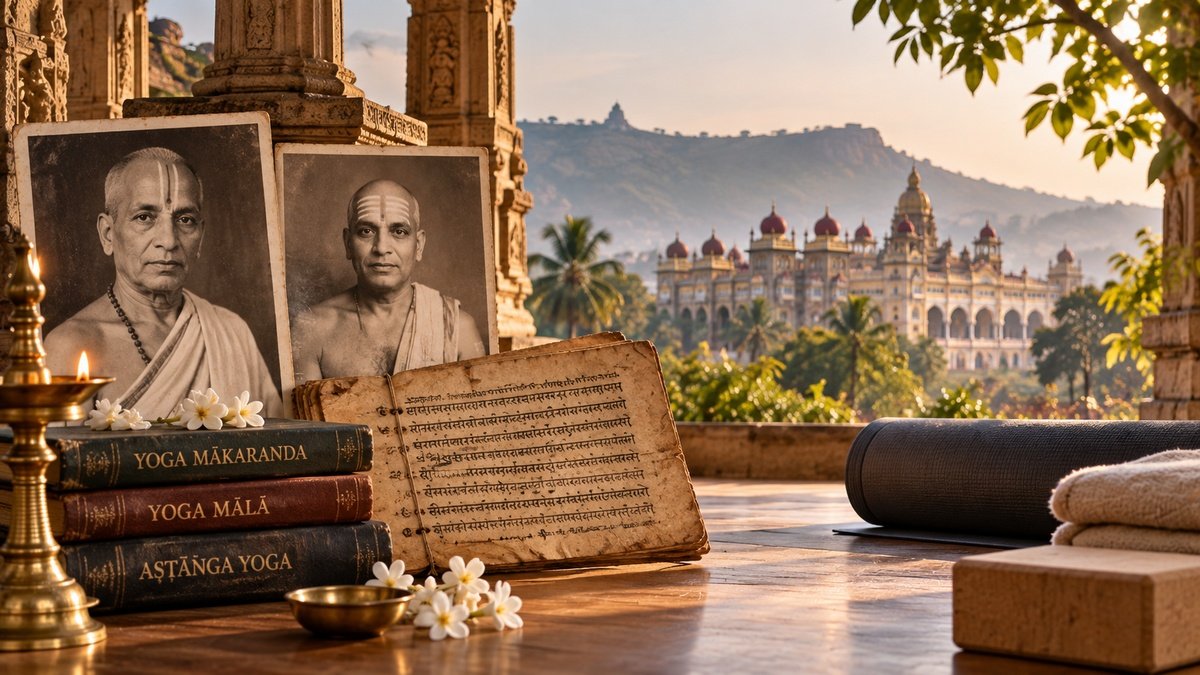
During the 1930s and 1940s, Krishnamacharya taught yoga in Mysore under the patronage of Maharaja Krishnaraja Wadiyar IV. His work there formed part of a broader environment in which the Mysore court supported education, physical culture and Indian intellectual traditions.
Krishnamacharya taught a physically dynamic form of āsana practice during this period. His 1934 book Yoga Makaranda documents postures alongside movements coordinated with breathing, showing important features associated with his teaching at the time.
However, Krishnamacharya’s teaching should not be reduced to a single fixed method. His work developed over a long career, and different students encountered different aspects of it.
Among those students was a young K. Pattabhi Jois.
Pattabhi Jois and the Development of Ashtanga Yoga
Pattabhi Jois studied with Krishnamacharya and subsequently became closely associated with the dynamic, sequence-based approach that developed into modern Ashtanga Yoga.
In 1937, Jois began teaching yoga at the Sanskrit College in Mysore. He later established his own teaching institution, the Ashtanga Yoga Research Institute, in 1948. :chatgpt-content-reference{index=”2″}
Over the following decades, Jois organised and taught the sequences that practitioners now associate with the Ashtanga system.
His book Yoga Mala, first published in Kannada in 1962, described the Primary Series and connected postural practice with breathing, vinyāsa and elements of yoga philosophy. :chatgpt-content-reference{index=”3″}
This does not mean that Jois created his method without earlier influences. Krishnamacharya’s teaching was fundamental to its development. At the same time, describing contemporary Ashtanga as an unchanged ancient sequence would go beyond the historical evidence.
The method developed through teaching, repetition and transmission within a particular twentieth-century context.
What Was the Yoga Korunta?
One of the most intriguing questions in the history of Ashtanga Yoga concerns a text usually called the Yoga Korunta or Yoga Kurunta.
According to accounts associated with the Ashtanga lineage, Krishnamacharya learned a system connected with a text attributed to a sage named Vāmana and later transmitted this knowledge to Pattabhi Jois.
The story became important in explanations of the origins of Ashtanga Yoga.
However, historical evidence requires a distinction between lineage account and independently verifiable source.
Researchers have not produced a surviving manuscript that can establish the Yoga Korunta as the textual source of the modern Ashtanga sequences. Scholars Jason Birch and Mark Singleton have examined possible textual connections, but the evidence does not establish the lineage narrative as historical fact.
Birch has also noted inconsistencies in accounts of the text within Krishnamacharya’s wider lineage. Until further evidence emerges, hypotheses about precisely what the Yoga Korunta contained remain speculative.
Therefore, it is reasonable to describe the Yoga Korunta as part of Ashtanga’s lineage history. It is not reasonable to present it as a surviving ancient manual that conclusively documents the modern series.
Was Ashtanga Influenced by Physical Culture?
The relationship between modern yoga and twentieth-century physical culture has become an important area of yoga studies.
Researchers including Mark Singleton have explored how Indian yoga teachers worked during a period when gymnastics, bodybuilding, physical education and other movement systems circulated internationally.
This scholarship has helped challenge a simple picture in which modern postural yoga descended unchanged from ancient āsana traditions.
However, influence should not be confused with reduction.
Recognising possible relationships between yoga and physical culture does not mean that modern Ashtanga is merely gymnastics under another name. Nor does it mean that Krishnamacharya simply copied a Western exercise system.
Historical development is usually more complicated. Traditions can preserve older ideas while absorbing, reorganising and responding to practices around them.
Modern Ashtanga emerged within precisely this kind of changing environment.
From Mysore to an International Practice
For many years, Jois taught primarily in Mysore. Eventually, however, students from outside India began travelling there to study.
Western practitioners arrived during the 1960s, and Jois began travelling internationally to teach during the 1970s. His 1975 visit to California became one important moment in the method’s growing international visibility. :chatgpt-content-reference{index=”4″}
Students returned home carrying what they had learned. Some became teachers, established practice communities and introduced the method to new audiences.
Over subsequent decades, Ashtanga communities developed across Europe, North America and elsewhere.
Mysore itself also became an international destination for practitioners seeking direct study within the lineage.
This movement created something distinctive: a yoga method strongly identified with one Indian city while simultaneously becoming a transnational practice.
Did the Ashtanga Series Always Look the Same?
The existence of established sequences can make it tempting to imagine that every detail of Ashtanga has always existed in its present form.
Historical accounts suggest a more developmental picture.
Teaching conventions, groupings of postures and the organisation of the series evolved during the twentieth century. Different generations of students also encountered variations in how Jois taught particular aspects of the method.
This should not be surprising. Living teaching traditions often become more systematised as they expand.
What eventually appears to be a fixed curriculum may have developed through years of teaching, revision and transmission.
That distinction is important. A tradition can possess continuity without remaining historically unchanged.
Pattabhi Jois, Abuse and the History We Cannot Leave Out
A responsible account of the history of Ashtanga Yoga must also address a difficult part of Pattabhi Jois’s legacy.
Women who studied with Jois have described sexual abuse occurring during physical adjustments in yoga classes. Their accounts include unwanted sexual touching presented within the context of hands-on teaching. Although some women had spoken about these experiences earlier, wider public acknowledgement developed much later. The University of Virginia’s scholarly Ashtanga guide records that these accounts became widely discussed publicly in 2017. :chatgpt-content-reference{index=”5″}
This history matters not because it defines every practitioner or teacher associated with Ashtanga, but because it reveals what can happen when physical authority, lineage authority and inadequate consent boundaries intersect.
It also complicates the way yoga communities remember influential teachers.
Acknowledging Jois’s role in developing and internationally transmitting Ashtanga does not require ignoring documented accounts of harm. Equally, acknowledging that harm does not require pretending that the wider tradition consists only of one individual’s actions.
Both belong in an accurate historical account.
From Authority to Accountability
The history raises questions that extend beyond one teacher or one yoga tradition.
Traditional teacher-student relationships can place considerable trust in the teacher. Within an international yoga culture, that authority may become even stronger when teachers acquire reputations as direct representatives of a lineage.
Yet knowledge and authority are not the same as unlimited permission.
Contemporary discussions within Ashtanga have therefore increasingly included consent, safeguarding, physical adjustments and the responsibilities attached to teacher-student power.
These questions connect directly with the teaching environment explored in our article on Mysore Style Ashtanga. Individual attention can be a valuable pedagogical feature, but individual teaching should still preserve the practitioner’s agency.
Historical awareness can help communities examine not only what they inherited, but also which conventions deserve reconsideration.
A Common Misunderstanding: Modern Does Not Mean Inauthentic
Learning that a yoga method developed significantly during the twentieth century can sometimes produce an unnecessary choice.
Either the practice must be ancient and therefore authentic, the reasoning goes, or modern development somehow makes it less legitimate.
History does not require that conclusion.
Yoga traditions have repeatedly developed, interpreted earlier teachings and responded to new circumstances. The fact that modern Ashtanga has a discernible twentieth-century history tells us something about how traditions develop; it does not, by itself, determine the value of practising them.
Likewise, recognising innovation does not erase older influences.
Krishnamacharya and Jois worked within Indian yoga traditions while also teaching in particular historical circumstances. Understanding both continuity and change gives us a more useful picture than insisting on either timeless antiquity or complete modern invention.
An Orenna Perspective: Tradition Can Include Revision
Tradition is sometimes imagined as the preservation of something exactly as it was.
Yet transmission inevitably involves people: teachers interpret, students remember, communities develop and circumstances change.
Historical understanding allows us to respect what has been inherited without making inheritance immune from examination.
Some elements may continue because they remain meaningful. Others may change because greater knowledge, different circumstances or the experiences of people previously unheard require reconsideration.
Perhaps continuity is not found in refusing change, but in engaging carefully with what we have received.
A tradition can be inherited without being frozen, and respected without being beyond question.
Continue Exploring
To understand the method before exploring its history, begin with Practice in Sequence: Understanding Ashtanga Yoga. Then explore Breath, Movement and Sequence: How Ashtanga Yoga Is Practised and Learning Without Following the Teacher: Understanding Mysore-Style Ashtanga.
The final article in this series turns to a different historical question: why does a twentieth-century postural method use a Sanskrit term that also describes Patañjali’s eightfold path? Continue with Eight Limbs, One Practice? Ashtanga Yoga Beyond Āsana.
You may also explore the broader development of twentieth-century practice in The History of Modern Yoga and learn more about Krishnamacharya.
References & Further Reading
Birch, J. (2018). ‘The Proliferation of Āsana-s in Late-Medieval Yoga Texts’. In Yoga in Transformation. Research examining the historical development of postural practice and the unresolved questions surrounding the Yoga Kurunta.
Birch, J. & Singleton, M. (2019). ‘The Yoga of the Haṭhābhyāsapaddhati: Haṭhayoga on the Cusp of Modernity’. Journal of Yoga Studies. Read the research.
Singleton, M. (2010). Yoga Body: The Origins of Modern Posture Practice. Oxford University Press.
University of Virginia, Mandala Collections. Ashtanga Yoga: A Curated Guide. A scholarly guide to the development, sources and contemporary history of Ashtanga Yoga. Explore the guide.
Jois, K. Pattabhi. Yoga Mala. Originally published in Kannada in 1962; later published in English translation.