

Walk into a conventional yoga class and there is usually an obvious centre of attention. A teacher stands at the front, offers instructions and guides the room through a shared sequence. Everyone may adapt the practice differently, but the class generally moves together.
Mysore Style Ashtanga can look quite different.
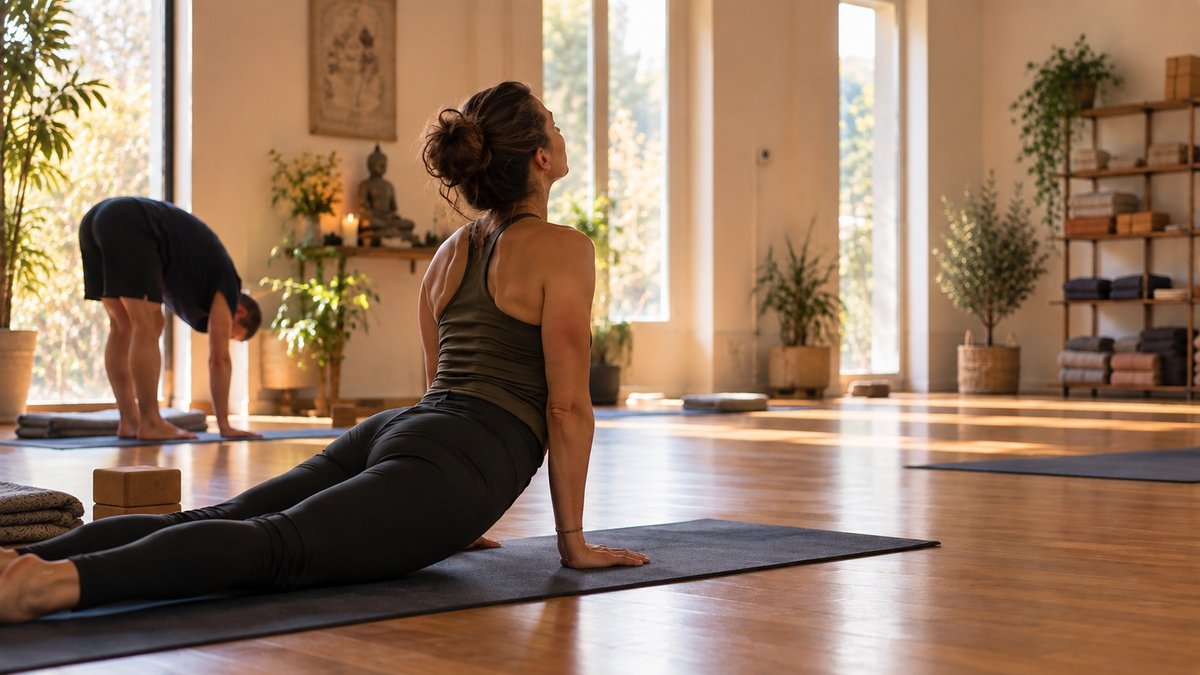
One person may be beginning with Sun Salutations while somebody nearby is already halfway through their practice. Elsewhere, another practitioner may be working with a shorter sequence while someone else is finishing. Rather than continuously directing the class from the front, the teacher moves around the room.
At first, this can appear as though everyone is simply practising alone. Yet Mysore-style teaching is better understood as individual instruction taking place within a shared practice space.
The distinction matters. Students are not learning without a teacher. Instead, they are learning without needing to follow the teacher’s every instruction in real time.
What Is Mysore Style Ashtanga?
Mysore Style Ashtanga takes its name from the South Indian city now officially called Mysuru, formerly Mysore, in Karnataka. K. Pattabhi Jois taught there for much of the twentieth century, and the city became closely associated with the Ashtanga method.
Rather than leading the entire group through the sequence simultaneously, the teacher works with students individually while they practise alongside one another.
Each person moves through the portion of the Ashtanga sequence they are currently learning. Their breathing and familiarity with the sequence provide much of the pacing. Meanwhile, the teacher observes the room and offers guidance where appropriate.
This creates an unusual combination: the structure is shared, but the practice is individual.
A beginner might practise for a relatively short period while learning the opening part of the sequence. A more experienced practitioner may continue considerably further. Consequently, two people on neighbouring mats can belong to the same class without doing the same posture at the same moment.
What Does a Mysore Style Ashtanga Room Look Like?
A Mysore room often has no single visual focal point.
Instead of arranging everyone around a teacher demonstrating at the front, practitioners work through their own practice. Depending on the school, students may also arrive within a designated practice window rather than at one identical starting time.
As a result, the room develops several overlapping rhythms. Someone may be standing while another person is seated. One practitioner might be resting as somebody else begins.
This apparent lack of synchronisation does not mean there is no structure. Quite the opposite: the established sequence provides a framework that helps both teacher and practitioner recognise where they are within the method.
This is one reason repetition and sequence are so important within Ashtanga Yoga practice. Familiarity with the order gradually reduces the need to wait for somebody else to announce what comes next.
Learning the Sequence from Memory
Memorisation plays an important role in Mysore-style learning, but students do not necessarily arrive already knowing the Primary Series.
Teachers can introduce the sequence progressively. A newer practitioner learns a manageable portion, repeats it and gradually becomes familiar with its order. Over time, the teacher may introduce additional material as appropriate.
Forgetting what comes next is therefore not a failure of the method. It is part of learning it.
Once practitioners no longer depend on continuous external cues, something significant changes in the relationship between teacher and student. The teacher does not disappear, but no longer needs to narrate every movement.
Attention can then shift towards remembering, observing, pacing and responding to the practice as it unfolds.
In this sense, memorisation is not simply about proving that somebody knows the correct order. Instead, it helps create the conditions for guided self-practice.
The Teacher Is Still Teaching
The term self-practice can easily create the wrong impression.
A Mysore class is not simply a room made available for people to practise independently. Throughout the session, the teacher observes, responds and works with individuals.
One student may need a reminder of the sequence. Another might benefit from an alternative approach to a posture. Someone may decide to stop earlier than usual. Elsewhere in the room, the most useful intervention may be no intervention at all.
Teaching therefore becomes less about delivering one set of instructions to everybody and more about deciding when, where and how to intervene.
Silence should not be mistaken for an absence of teaching. Observation itself forms part of the teacher’s work. Sometimes allowing a practitioner space to continue independently can be as relevant as offering another instruction.
The result can resemble one-to-one teaching embedded within a group environment rather than either a conventional group class or a private lesson.
Progressive Learning Does Not Mean Everyone Reaches the Same Destination
Ashtanga has often been associated with progressively learning additional postures. In many Mysore settings, teachers introduce further parts of the sequence as a student’s practice develops.
However, progression can become misleading if people interpret it only as accumulating increasingly complex postures.
Different bodies, histories, responsibilities, ages, energy levels and circumstances shape how people practise. A useful practice may therefore include adaptations, pauses, alternatives or a deliberately shorter sequence.
Furthermore, doing more of a series does not automatically indicate greater understanding of yoga.
As explored in our introduction to Ashtanga Yoga, adaptation does not necessarily contradict structure. A recognisable framework can remain while the way a person works within it changes.
Progressive learning is therefore better understood as an educational process than as a race through a syllabus.
Mysore Style Ashtanga and Individual Pacing
One of the most distinctive features of Mysore Style Ashtanga is that people do not have to move through the room at an identical pace.
In a led class, the teacher’s count and instructions create much of the shared timing. During Mysore practice, practitioners take greater responsibility for navigating the sequence they know.
That does not mean pacing becomes arbitrary. The Ashtanga method still provides considerable structure. However, within that structure, students are not continually trying to remain synchronised with everyone around them.
This distinction can be particularly important when discussing accessibility. A group does not need to become physically uniform in order to share a practice.
Someone can take more time, practise less of the sequence or work with an adaptation without requiring the entire room to make the same choice.
In principle, the method therefore contains an interesting possibility: people can participate together without needing to practise identically.
Mysore Practice and Led Ashtanga Classes
Mysore and led classes are not simply two names for the same teaching format.
During a led Ashtanga class, the teacher directs the group through a sequence using verbal instruction and, traditionally, a counted rhythm. Practitioners therefore move through much of the practice together.
In a Mysore class, by contrast, each practitioner remembers and navigates their own portion of the sequence while the teacher provides individual guidance.
These formats can serve different educational purposes. A led class makes the collective structure and pacing of the sequence particularly visible. Mysore practice, meanwhile, places more responsibility on the individual to remember that structure and work within it.
Neither format needs to be described as inherently more advanced. A person can be highly experienced and still benefit from led practice, while a newcomer can begin learning through a Mysore setting with appropriate guidance.
Autonomy Within a Structured Method
At first glance, autonomy and fixed sequence might sound contradictory.
If the order has already been established, how much autonomy can the practitioner really have?
The answer depends partly on what autonomy means.
Autonomy does not require inventing a different sequence every morning. It can also involve developing the capacity to practise without constant external prompting, recognise when something needs to change, communicate with a teacher and participate actively in decisions concerning one’s own practice.
Seen this way, structure and autonomy do not necessarily oppose one another.
The sequence supplies a framework, and practitioners gradually learn how to navigate it. Meanwhile, the teacher remains a source of observation, knowledge and guidance rather than becoming the person who must continuously tell each student what to do next.
Physical Adjustments and Consent
Hands-on adjustments have historically been highly visible within some Ashtanga teaching environments, particularly in Mysore-style classes. However, physical contact is not synonymous with good teaching, nor is it a requirement for meaningful individual instruction.
Teachers can use verbal guidance, demonstration, observation, props, environmental changes or other forms of support.
Where a teacher offers physical contact, contemporary professional standards make an important distinction: consent should be explicit, informed and ongoing.
Previous consent does not automatically provide permission for another adjustment later. A teacher should not interpret silence as agreement, and practitioners should be able to decline touch without needing to justify that decision.
This is particularly relevant in a Mysore environment because individual teaching can create repeated teacher-student interactions over a long period. Familiarity should not replace consent.
Individual teaching works best when the practitioner remains an active participant rather than becoming a passive recipient of the teacher’s decisions.
What About Moon Days?
Some Ashtanga schools pause their usual āsana practice on days associated with the full and new moon. Practitioners commonly call these moon days.
This convention belongs particularly to the Ashtanga lineage rather than representing a universal rule across yoga traditions.
Modern explanations sometimes attribute the custom to physiological or energetic effects of lunar phases. Such explanations deserve caution. Historical accounts also connect the convention with Pattabhi Jois’s teaching calendar and with lunar observances in the cultural and educational context in which he studied and taught.
For contemporary practitioners, the practical result is simpler than some of the explanations attached to it. Some Mysore programmes schedule regular rest days around the new and full moon, while others organise their teaching differently.
It is therefore useful to recognise moon days as a lineage convention without turning them into a universal biological rule.
A Common Misunderstanding: Mysore Is Not an Unsupervised Advanced Class
Perhaps the most persistent misunderstanding about Mysore practice is that students need to know the whole sequence before they can attend.
That reverses the educational logic of the method.
Memorisation is important, but Mysore-style teaching can also provide the setting in which somebody learns the sequence. A new practitioner may begin with a relatively small amount of material and build familiarity through repetition.
Likewise, the quiet, self-directed appearance of the room does not mean that everybody present is an advanced practitioner.
Within a single class, people can be learning very different portions of the same system simultaneously.
That is one of the defining features of the method: everyone may be learning within the same system without having the same practice.
An Orenna Perspective: Independence Does Not Mean Practising Alone
There is a subtle difference between independence and isolation.
Learning something deeply often involves gradually becoming less dependent on continuous instruction. We remember. We recognise patterns. Through experience, we make observations and begin to understand when we need guidance and when we can continue independently.
Mysore-style teaching makes that process unusually visible.
The teacher remains present without needing to occupy every moment of the practice. Other practitioners share the room without needing to move exactly as we move.
Perhaps this is one of the more interesting lessons contained within the format: shared practice does not require identical practice, and guidance does not require surrendering agency.
Continue Exploring
Mysore-style teaching makes more sense when understood alongside the structure of the practice itself. Begin with Practice in Sequence: Understanding Ashtanga Yoga, then explore Breath, Movement and Sequence: How Ashtanga Yoga Is Practised for a closer look at repetition, sequence and the mechanics of practice.
The next article in this series moves from pedagogy into history, examining how the modern Ashtanga method developed in Mysuru and travelled internationally: From Mysore to the Modern Studio: The History of Ashtanga Yoga.
References & Further Reading
Shaw, A. (2022). ‘A tool to help me through the darkness’: suffering and healing among teacher-practitioners of Ashtanga yoga. Anthropology & Medicine. Read the research article.
University of Virginia, Mandala Collections. Ashtanga Yoga: A Curated Guide. A scholarly resource exploring modern Ashtanga Yoga and its association with Pattabhi Jois and Mysore. Explore the guide.
Yoga Alliance. Scope of Practice. Professional guidance includes explicit and informed consent for physical adjustments. Read the Scope of Practice.
District Mysuru, Government of Karnataka. Information on the history and contemporary identity of Mysuru. Explore the official Mysuru district resource.