

Say Ashtanga Yoga in a contemporary studio and many people will picture a demanding sequence of postures: Sun Salutations, standing poses, seated sequences and a practice connected through breath and movement.
Yet the word aṣṭāṅga has a much older meaning.
In Sanskrit, aṣṭa means eight and aṅga means limb or component. Long before the development of the modern postural method associated with K. Pattabhi Jois, Patañjali’s Yoga Sūtras described an eight-limbed approach to yoga.
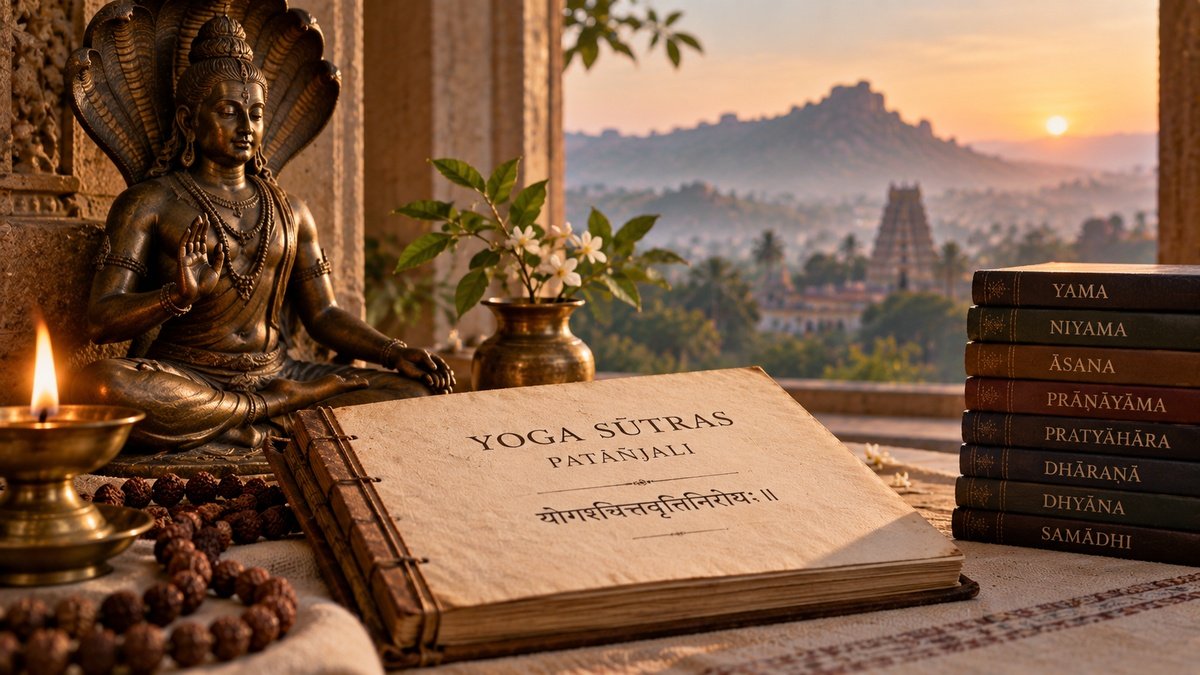
The Ashtanga eight limbs include ethical disciplines, personal observances, posture, breath regulation, the relationship with sensory experience, concentration, meditation and samādhi.
This creates an important distinction. Patañjali’s aṣṭāṅga and modern Ashtanga Yoga are connected by name and philosophical interpretation, but they are not historically identical systems.
Understanding that difference opens a much larger question: what happens when we look beyond the sequence of postures?
What Does Aṣṭāṅga Actually Mean?
The Sanskrit term aṣṭāṅga literally refers to something composed of eight limbs or parts.
Within Patañjali’s Yoga Sūtras, the term appears in the second chapter. Sūtra II.29 presents eight components of yogic practice:
Yama — ethical restraints concerned with how one acts in relation to others and the world.
Niyama — personal observances or disciplines.
Āsana — posture.
Prāṇāyāma — regulation of the breath or vital energy.
Pratyāhāra — withdrawal or disengagement of the senses from their objects.
Dhāraṇā — concentration or the placing of attention.
Dhyāna — meditation.
Samādhi — meditative absorption.
Together, these constitute Patañjali’s aṣṭāṅga yoga: an eightfold discipline directed towards the broader aims of Classical Yoga.
Āsana is therefore present, but it is one limb among eight.
The Ashtanga Eight Limbs Are Not Eight Levels of Posture
Modern yoga culture can make the word limb sound rather like a level in a training programme: complete one stage and then progress to the next.
That can create a misleading picture.
The Ashtanga eight limbs are not eight increasingly difficult categories of physical practice. Nor should they be confused with the different posture series taught within modern Ashtanga Yoga.
The Primary, Intermediate and Advanced series belong to the twentieth-century postural method explored throughout this Journal series. Patañjali did not describe those sequences.
Likewise, mastering increasingly complex āsanas does not mean that somebody has progressed through Patañjali’s eight limbs.
The distinction is fundamental because it prevents physical complexity from becoming a measure of philosophical development.
1. Yama — How We Relate
The first limb, yama, concerns restraints or ethical disciplines.
Patañjali identifies five: ahiṃsā (non-harming), satya (truthfulness), asteya (non-stealing), brahmacarya and aparigraha (non-grasping or non-possessiveness).
The precise interpretation of these principles has varied across historical and contemporary contexts. Brahmacarya, for example, has strong historical associations with celibacy or sexual restraint, although modern yoga communities sometimes interpret it more broadly as moderation or wise use of energy.
What matters here is their position within the system.
Patañjali does not begin his eight limbs with physical accomplishment. He begins with conduct.
This makes yoga concerned not only with what happens on a mat, but also with how a practitioner acts.
2. Niyama — Personal Observances
The second limb turns towards personal disciplines.
The five niyamas are śauca (purity or cleanliness), santoṣa (contentment), tapas (discipline or austerity), svādhyāya (study or self-study) and Īśvarapraṇidhāna (devotion or dedication to Īśvara).
Modern interpretations sometimes translate these concepts into general well-being principles. However, their original philosophical setting is more specific than a contemporary lifestyle checklist.
In Patañjali’s system, they participate in a disciplined path concerned with transforming the conditions that maintain misidentification and suffering.
They therefore belong within the philosophical architecture of Classical Yoga rather than simply providing inspirational values for modern life.
3. Āsana — The Limb Most Visible Today
The third limb is āsana.
For many contemporary practitioners, this is the most recognisable Sanskrit word in the entire list. Modern yoga has developed an extensive vocabulary of standing poses, balances, twists, backbends and other postural forms.
Yet the treatment of āsana in the Yoga Sūtras is remarkably concise compared with the attention given to posture in modern yoga.
Patañjali does not provide the Primary Series. He does not describe Sun Salutations, vinyāsa transitions or the postural sequences now associated with Ashtanga Yoga.
Those belong to later histories of yoga.
Recognising this does not make modern āsana somehow less legitimate. It simply prevents us from projecting a contemporary postural system backwards into a text that was concerned with something different.
4. Prāṇāyāma — Working with Breath
The fourth limb is prāṇāyāma.
Breath is already highly visible within modern Ashtanga practice. As explored in Breath, Movement and Sequence: How Ashtanga Yoga Is Practised, breathing helps organise movement, rhythm and attention throughout the sequence.
However, Patañjali’s prāṇāyāma should not simply be equated with breathing during vinyāsa.
Within Classical Yoga, prāṇāyāma has its own place within the eightfold system and concerns the regulation of respiration after the establishment of āsana.
Modern Ashtanga practitioners may therefore encounter breath in several ways, but those practices should not automatically be treated as identical simply because they involve breathing.
5. Pratyāhāra — Changing Our Relationship with the Senses
Pratyāhāra, the fifth limb, is often translated as withdrawal of the senses.
That phrase can sound as though the practitioner must somehow stop seeing, hearing or feeling. A more useful starting point is to understand it as a changing relationship between the senses and their objects.
Instead of attention continually following every sound, sight or sensation, the practitioner develops greater capacity not to be pulled automatically towards external stimuli.
This provides an important transition within Patañjali’s eightfold structure.
The earlier limbs include conduct, personal discipline, posture and breath. From pratyāhāra onwards, the emphasis moves increasingly towards attention and meditative practice.
6. Dhāraṇā — Placing Attention
The sixth limb, dhāraṇā, concerns concentration.
Here, attention becomes deliberately placed or held in relation to a particular object or locus.
This differs from the ordinary movement of attention, which can shift repeatedly between thoughts, sensations, memories and events around us.
Concentration provides the basis for the increasingly sustained meditative states described in the limbs that follow.
For a modern practitioner, it may be tempting to equate any focused moment during āsana with dhāraṇā. Such comparisons can be useful as contemporary interpretations, but they should not erase the specific meditative framework in which Patañjali uses the term.
7. Dhyāna — Meditation
Dhyāna is the seventh limb and is commonly translated as meditation.
Within the later stages of Patañjali’s system, concentration becomes increasingly continuous. Rather than attention repeatedly leaving its object and returning, the meditative process becomes more sustained.
Dhyāna therefore belongs to a particular progression of attention rather than simply meaning relaxation, reflection or sitting quietly.
This distinction is useful because contemporary language often uses meditation for a very wide range of practices.
Patañjali is describing something more technically situated within his system.
8. Samādhi — Meditative Absorption
The eighth limb is samādhi, usually translated as meditative absorption.
Samādhi is not simply a particularly calm yoga class or a feeling of being deeply relaxed after practice.
It belongs to the sophisticated psychology and soteriology of Classical Yoga. The Yoga Sūtras describe different forms and stages of samādhi as part of a much larger account of how the fluctuations and structures of mind relate to knowledge, identification and liberation.
This is important because contemporary wellness language can easily turn historical philosophical concepts into descriptions of pleasant states.
Calm may be valuable. Relaxation may be valuable. Neither term should automatically be substituted for samādhi.
Are the Ashtanga Eight Limbs a Ladder?
Because Patañjali numbers eight limbs, readers sometimes imagine a simple staircase: finish the first limb, move to the second and eventually reach the eighth.
The structure is more nuanced.
There is certainly an ordered architecture within the text. The later limbs increasingly concern concentrated and meditative states, while the earlier limbs establish ethical and practical disciplines.
Yet describing the system as eight completely separate levels can obscure their relationship.
Ethics do not become irrelevant when meditation begins. Likewise, posture does not need to disappear simply because attention has developed.
The metaphor of limbs is useful precisely because limbs can belong to one larger whole.
So Why Is Modern Ashtanga Yoga Called Ashtanga?
This brings us back to the apparent puzzle.
Modern Ashtanga Yoga is immediately recognisable through its sequences of āsana, yet its name refers to an eight-limbed philosophical framework in which āsana is only one component.
Pattabhi Jois explicitly situated his teaching in relation to Patañjali’s eight limbs. His Yoga Mala, for example, discusses the early limbs before presenting the postural practice for which his method became internationally known. Modern Ashtanga teaching has continued to describe the practice as connected with the eightfold path.
Nevertheless, philosophical association should not be confused with historical identity.
Patañjali did not create the modern Ashtanga sequences. The Yoga Sūtras do not describe Primary Series, Mysore-style classes, tristhāna or the contemporary vinyāsa count.
Those features belong to the much later method whose history we explored in From Mysore to the Modern Studio: The History of Ashtanga Yoga.
We can therefore hold two ideas at once: modern Ashtanga explicitly understands itself in relation to Patañjali’s aṣṭāṅga, while the two should not be collapsed into the same historical practice.
Can Āsana Express More Than One Limb?
Another question follows naturally. If āsana is only the third limb, does practising postures mean that somebody is practising only one eighth of yoga?
Not necessarily.
A contemporary practitioner might bring ethical reflection, personal discipline, breath awareness or concentration into a postural practice. Modern Ashtanga teachers may also interpret particular elements of the method through the language of the eight limbs.
However, we should distinguish interpretation from equivalence.
Focusing the gaze during a posture does not automatically make it identical to Patañjali’s dhāraṇā. Coordinating breath and movement does not mean every breath becomes Classical Yoga prāṇāyāma. Completing a difficult sequence does not demonstrate attainment of the other limbs.
The relationship can be meaningful without requiring us to pretend that different practices are historically or technically identical.
A Common Misunderstanding: Advanced Āsana Is Not Advanced Yoga
The visible nature of posture makes physical achievement particularly easy to measure.
A deeper backbend can be photographed. A demanding balance can be observed. Completing another series provides an obvious marker of progression within a postural curriculum.
Ethical conduct, concentration and the quality of one’s relationship with experience are far less visible.
This creates a risk: physical complexity can quietly become a substitute for yogic development.
Patañjali’s eightfold framework disrupts that assumption.
Within it, physical posture occupies an important but limited place. Nothing in the structure suggests that the person capable of the most complex āsana has therefore mastered truthfulness, non-harming, non-grasping, concentration or meditation.
Complexity of posture and depth of yoga are not interchangeable measures.
An Orenna Perspective: Beyond What Can Be Seen
Āsana is visible. Much of yoga is not.
We can see the shape of a posture, the movement between positions and the apparent complexity of a sequence. We cannot see another person’s attention with the same certainty. Nor can we determine ethical understanding, self-awareness or contemplative depth by looking at the shape their body makes.
The Ashtanga eight limbs offer a useful counterpoint to a culture in which yoga can become almost entirely visual.
They remind us that practice can involve how we act, what we attend to, how we relate to experience and what we gradually learn to observe.
This does not require rejecting āsana. It requires placing it within a larger landscape.
What is most visible in yoga is not necessarily the whole of yoga.
Continue Exploring
This article completes our five-part exploration of modern Ashtanga Yoga.
Begin with Practice in Sequence: Understanding Ashtanga Yoga for an introduction to the method. Then explore Breath, Movement and Sequence: How Ashtanga Yoga Is Practised, Learning Without Following the Teacher: Understanding Mysore-Style Ashtanga and From Mysore to the Modern Studio: The History of Ashtanga Yoga.
For a closer exploration of Patañjali’s philosophical framework itself, continue with The Eight Limbs of Yoga.
References & Further Reading
Bryant, Edwin F. (2009). The Yoga Sūtras of Patañjali: A New Edition, Translation, and Commentary. North Point Press.
Mallinson, James & Singleton, Mark. (2017). Roots of Yoga. Penguin Classics.
Internet Encyclopedia of Philosophy. Yoga Sutras of Patanjali. An academic overview of Patañjali’s philosophical system, including the eight limbs and their relationship to the wider project of Classical Yoga. Explore the resource.
Jois, K. Pattabhi. (2002). Yoga Mala. North Point Press. Originally published in Kannada in 1962.
University of Virginia, Mandala Collections. Ashtanga Yoga: A Curated Guide. A scholarly guide examining modern Ashtanga Yoga, its philosophical references and its twentieth-century development. Explore the guide.