


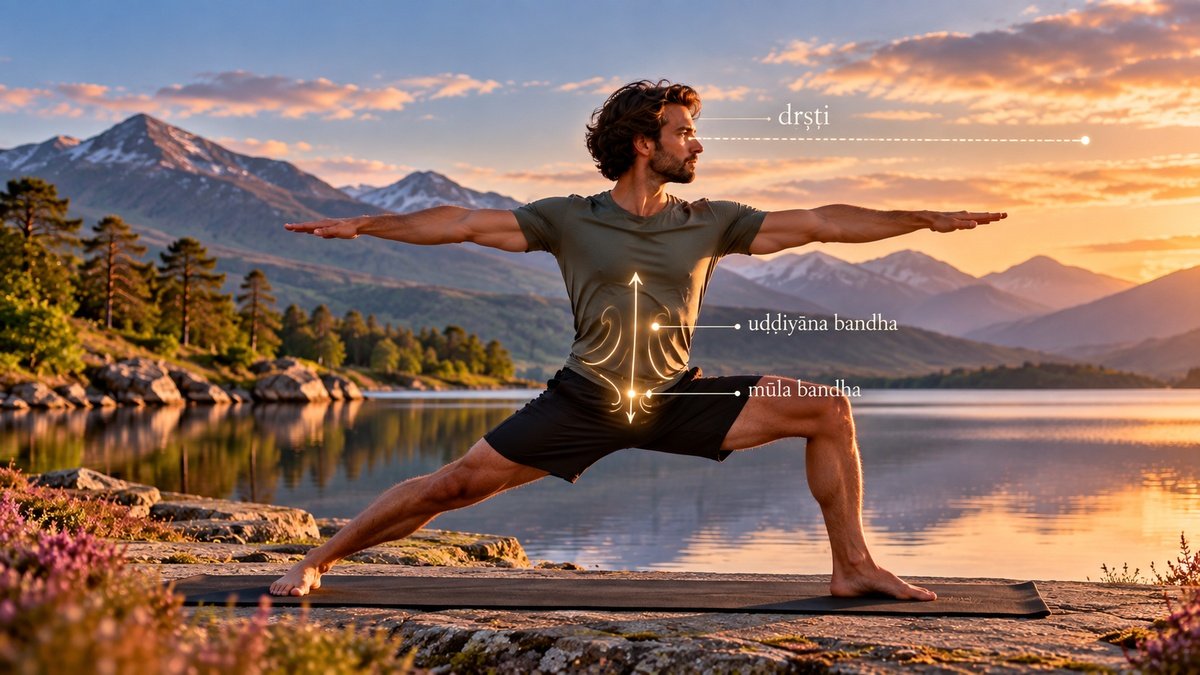
Once the basic structure of Ashtanga Yoga becomes familiar, another question emerges: what actually organises the practice from one movement to the next?
An Ashtanga Yoga practice brings several elements together. The sequence provides an established route. Breath accompanies movement. Vinyāsa connects postures and transitions. Dṛṣṭi directs the gaze. Bandha belongs to the method’s internal vocabulary of bodily organisation and attention.
None of these elements operates entirely on its own.
Together, they help explain why Ashtanga can feel different from simply performing a predetermined collection of yoga postures.
Repetition then adds another dimension. As the sequence becomes more familiar, practitioners may depend less on remembering what comes next and notice more about how they are actually moving through it.
This article looks inside that process: not simply at which postures appear in Ashtanga Yoga, but at how the practice is organised.
What Organises an Ashtanga Yoga Practice?
At first, the sequence may seem to be the most obvious organising principle.
That makes sense. Unlike many contemporary Vinyasa classes, Ashtanga Yoga works with an established order rather than asking the teacher to design a substantially different practice each time.
However, knowing the order of the postures is only part of the method.
The practitioner also coordinates particular movements with breathing, works with recurring transitions and directs attention in specific ways.
As familiarity develops, these different components can begin to function together rather than appearing as separate instructions.
For someone learning the practice, however, it can be useful to examine them individually.
Sequence Creates the Framework
The established sequence gives Ashtanga Yoga practice its most visible structure.
Instead of continually asking which posture should follow, practitioners gradually learn a recurring order. Opening movements lead into standing postures, the relevant series follows, and closing postures complete the practice.
This structure does more than create predictability.
Because the broad architecture remains relatively stable, repetition can make comparison possible. A transition that felt straightforward yesterday may feel different today. A familiar posture may require another approach. Breathing may feel spacious during one practice and more constrained during another.
Consequently, the sequence can function as a reference point rather than merely a routine to complete.
Article 42, Practice in Sequence: Understanding Ashtanga Yoga, introduces this overall structure and the role of the Primary Series. Here, our concern is what happens within that structure.
What Does Vinyāsa Mean in Ashtanga Yoga?
The term vinyāsa has several uses within modern yoga, so context matters.
In Ashtanga Yoga, vinyāsa refers particularly to the coordination of movement and breath within an organised sequence.
Each posture therefore exists within a larger pattern of entering, remaining and moving onward.
This helps explain the name Ashtanga Vinyasa Yoga.
Rather than treating transitions as empty spaces between the “real” postures, the method gives them a defined place within the practice.
A transition still does not need to become an athletic performance. The purpose of recognising it as part of the practice is not to make every movement more elaborate.
Instead, it asks the practitioner to notice how one position becomes another.
Movement Does Not Begin and End With the Posture
Photographs of yoga naturally emphasise shapes. A photograph can capture a Warrior position, a forward fold or a balance far more easily than it can show the movement that preceded it.
Ashtanga Yoga practice makes that missing space significant.
How does weight transfer from one place to another? When does an inhale accompany a movement? Where does an exhale occur? How does someone enter a posture, and how do they leave it?
These questions shift attention away from the posture as an isolated destination.
As a result, the practice includes not only where the body arrives but also the route it takes to get there.
This principle also connects naturally with our exploration of Vinyasa Yoga, although general Vinyasa classes usually allow considerably more freedom in how teachers construct the sequence.
How Does Breath Work in Ashtanga Yoga Practice?
Breathing provides another organising element.
Specific movements are traditionally coordinated with inhalation or exhalation. In broad terms, expanding or lifting movements often accompany an inhale, while folding or contracting movements often accompany an exhale.
The exact pattern depends on the movement and its place within the sequence.
Consequently, breath can help establish rhythm without requiring practitioners to move as quickly as possible.
This distinction matters. Coordinating movement with breathing is not the same as forcing breathing to keep pace with an external performance.
If someone cannot comfortably maintain the expected rhythm, the appropriate response is not necessarily to push harder. Pace, movement and the practice itself can be reconsidered.
Breath belongs within the practice; it should not become something the practitioner must fight against in order to complete it.
Is Ashtanga Breathing the Same as Ujjāyī Prāṇāyāma?
Ashtanga classes often describe an audible, controlled form of breathing as ujjāyī. However, terminology around this point deserves care.
Modern teachers do not always use the word in precisely the same way, and contemporary postural practice should not automatically be treated as identical to descriptions of ujjāyī found in premodern Haṭha Yoga texts.
For the practitioner, the more immediate point is that Ashtanga traditionally gives breathing sustained attention throughout the sequence.
The breath is generally intended to remain controlled rather than becoming an incidental response to increasingly strenuous movement.
That makes breathing both practical and attentional: it helps organise movement while also giving the practitioner something recurring to notice.
For the wider history and meaning of yogic breath practices, see our separate article on pranayama.
What Is Dṛṣṭi?
Dṛṣṭi is commonly translated in modern Ashtanga teaching as a looking place or gaze point.
Rather than allowing the eyes to move continuously around the room, practitioners direct the gaze in relation to particular postures.
Different positions use different looking places.
The practical significance is easy to overlook because gaze appears much less dramatic than a complex posture. Nevertheless, where someone looks can influence how they orient attention within a movement.
Dṛṣṭi also changes the relationship with the surrounding room.
Instead of continually checking what another practitioner is doing, looking towards the teacher or comparing external shapes, the gaze has a more specific task.
That does not mean practitioners become unaware of their surroundings. Safety and spatial awareness still matter. Rather, dṛṣṭi provides another way of organising attention within the practice.
What Are Bandhas?
Bandha is another Sanskrit term that appears frequently in Ashtanga Yoga practice.
The word can carry meanings related to binding, fastening or locking. Within yoga traditions, however, bandha has a complex history, and its meaning cannot be reduced to a single modern muscular instruction.
Contemporary Ashtanga teaching commonly places particular emphasis on mūla bandha and uḍḍīyāna bandha.
Teachers may explain these through different combinations of bodily engagement, breathing, attention and energetic language.
Because those explanations vary, it is useful to avoid presenting one anatomical cue as though it completely defines the traditional concept.
For example, reducing mūla bandha simply to “contract the pelvic floor” risks turning a historically complex yogic technique into a single muscle instruction. Likewise, descriptions of uḍḍīyāna within flowing Ashtanga practice should not automatically be treated as identical to every form of uḍḍīyāna bandha described elsewhere in Haṭha Yoga.
Within a contemporary Ashtanga class, bandha is better approached as part of the method’s vocabulary of bodily organisation and attention, while recognising that the concept has a wider history beyond modern postural practice.
What Is Tristhāna?
Modern Ashtanga teaching often brings three elements together under the term tristhāna: posture, breathing and looking place.
In practical terms, this means the practitioner is not concerned only with producing an āsana.
The physical position forms one part of the experience. Breathing provides another point of organisation, while dṛṣṭi gives the gaze a direction.
This three-part framework helps explain why an externally impressive posture does not necessarily represent the whole method.
A person might reproduce the visible shape while paying little attention to breathing or gaze. Conversely, someone working with a simpler variation can still engage carefully with movement, breath and attention.
Therefore, the external complexity of the posture tells us relatively little about the quality of someone’s attention within it.
Why Repeat the Same Sequence?
Repetition is sometimes interpreted as a way to perfect the sequence.
That can certainly be one consequence: familiarity may improve coordination and make the order easier to remember.
However, repetition can serve another purpose.
When the broad structure remains familiar, fewer elements are entirely new. This can create more opportunity to notice variation within the practitioner rather than variation in the choreography.
The same forward fold does not necessarily feel the same every day. Neither does a balance, a transition or a familiar breathing pattern.
In this sense, repetition can reveal difference.
The sequence provides continuity, while the practitioner encounters the changing conditions within which that sequence takes place.
Memorisation Changes the Practice
Learning the sequence from memory also changes the role of external instruction.
In many yoga classes, practitioners continually listen for the next posture. The teacher determines what happens next, and the class responds.
Once an Ashtanga practitioner knows a sequence, that dependency can decrease.
The practitioner still learns from a teacher, but the sequence itself gradually becomes familiar enough to navigate without constant verbal prompting.
This creates space for another kind of attention. Instead of repeatedly switching between listening, interpreting and responding to new instructions, the practitioner already has some knowledge of the route.
That does not make teaching unnecessary. It changes the nature of the teaching.
This becomes especially visible in Mysore-style Ashtanga, which we examine separately in Article 44.
Progression Does Not Have to Mean Collecting Postures
The progressive structure of Ashtanga can easily produce another interpretation: more postures must mean more progress.
That is too simple.
Learning additional postures expands the sequence someone practises, but it does not provide a complete measure of their practice.
A practitioner can move further through a series while still rushing, ignoring discomfort or becoming preoccupied with achieving particular shapes. Another person may work with fewer postures while developing greater familiarity, attention and discernment within them.
Therefore, progression has more than one dimension.
There is progression through the formal sequence, but there can also be increasing understanding of pacing, breathing, movement choices and personal limits.
The two should not automatically be treated as the same thing.
Can a Fixed Ashtanga Yoga Practice Be Adapted?
Yes. A structured method and individual adaptation do not have to oppose one another.
The important question is what an adaptation is trying to preserve.
For one practitioner, preserving the broad order of the sequence may be useful while changing the range of movement within particular postures. Someone else may alter a transition, use a prop or omit an element that is not appropriate for them.
A shorter practice can also remain recognisably Ashtanga in structure.
Adaptation therefore does not necessarily mean abandoning the method. It can mean distinguishing the essential organising principles from one particular physical expression of them.
This is especially important when practitioners differ in mobility, proportions, strength, experience, disability, pregnancy, injury history or simply how they feel on a particular day.
No sequence removes those differences.
Our wider discussion of Adaptive & Chair Yoga explores why adaptation can form part of thoughtful yoga teaching rather than representing a failure to perform the supposedly “real” practice.
What About Transitions?
Transitions deserve particular attention because they are easy to treat as secondary.
In a visually oriented practice culture, the completed posture often receives the photograph, the name and the sense of achievement. The transition disappears between those moments.
Ashtanga Yoga makes that disappearance harder.
Repeated transitions occur throughout the sequence, which means the way someone moves between positions can become as familiar as the positions themselves.
That familiarity creates opportunities for choice.
A transition can be simplified. Weight-bearing can be reconsidered. Pace can change. A movement can be omitted when necessary.
Consequently, preserving the integrity of a practice does not require turning every transition into its most demanding version.
A Common Misunderstanding: More Intensity Does Not Mean More Ashtanga
The visible athleticism of Ashtanga can make intensity appear central to authenticity.
It is easy to assume that deeper postures, faster transitions, stronger jump-backs or increasingly advanced series represent a more legitimate practice.
Yet intensity is not an organising principle in the same way that sequence, movement, breath and attention are.
A practitioner does not make a movement more attentive simply by making it harder.
Likewise, choosing a less demanding transition does not automatically remove the relationship between breathing, movement and sequence.
The distinction matters because otherwise the method can become a test of physical performance rather than a framework for practice.
The Orenna Perspective: The Practice Exists Between the Instructions
A sequence can be written down.
We can list its postures, count its movements and identify where inhalation or exhalation traditionally occurs. We can name a dṛṣṭi and describe a transition.
Yet a list of instructions cannot fully describe what happens when a particular person practises them on a particular day.
That space matters.
Structure provides orientation, but awareness is required to notice what happens inside it.
A familiar sequence may reveal when movement feels different. Breath may suggest that the current pace needs reconsideration. A transition may invite another option. Attention may wander and return.
From an Orenna perspective, this is where structure becomes most interesting.
The sequence does not need to disappear for individual experience to matter. Equally, individual experience does not require the sequence to lose all form.
The practice exists not only in following the instructions, but in noticing what happens while we follow them.
Continue Exploring Ashtanga Yoga
This article is the second part of our five-part exploration of Ashtanga Yoga.
If you are new to the method, begin with Practice in Sequence: Understanding Ashtanga Yoga, which introduces the overall structure and terminology.
Next, we move from the mechanics of the practice to the way it is traditionally taught in Learning Without Following the Teacher: Understanding Mysore-Style Ashtanga.
Later articles explore the history of Ashtanga Yoga and the important distinction between this modern postural method and Patañjali’s aṣṭāṅga, or eight-limbed, framework.
References & Further Reading
Birch, J. & Singleton, M. (2019). “The Yoga of the Haṭhābhyāsapaddhati: Haṭhayoga on the Cusp of Modernity.” Journal of Yoga Studies, 2.
Ciołkosz, M. (2022). Thinking in Āsana: Movement and Philosophy in Viniyoga, Iyengar Yoga, and Ashtanga Yoga. Equinox Publishing.
Singleton, M. (2010). Yoga Body: The Origins of Modern Posture Practice. Oxford University Press.
Mallinson, J. & Singleton, M. (2017). Roots of Yoga. Penguin Classics.
For academic research into the history of physical yoga and the relationship between premodern and modern practice, see the SOAS Haṭha Yoga Project.