


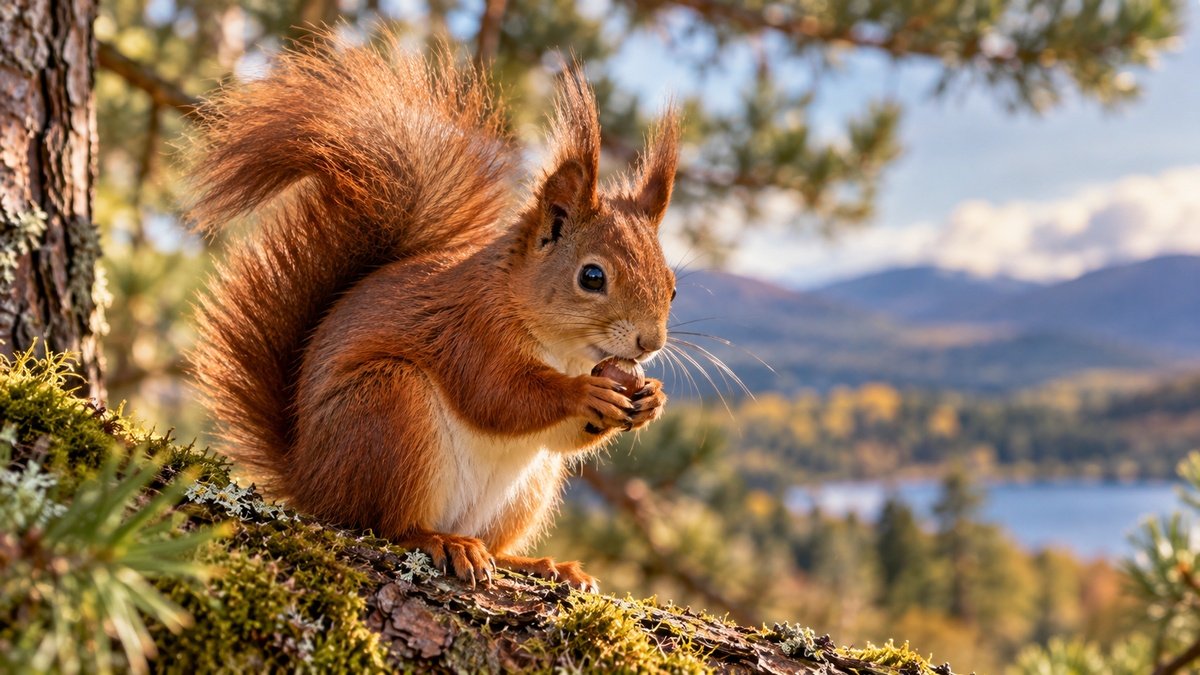
Red squirrels in Scotland can transform an ordinary moment in woodland. A movement across a branch, a flash of russet fur or the curve of a tail among the trees can suddenly draw attention into the canopy.
They are particularly associated with Scotland’s forests, including the pinewoods of the Highlands. Yet the red squirrel is more than an appealing woodland encounter. Its story reveals how closely wildlife depends on habitat, food, woodland structure and the connections between one place and another.
It is also a story of ecological change.
Red squirrels were once widespread across Britain. Today, Scotland supports most of the remaining British population. However, their distribution has changed substantially, particularly following woodland loss and the spread of introduced grey squirrels.
Understanding red squirrels therefore means looking beyond the animal itself. We also need to notice the forest around it.
Red Squirrels in Scotland
The Eurasian red squirrel, Sciurus vulgaris, is Scotland’s only native squirrel species.
Red squirrels live in a range of wooded environments. These include conifer forests, broadleaf woodland, mixed woodland, parks and gardens where suitable trees and food are available.
Scotland is particularly important for the species. NatureScot estimates that around 80% of Britain’s remaining red squirrels live in Scotland’s woodlands, parks and gardens.
However, red squirrels are not distributed evenly across the country. Strong populations remain in parts of the Highlands and other areas where suitable habitat persists and pressure from grey squirrels is lower.
Consequently, seeing a red squirrel in Scotland today connects us with both a living native species and a much larger conservation story.
A Life Among the Trees
Red squirrels spend much of their lives in trees, where they feed, travel, rest and breed.
Their bodies are well suited to this environment. Strong hind legs help them jump between branches, while sharp claws provide grip on bark. Meanwhile, the long tail can assist with balance as a squirrel moves through the canopy.
Nevertheless, red squirrels also come to the ground. They may descend to search for food, move between trees or cross gaps within woodland.
That movement helps explain why the structure of a forest matters. A woodland is not simply a collection of individual trees. For an animal travelling through the canopy, the distance and relationship between those trees can shape how easily it moves through its habitat.
What Do Red Squirrels Eat?
Red squirrels have a varied diet, and what they eat changes according to season and availability.
Tree seeds are particularly important. Seeds from pine, spruce and larch cones can provide valuable food, while nuts, fungi, fruits, shoots and other plant material may also form part of the diet.
As a result, different trees can provide food at different times. A woodland containing suitable and varied food sources can therefore offer greater continuity across the seasons.
Food availability also changes from year to year. Trees do not produce identical quantities of seeds every season, so squirrels must respond to a food supply that is naturally variable.
They may also store food for later use. Consequently, the woodland becomes not only somewhere to find food immediately, but also a landscape through which resources are gathered, moved and stored.
Where Do Red Squirrels Sleep?
Red squirrels use nests known as dreys.
A drey is generally constructed among tree branches and can include twigs, leaves, mosses and other plant material. From the ground, however, it may be difficult to distinguish a squirrel drey from some bird nests.
Dreys provide places for rest, shelter and breeding. Therefore, protecting red squirrels also requires attention to the structures they depend upon within woodland rather than focusing only on the animals themselves.
In Scotland, red squirrels and their dreys receive legal protection. Forestry operations in areas where squirrels are present consequently require appropriate planning to minimise disturbance and protect breeding sites.
Red Squirrels and the Caledonian Forest
For many people, red squirrels and Scots pine belong naturally within the same Highland image.
There is good reason for that association. Red squirrels can live successfully within native pinewoods, and pine seeds provide an important food source.
Our exploration of the Caledonian Forest considered woodland as more than a collection of trees. Red squirrels make that principle particularly visible.
A Scots pine provides more than visual character. Its branches create routes through the canopy, while its cones can provide food. Older woodland also contains relationships between trees, understory vegetation, fungi, insects, birds and mammals.
However, red squirrels are not restricted to ancient native pinewoods. They can use several woodland types, including managed conifer forests. In fact, some productive conifer forests support important red squirrel populations in Scotland.
Therefore, describing the species simply as an animal of untouched ancient forest would overlook much of its contemporary ecology.
Why Connected Woodland Matters
The amount of woodland matters to red squirrels, but so does its arrangement.
Where suitable habitat becomes divided into isolated patches, squirrels may need to travel across open ground or other unsuitable areas to reach food, breeding opportunities or neighbouring populations.
NatureScot notes that fragmented habitat can isolate red squirrel populations from one another and from food sources. In addition, crossing open ground can increase exposure to predators.
Woodland connectivity can therefore influence how animals move through a wider landscape.
Nevertheless, connectivity is not simply a matter of joining every woodland to every other woodland. In places where grey squirrels threaten red squirrel populations, conservation planning may also need to consider how woodland connections could affect the movement of both species.
As with many ecological questions, context matters.
Why Have Red Squirrels Declined?
The decline of red squirrels in Britain does not have one single cause.
Historical woodland loss reduced habitat, while later fragmentation separated some remaining populations. However, the introduction and subsequent spread of the eastern grey squirrel, Sciurus carolinensis, created an additional and particularly important pressure.
Grey squirrels are native to North America rather than Britain. People introduced them to Britain during the nineteenth and early twentieth centuries, after which they spread into many areas.
Today, the relationship between red and grey squirrels is one of the central issues in British red squirrel conservation.
Red Squirrels, Grey Squirrels and Competition
Red and grey squirrels use many of the same woodland resources. Consequently, where both species occur, they can compete for food and habitat.
Grey squirrels can use some food resources particularly efficiently and can occur at higher densities in suitable habitats. Over time, this competition can make it more difficult for red squirrel populations to persist.
However, describing grey squirrels as deliberately driving red squirrels away would misrepresent what is happening.
The animals are not making a decision to displace another species. Instead, two species with overlapping ecological requirements are interacting within an environment where one was introduced by people and has competitive advantages in many woodland habitats.
That distinction matters because conservation biology describes ecological processes rather than assigning moral intentions to wildlife.
Squirrelpox Adds Another Pressure
Competition is not the only reason grey squirrels create difficulties for red squirrel conservation.
Some grey squirrel populations carry squirrelpox virus. Grey squirrels can carry the virus without developing the severe disease seen in red squirrels.
For red squirrels, however, infection can cause serious and frequently fatal disease. Consequently, squirrelpox can accelerate local red squirrel decline where the virus is circulating and the two species come into contact.
This is particularly important in areas where grey squirrel populations are expanding towards significant red squirrel populations.
Monitoring therefore has an important role. Recording where red and grey squirrels are seen can help conservation organisations understand changes in distribution and identify areas where intervention may be needed.
Conserving Red Squirrels in Scotland
Protecting red squirrels in Scotland involves several approaches rather than one single solution.
Suitable woodland needs to remain available, while forest management can help maintain reliable food resources and habitat structure. Monitoring also helps conservation organisations understand where red and grey squirrel populations are changing.
In strategically important areas, targeted grey squirrel control is currently another part of conservation management. The purpose is to reduce competition and lower the risk of squirrelpox reaching or circulating within vulnerable red squirrel populations.
Scottish Forestry also identifies designated red squirrel strongholds. These are areas managed with the long-term persistence of red squirrel populations in mind.
Conservation therefore takes place at several scales: individual trees and dreys, woodland structure, connected habitats and wider regional populations.
Not Every Forest Is the Same
Red squirrel conservation also reveals why the word forest can conceal important differences.
A native pinewood, mixed woodland and commercial conifer plantation may all contain trees, but their species composition, age structure, food resources and management can differ considerably.
Some conifer plantations provide valuable habitat for red squirrels and can help support populations where grey squirrels are absent or controlled. However, that does not mean every landscape should become conifer plantation.
Our articles on the Caledonian Forest and Highland peatlands illustrate the same principle from different directions.
Native woodland has ecological value. Peatland has ecological value. Managed forest can also provide habitat for particular species.
Therefore, the useful question is not simply, Are there trees?
Instead, we can ask: What kind of woodland is this, what lives here, and what relationships does its management support?
Red Squirrels and a Changing Highland Landscape
Highland woodland does not remain unchanged around its wildlife.
Trees grow and fall, while storms create openings in the canopy. Forestry changes woodland structure, and regeneration introduces new generations of trees. At the same time, climate and land management influence which species can establish successfully.
Animals respond to those changes.
A red squirrel population that has sufficient food and connected habitat today may encounter different conditions in future decades. Consequently, conservation cannot focus only on preserving a photograph of what the forest looks like now.
It also involves thinking about what the woodland may become.
Weather Changes the Woodland Too
The experience of woodland changes continuously with weather and season.
Rain darkens bark and vegetation, while wind moves branches through the canopy. Frost alters the forest floor, and changing daylight affects how easily movement among the trees can be noticed.
For wildlife, these conditions are not simply atmosphere. Weather interacts with food availability, shelter and the energetic demands of daily life.
However, individual animals respond to environmental conditions in complex ways. It would therefore be too simple to predict squirrel behaviour from one weather condition alone.
As explored in our article on Highland weather, changing conditions are part of the landscape rather than interruptions to it.
Seeing Red Squirrels in Scotland Responsibly
Seeing red squirrels in Scotland does not require approaching them closely.
Quiet observation from an appropriate distance allows natural behaviour to continue with less disturbance. Binoculars or a camera lens can help provide a closer view without physically moving closer to the animal.
Where hides, viewing areas or designated woodland paths are available, they can provide useful opportunities for observation. Nevertheless, a sighting can never be guaranteed because wild animals decide where they move.
Feeding wildlife also requires care. Shared feeders can potentially contribute to disease transmission if they are not appropriately managed and cleaned. Therefore, local conservation guidance should be followed where supplementary feeding takes place.
If a squirrel appears visibly unwell, conservation organisations such as Saving Scotland’s Red Squirrels provide guidance on reporting suspected disease.
Respectful wildlife watching allows an encounter to remain an encounter rather than becoming an attempt to control what the animal does.
You Do Not Need to Walk Deep Into a Forest
Wildlife imagery often suggests that meaningful encounters require remote landscapes, long walks or specialist outdoor experience.
They do not.
Depending on location, red squirrels may be observed from woodland paths, hides, visitor facilities, gardens, parks and other places where suitable habitat exists.
Mobility, health, sensory preferences, transport, weather, work, caring responsibilities and available time can all shape how someone experiences wildlife and woodland.
For some people, a long forest walk may be enjoyable. For others, watching quietly from an accessible location may be more suitable. Neither experience is inherently more meaningful.
Attention does not depend on distance travelled.
A Common Misunderstanding: Grey Squirrels Simply Drive Red Squirrels Away
The relationship between red and grey squirrels is sometimes described as though one animal deliberately chases the other from the forest.
The ecological reality is more complex.
Grey squirrels compete with red squirrels for overlapping resources, and that competition can disadvantage red populations. In addition, some grey squirrels carry squirrelpox virus, which can cause severe and often fatal disease in red squirrels.
Habitat also matters. Woodland type, food availability, fragmentation and the surrounding distribution of both species can influence what happens in a particular area.
Therefore, the decline of red squirrels cannot be reduced to a story about one individual animal behaving badly towards another.
Grey squirrels did not choose to come to Britain. People introduced them. Their subsequent ecological impact is real, but assigning human motives or moral categories to the animals does not explain that impact.
Conservation instead asks a practical question: What conditions will allow native red squirrel populations to persist?
The Orenna Perspective — A Forest Is Made From Relationships
At Orenna, a forest becomes more interesting when we stop seeing it as a background.
A Scots pine is a tree, but it is also potential food, shelter and a route through the canopy. A fallen branch becomes habitat for other organisms. Fungi interact with roots and decaying material, while weather changes the conditions around them.
Meanwhile, a red squirrel moves through this network rather than simply appearing in front of it.
Understanding red squirrels in Scotland therefore changes what we can notice in woodland. Cones become food sources. Branches become pathways. Gaps between forests become questions about connectivity. The presence of another squirrel species becomes part of a much larger history of human movement and ecological change.
This does not mean that every woodland visit needs to become an ecological study. Nor does someone need specialist knowledge to appreciate seeing a squirrel disappear between the trees.
However, understanding can add another layer to attention.
Our exploration of nature and wellbeing considered how place can shape what becomes available to notice. Wildlife can do something similar. A brief movement in the canopy can reveal connections that were present before we noticed them.
Sometimes understanding a landscape begins by noticing who else depends upon it.
References & Further Reading
NatureScot. Red Squirrel. Information on red squirrel distribution, woodland habitat, conservation and the importance of Scotland for Britain’s remaining population.
NatureScot. Protected Species: Red Squirrels. Guidance on the legal protection given to red squirrels and their dreys in Scotland.
Scottish Forestry. Conserving Red Squirrels. Information on woodland habitat, red squirrel strongholds, grey squirrel pressure and current conservation measures in Scotland.
Scottish Forestry. Forestry Operations and Red Squirrels. Guidance on protecting red squirrels, dreys and food sources during forestry operations.
Saving Scotland’s Red Squirrels. Scotland’s Red Squirrels. Information on red and grey squirrel distribution, habitat fragmentation, squirrelpox and conservation activity across Scotland.
Saving Scotland’s Red Squirrels. About Saving Scotland’s Red Squirrels. Information on monitoring, grey squirrel management, community participation and current approaches to protecting red squirrel populations.
The Orenna Journal explores yoga, well-being, philosophy and place from historical, evidence-informed and contemporary perspectives. Wildlife populations, disease patterns and conservation priorities can change over time and differ between locations. This article provides a general introduction to red squirrels in Scotland rather than wildlife-management advice.



