


Shadow Yoga has a name that invites misunderstanding.
To a contemporary reader, “shadow” may suggest psychological shadow work: examining repressed emotions, unconscious personality traits or hidden parts of the self.
That is not what the name means within this system.
Shadow Yoga is a modern school of Haṭha Yoga developed by Sundernāth, also known as Shandor Remete, and Emma Balnaves. Its approach places unusual emphasis on the preparation that occurs before more conventional āsana practice.
Standing work, squatting, rhythmic movement, spiralling patterns, breath, coordination and forms influenced by traditional dance and martial disciplines help establish the foundations from which later practice develops.
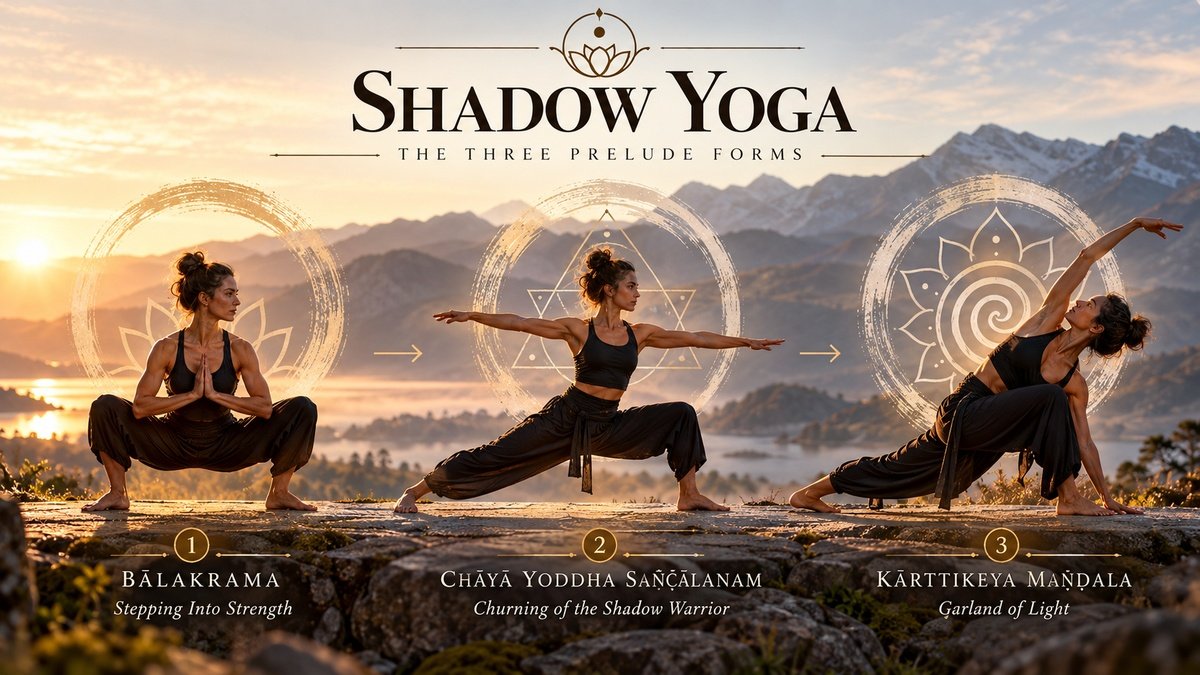
Its best-known preparatory sequences are the three Prelude Forms: Bālakrama, Chāyā Yoddha Sañcālanam and Kārttikeya Maṇḍala.
Yet these forms are deliberately called preludes.
They prepare the practitioner for something further.
What Is Shadow Yoga?
Shadow Yoga describes itself as a school of Haṭha Yoga.
The contemporary system was conceived by Sundernāth and Emma Balnaves around 2000, although the practices and traditions from which it draws have considerably older histories.
Its methodology does not begin by accumulating increasingly difficult yoga postures.
Instead, preparatory practices develop the feet, legs, joints, coordination, breathing and capacity for rhythmic movement before the practitioner moves more deeply into āsana, mudrā, prāṇāyāma and contemplative practice.
This creates an important distinction.
Shadow Yoga is modern as a named school, while many of the traditions, texts and practices informing it are much older.
Who Created Shadow Yoga?
Sundernāth (Shandor Remete) is the founder of Shadow Yoga.
Born in Hungary, Remete encountered yoga from an early age and subsequently spent decades studying and practising yoga alongside other systems of physical cultivation.
His approach developed through engagement with Haṭha Yoga, martial disciplines, dance, Āyurveda and teachings associated with the Nāth tradition.
Emma Balnaves is co-founder and teacher of Shadow Yoga. She became involved with yoga in adolescence and later undertook extensive study in yoga, Āyurveda and related internal arts.
Together, Sundernāth and Balnaves developed and transmitted the contemporary Shadow Yoga system internationally.
Therefore, it would be misleading to describe Shadow Yoga as an ancient school transmitted unchanged under this name.
The named method belongs to modern yoga history.
Why Is It Called Shadow Yoga?
The word shadow does not refer primarily to psychological shadow work.
Shadow Yoga connects its name with the Sanskrit concept of chāyā, meaning shadow, and particularly with Chāyā Puruṣa, the “shadow person” or “shadow man”.
The school’s own account connects this concept with teachings found in works including the Śiva Svarodaya and Śiva Saṃhitā.
Within Shadow Yoga’s philosophical interpretation, the human being consists of layers that can obscure clear perception of an essential inner reality.
The “shadow” therefore belongs to a traditional yogic and subtle-body framework.
It should not automatically be translated into modern psychological categories.
Nor should these subtle layers be presented as anatomical structures that biomedical science has independently identified.
Is Shadow Yoga a Form of Shadow Work?
No.
The similarity in terminology can cause considerable confusion.
Modern psychological and wellness language often uses shadow work for practices concerned with unconscious, rejected or hidden aspects of personality, frequently drawing loosely from ideas associated with Carl Jung.
Shadow Yoga belongs to a different conceptual history.
Its name arises from yogic ideas surrounding chāyā and the layered constitution of the practitioner.
A Shadow Yoga practice may certainly encourage attention and self-observation.
However, describing it as a method for uncovering repressed trauma or integrating a Jungian shadow would impose a different framework upon the system.
Why Does Shadow Yoga Begin Before Asana?
One of the most interesting features of Shadow Yoga is its insistence on preparation.
Modern yoga classes often introduce āsanas immediately.
Shadow Yoga asks what needs to happen first.
Its preparatory work develops fundamental movement capacities through the feet, ankles, knees, hips, spine and limbs while coordinating these actions with breathing and attention.
Rather than assuming that the body is already prepared for increasingly complex postures, the method builds the conditions from which those postures can emerge.
This preparatory principle is expressed most visibly through the Prelude Forms.
What Are the Three Shadow Yoga Prelude Forms?
Shadow Yoga teaches three principal Prelude Forms.
Each develops particular qualities while preparing for subsequent stages of practice.
They are:
1. Bālakrama — Stepping Into Strength
2. Chāyā Yoddha Sañcālanam — Churning of the Shadow Warrior
3. Kārttikeya Maṇḍala — Garland of Light
The forms are progressive rather than interchangeable collections of exercises.
The official Shadow Yoga teaching places particular importance on cultivating the earlier material before approaching the more demanding later Prelude.
What Is Balakrama?
Bālakrama, translated by Shadow Yoga as “Stepping Into Strength”, is the first Prelude.
Its work begins close to the ground.
The feet and lower limbs receive particular attention through standing positions, stepping patterns and movements that develop the relationship between the feet, legs and centre of the body.
Shadow Yoga’s own teaching emphasises rooted feet and relaxed knees so that movement can remain responsive rather than rigid.
This first Prelude establishes foundations that later forms require.
Strength here is therefore not simply muscular force.
It includes the ability to organise movement from the ground upwards.
What Is Chaya Yoddha Sanchalanam?
Chāyā Yoddha Sañcālanam, the second Prelude, is translated as “Churning of the Shadow Warrior”.
Warrior-like stances become prominent.
The practitioner develops coordination between movement, breathing, the limbs and the centre while maintaining an upright yet responsive spine.
Compared with the first Prelude, the demands on coordination become more complex.
Movement does not merely travel from one posture to another.
Instead, the sequence develops rhythm, direction and the capacity to transmit force through an integrated body.
What Is Karttikeya Mandala?
Kārttikeya Maṇḍala, translated as “Garland of Light”, is the third Prelude.
It introduces more extensive twisting, spiralling and coordinated movement through the limbs and trunk.
The body repeatedly contracts and expands through rhythmic patterns.
Shadow Yoga describes this Prelude as longer, deeper and more rigorous than the preceding forms.
For that reason, the earlier Preludes provide preparation rather than optional preliminary material to skip.
The sequence illustrates a central principle of the system: complexity should emerge from preparation.
Why Do the Preludes Include Squats, Stances and Spirals?
The movement vocabulary of Shadow Yoga can look different from that of a conventional studio yoga class.
Deep squatting patterns, low stances, stepping, spiralling actions and rhythmic movements feature prominently.
These actions develop mobility, coordination, balance and strength while preparing movement pathways used later in āsana.
The method also reflects Sundernāth’s engagement with martial and dance traditions.
That does not mean Shadow Yoga is simply a martial art disguised as yoga.
Rather, those disciplines contribute movement principles to a system whose stated orientation remains Haṭha Yoga.
What Is Nrtta Sadhana?
Nṛtta Sādhana occupies an important place within the wider Shadow Yoga system.
Nṛtta refers to pure dance.
Shadow Yoga describes this practice as a means of rediscovering natural rhythmic currents through movement.
The school’s presentation connects Nṛtta with older ascetic and dance traditions and uses sequences associated symbolically with figures such as Śiva and Kālī.
Its forms include Ānanda Tāṇḍava, Aṣṭa Mātṛkās, Lāsya and Śiva Tāṇḍava, alongside additional practices within the evolving system.
Here, dance does not primarily mean theatrical performance.
It functions as sādhana: disciplined practice.
What Is the Connection with the Natha Tradition?
Shadow Yoga explicitly situates its teaching within a relationship to the Nāth Sampradāya.
Sundernāth describes himself as an initiate of the Nāth tradition.
The Nāths occupy an important place in the history of medieval yoga and particularly in the development of practices later associated with Haṭha Yoga.
Figures such as Matsyendranāth and Gorakṣanāth became especially important within Nāth lineages and the broader history of yoga.
However, historical relationships among Nāth traditions, Haṭha Yoga texts and contemporary schools remain complex.
Consequently, the statement that Shadow Yoga belongs to a living Nāth lineage represents an important part of the school’s own lineage identity, while the modern organisation of Shadow Yoga remains associated specifically with Sundernāth and Emma Balnaves.
How Does Shadow Yoga Understand Hatha Yoga?
Shadow Yoga’s understanding of Haṭha Yoga reaches considerably beyond stretching and posture.
Its teaching includes preparation, āsana, mudrā, prāṇāyāma, mantra, concentration and meditation.
That broader orientation resembles the historical complexity of Haṭha Yoga more closely than the modern studio use of “Hatha” simply to mean a slower physical class.
Nevertheless, Shadow Yoga represents one contemporary interpretation and transmission of this wider heritage.
It should not be treated as the single authoritative definition of historical Haṭha Yoga.
Does Shadow Yoga Use Pranayama?
Yes, but progression matters.
Within Shadow Yoga, prāṇāyāma belongs to a larger sequence of cultivation rather than functioning simply as a breathing exercise added to the end of a class.
The method places physical preparation, āsana and other practices within a progression towards increasingly internal work.
Traditional concepts such as prāṇa also appear within this framework.
As elsewhere in The Orenna Journal, we should distinguish this yogic concept from modern physiology.
Prāṇa should not simply be translated as oxygen, electricity or another measurable physical energy.
What Role Do Mudra and Bandha Play?
Mudrā and bandha form part of the deeper Haṭha Yoga methodology from which Shadow Yoga draws.
Modern classes sometimes reduce mudrā to hand gestures and bandha to muscular contractions.
Historically, both categories are more complex.
Haṭha Yoga texts describe mudrās and bandhas in connection with breath, vital processes and the subtle body.
Shadow Yoga preserves this broader orientation.
These practices therefore belong within a progressive system rather than functioning simply as decorative additions to physical postures.
What Is Laya Krama?
Laya Krama belongs to the more internal dimensions of the Shadow Yoga system.
The school describes it as a process concerned with laya, or reabsorption, involving practices including prāṇāyāma, mudrā, pratyāhāra and dhāraṇā.
Shadow Yoga identifies preparatory practices such as Nṛtta Sādhana as necessary foundations for this work.
This is important because it reveals the larger trajectory of the system.
The Prelude Forms are not intended to become an end in themselves.
Physical preparation ultimately supports increasingly internal practices of attention and meditation.
Does Shadow Yoga Have Fixed Sequences?
Yes — but with an important qualification.
The Prelude Forms are structured sequences.
However, the official Shadow Yoga teaching states that fixed forms should ultimately develop the capacity for freestyle practice.
This creates an interesting pedagogical progression.
Structure comes first.
Through repetition, the practitioner learns principles of movement, breath, rhythm and organisation.
Eventually, those principles can support a more individual practice rather than permanent dependence upon a prescribed sequence.
Therefore, the fixed form acts as a teacher rather than necessarily becoming the final destination.
Is Shadow Yoga Like Ashtanga Yoga?
Both systems use disciplined progression and structured practice, but they should not be conflated.
Ashtanga Yoga is associated with recurring series developed through the modern Mysore tradition of K. Pattabhi Jois.
Shadow Yoga developed through Sundernāth and Emma Balnaves and uses its own Prelude Forms, Nṛtta and subsequent stages of practice.
Their movement vocabularies also differ considerably.
Most importantly, Shadow Yoga treats its fixed preparatory forms as training towards more individualised practice.
Is Shadow Yoga Like Vinyasa Yoga?
Shadow Yoga includes continuous movement, but that alone does not make it Vinyasa Yoga.
Its Prelude Forms contain deliberate stepping, stances, squatting, spiralling and rhythmic patterns organised according to the methodology of the school.
The purpose also extends beyond creating a flowing physical sequence.
Preparatory movement develops capacities required for later āsana and internal practices.
Calling it simply another flow style therefore misses much of its structure and intention.
Is Shadow Yoga Similar to Martial Arts?
Some aspects can certainly look martial.
Low stances, directional stepping, coordinated limbs and controlled transitions create an obvious visual resemblance.
Sundernāth’s wider study of martial disciplines also contributed to the development of the method.
Yet Shadow Yoga does not teach combat as its objective.
It uses movement principles drawn from several physical disciplines within a yogic framework.
Influence does not mean equivalence.
What Are Marma Points in Shadow Yoga?
Shadow Yoga teaching also refers to marma, a concept with important histories in Indian medical and martial traditions.
Marmas are traditionally understood as significant or vulnerable bodily locations.
Different traditions have interpreted their functions in different ways.
Shadow Yoga incorporates marma theory within its understanding of movement and internal practice.
However, traditional marma concepts should not automatically be converted into claims about scientifically verified “energy points”.
Historical framework and contemporary anatomy can be discussed alongside one another without pretending that they are identical systems.
Is Shadow Yoga Suitable for Beginners?
Beginners can encounter Shadow Yoga through appropriate introductory teaching.
Indeed, preparation is fundamental to the method.
That does not mean every Shadow Yoga practice is suitable for every beginner.
Deep squatting, demanding stances, complex coordination and later internal practices may require gradual development.
The Prelude system itself argues against rushing.
Progression should follow capacity rather than ambition.
A beginner therefore does not need to imitate the practice of someone who has spent years cultivating the method.
Does Shadow Yoga Use Props?
Props do not define Shadow Yoga in the way that they characterise some approaches to Iyengar Yoga.
The method instead gives substantial attention to learning how the body organises itself through stance, movement, breath and appropriate preparation.
That does not make external support inherently incompatible with intelligent practice.
Different practitioners may still require adaptation.
No commitment to a traditional method should override sensible consideration of individual circumstances.
Does Shadow Yoga Release Blocked Energy?
Shadow Yoga uses traditional language concerning prāṇa, subtle pathways, marma and the removal of obstructions.
Those concepts belong to the philosophical and practical framework through which the system understands the body.
They should not automatically become biomedical statements.
For example, saying that movement removes an energetic obstruction within a traditional yogic model is different from claiming that a scientifically measurable substance has been physically unblocked.
Likewise, feeling freer or less restricted after movement does not prove the existence of a particular subtle structure.
The distinction protects both traditional interpretation and scientific accuracy.
Does Shadow Yoga Release Trauma?
Shadow Yoga should not automatically be presented as trauma therapy.
Movement, breathing and sustained attention can produce meaningful subjective experiences. Some practitioners may notice emotions or memories while practising.
However, this does not establish that trauma is literally stored inside a particular muscle, joint or energetic pathway and then physically released by a sequence.
Clinical trauma treatment belongs to an appropriately qualified professional context.
Yoga practice can remain valuable without requiring therapeutic claims that exceed its scope.
A Common Misunderstanding: Shadow Yoga Is Not About Darkness
The word shadow can make the practice sound mysterious, psychological or even deliberately esoteric.
That interpretation misses the more specific framework from which the name emerges.
Shadow Yoga uses “shadow” within a yogic understanding of layers, obstruction and perception.
Its practical response is equally significant.
The system does not begin by asking practitioners to analyse their darkest thoughts.
It begins with the feet.
Standing, stepping, squatting, breathing and learning how to move precede increasingly internal practices.
That progression is one of the clearest ways to understand the method.
An Orenna Perspective: The Practice Before the Practice
Modern yoga can make progress appear additive.
Learn another posture. Attempt a deeper variation. Add another technique.
Shadow Yoga introduces a different question:
What if what comes before the posture matters as much as the posture itself?
A foot that cannot organise contact with the ground changes everything above it.
A breath disrupted by unnecessary effort changes the movement it accompanies.
A complex posture approached before its foundations exist may reveal ambition more readily than understanding.
Preparation can look less impressive because its purpose is not spectacle.
Yet preparation changes what becomes possible afterwards.
Perhaps some of the most consequential parts of practice are precisely those that prepare us for something we are not yet ready to do.
References & Further Reading
Shadow Yoga. Official teachings and resources by Sundernāth (Shandor Remete) and Emma Balnaves provide the principal primary sources for the school’s history, Prelude Forms, Nṛtta Sādhana and wider practice methodology.
Shandor Remete. Shadow Yoga, Chaya Yoga: The Principles of Hatha Yoga. A primary presentation of the principles underlying the Shadow Yoga method.
James Mallinson & Mark Singleton. Roots of Yoga. Provides broader historical context for Haṭha Yoga, āsana, prāṇāyāma, mudrā and related practices.
James Mallinson. Research on the history of Haṭha Yoga and Nāth traditions provides important scholarly context for distinguishing medieval yogic developments from their modern interpretation.



