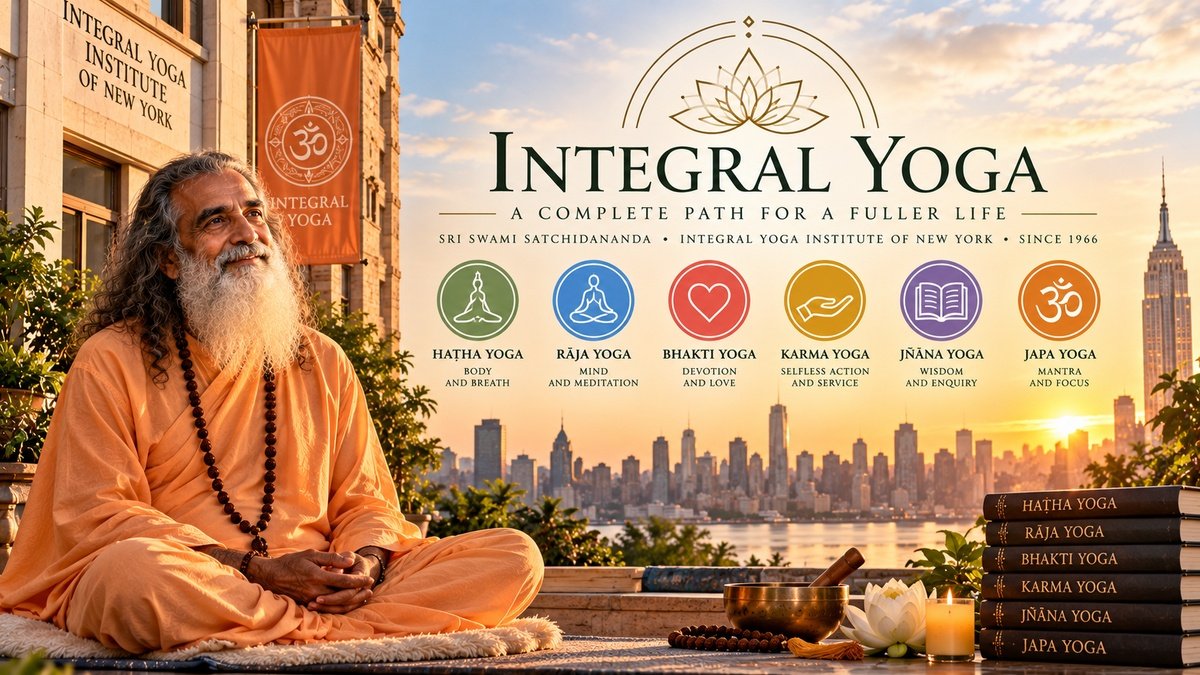
Integral Yoga begins with a broad proposition: no single practice necessarily encompasses everything that yoga can ask of a person.
Physical posture has a place. So do breathing, meditation, ethical discipline, devotion, philosophical enquiry, mantra and service.
Rather than choosing one of these dimensions and treating it as the whole of yoga, Sri Swami Satchidananda brought them together within a comprehensive modern system.
He called that system Integral Yoga.
Its six principal branches are Haṭha Yoga, Rāja Yoga, Bhakti Yoga, Karma Yoga, Jñāna Yoga and Japa Yoga.
Each approaches practice differently. Together, they form a method intended to extend from the body and breath into attention, relationships, action, knowledge and spiritual life.
This makes Integral Yoga considerably larger than a particular style of yoga class.
So what is Integral Yoga? Who was Swami Satchidananda? What did he inherit from Swami Sivananda? Why are there six branches? What happened at Woodstock? What is Yogaville? And how does a tradition built around integration understand the relationship between practice and everyday life?
What Is Integral Yoga?
Integral Yoga is a modern yoga tradition founded by Sri Swami Satchidananda and formally established in the United States during the 1960s.
Its distinctive feature is synthesis.
Rather than organising practice around āsana alone, Integral Yoga combines six branches of yoga:
Haṭha Yoga — physical and respiratory practice
Rāja Yoga — ethical discipline, concentration and meditation
Bhakti Yoga — devotion
Karma Yoga — selfless action and service
Jñāna Yoga — philosophical enquiry and knowledge
Japa Yoga — repetition of mantra
These branches do not function as six competing styles from which someone must choose one.
Within Integral Yoga, they complement one another.
The body can be practised through Haṭha Yoga. The mind can be examined through Rāja Yoga and Jñāna Yoga. Devotion finds expression through Bhakti. Action becomes practice through Karma Yoga. Mantra provides another form of concentration and contemplative discipline through Japa.
Yoga consequently becomes something that can continue when the physical practice has finished.
Who Was Sri Swami Satchidananda?
Sri Swami Satchidananda was an Indian spiritual teacher and the founder of the Integral Yoga organisation.
He was born in South India in 1914.
His spiritual development involved contact with several Indian teachers and traditions before he became a disciple of Swami Sivananda Saraswati, founder of the Divine Life Society in Rishikesh.
Sivananda initiated him into sannyāsa, the Hindu renunciate order, in 1949.
Satchidananda subsequently taught in India and Sri Lanka before travelling internationally.
In 1966, he arrived in the United States during what was initially intended to be a relatively short visit.
Instead, New York became the setting for a major new phase of his teaching.
His students established the first Integral Yoga Institute there later that year.
Satchidananda eventually became one of the prominent Indian teachers involved in the expansion of yoga and Indian spirituality within late twentieth-century American culture.
What Is the Connection Between Swami Sivananda and Integral Yoga?
Sri Swami Satchidananda’s relationship with Swami Sivananda is fundamental to the history of Integral Yoga.
Sivananda founded the Divine Life Society in Rishikesh in 1936 and taught a broad approach to spiritual practice that incorporated service, devotion, meditation, philosophical study and physical yoga.
Satchidananda met Sivananda in 1949 and received monastic initiation from him.
Integral Yoga’s own historical account identifies Sivananda’s Poorna Yoga teachings as an important foundation for Satchidananda’s later synthesis.
Pūrṇa can carry the sense of full, complete or whole.
When Satchidananda presented these teachings in the West, he used the expression Integral Yoga.
His system also developed through his Tamil Vedāntic and Śaiva background, engagement with the Yoga Sūtras and the Bhagavad Gītā, and his own interpretation of how different yogic paths could function together.
Integral Yoga therefore has a specific lineage and history. It did not arise simply by collecting six unrelated yoga techniques under one modern label.
When Did Integral Yoga Begin?
1966 provides the key institutional date.
Sri Swami Satchidananda travelled to the United States that year after being invited to New York.
His early American students attended talks, Haṭha Yoga classes and kīrtan with him.
Interest grew quickly.
On 7 October 1966, his students established the Integral Yoga Institute of New York at 500 West End Avenue in Manhattan.
The organisation subsequently expanded beyond New York.
Integral Yoga centres developed elsewhere in the United States and internationally, while teacher education, publications, residential communities and other programmes gradually extended the organisation’s work.
Integral Yoga’s history therefore belongs to the wider story of Indian teachers bringing yoga traditions into direct conversation with Western counterculture and rapidly changing ideas about health, spirituality and religious identity during the 1960s and 1970s.
Why Is It Called Integral Yoga?
The word integral points towards integration or completeness.
Within Satchidananda’s method, yoga does not concern only one dimension of human experience.
Physical discipline matters, but so do the mind, intellect, emotions, actions and spiritual orientation.
The six branches provide different methods through which those dimensions can be explored.
Someone may find meditation comparatively natural but struggle with action without expectation of reward. Another practitioner may enjoy physical yoga while finding sustained philosophical enquiry difficult.
Integration does not require every practice to look identical.
Instead, the different branches are intended to support a more comprehensive discipline.
What Are the Six Branches of Integral Yoga?
The six branches provide the organisational foundation of Integral Yoga.
They draw upon established categories within Indian yoga traditions, although their combination into this particular six-part system belongs to Satchidananda’s modern teaching.
The branches are not presented as a hierarchy in which physical practice must eventually be abandoned for something supposedly superior.
Instead, each addresses a different dimension of practice.
Understanding them individually makes the meaning of “Integral” considerably clearer.
1. Haṭha Yoga — Practice Through the Body and Breath
Haṭha Yoga provides the physical foundation of the Integral Yoga system.
Its practices include āsana, prāṇāyāma, mudrā, bandha, cleansing practices, relaxation and considerations around diet.
Integral Yoga Haṭha classes are generally meditative rather than organised around continuous physical intensity.
Postures may be followed by pauses that allow practitioners to notice the effects of the movement before continuing.
Breathing and deep relaxation also occupy substantial roles.
This differs from contemporary uses of Hatha Yoga merely as a label for a slower alternative to Vinyasa.
Historically, Haṭha Yoga represents a much larger family of yogic practices, and Integral Yoga draws upon that broader understanding.
2. Rāja Yoga — Practice Through the Mind
Rāja Yoga provides the meditative and psychological dimension of Integral Yoga.
Satchidananda’s presentation centres strongly on Patañjali’s Yoga Sūtras.
The familiar eight limbs of yoga — yama, niyama, āsana, prāṇāyāma, pratyāhāra, dhāraṇā, dhyāna and samādhi — provide its principal framework.
Ethical practice therefore precedes meditation within the structure rather than appearing as an optional addition.
Rāja Yoga also explores concentration, the workings of mind and the cultivation of meditative awareness.
Satchidananda’s English translation and commentary on The Yoga Sutras of Patanjali, published in 1978, became one of the best-known modern presentations of the text within English-speaking yoga communities.
3. Bhakti Yoga — Practice Through Devotion
Bhakti Yoga is the path of devotion.
Its practices can include prayer, chanting, kīrtan, pūjā and the cultivation of devotion towards the Divine.
This dimension can feel unfamiliar when yoga has been encountered primarily through secular movement classes.
Yet devotional traditions form a substantial part of Indian religious and yogic history.
Within Integral Yoga, Bhakti creates a place for emotion and devotion within spiritual practice rather than treating intellectual understanding or physical discipline as sufficient by themselves.
How practitioners understand the Divine can differ, particularly within Integral Yoga’s strongly interfaith environment.
4. Karma Yoga — Practice Through Action
Karma Yoga turns ordinary action into a field of practice.
The term is strongly associated with teachings found in the Bhagavad Gītā, particularly action undertaken without attachment to its fruits.
Within Integral Yoga, Karma Yoga commonly takes the form of selfless service.
The important question becomes not merely what am I doing? but how am I relating to the action and its result?
Service can reveal expectation, frustration, pride, attachment and the desire for recognition.
Consequently, yoga no longer stops when someone rolls up a mat.
Work, responsibility and relationships can become part of practice.
5. Jñāna Yoga — Practice Through Enquiry
Jñāna Yoga is commonly described as the path of knowledge or wisdom.
It involves philosophical enquiry into fundamental questions about identity, consciousness and reality.
Within Vedāntic traditions, this can include examining the distinction between the changing contents of experience and what is understood as the deeper Self.
Study, reflection and discrimination therefore become forms of practice.
This is not simply acquiring information about yoga.
Knowing more Sanskrit terms or historical dates does not by itself constitute Jñāna Yoga.
The enquiry ultimately concerns how knowledge changes one’s understanding of self and reality.
6. Japa Yoga — Practice Through Mantra
Japa Yoga centres on repetition of a sacred sound or mantra.
Repetition may occur aloud, quietly or mentally, depending upon the practice.
Mantra provides an object for sustained attention while also carrying religious and spiritual significance within the traditions from which it comes.
Integral Yoga gives Japa its own place within the six branches rather than treating mantra merely as an occasional addition to meditation.
The organisation also maintains a tradition of mantra dīkṣā, or mantra initiation, transmitted through authorised teachers within its lineage.
This reminds us that Integral Yoga contains both publicly accessible practices and dimensions rooted more specifically in guru-disciple and monastic traditions.
What Happens in an Integral Yoga Hatha Class?
A typical Integral Yoga Haṭha class is generally quieter and more meditative than the vigorous flow associated with many contemporary yoga studios.
Practices can include centring, chanting, āsana, relaxation, prāṇāyāma and meditation.
Rather than keeping the body in continuous movement, the method can create pauses between postures.
Those pauses give practitioners an opportunity to observe sensations, breathing and the effects of the preceding posture.
The sequence may also balance effort with deliberate relaxation.
However, class content varies according to teacher, level and population.
Integral Yoga organisations now offer gentle, restorative, prenatal and other adapted formats alongside traditional Haṭha classes.
What Does Woodstock Have to Do with Integral Yoga?
One of the most remarkable moments in Integral Yoga history occurred far outside a yoga studio.
In August 1969, Sri Swami Satchidananda delivered the opening address at the Woodstock Music and Art Festival in New York State.
Before an audience numbering in the hundreds of thousands, he spoke about peace, harmony and the power of collective intention.
He also led the gathering in chanting.
The appearance gave Satchidananda extraordinary visibility within American counterculture and became one of the defining public moments of his career.
However, Woodstock did not create Integral Yoga.
The New York Integral Yoga Institute had already existed for almost three years.
Woodstock instead introduced its founder and his message to an audience on an entirely different scale.
What Is Yogaville?
Satchidananda Ashram–Yogaville is the international headquarters of Integral Yoga.
The organisation established its permanent headquarters in Virginia in 1979.
Yogaville developed as a residential spiritual community, teaching centre and ashram.
Its activities include yoga practice, meditation, teacher education, retreats, worship, study and community life.
The setting makes another aspect of Integral Yoga particularly visible: it was never intended to function solely as a studio-based exercise method.
Living, working, studying, serving and practising can all become part of the same spiritual environment.
What Is the LOTUS Shrine?
One of Yogaville’s most distinctive buildings is the Light Of Truth Universal Shrine, usually known as LOTUS.
Opened in 1986, the shrine embodies Satchidananda’s commitment to interfaith understanding.
Its purpose is not to collapse different religions into one indistinguishable system.
Instead, the shrine symbolically recognises multiple religious paths while expressing Satchidananda’s conviction that spiritual traditions can coexist within a deeper unity.
This interfaith emphasis became an important characteristic of Integral Yoga and distinguishes the organisation from yoga systems concerned primarily with posture methodology.
Is Integral Yoga a Religion?
Integral Yoga contains unmistakably spiritual and religious dimensions.
Its lineage includes Hindu monasticism, Vedānta, Śaiva influences, mantra initiation, devotional practice, guru-disciple relationships and concepts of Self-realisation.
Removing those elements entirely would produce an incomplete historical description.
At the same time, Satchidananda strongly promoted interfaith understanding rather than requiring practitioners to adopt one exclusive religious identity.
People from different religious backgrounds — as well as people approaching yoga outside formal religion — have participated in Integral Yoga communities.
It is therefore more accurate to describe Integral Yoga’s spiritual framework clearly than either to reduce it to secular exercise or to assume that participation requires conversion to a particular religion.
Is Integral Yoga the Same as Sri Aurobindo’s Integral Yoga?
No.
This is one of the most important distinctions surrounding the name.
Sri Aurobindo and The Mother, Mirra Alfassa, developed a spiritual philosophy also known in English as Integral Yoga.
That tradition emerged earlier and is associated principally with Sri Aurobindo’s philosophical writings and the Sri Aurobindo Ashram in Pondicherry.
Sri Swami Satchidananda’s Integral Yoga is a separate lineage and system.
It developed through Swami Sivananda’s influence and Satchidananda’s synthesis of six branches of yoga.
The shared English name should therefore not be interpreted as evidence that the two systems are historically or institutionally identical.
Is Integral Yoga the Same as Sivananda Yoga?
No, although the two traditions share an important lineage connection.
Swami Satchidananda and Swami Vishnudevananda both studied with Swami Sivananda of Rishikesh.
Vishnudevananda developed the international teaching system now commonly called Sivananda Yoga.
Satchidananda developed Integral Yoga.
Both consequently reflect aspects of Sivananda’s broad approach to yoga, yet they became distinct organisations with different teaching structures and institutional histories.
A shared teacher does not make two later traditions interchangeable.
Is Integral Yoga the Same as Hatha Yoga?
No.
Haṭha Yoga forms one of the six branches within Integral Yoga.
A person attending an Integral Yoga Haṭha class may understandably experience the physical practice as the most visible part of the tradition.
However, limiting Integral Yoga to that class would leave out Rāja, Bhakti, Karma, Jñāna and Japa Yoga.
The physical practice is therefore an entry point rather than a complete definition.
Is Integral Yoga Suitable for Beginners?
Many Integral Yoga Haṭha practices can be approached by beginners, particularly when the class is specifically designed as introductory or gentle.
The method’s emphasis on deliberate movement, relaxation and meditation can provide time to become familiar with practice without requiring continuous fast transitions.
However, “suitable for beginners” should not imply that every Integral Yoga practice suits every person.
Physical capacity, health circumstances, familiarity with meditation and comfort with spiritual or devotional content vary.
The wider system also contains practices extending considerably beyond introductory āsana.
Beginning Integral Yoga therefore means entering a broad tradition, not completing a simplified version of it.
What Are the Potential Benefits of Integral Yoga?
The different branches create opportunities to explore movement, mobility, strength, breathing, relaxation, concentration, meditation, philosophical reflection, devotional practice and service.
Individual practitioners may value different aspects of that combination.
However, Integral Yoga organisations have historically participated in health-related programmes and research, and this can sometimes encourage stronger claims than a general educational article should make.
Research into yoga-based lifestyle programmes does not establish that every component of Integral Yoga independently treats or prevents disease.
Nor should spiritual concepts be converted automatically into biomedical mechanisms.
For The Orenna Journal, it is more accurate to distinguish the tradition’s own understanding of wellbeing from specific clinical claims requiring separate evidence.
A Common Misunderstanding: Integral Does Not Mean Doing Everything
A six-branch system can sound like an enormous checklist.
Practise every posture. Master meditation. Understand philosophy. Chant perfectly. Become devotional. Serve without attachment.
Yet integration does not require constant accumulation.
Different dimensions of practice can illuminate one another.
Physical practice may reveal impatience. Meditation may make that impatience easier to notice. Karma Yoga may reveal it again while working with another person. Philosophical enquiry may ask who is experiencing it.
The practices differ, but the person encountering them remains connected.
Integration is not necessarily about doing more. It can be about discovering how apparently separate parts of practice belong to the same life.
An Orenna Perspective: When Yoga Leaves the Mat
Integral Yoga asks a useful question of contemporary yoga culture.
What remains when the physical practice ends?
If yoga exists only during the hour in which the body moves through postures, much of human experience remains outside its boundaries.
Satchidananda’s six-branch framework expands those boundaries.
There is practice in movement, but also in stillness.
There is practice in thought, but also in action.
There is room for disciplined enquiry and for devotion. There is personal practice and service directed beyond oneself.
We do not have to treat every branch identically to recognise the larger principle.
A yoga practice may begin on a mat. An integrated practice asks what happens when we stand up and return to the rest of our life.
References & Further Reading
Integral Yoga International. Official teachings and historical materials on Sri Swami Satchidananda, the six branches of Integral Yoga, the Integral Yoga Institute and Satchidananda Ashram–Yogaville.
Satchidananda, Sri Swami. (1970). Integral Yoga Hatha. A presentation of the physical and respiratory practices within the Integral Yoga tradition.
Satchidananda, Sri Swami. (1978). The Yoga Sutras of Patanjali. Satchidananda’s translation and commentary, central to the Rāja Yoga dimension of Integral Yoga.
Satchidananda, Sri Swami. The Living Gita: The Complete Bhagavad Gita. His commentary on the Bhagavad Gītā and its teachings on action, devotion and spiritual life.
Satchidananda Ashram–Yogaville. Historical resources on the development of Yogaville and the Light Of Truth Universal Shrine.
Singleton, Mark. (2010). Yoga Body: The Origins of Modern Posture Practice. Oxford University Press. Wider historical context for the development of modern yoga and its physical practices.
Mallinson, James & Singleton, Mark. (2017). Roots of Yoga. Penguin Classics. Primary-source translations providing historical context for the diverse practices later brought together under modern understandings of yoga.