

Sivananda Yoga can appear deceptively simple.
A traditional class follows a recognisable structure. Breathing practices are followed by sun salutations and a sequence organised around twelve principal āsanas. Relaxation is deliberately incorporated throughout the practice.
Yet the method extends considerably beyond the yoga mat.
Its teaching system includes meditation, Vedānta philosophy, vegetarian diet, prāṇāyāma, relaxation, devotional practice and service. Behind these elements sits an important relationship between two teachers: Swami Sivananda and his disciple Swami Vishnudevananda.
The distinction between them matters.
Swami Sivananda developed a broad approach often described as the Yoga of Synthesis. Vishnudevananda subsequently organised aspects of those teachings into the structured international system now widely recognised as Sivananda Yoga.
So what is Sivananda Yoga? Who developed it? Where did it originate? What are its Five Points? Why are twelve particular postures central to the physical practice? And how does a method that appears highly structured understand yoga beyond āsana?
What Is Sivananda Yoga?
Sivananda Yoga is a modern system of yoga developed through the teachings of Swami Vishnudevananda, a disciple of Swami Sivananda of Rishikesh.
Its physical practice belongs broadly within the modern Haṭha Yoga landscape, but Sivananda Yoga does not define yoga simply through posture.
The method combines āsana with prāṇāyāma, relaxation, meditation, philosophical study, dietary principles and other dimensions of yogic practice.
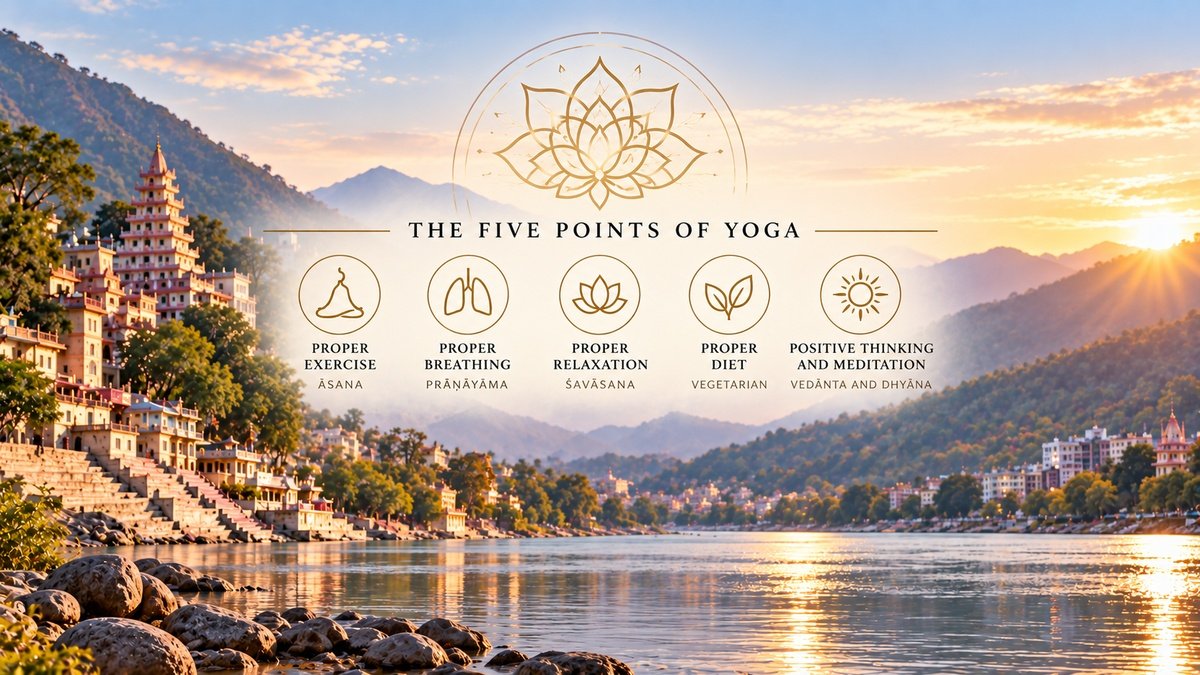
Vishnudevananda organised the approach around what became known as the Five Points of Yoga.
These are Proper Exercise, Proper Breathing, Proper Relaxation, Proper Diet, and Positive Thinking and Meditation.
Within the wider Sivananda tradition, these practical principles sit alongside the classical paths of Karma Yoga, Bhakti Yoga, Rāja Yoga and Jñāna Yoga.
Consequently, a Sivananda class represents only one part of a much larger system.
Who Was Swami Sivananda?
Swami Sivananda Saraswati was one of the influential Indian spiritual teachers of the twentieth century.
Born Kuppuswami in Tamil Nadu in 1887, he trained as a physician and worked for a period in Malaya before renouncing his medical career and returning to India.
He eventually settled in Rishikesh, on the banks of the Ganges in northern India.
There he became a renunciant, teacher and prolific writer.
In 1936, he founded the Divine Life Society. His teachings subsequently reached an international audience through books, correspondence and the work of his disciples.
Sivananda emphasised a broad integration of yogic paths rather than reducing yoga to one technique.
His frequently repeated formulation — Serve, Love, Give, Purify, Meditate, Realise — captures something of this orientation.
Service, devotion, meditation, philosophical inquiry and disciplined practice could contribute to one integrated spiritual life.
This approach became known as his Yoga of Synthesis.
Did Swami Sivananda Create Sivananda Yoga?
Not exactly.
This is one of the most important historical distinctions surrounding the method.
Swami Sivananda was the spiritual teacher and philosophical source from whom the tradition takes its name.
However, the recognisable teaching system encountered today in Sivananda Yoga centres was substantially organised and disseminated by his disciple Swami Vishnudevananda.
That includes the Five Points of Yoga and the structured approach to āsana practice familiar from Sivananda classes.
Calling Sivananda the inspiration and Vishnudevananda the principal systematiser therefore gives a clearer picture than attributing the entire modern method to either figure alone.
Who Was Swami Vishnudevananda?
Swami Vishnudevananda was born in Kerala, India, in 1927.
As a young man, he became a disciple of Swami Sivananda and joined his ashram in Rishikesh.
He became particularly involved in teaching Haṭha Yoga at the Yoga Vedanta Forest Academy.
According to the Sivananda organisation’s lineage account, Sivananda sent Vishnudevananda to the West in 1957 to spread yoga internationally.
Vishnudevananda subsequently established teaching centres, ashrams and training programmes across several countries.
His 1960 book The Complete Illustrated Book of Yoga became an influential English-language presentation of yoga and contributed significantly to his international reach.
Through this work, Vishnudevananda transformed his teacher’s broad philosophical inheritance into a particularly recognisable educational system.
Where Did Sivananda Yoga Develop?
The lineage begins in India, particularly through Swami Sivananda’s ashram and Divine Life Society in Rishikesh.
The international Sivananda Yoga organisation, however, developed substantially outside India.
After travelling west in 1957, Vishnudevananda established the first Sivananda Yoga Vedanta Centre in Montreal, Canada, in 1959.
Further centres and ashrams followed.
The resulting network eventually spread through North America, Europe, India and other regions.
This makes Sivananda Yoga an interesting example of twentieth-century yoga transmission.
Its philosophical and spiritual foundations were explicitly Indian, while much of its institutional form developed through an international network created for modern students.
When Did Sivananda Yoga Become an International System?
The late 1950s and 1960s were particularly important.
Vishnudevananda arrived in the West in 1957 and established the Montreal centre two years later.
His teaching expanded through further centres, publications and residential programmes.
In 1969, he established a formal Yoga Teachers’ Training Course in Canada.
The organisation describes this as the first programme of its kind in the West.
Teacher training became particularly significant to the international expansion of the method because graduates could reproduce a recognisable approach to practice in different countries.
Consistency became one of Sivananda Yoga’s defining characteristics.
What Are the Five Points of Sivananda Yoga?
Swami Vishnudevananda organised the practical teaching of Sivananda Yoga around Five Points.
1. Proper Exercise — Āsana
Physical postures are practised slowly and attentively rather than primarily as athletic exercise.
2. Proper Breathing — Prāṇāyāma
Breathing practices form an integral part of the method rather than appearing as an occasional addition to posture practice.
3. Proper Relaxation — Śavāsana
Conscious relaxation appears both within the āsana sequence and as a distinct practice.
4. Proper Diet — Vegetarian
The traditional Sivananda system advocates a vegetarian diet as part of its wider yogic lifestyle.
5. Positive Thinking and Meditation — Vedānta and Dhyāna
Philosophical inquiry and meditation place the physical practice within a broader understanding of mind, consciousness and spiritual development.
The language of proper reflects the terminology used by the tradition itself.
It should therefore be understood as part of the Sivananda teaching framework rather than as a universal judgement about how every person must exercise, breathe, eat or meditate.
What Are the Four Paths of Yoga in the Sivananda Tradition?
The Five Points provide a practical framework, but Sivananda Yoga also draws heavily on Swami Sivananda’s Yoga of Synthesis.
This integrates four traditional approaches.
Karma Yoga emphasises selfless action and service.
Bhakti Yoga centres on devotion.
Rāja Yoga concerns disciplined work with the mind and includes meditation.
Jñāna Yoga uses philosophical inquiry and knowledge in the pursuit of self-realisation.
Rather than insisting that every practitioner belongs exclusively to one path, Sivananda’s synthesis sought to incorporate aspects of several.
This helps explain why Sivananda centres can contain chanting, meditation, philosophy, service and āsana within the same teaching environment.
What Happens in a Sivananda Yoga Class?
A traditional Sivananda open class follows a relatively consistent structure.
The session commonly begins with initial relaxation and breathing practices.
Kapalabhati and alternate-nostril breathing are particularly characteristic of the method.
Sun salutations prepare the body for the principal āsana sequence.
The class then progresses through postures organised around twelve foundational āsanas, with relaxation incorporated between sections of the practice.
Variations may be introduced according to experience and context.
A final period of relaxation concludes the physical sequence.
Compared with highly variable contemporary Vinyasa classes, the structure is deliberately recognisable from one session to another.
What Are the 12 Basic Āsanas?
The Sivananda system organises its physical practice around twelve principal postures.
These are:
1. Śīrṣāsana — Headstand
2. Sarvāṅgāsana — Shoulderstand
3. Halāsana — Plough
4. Matsyāsana — Fish
5. Paścimottānāsana — Seated Forward Bend
6. Bhujangāsana — Cobra
7. Śalabhāsana — Locust
8. Dhanurāsana — Bow
9. Ardha Matsyendrāsana — Half Spinal Twist
10. Kākāsana — Crow
11. Pāda Hastāsana — Standing Forward Bend
12. Trikoṇāsana — Triangle
These positions provide the architecture around which variations and other preparatory movements can be organised.
They should not be interpreted as twelve tests that every practitioner must pass.
Several of them — particularly inversions such as Headstand — require appropriate preparation, individual judgement and, where necessary, adaptation or substitution.
A traditional sequence can provide structure without requiring every body to perform every posture identically.
Why Does Sivananda Yoga Use a Consistent Sequence?
Repetition creates familiarity.
When practitioners repeatedly encounter a recognisable sequence, less attention needs to be devoted to discovering what comes next.
That can create more space to observe breathing, effort, attention and changes within familiar postures.
A consistent structure also made the method highly teachable.
As Sivananda teacher-training programmes expanded internationally, a shared sequence helped establish continuity between centres and teachers.
Yet consistency and rigidity are not synonymous.
Individual teachers may introduce preparatory movements, variations or adaptations according to the students in front of them.
Why Does Headstand Appear So Early in the Sequence?
This is one of the most distinctive features of traditional Sivananda sequencing.
After preliminary relaxation, prāṇāyāma and sun salutations, Śīrṣāsana — Headstand — traditionally appears as the first of the twelve principal āsanas.
The Sivananda tradition gives the posture considerable importance and traditionally describes it as the king of the āsanas.
Historical teaching materials also attribute an extensive range of benefits to Headstand and other postures.
Some of those traditional health claims are considerably stronger than contemporary evidence allows us to state as established medical effects.
For a modern practitioner, the prominence of Headstand within the traditional sequence does not mean that everyone should perform it.
The structure of a tradition and the appropriate practice for an individual remain separate questions.
Why Is Relaxation So Important in Sivananda Yoga?
Relaxation is not treated merely as the reward at the end of physical work.
It is one of the Five Points.
Śavāsana may therefore appear at several stages during practice rather than only during the final minutes of class.
This creates a distinctive rhythm.
Effort is followed by pause. Movement is followed by stillness. Practitioners have repeated opportunities to notice what remains when deliberate muscular action decreases.
The tradition provides its own energetic and philosophical explanations for this process.
From a contemporary teaching perspective, we can also describe the simpler observable function: pauses alter the pace of the session and create opportunities for attention and recovery between periods of physical activity.
What Role Does Prāṇāyāma Play?
Prāṇāyāma is fundamental rather than optional within the Sivananda system.
Two techniques are especially familiar in general classes: kapālabhāti and anuloma viloma, the latter commonly taught as alternate-nostril breathing.
More advanced training may introduce additional breathing practices and breath retention.
Traditional explanations understand prāṇāyāma through the concept of prāṇa, the vital principle described within Indian yogic traditions.
Modern physiological explanations of breathing operate within a different conceptual framework.
The two should not simply be collapsed into one another.
Breathing practices can also vary substantially in intensity, so progressive teaching and appropriate adaptation remain important.
Is Sivananda Yoga the Same as Hatha Yoga?
Sivananda Yoga is a modern method substantially informed by Haṭha Yoga, but the two terms are not interchangeable.
As explored in our article on Hatha Yoga, historical Haṭhayoga encompasses a much larger and older family of yogic techniques and traditions.
Sivananda Yoga developed during the twentieth century.
It selects, organises and teaches particular postural and breathing practices within a wider Vedāntic and spiritual framework inherited from Swami Sivananda.
Therefore, Sivananda Yoga can reasonably be described as a modern Haṭha-oriented tradition without implying that it represents the entirety of historical Haṭhayoga.
How Is Sivananda Yoga Different from Ashtanga Yoga?
Both systems use recognisable sequences, but their structures and rhythms differ substantially.
Modern Ashtanga Yoga links postures through recurring vinyāsa transitions and places considerable emphasis on continuous coordination between breathing and movement.
Sivananda practice usually creates clearer pauses between postures.
Relaxation has a more explicit structural role, while separate prāṇāyāma practices form a characteristic part of the class.
The philosophical and institutional histories are also different.
A fixed or recurring sequence therefore tells us relatively little by itself about how a yoga method actually functions.
How Is Sivananda Yoga Different from Vinyasa Yoga?
Vinyasa Yoga commonly gives the teacher considerable freedom to construct a different sequence for each class.
Sivananda Yoga preserves a much more recognisable architecture.
Vinyasa classes also tend to emphasise transitions between postures as part of the continuous movement practice.
Sivananda classes usually distinguish the individual āsanas more clearly and incorporate deliberate relaxation between parts of the sequence.
Neither structure is inherently more complete.
They organise attention and movement differently.
Is Sivananda Yoga a Religious Practice?
Sivananda organisations teach yoga within an explicitly spiritual and philosophical framework.
Vedānta, meditation, mantra, devotional chanting, Sanskrit prayers and concepts concerning spiritual liberation all form part of the wider tradition.
Ashram life can make these elements particularly visible.
At the same time, people participate in Sivananda classes for many different reasons and are not required simply by attending an āsana class to adopt a particular religious identity.
Calling the method merely a fitness system would therefore be inaccurate.
Calling every participant religious would be equally imprecise.
Its historical framework is spiritual; an individual’s relationship with that framework remains their own.
Who Can Practise Sivananda Yoga?
The structured nature of Sivananda Yoga can make the method approachable because students gradually become familiar with what a class contains.
However, a standard sequence does not mean every posture is appropriate for every person.
Some of the twelve foundational āsanas involve substantial demands, particularly inversions, spinal extension and arm balance.
Teachers can use preparation, variation, props or alternative positions where appropriate.
Likewise, breathing practices can be modified rather than assuming that every participant should perform the same technique at the same intensity.
Adaptation does not invalidate the method.
It allows the underlying practice to meet the person actually practising it.
Is Sivananda Yoga Good for Beginners?
It can provide a clear introduction when taught appropriately.
The recurring structure reduces some of the unpredictability found in classes where sequences change continuously.
Students can become familiar with the names, order and basic organisation of the practice over time.
Nevertheless, traditional should not be interpreted as automatically beginner-level.
Headstand, Shoulderstand and several backbending postures may require considerable preparation or modification.
A beginner-appropriate class should therefore teach progressively rather than using the traditional sequence as a checklist that must be completed immediately.
What Are the Benefits of Sivananda Yoga?
Sivananda Yoga incorporates physical activity, mobility, balance, breathing practice, relaxation and meditation.
These elements may provide different experiences and benefits depending on the individual, frequency of practice and way they are taught.
The tradition itself makes extensive claims about the effects of individual postures on organs, glands, circulation, the nervous system and particular health conditions.
Some historical yoga literature uses similarly specific physiological language.
Those statements should not automatically be repeated as established medical facts.
Contemporary evidence supports discussing yoga more cautiously in relation to areas such as physical function, movement, relaxation and aspects of well-being, while recognising substantial variation between practices and practitioners.
The value of Sivananda Yoga does not depend on attributing a medical effect to every posture.
Why Is Diet Part of Sivananda Yoga?
Vegetarian diet forms the fourth of Vishnudevananda’s Five Points.
Within the tradition, food is understood not merely through nutrition but through broader yogic ideas concerning ethical conduct, mental qualities and spiritual practice.
This places diet within the lifestyle dimension of Sivananda Yoga rather than treating it simply as a strategy for changing body composition.
However, a traditional dietary principle and individual nutritional requirements are different questions.
People have different medical, cultural, practical and nutritional circumstances.
The presence of vegetarianism within the Sivananda system can be described accurately without converting it into universal nutritional advice.
What Is a Sivananda Ashram?
An ashram provides a residential environment in which practice extends beyond a single yoga class.
Sivananda ashrams typically incorporate meditation, chanting, āsana, prāṇāyāma, philosophical study, vegetarian meals and Karma Yoga or service into the rhythm of daily life.
This makes the broader architecture of the tradition considerably easier to see.
The āsana class is one component within a daily discipline rather than the whole of yoga.
That distinction is important when encountering Sivananda Yoga primarily through a studio timetable.
What Should We Know About the Sivananda Organisation and Abuse Allegations?
A complete contemporary account also needs to acknowledge serious allegations concerning figures within the international Sivananda organisation.
Beginning publicly in 2019, allegations of sexual abuse against Swami Vishnudevananda and allegations concerning other senior figures prompted investigations and substantial discussion within former and current Sivananda communities.
Project SATYA, an independent initiative created by former members and supporters, published reports documenting allegations and examining institutional responses.
The International Sivananda Yoga Vedanta Centres also commissioned an independent investigation.
These developments complicate any presentation of the tradition based solely on reverential lineage narratives.
They do not require erasing the historical influence of Sivananda Yoga, nor do they determine how every practitioner must relate to practices they may have found meaningful.
They do require transparency.
A yoga tradition can be studied for its practices, philosophy and historical influence while also examining questions of authority, accountability and institutional culture.
A Common Misunderstanding: Sivananda Yoga Is Not Simply Twelve Poses
The twelve āsanas are visually memorable.
They are also easy to reproduce in books, diagrams and teacher-training manuals.
That visibility can make them appear to define the entire method.
They do not.
Remove breathing, relaxation, meditation, philosophy, ethical orientation and the wider paths of yoga, and something fundamental to the Sivananda conception of practice disappears.
This is particularly significant because Swami Sivananda’s original teaching emphasised synthesis.
The sequence provides a structure for practice; it was never intended to define the whole of yoga.
An Orenna Perspective: Structure Can Create Space
Contemporary yoga often celebrates variety.
A different sequence. A different theme. A new posture. Another way of moving.
Sivananda Yoga offers an interesting counterpoint.
Its recurring structure asks what becomes possible when novelty decreases.
Returning to familiar movements can reveal differences that changing the sequence might conceal. The posture may remain recognisable while breathing, attention, energy, confidence or capacity changes from one practice to another.
Repetition does not have to mean rigidity.
Nor does adaptation require abandoning tradition.
A framework can remain recognisable while the experience inside it continues to change.
Sometimes familiarity does not narrow a practice. It gives us enough space to notice it more closely.
References & Further Reading
International Sivananda Yoga Vedanta Centres. The Teachings. The organisation’s account of Swami Vishnudevananda’s Five Points and their relationship with the four paths of yoga. Explore the teachings.
International Sivananda Yoga Vedanta Centres. 12 Basic Asanas. The organisation’s presentation of the twelve foundational postures used in the Sivananda Open Class. Explore the sequence.
International Sivananda Yoga Vedanta Centres. Lineage. Institutional history of Swami Sivananda and Swami Vishnudevananda and the international development of the organisation. Explore the lineage.
The Divine Life Society. Works of Swami Sivananda, including Yoga in Daily Life, provide primary material for understanding his broader Yoga of Synthesis and spiritual teaching.
Project SATYA. Investigation Reports. Reports concerning allegations of abuse within the International Sivananda Yoga Vedanta Centres and their leadership. Explore the investigation reports.