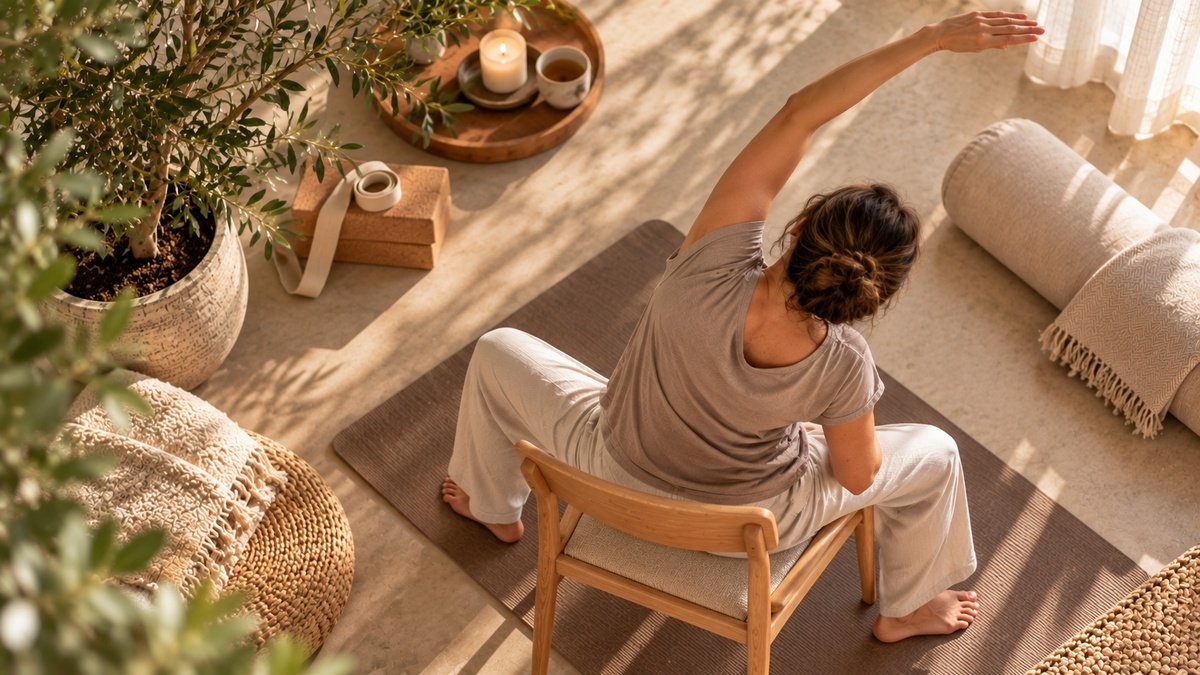
Yoga does not have to look one particular way.
A practice can happen standing, seated on the floor or sitting in a chair. Someone may use a wall for balance, blocks to change the height of a position or a bolster for additional support. Movement can be large or small, and stillness can also form part of the experience.
Adaptive Yoga begins with a simple idea: instead of asking the person to fit the practice, we can adapt the practice to the person.
This approach creates more ways to explore yoga. It also challenges the idea that a practice only counts when the body can reproduce a particular shape.
What Is Adaptive Yoga?
Adaptive Yoga describes an approach that adjusts yoga practices to suit the individual. The teacher may change a position, movement, pace, level of support or way of practising according to the person’s needs and circumstances.
Those changes can take many forms. A standing posture might use a wall for support. Someone may practise a movement from a chair instead of the floor. Blocks can bring the floor closer, while blankets or bolsters can provide comfort in resting positions.
Adaptation can also involve more than physical movement. The length of a practice, the pace of transitions and the amount of verbal guidance can all change.
As a result, there is no single Adaptive Yoga sequence. The approach depends on the person who is practising.
Chair Yoga Is Yoga
Chair Yoga is one way to make yoga practice more adaptable. It can provide a stable base for movement, breathing, meditation and periods of stillness.
For some people, a chair offers an alternative to getting down to the floor. Others may use it for balance during standing movements or as a support during transitions.
However, Chair Yoga should not be understood simply as a reduced version of floor-based yoga.
A chair changes the physical relationship between the body, gravity and the surrounding space. Therefore, the practice may need different movements and different ways of organising familiar yoga ideas.
Breathing practices can take place while seated. Attention can move through the body without large movements. Meditation does not require sitting cross-legged, and a chair can also support gentle movement through different areas of the body.
The result is not yoga made “less”. It is yoga approached differently.
The Practice Does Not Depend on the Pose
Modern images of yoga often place the posture at the centre of the practice. This can create the impression that progress means producing increasingly difficult physical shapes.
Yet yoga contains much more than physical posture.
Breath, attention, concentration, meditation and ethical reflection all sit within the wider landscape of yoga. Even within an asana practice, the external shape tells us very little about the person’s internal experience.
Two people can explore the same intention through very different physical positions. One may stand, another may sit in a chair, while someone else may practise from the floor.
The positions look different, but difference does not automatically create a hierarchy between them.
Once we understand this, adaptation becomes easier to recognise as part of practice rather than an exception to it.
Adaptation Can Take Many Forms
People often associate Adaptive Yoga with props, but props represent only one part of the process.
A teacher can change the starting position, range of movement or number of repetitions. They might slow a transition, offer an alternative movement or remove an unnecessary step.
The environment can change too. Someone may prefer more space around the chair or mat. Another person may benefit from having a wall nearby. Temperature, lighting and sound can also influence how comfortable a practice feels.
Communication matters as well. Clear instructions, time to process them and genuine choices can make a significant difference to the experience.
Therefore, adaptation is not simply about replacing one difficult pose with an easier one. It involves considering how the whole practice works for the individual.
Support Is a Tool, Not a Measure of Ability
Props can expand the possibilities within yoga.
A chair can offer stability. Blocks can change height or distance. A wall may provide another point of contact, while bolsters and blankets can support positions that involve rest.
None of these tools tells us how capable someone is.
In fact, the same practitioner may choose different levels of support on different days. Energy, comfort and circumstances can change, so the practice can respond accordingly.
Using support does not mean that someone has failed to perform the “full” posture. Instead, a prop can help create a version of the practice that makes sense for that person at that moment.
Choice Matters
Adaptive Yoga works best when choice remains genuine.
A teacher can offer options without presenting one as the ideal version. For example, someone might choose to stand, sit or use additional support. Another person may decide not to practise a particular movement at all.
Good adaptation also avoids assumptions. A teacher cannot know what somebody needs simply by looking at their body, age or mobility.
Conversation can provide more useful information. Asking about comfort, preferences and practical needs allows the practitioner to take part in decisions about their own practice.
This approach moves away from the idea that the teacher must “fix” the person. Instead, teacher and practitioner can explore suitable options together.
Adaptive Does Not Mean Anything Goes
Individualisation does not remove the need for professional boundaries.
A yoga teacher can adapt yoga within their training, experience and professional competence. However, they should not diagnose health conditions or use yoga as a substitute for medical treatment.
Sometimes a practitioner may have symptoms, health concerns or circumstances that require advice from an appropriate healthcare professional. In those situations, recognising the limits of the yoga teacher’s role forms part of responsible teaching.
Adaptation therefore combines flexibility with judgement. The aim is to offer meaningful choices while remaining clear about professional scope and safety.
What Might an Adaptive Yoga Practice Look Like?
An Adaptive Yoga session may look quite different from the yoga class someone expects to see.
One person might begin seated in a chair and explore movement through the shoulders, spine, hands and feet. They may later stand while using the chair for support before returning to a seated breathing practice.
Another practitioner might work mainly from a mat but use bolsters, blocks and a wall to change particular positions. Someone else may prefer a quieter practice with very little movement.
The session does not need to include every possible form of yoga. Instead, it can focus on what has purpose for the person practising that day.
For this reason, two Adaptive Yoga sessions may look completely different while still sharing the same principle: the practice responds to the practitioner.
A Common Misunderstanding: Adaptive Yoga Is Not Only for Certain People
People sometimes assume that Adaptive Yoga belongs only to older adults, disabled people or those recovering from illness or injury.
Adaptive approaches can certainly make yoga more accessible in many circumstances. However, adaptation is relevant far more widely.
Bodies differ. Experience differs. Energy changes from day to day, and environments create different practical demands. Pregnancy may change a practice. Ageing may change it. A temporary injury may require another approach. Sometimes a person simply prefers a different way to move or rest.
In other words, adaptation does not need to begin with a label or diagnosis.
It begins by recognising that people are not identical.
The Orenna Perspective
At Orenna, adaptation is not an additional service applied only when someone cannot perform a standard practice. It is part of how an individual practice takes shape.
The starting point is the person in front of us.
A practice may use a mat, chair, wall, bolsters, blocks or blankets. Movement may be standing, seated or floor-based. Some sessions may include more movement, while others may give greater space to breathing, stillness or rest.
Transitions matter too. How someone enters and leaves a position can be just as important as the position itself. Therefore, the route into a practice can change alongside the final shape.
Most importantly, there is no ideal body that someone must bring to yoga.
There are simply different bodies, different circumstances and different ways to practise.
References & Further Reading
Yoga Alliance. Scope of Practice. Professional guidance for Yoga Alliance members on teaching within training, experience and professional competence, including appropriate referral where needs fall outside that scope.
Accessible Yoga Association. Educational resources exploring accessibility, inclusion and ways of making yoga practices available to people with a wide range of bodies and abilities.
National Center on Health, Physical Activity and Disability (NCHPAD). Resources relating to inclusive and adapted physical activity for people with disabilities and different functional needs.
The Orenna Journal provides general educational information and does not provide medical diagnosis or treatment. Yoga practice should reflect individual circumstances. Where symptoms, health conditions or other concerns require assessment or treatment, seek advice from an appropriately qualified healthcare professional.