Palms together at the heart.
Thumb and index finger touching.
Or perhaps the hands resting quietly in the lap.
These gestures appear so frequently in yoga photographs, meditation classes and contemporary wellness culture that their meanings can seem self-evident.
However, familiar Yoga Mudras do not form one universal dictionary of hand positions.
A gesture may carry a particular meaning within Hindu or Buddhist iconography, function differently within ritual, acquire another interpretation within a yoga lineage and then receive additional explanations in modern teaching.
Moreover, the same physical shape can sometimes appear under different names.
So rather than asking only, “What does this mudrā mean?”, we need another question:
Where does that meaning come from?
Before We Begin: What Is a Mudrā?
The Sanskrit word mudrā can refer to a seal, sign, mark or gesture.
In contemporary yoga, people often use the word for symbolic hand positions. Historically, however, mudrā developed across a much broader range of religious, ritual and yogic contexts.
For example, premodern Haṭha Yoga uses the term for sophisticated bodily practices that may involve posture, breath, the tongue, pressure and bandha.
Our cornerstone article Mudrā: Understanding the Gestures, Seals and Practices of Yoga explores that larger territory.
This article has a narrower purpose: examining some of the hand gestures that contemporary yoga practitioners are most likely to encounter and asking what their familiar meanings actually represent.
Do Yoga Mudras Have Fixed Meanings?
Not always.
Modern mudrā guides often present a simple formula:
one gesture → one name → one meaning → one benefit.
The historical picture is considerably less tidy.
Names can vary between sources. Similarly, related hand positions may appear in different traditions. Symbolism can change, while modern teachers may add interpretations that earlier sources did not emphasise.
This variation does not make the gestures meaningless. Instead, it shows that mudrā meanings require context.
Therefore, for each gesture below, it is useful to distinguish its broader historical or cultural associations from interpretations commonly found in modern yoga.
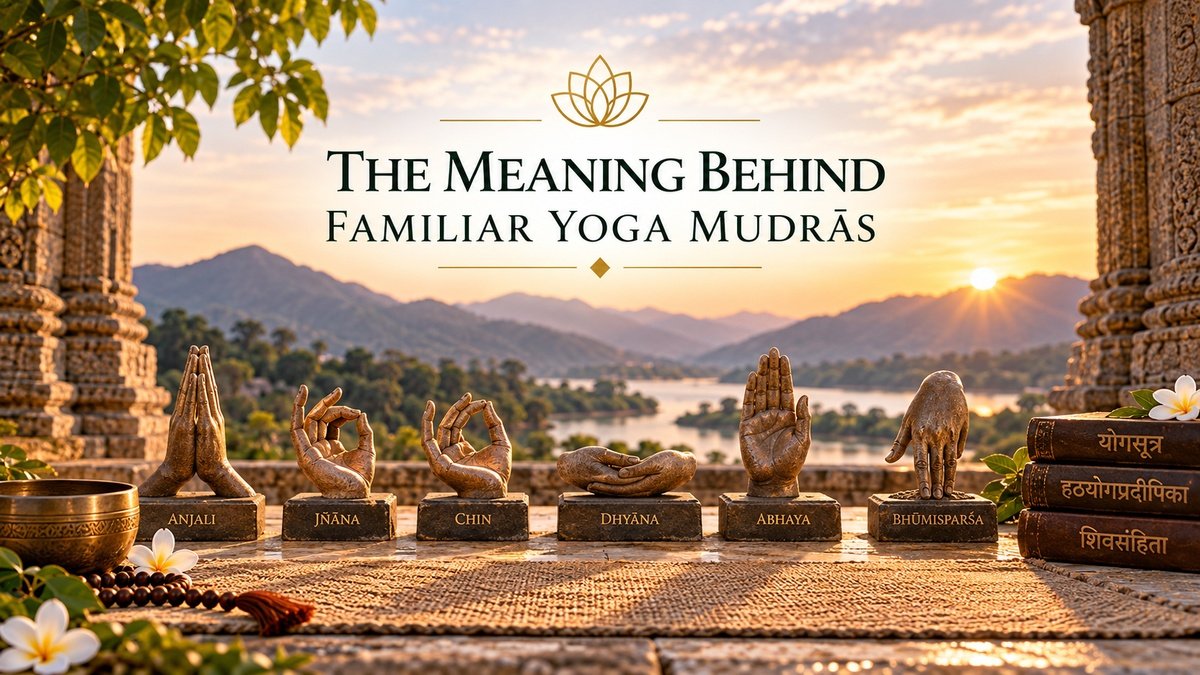
1. Añjali Mudrā — The Gesture of Reverence
Añjali Mudrā is perhaps the most immediately recognisable hand gesture in contemporary yoga.
The palms come together, usually in front of the chest. The Sanskrit word añjali refers to a gesture of reverence, salutation or offering made with joined hands.
Across South Asian religious and social contexts, joined palms can communicate respect, greeting, devotion or reverence.
Modern yoga frequently uses the gesture at the beginning or end of practice. In addition, teachers may invite students to bring the palms together during meditation or alongside the greeting namaste.
Contemporary interpretations sometimes describe the gesture as representing union, balance, gratitude or the bringing together of opposites.
Those interpretations can provide meaningful contemplative themes. However, they should not automatically become the single ancient definition of the gesture.
Broad association: reverence, salutation, offering and respect.
2. Jñāna Mudrā — The Gesture Associated with Knowledge
Jñāna Mudrā commonly brings the thumb and index finger into contact while the remaining fingers extend or relax.
Jñāna means knowledge or knowing. Today, the gesture frequently accompanies meditation and prāṇāyāma.
Modern explanations sometimes interpret the thumb and index finger symbolically. For example, one may represent individual consciousness and the other universal consciousness, while their contact represents union or recognition.
Other explanations assign meanings to all five fingers. Importantly, such symbolism can vary between teaching systems.
The contemporary visibility of this hand position also does not establish that it occupied the same central place throughout the earlier history of Haṭha Yoga.
Indeed, historical research into gestures such as Cinmudrā shows why familiar modern yoga imagery should not automatically be projected unchanged into antiquity.
Broad modern association: knowledge, awareness and meditation.
3. Chin Mudrā — How Is It Different from Jñāna Mudrā?
Chin Mudrā — also written Cin Mudrā or Cinmudrā in different transliteration conventions — often looks extremely similar to Jñāna Mudrā.
Here, the thumb and index finger meet while the other fingers remain extended or relaxed.
Modern yoga teachers sometimes distinguish the two according to palm orientation. One common convention, for instance, describes Jñāna Mudrā with the palms facing upward and Chin Mudrā with the palms facing downward.
However, this distinction is not universally standardised across all traditions and sources.
Consequently, it is better to say that particular teaching systems distinguish these gestures in this way rather than presenting the rule as universal.
Today, both commonly appear in seated meditation and breathing practices.
Broad modern association: awareness, consciousness and contemplative practice.
4. Dhyāna Mudrā — The Gesture of Meditation
Dhyāna Mudrā commonly places the hands in the lap, often with one hand resting inside or upon the other.
The word dhyāna refers to meditation or meditative contemplation.
The gesture has particularly strong associations with Buddhist meditation iconography. For example, images of the Buddha frequently show forms of this meditative hand position, although details vary according to tradition and representation.
Contemporary yoga practitioners may use a similar position simply because it provides a stable and comfortable place for the hands during seated meditation.
Therefore, the physical arrangement can serve both symbolic and practical functions.
Broad association: meditation, contemplation and collected attention.
5. Abhaya Mudrā — The Gesture of Fearlessness
Abhaya Mudrā usually shows one hand raised with the palm facing outward.
The Sanskrit term abhaya relates to fearlessness or freedom from fear.
The gesture appears prominently in Buddhist and Hindu iconography, where it can communicate reassurance, protection, peace or the absence of threat.
Unlike many hand mudrās taught as contemporary yoga practices, its significance becomes especially clear when a religious figure displays it.
In that context, the gesture communicates meaning. It does not need to function as a hand exercise held for a prescribed number of minutes.
A contemporary practitioner might still use the gesture contemplatively. Nevertheless, that modern application should remain distinguishable from its iconographic and religious histories.
Broad association: fearlessness, reassurance and protection.
6. Bhūmisparśa Mudrā — Touching the Earth
Bhūmisparśa Mudrā is one of the most recognisable gestures in Buddhist imagery.
Bhūmi means earth, while sparśa relates to touching. In representations of the Buddha, one hand reaches towards the earth.
The gesture refers to the narrative in which the Buddha calls the earth to witness at the time of awakening.
Its significance therefore comes from a particular Buddhist narrative and iconographic context.
Modern yoga sometimes borrows the image as a general symbol of grounding or connection with the earth. Although understandable, that contemporary interpretation is broader than the gesture’s specific Buddhist narrative meaning.
Broad association: the earth as witness to the Buddha’s awakening.
7. Dharmacakra Mudrā — Turning the Wheel of Dharma
Dharmacakra Mudrā appears prominently in Buddhist iconography.
The term combines dharma with cakra, meaning wheel. Accordingly, the gesture relates to the “turning of the wheel of Dharma”, particularly the Buddha’s teaching.
Representations commonly position the hands near the chest, with the fingers arranged in a symbolic configuration. However, variants occur across Buddhist traditions and artistic periods.
This gesture provides another useful reminder that not every mudrā encountered in a yoga book originated as a technique for changing the practitioner’s internal energy.
Mudrā can also communicate doctrine, identity and narrative through gesture.
Broad association: teaching and the transmission of Dharma.
8. Vitarka Mudrā — Teaching and Discussion
Vitarka Mudrā also appears in Buddhist iconography.
The thumb and index finger commonly meet to form a circle while the hand remains raised.
Because this configuration resembles hand positions familiar from modern meditation, it can easily appear to be the same gesture under another name.
Context, however, changes its interpretation.
Vitarka Mudrā commonly carries associations with teaching, discussion, reasoning or the communication of Buddhist doctrine.
Once again, similar finger geometry does not guarantee identical meaning.
Broad association: teaching, discussion and intellectual transmission.
9. Prāṇa Mudrā — A Familiar Modern Yoga Gesture
Prāṇa Mudrā commonly appears in contemporary mudrā manuals.
Modern instructions typically bring the thumb into contact with the ring and little fingers while the index and middle fingers extend.
Teachers may associate the gesture with vitality, energy or prāṇa. Some modern systems go considerably further, attributing specific therapeutic effects or elemental correspondences to the finger arrangement.
At this point, historical caution becomes particularly important.
Indian traditions certainly contain sophisticated concepts of prāṇa. However, that does not demonstrate that every modern hand gesture carrying the name “Prāṇa Mudrā” has an unchanged ancient pedigree or a medically established effect.
As explored in Mudrā, Prāṇa and the Subtle Body, prāṇa belongs to traditional yogic conceptual systems and should not simply be translated as electricity or oxygen.
Broad modern association: prāṇa, vitality and energetic symbolism.
10. Apāna Mudrā — A Modern Gesture Associated with Apāna
Apāna Mudrā commonly appears in contemporary yoga and mudrā guides.
Instructions often bring the thumb, middle finger and ring finger together while the index and little fingers remain extended.
Modern explanations associate the gesture with apāna, one of the traditional vital functions or vāyus. Some sources then connect it with elimination, digestion or detoxification.
Here, two separate questions require attention.
First, traditional yoga and Indian medical systems do contain concepts of apāna. Second, that historical fact does not automatically validate every modern therapeutic claim attached to a particular finger configuration.
Therefore, claims that a hand mudrā treats digestive disorders or “detoxifies” the body require evidence beyond traditional terminology.
Broad modern association: apāna and downward-moving vital functions within contemporary mudrā systems.
11. Pṛthvī Mudrā — The Earth Gesture
Pṛthvī Mudrā, often written as Prithvi Mudra, commonly joins the thumb and ring finger.
Pṛthvī means earth.
Modern mudrā systems frequently interpret the ring finger as corresponding to the earth element and the thumb to fire. Consequently, teachers may associate the gesture with stability, grounding or strengthening the earth element.
These explanations belong to particular systems of elemental correspondence.
Indian traditions certainly contain extensive theories of the elements. Nevertheless, the existence of those theories does not establish one universal ancient rule assigning each finger to a particular element.
Broad modern association: earth, stability and grounding.
12. Vāyu Mudrā — The Air Gesture
Vāyu Mudrā is commonly associated with the element of air in modern hand-mudrā systems.
Instructions often bend the index finger towards the base of the thumb while the thumb rests over it.
Some contemporary charts assign increasingly specific physical or emotional benefits to this arrangement.
Again, it is important to distinguish traditional elemental concepts from claims that a particular finger position produces demonstrated therapeutic effects.
A practitioner can explore the gesture as part of a teaching system or contemplative framework without converting its symbolism into medical advice.
Broad modern association: air and vāyu within contemporary elemental mudrā systems.
13. Hakini Mudrā — What About the Fingertips Together?
A gesture commonly called Hakini Mudrā brings the fingertips of both hands together while keeping the palms apart.
It has become popular in modern yoga, meditation and concentration exercises.
Contemporary explanations sometimes connect the gesture with memory, concentration, coordination between the brain’s hemispheres or a chakra associated with the forehead.
In particular, claims involving “left-brain/right-brain integration” deserve caution.
Modern neuroscience does not support the popular idea that people operate through a simple opposition between a logical left hemisphere and a creative right hemisphere.
Likewise, placing the fingertips together does not establish that the gesture synchronises the hemispheres in a clinically meaningful way.
Even so, the hand position may provide a deliberate sensory focus during concentration.
Broad modern association: concentration and focused attention.
14. Yoni Mudrā — Why the Name Can Be Confusing
Yoni Mudrā demonstrates how complex mudrā terminology can become.
Yoni has meanings associated with womb, source or generative space.
In modern yoga, the name may refer to a hand gesture in which the fingers form a roughly downward-pointing shape.
However, historical yoga sources also use the name Yoni Mudrā for practices that are not simply this contemporary hand position.
As a result, searching for “Yoni Mudra” can produce instructions for considerably different practices.
The name alone is therefore insufficient. We also need the source, lineage or teaching context to determine which practice someone means.
Broad modern association: source, generative symbolism and inward attention, depending on the system.
15. Lotus Mudrā — Is It a Traditional Yoga Mudrā?
A hand gesture commonly called Lotus Mudrā appears frequently in contemporary yoga.
The palms or wrists remain connected while parts of the hands open outward to suggest a lotus flower.
Teachers may associate the gesture with openness, compassion, the heart or spiritual unfolding. Meanwhile, the lotus itself carries extensive religious symbolism across Indian traditions.
However, the antiquity of lotus symbolism does not automatically establish the antiquity of every modern hand configuration named after the lotus.
This distinction is easy to miss.
An ancient symbol does not necessarily make a contemporary gesture ancient.
Broad modern association: openness, lotus symbolism and contemplative themes of unfolding.
Why Do Different Websites Give Different Meanings?
Different sources often draw from different traditions.
For example, one teacher may follow a particular yoga lineage, while another uses a modern mudrā manual. A Buddhist source may explain a gesture iconographically, whereas a contemporary wellness website may interpret the same hand shape through chakras or the five elements.
Online material can then circulate without its original context.
Eventually, a modern interpretation may appear ancient simply because many websites repeat it. Yet repetition is not the same as historical evidence.
When explanations conflict, useful questions include:
What tradition is being described?
What is the source?
How old is that source?
Is this symbolism, traditional doctrine or a health claim?
These questions do not remove meaning from the practice. Instead, they help locate that meaning more accurately.
Do Finger Positions Correspond to the Five Elements?
Many contemporary mudrā charts assign one element to each finger.
A commonly encountered arrangement associates the thumb with fire, the index finger with air, the middle finger with space, the ring finger with earth and the little finger with water.
Practitioners may then combine fingers with the intention of influencing or balancing those elements.
Indian philosophical, medical and religious traditions certainly contain sophisticated elemental systems. However, we should not assume that every modern finger-element correspondence forms part of one universal ancient mudrā system.
Therefore, the historical source of a specific correspondence still matters.
This distinction becomes especially important when symbolic associations develop into claims about treating disease.
Can the Same Gesture Have More Than One Name?
Yes.
Similar or nearly identical hand configurations can appear under different names. Conversely, the same name can sometimes refer to different practices.
Translation, transliteration, regional traditions, lineage conventions and modern publishing all contribute to this variation.
For that reason, a photograph alone cannot always identify a mudrā reliably.
Knowing the source often tells us more than knowing the shape.
How Should You Practise Yoga Mudras?
For simple contemplative hand gestures, begin comfortably.
Allow the shoulders and arms to remain relatively relaxed, and avoid forcing the fingers into an idealised shape.
Next, notice the contact between the hands or fingers. You might observe pressure, temperature, muscular effort or other sensations without needing to manufacture a particular experience.
If the gesture carries a traditional symbolic meaning, you may choose to contemplate that meaning.
Alternatively, if you follow a specific lineage or teaching method, its instructions provide a clearer framework than combining rules from unrelated systems.
Most importantly, pain is not evidence that a mudrā is “working”. Joint discomfort, numbness or strain provides a reason to release or adapt the position.
How Long Should You Hold a Mudrā?
No universal duration applies to every gesture.
A symbolic gesture may appear momentarily within ritual or iconography. By contrast, a meditation mudrā may remain in place throughout a seated practice. Contemporary systems may also prescribe particular durations.
Those instructions belong to their respective methods.
Therefore, claims that every mudrā must be held for an exact number of minutes deserve caution unless the source and teaching system are clear.
Do Yoga Mudras Have Health Benefits?
This question deserves more than a paragraph.
Modern sources attribute an extraordinary range of effects to mudrās, from improving concentration and sleep to regulating organs, balancing hormones, treating digestive conditions and changing emotional states.
However, these claims do not all have the same origin or evidential support.
Traditional explanations, contemporary interpretations, subjective experiences and clinical evidence represent different kinds of information. Consequently, they should not be treated as though they provide the same kind of evidence.
The final article in this series therefore asks the question directly:
Do Mudrās Really Work? Tradition, Modern Claims and Evidence.
There we will separate what traditions claim, what contemporary teachers commonly say, what research has investigated and what remains uncertain.
An Orenna Perspective: Meaning Lives in Context
A hand can form a beautiful shape, and a photograph can give that shape a Sanskrit name.
Then a chart may assign it an element, an emotion, an organ and a benefit. Within a few lines, uncertainty disappears.
Yet mudrā becomes more interesting when we resist that simplicity.
A gesture may carry devotion or represent teaching. Elsewhere, it might recall a religious narrative, provide a place for the hands during meditation or participate in a traditional subtle-body model.
Furthermore, gestures can acquire new meanings as yoga continues to change.
The task is not to force every mudrā back to one supposedly original definition. Rather, it is to understand the differences between history, tradition and modern interpretation.
The fingers show us the gesture. Context tells us what it means.
References & Further Reading
James Mallinson and Mark Singleton. Roots of Yoga. Penguin Classics. A major sourcebook for understanding the diversity of premodern yoga practices and the wider historical category of mudrā.
Shamita Ray. “Cinmudrā: Origins, Evolution and Meaning.” Journal of Yoga Studies. A detailed historical examination of a gesture now strongly associated with yoga and meditation.
Robert E. Buswell Jr. and Donald S. Lopez Jr. The Princeton Dictionary of Buddhism. Princeton University Press. Useful for understanding Buddhist mudrā terminology, iconography and doctrinal contexts.
Sthaneshwar Timalsina. “Language of Gestures: Mudrā, Mirror, and Meaning in Śākta Philosophy.” Religions. Examines gesture and meaning within Śākta Tantric philosophical contexts.
Haṭha Yoga Project, SOAS University of London. Academic research into premodern Haṭha Yoga provides important context for distinguishing the historical category of mudrā from its narrower modern association with hand gestures.