
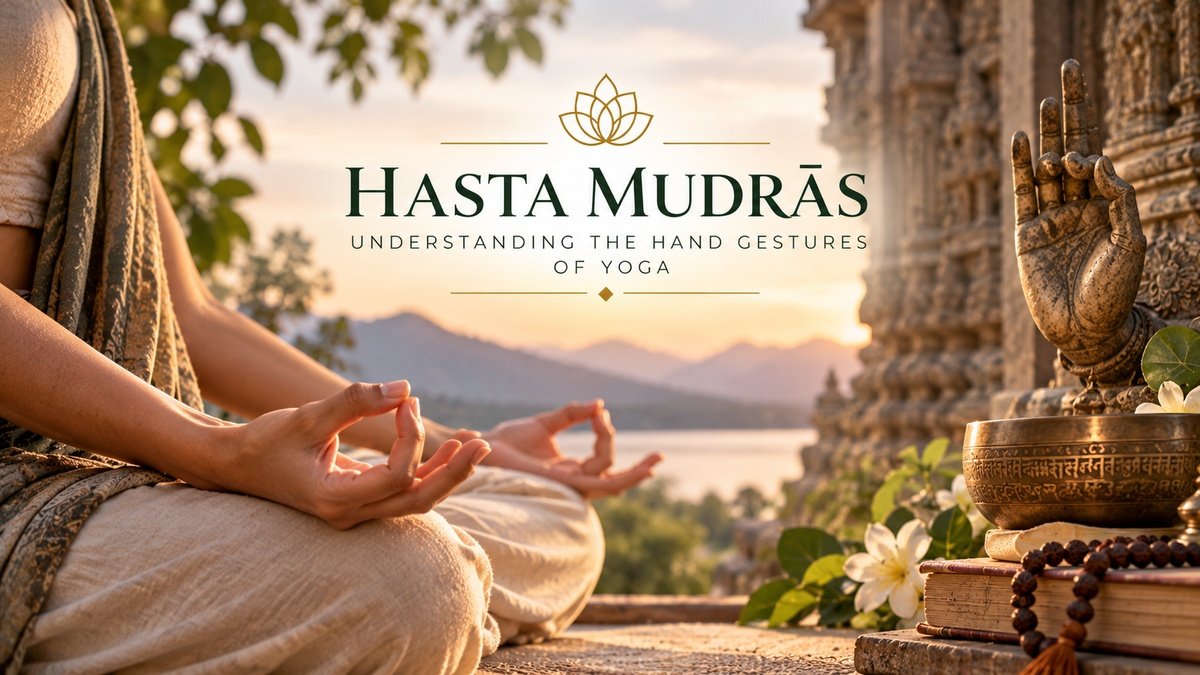
Bring the palms together at the centre of the chest.
Rest the hands on the thighs and allow the thumb and index finger to meet.
Place one hand inside the other during meditation.
These small arrangements of the hands have become some of the most recognisable visual symbols of contemporary yoga.
They are commonly described as Hasta Mudras — hand gestures used within yoga, meditation and related contemplative practices.
Yet a hand position is not automatically a universal code with one meaning that has remained unchanged throughout Indian history.
Some gestures have religious or ritual histories. Others appear prominently in iconography. Similar hand shapes may occur in meditation, yoga and Indian performance traditions without functioning identically in each setting.
Modern yoga has also developed its own ways of explaining and organising mudrās.
Understanding hasta mudrās therefore requires more than learning where to place the fingers.
It requires us to ask what a gesture means, where that interpretation comes from and what role the hands are actually playing within the practice.
What Does Hasta Mudrā Mean?
The Sanskrit word hasta means hand.
Mudrā has a broader semantic range that can include ideas such as a seal, sign, mark or gesture.
Hasta mudrā therefore refers broadly to a mudrā performed with the hand or hands.
That sounds straightforward, but it immediately raises another question.
What makes a deliberate hand position a mudrā rather than simply a gesture?
The answer depends on context.
A mudrā may communicate symbolic meaning, participate in ritual, accompany meditation or form part of a larger contemplative practice.
Its significance does not necessarily come from the geometry of the fingers alone.
It comes from the relationship between gesture, intention, tradition and context.
Are All Mudrās Hand Gestures?
No.
This distinction is fundamental to understanding the subject.
Hand mudrās have become highly visible in contemporary yoga, but the historical category of mudrā is much larger.
Premodern Haṭha Yoga texts describe practices such as Mahāmudrā, Khecarī Mudrā and Viparītakaraṇī. These may involve posture, breath, the tongue, bodily actions or inversion rather than a symbolic arrangement of the fingers.
Consequently, hasta mudrā is one category within the wider world of mudrā.
If you are beginning with the subject as a whole, our cornerstone guide Mudrā: Understanding the Gestures, Seals and Practices of Yoga provides the wider map.
The historical development is explored separately in More Than Hand Gestures: The History and Meaning of Mudrā.
Where Are Hand Mudrās Found?
Hand gestures appear across multiple South Asian religious, ritual, artistic and contemplative traditions.
They can be found in Hindu and Buddhist contexts, among others.
They also appear in sacred imagery, ritual practices and sophisticated systems of Indian performance.
Yoga participates in this much larger cultural history, but it does not absorb every gesture into one unified yogic system.
A hand position represented in Buddhist sculpture may have a particular iconographic meaning.
A similar-looking gesture used during ritual may serve another function.
A contemporary yoga teacher may then use a hand position during meditation with yet another interpretation.
Visual resemblance alone cannot tell us that all three practices mean exactly the same thing.
Why Are the Hands So Important?
Hands are unusually expressive parts of the human body.
We use them to greet, point, offer, receive, protect, refuse, bless, pray and communicate.
A gesture can therefore carry meaning without requiring a spoken explanation.
Religious and contemplative traditions can develop this expressive capacity into more formalised systems.
Within particular contexts, the arrangement of the hands may represent an idea, identify an aspect of a figure, accompany ritual action or support a contemplative practice.
The hands also provide a direct point of sensory attention.
During meditation, for example, noticing contact between fingers or the weight of the hands can offer a simple physical reference for awareness.
That sensory function does not require us to assign a medical effect to the gesture.
Do Hasta Mudrās Have One Universal Meaning?
No.
A common modern approach presents mudrās as though they form a universal dictionary:
one hand position = one name = one meaning = one effect.
Historical traditions are rarely so tidy.
Names can vary.
Similar gestures can carry different interpretations.
One tradition may emphasise ritual meaning while another emphasises meditation or philosophical symbolism.
Modern teachers may add further explanations.
This does not make the gesture meaningless.
It means that meaning has a source and a context.
When someone says, “This mudrā means…”, a useful follow-up question is:
According to which tradition or teaching system?
What Is Añjali Mudrā?
One of the most familiar gestures in modern yoga brings the palms together.
Yoga teachers commonly call this Añjali Mudrā.
The Sanskrit term añjali refers to a gesture of reverence, salutation or offering made with the hands joined together.
Today, practitioners may place the palms together at the chest at the beginning or end of a class, during meditation or alongside a spoken greeting such as namaste.
However, the gesture should not be reduced to “the namaste position”.
Joining the palms has a wider history across South Asian religious and social contexts, and its meaning depends partly on how and where it is used.
Modern yoga may interpret the gesture through themes such as centring, gratitude or bringing opposites together. Those interpretations can be meaningful within a particular teaching context without becoming the single historical definition of añjali.
What Are Jñāna Mudrā and Chin Mudrā?
Another familiar yoga image shows the thumb and index finger meeting while the remaining fingers extend or relax.
Modern yoga commonly associates variations of this configuration with Jñāna Mudrā and Chin Mudrā.
The gesture frequently accompanies seated meditation or prāṇāyāma.
Teachers sometimes distinguish the two according to whether the palms face upwards or downwards, while particular traditions may offer philosophical interpretations of the fingers and their contact.
These distinctions are not necessarily universal across every historical or modern source.
Importantly, the gesture’s enormous visibility in modern yoga should not lead us to assume that it occupied the same central role throughout the earlier history of Haṭha Yoga.
As we saw in our history of Mudrā, the documentary history of familiar hand gestures can be more recent and complex than their contemporary popularity suggests.
What Is Dhyāna Mudrā?
Dhyāna means meditation or meditative contemplation.
A gesture commonly called Dhyāna Mudrā places the hands in the lap, often with one resting upon the other.
It is particularly recognisable from Buddhist meditation imagery, although forms and interpretations vary.
The gesture illustrates an important principle for understanding hasta mudrās:
a hand position used in modern yoga may have a history extending beyond yoga as a modern postural practice.
Knowing that history gives the gesture greater context without preventing a contemporary practitioner from using it during meditation.
What Is Abhaya Mudrā?
Abhaya Mudrā is another gesture many people recognise from religious imagery.
It typically shows an open hand raised with the palm facing outward.
The Sanskrit term abhaya relates to fearlessness or freedom from fear, and the gesture commonly carries associations with reassurance, protection or the absence of threat.
It appears prominently in Buddhist and Hindu iconography.
Abhaya Mudrā also demonstrates why we should distinguish iconographic gesture from yoga exercise.
Its importance does not depend on holding the hand in that position for several minutes in order to produce a physiological response.
The gesture can communicate meaning through representation itself.
Are Hasta Mudrās the Same as Hand Gestures in Indian Dance?
Not automatically.
Indian classical performance traditions use highly developed systems of hand gesture, often known through terms such as hasta or mudrā.
These gestures can communicate characters, objects, actions, emotions or narrative information.
Religious imagery, ritual and performance have interacted across long cultural histories, so overlaps are unsurprising.
Nevertheless, a gesture used within Bharatanatyam or another performance tradition should not automatically be reclassified as a yoga mudrā with the same function.
The physical shape may travel across contexts while its purpose changes.
Again, shape alone does not determine meaning.
Why Do Modern Mudrā Charts Show So Many Hand Positions?
Contemporary yoga and wellness culture has produced extensive catalogues of hand mudrās.
Some are rooted in particular traditional sources or teaching lineages.
Others bring together gestures from different traditions.
Modern manuals may then systematise them into accessible categories associated with meditation, elements, emotions, bodily systems or health concerns.
This makes mudrā easy to teach and visually memorable.
It can also create a false impression that one comprehensive chart represents an ancient, universally agreed system.
Before repeating a chart, it is worth asking where its correspondences originated.
Do the Five Fingers Represent the Five Elements?
Many modern mudrā guides provide a neat correspondence:
thumb — fire
index finger — air
middle finger — space or ether
ring finger — earth
little finger — water
From this model, different finger combinations may be said to increase, decrease or balance particular elements.
Indian philosophical, medical and religious traditions certainly contain sophisticated theories of elements.
However, the existence of elemental thought in India does not by itself establish that every contemporary finger-to-element chart represents one universal ancient mudrā system.
Specific correspondences need their own historical sources.
This is particularly important when elemental symbolism becomes the basis for medical claims.
We will examine these claims separately in Do Mudrās Really Work? Tradition, Modern Claims and Evidence.
Do Hasta Mudrās Direct Prāṇa?
Some yoga traditions and modern teaching systems explain hand mudrās through the language of prāṇa.
Within those frameworks, a gesture may be understood as influencing, containing or directing subtle activity.
That explanation belongs to a traditional or modern yogic model.
It should not automatically become a claim that the fingers create a measurable electrical circuit or redirect neurological energy through the body.
Prāṇa is not simply electricity, oxygen or nerve conduction translated into Sanskrit.
The distinction allows us to take traditional explanations seriously without turning them into unsupported biomedical claims.
Our dedicated article Mudrā, Prāṇa and the Subtle Body examines this question in depth.
Can a Hand Mudrā Affect Meditation?
It can certainly change how a person experiences the position of their hands.
A deliberate gesture can provide a point of attention.
The practitioner may notice touch, pressure, warmth, muscular effort or the weight of the hands.
Using the same gesture repeatedly can also become a familiar part of a meditation ritual.
Symbolism may add another dimension. If a practitioner associates a gesture with reverence, fearlessness or contemplation, that meaning can influence how they approach the practice.
These observations are different from claiming that one finger configuration necessarily produces a specific neurological or psychological state in everyone who performs it.
Do You Need to Hold a Mudrā for a Specific Number of Minutes?
There is no universal duration for every hasta mudrā.
Modern sources sometimes prescribe precise periods such as five, fifteen or forty-five minutes.
Such instructions may belong to a particular teaching system, but they should not automatically be presented as rules governing all mudrā practice.
Context matters again.
A ritual gesture may be performed as one action within a sequence.
A meditation mudrā may remain in place while someone sits.
A yoga teacher may introduce a gesture only for several breaths.
Duration follows the purpose and method of the practice rather than one universal mudrā clock.
Which Hand Should You Use?
Some mudrās use both hands symmetrically.
Others involve different positions for each hand, while certain ritual or iconographic gestures may be associated with a particular side.
Modern instructions can also specify right or left according to their own interpretive systems.
There is therefore no useful rule stating that every mudrā must always be performed with one particular hand.
Follow the instructions appropriate to the specific practice and tradition rather than applying one rule to every gesture.
Do the Fingers Need to Press Firmly?
For simple contemplative hand mudrās, force is rarely necessary.
The hands can remain relatively relaxed unless a particular method instructs otherwise.
Finger joints vary considerably between people.
Arthritis, injury, hypermobility, neurological conditions or ordinary anatomical differences may make a textbook hand shape uncomfortable or inaccessible.
The visual perfection of the gesture should not become more important than the person performing it.
A light contact, supported hand position or comfortable adaptation may be more appropriate.
If a gesture causes pain, numbness or persistent discomfort, there is little reason to force the fingers into position simply to reproduce a photograph.
Can Hasta Mudrās Be Practised Without Sitting Cross-Legged?
Yes.
A hand gesture does not inherently require a particular seated posture.
Depending on the practice, someone might use a simple mudrā while sitting on a chair, standing, lying comfortably or adopting another stable position.
Cross-legged sitting may appear frequently in yoga and meditation imagery, but it is not a prerequisite for meaningful attention.
Comfort and stability often provide a better foundation than forcing the body into an idealised meditation shape.
Can You Practise a Mudrā Without Knowing Its Meaning?
Physically, yes.
But learning something about the gesture can change the quality of the practice.
If a mudrā comes from a particular religious or contemplative context, understanding that context prevents it from becoming merely decorative.
This does not mean every practitioner must adopt the beliefs associated with every gesture.
It means recognising that practices have histories.
A secular practitioner can acknowledge the traditional meaning of a gesture while deciding how, or whether, it belongs within their own practice.
Are Hasta Mudrās Religious?
Some certainly have religious histories or functions.
Others now circulate in contexts that practitioners understand as meditation, yoga or wellbeing rather than worship.
The categories are not mutually exclusive.
A gesture can have a religious history and later acquire additional uses.
Rather than removing its history to make the practice appear universally secular, we can simply describe its context accurately.
Knowing where a gesture comes from does not dictate what a contemporary practitioner must believe.
Is Using Mudrās Cultural Appropriation?
There is no useful universal answer based solely on whether someone’s fingers form a particular shape.
Questions of cultural appropriation involve context, power, representation, attribution and the way a practice is presented.
Learning and teaching across cultures are not inherently the same as claiming ownership of another tradition.
Problems become more apparent when historical context disappears, invented claims replace source traditions, sacred practices become exotic decoration, or a teacher presents borrowed knowledge as a personal discovery.
Accuracy and attribution therefore matter.
Respect does not require freezing traditions in time. It does require recognising that they did not begin with us.
How Can a Beginner Explore Hasta Mudrās?
Start with very little.
Choose one simple gesture rather than collecting twenty.
Learn its name and investigate where the interpretation you have been given comes from.
Allow the hands to remain comfortable.
Then notice the gesture directly.
What touches?
Where is there unnecessary tension?
Does the gesture change the position of the arms or shoulders?
What happens when attention rests on the hands?
If the mudrā carries symbolic meaning, consider that meaning without assuming that you must manufacture a particular sensation.
The practice can remain observational rather than performative.
What Should We Explore Next?
Hasta mudrās introduce us to the most visually familiar part of the subject.
But they represent only one branch.
The next article in The Orenna Journal Mudrā Series moves deliberately away from the fingers.
In Beyond the Hands: Mudrā in Haṭha Yoga, we encounter practices such as Mahāmudrā, Khecarī Mudrā and Viparītakaraṇī and ask why medieval yogins called these complex bodily techniques mudrās.
Later, The Meaning Behind Familiar Yoga Mudrās will provide our detailed reference guide to individual hand gestures, their names, contexts and contemporary interpretations.
An Orenna Perspective: The Hand Is Not a Diagram
A mudrā chart can make the hand look like a map.
One finger becomes fire.
Another becomes air.
A gesture receives a benefit.
The practice appears complete.
Yet the human hand carries more than correspondences.
It touches, communicates, offers, protects and expresses.
Across centuries, traditions have used that expressive capacity in different ways.
For contemporary practitioners, perhaps the most useful starting point is not to ask how many mudrās we can memorise.
It is to become more attentive to what a particular gesture is asking the hands to express — and to the tradition that taught them how.
The shape may be visible. Its meaning requires context.
References & Further Reading
James Mallinson and Mark Singleton. Roots of Yoga. Penguin Classics. A major sourcebook for the history of yoga and an important reference for distinguishing hand gestures from the broader category of yogic mudrā.
Shamita Ray. “Cinmudrā: Origins, Evolution and Meaning.” Journal of Yoga Studies. A detailed historical investigation of one of the hand gestures now most strongly associated with yoga.
Robert E. Buswell Jr. and Donald S. Lopez Jr. The Princeton Dictionary of Buddhism. Princeton University Press. Useful context for mudrā terminology and the role of gestures within Buddhist traditions.
Sthaneshwar Timalsina. “Language of Gestures: Mudrā, Mirror, and Meaning in Śākta Philosophy.” Religions. Explores the function and philosophical significance of gesture within Śākta Tantric contexts.
Haṭha Yoga Project, SOAS University of London. Research into premodern Haṭha Yoga provides essential context for understanding why the historical category of mudrā extends far beyond hand gestures.