
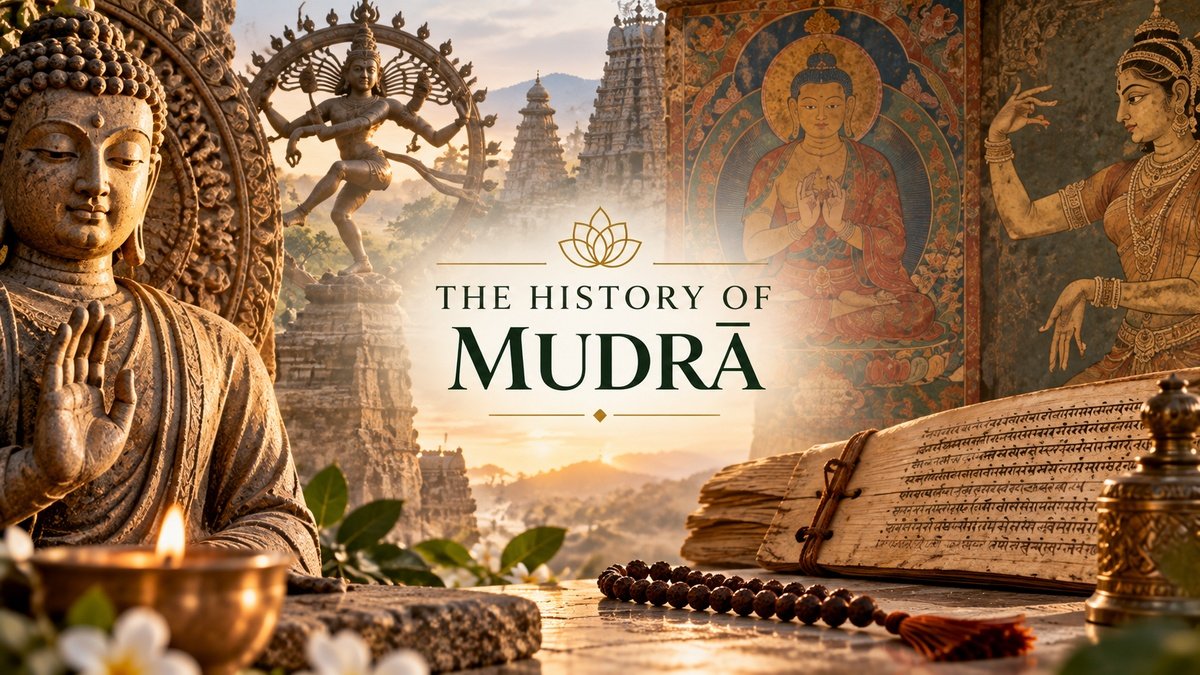
Place the thumb and index finger together and many contemporary yoga practitioners will recognise the shape immediately.
They may call it a mudrā.
Yet the history of Mudra cannot be reconstructed by starting with modern yoga hand gestures and simply projecting them backwards into antiquity.
The Sanskrit word has carried a much wider range of meanings. Across different periods and traditions, mudrā could refer to a seal, mark, sign, symbolic gesture, ritual action or specialised yogic practice.
In some settings, the hands communicate meaning.
In others, the entire body becomes involved.
And in medieval Haṭha Yoga, the concept of the “seal” became associated with physical techniques intended, within traditional yogic models, to manipulate or preserve vital processes within the body.
To understand how one word came to encompass such different practices, we need to follow its history rather than assume that mudrā has always meant the same thing.
First, What Does the Word Mudrā Mean?
The Sanskrit feminine noun mudrā carries meanings including seal, mark, sign and gesture.
That semantic range immediately tells us something important.
“Hand gesture” is a valid meaning in particular contexts, but it is not a sufficient translation for every historical use of the term.
A seal can authenticate something.
A mark can identify it.
A sign can communicate meaning.
A gesture can embody or enact meaning through the body.
Different Indian religious and yogic traditions developed different possibilities within this wider conceptual territory.
Consequently, the first question when encountering a historical mudrā should not simply be:
“What shape do the fingers make?”
A better question is:
“What does the word mean in this particular text, tradition and period?”
Where Did Mudrā Originate?
There is no convincing single-origin story in which one teacher invented mudrā and subsequently transmitted a complete system to everyone else.
The term developed within the much larger cultural and religious world of South Asia.
Over time, we find mudrā associated with Hindu, Buddhist and Jain traditions, as well as ritual, religious imagery, Tantra, yoga and forms of performance.
However, these uses should not be collapsed into one supposedly universal ancient system.
A gesture represented in Buddhist sculpture, a ritual mudrā performed within a Tantric ceremony and a bodily seal described in a Haṭha Yoga text can all carry the name mudrā while functioning differently.
The history therefore resembles a network of related meanings more than the history of one technique.
How Old Are Mudrās?
This apparently simple question needs qualification.
Gestures themselves are obviously ancient human forms of communication. That fact, however, does not establish that every later gesture called a mudrā existed from the earliest period or carried the same meaning.
Historical investigation depends on evidence: texts, inscriptions, sculpture, painting and other material sources.
Different uses of the word emerge at different times.
Likewise, particular gestures can acquire increasingly standardised meanings over centuries.
For example, research into Buddhist art indicates that the symbolic system associated with specific Buddha hand gestures developed historically rather than appearing immediately as one complete, fixed visual vocabulary.
That distinction is essential whenever modern yoga describes a mudrā as simply “thousands of years old”.
The category may have a long history while the precise form, name or interpretation of a particular gesture may be considerably later.
What Role Did Mudrās Play in Buddhism?
Buddhist traditions provide some of the most recognisable examples of symbolic hand gestures.
In Buddhist contexts, mudrās can appear in ritual practice and in representations of Buddhas, bodhisattvas and other figures.
The hands help communicate identity, events, teachings or particular qualities.
One familiar example is Bhūmisparśa Mudrā, the earth-touching gesture associated with the Buddha’s awakening narrative.
Abhaya Mudrā commonly carries associations with fearlessness or reassurance.
Dhyāna Mudrā appears in meditative imagery, while Dharmacakra Mudrā is associated with teaching the Dharma.
Yet Buddhist mudrā did not remain limited to a small collection of gestures.
As Mahāyāna and especially Vajrayāna traditions developed, mudrās became increasingly elaborate within ritual and iconographic systems.
In some Tantric Buddhist contexts, gestures operate alongside mantra, visualisation and ritual action.
The word can also carry meanings beyond hand gesture altogether.
This is another reason we should resist treating “mudrā” as one universally fixed category.
What About Mudrā in Hindu Traditions?
Hindu traditions likewise contain diverse uses of mudrā.
Gestures can form part of ritual worship, meditation, deity practice and Tantric traditions.
Religious images may use particular hand positions to communicate qualities or actions associated with a deity.
Within ritual, mudrās can participate in a larger sequence of embodied actions.
Some Tantric traditions use gestures while invoking, welcoming or making offerings to a deity. In such settings, mudrā does not function as decorative hand choreography.
The gesture belongs to a ritual system.
Its meaning comes partly from what the practitioner is doing, what is being invoked or represented, and how the gesture relates to mantra, visualisation and other elements of practice.
This wider context becomes particularly important when mudrās migrate into modern yoga environments where the original ritual framework may no longer accompany them.
What Is the Relationship Between Mudrā and Tantra?
Tantric traditions are particularly important to the history of Mudra.
However, Tantra itself encompasses multiple Hindu and Buddhist traditions rather than one uniform philosophy or technique.
Within some Tantric ritual systems, gestures participate in complex relationships between body, mantra, visualisation, deity and ritual space.
A practitioner might use different mudrās during different stages of ritual activity.
Here, gesture can do more than symbolise an idea from a distance.
Within the logic of the ritual, performing the gesture forms part of the enactment itself.
This distinction helps explain why translating every mudrā simply as “a symbolic hand gesture” can become inadequate.
The gesture may simultaneously signify, enact and ritually “seal” something within the practice.
Are Mudrās Used in Indian Dance?
Hand gestures also play sophisticated roles within Indian performance traditions.
Here we need another distinction.
Yoga, ritual, religious iconography and classical dance developed within overlapping cultural worlds, and gestures can sometimes resemble one another or share terminology.
Nevertheless, that does not make their systems interchangeable.
A hand configuration used to communicate narrative or meaning within a dance tradition should not automatically be described as a yogic meditation technique.
Likewise, a yoga teacher should not assume that the meaning assigned to a familiar hand shape in one modern yoga manual applies unchanged across Indian performance traditions.
Similarity of shape does not guarantee identity of function.
When Did Mudrā Become Part of Yoga?
There is no single moment when “mudrā entered yoga”.
The relationship developed through multiple historical intersections between ritual, Tantra, ascetic practice and evolving systems of yoga.
This becomes especially significant in the emergence of Haṭha Yoga.
Early Haṭha traditions increasingly developed physical methods concerned with controlling breath and other processes understood through premodern yogic models of the body.
Mudrās became fundamental techniques within these systems.
Yet these Haṭha mudrās could look remarkably different from the hand gestures now commonly taught in yoga studios.
How Did Haṭha Yoga Change the Meaning of Mudrā?
Haṭha Yoga gives us one of the most important developments in the history of Mudra.
Premodern Haṭha texts describe physical techniques known as mudrās or seals.
Within their traditional frameworks, these practices could manipulate breath or vital processes, preserve bindu, stimulate kuṇḍalinī or direct activity through the subtle body.
The practices might involve posture, muscular actions, breath retention, the tongue or inversion.
Consider Khecarī Mudrā, which involves the tongue rather than a symbolic finger configuration.
Viparītakaraṇī involves an inverted bodily arrangement.
Mahāmudrā combines bodily positioning with other yogic actions.
Consequently, the word mudrā in a Haṭha Yoga text may refer to something fundamentally different from the hand gesture a contemporary practitioner encounters during meditation.
We examine these practices individually in Beyond the Hands: Mudrā in Haṭha Yoga.
What Did These Yogic “Seals” Seal?
The English translation seal can sound mysterious unless we understand the framework in which these practices operated.
Premodern yogic traditions developed models of the body that differ from contemporary biomedical anatomy.
They could describe prāṇa or vital winds, channels, bindu, kuṇḍalinī and other subtle processes.
Within those systems, particular techniques were understood to control, redirect, preserve or prevent the loss of something considered vital to yogic practice.
The idea of a “seal” therefore becomes intelligible within the traditional model.
However, explaining that model historically is different from claiming that modern physiology has demonstrated the existence of the same mechanisms.
We explore that distinction in Mudrā, Prāṇa and the Subtle Body.
Did Every Haṭha Yoga Text Teach the Same Mudrās?
No.
This is another place where modern summaries can create an impression of uniformity that the historical material does not support.
Different texts contain different collections, classifications and explanations.
The influential Haṭhapradīpikā presents mudrās within its synthesis of earlier Haṭha practices, but it did not invent the techniques from nothing.
Earlier textual traditions had already described practices that contributed to the developing repertoire of Haṭha Yoga.
Later works continued to organise, reinterpret and expand yogic techniques.
Therefore, when a modern source presents “the ten ancient yoga mudrās” as though one definitive list governed every school and century, it removes much of the historical complexity.
A numbered list can accurately represent a particular text without becoming a universal catalogue for all yoga.
Were Hand Mudrās Always Central to Haṭha Yoga?
Not in the way modern yoga imagery might lead us to expect.
This distinction becomes particularly interesting when we examine Cinmudrā, the familiar gesture in which the index finger and thumb meet.
Today, the gesture frequently accompanies seated meditation and prāṇāyāma. It has become visually emblematic of yoga itself.
However, recent historical research by yoga scholar Shamita Ray found scant references to cinmudrā in the earlier Haṭha Yoga corpus and traced its textual presence in yoga particularly through later sources.
This does not mean that nobody could have made the gesture earlier.
It means the available evidence does not support casually projecting its familiar modern role unchanged across the whole history of Haṭha Yoga.
This is an excellent example of why the history of a practice must be distinguished from its present-day familiarity.
So Where Do Familiar Hand Mudrās Fit?
Hand mudrās have extensive histories of their own.
They appear in religious imagery, ritual and contemplative traditions, and some became integrated into modern yoga practice.
Yet even apparently familiar gestures can carry different names or meanings depending on their context.
This makes it difficult to construct one historical chart in which every finger position has always represented exactly the same concept.
Our next article in this series therefore concentrates specifically on the hands:
Hasta Mudrās: Understanding the Hand Gestures of Yoga.
There we can separate the history of hand gesture from the broader category of yogic mudrā and examine how these gestures function in contemporary practice.
How Did Mudrās Reach Modern Yoga?
Modern yoga did not inherit one untouched mudrā system.
Instead, contemporary practice developed through processes of transmission, selection, reinterpretation and synthesis.
Some practices continued through specific teaching traditions.
Modern teachers and organisations also brought together material from yoga, Tantra, meditation, devotional traditions and other sources.
Printed manuals, international teaching networks and later digital media made particular mudrās increasingly visible.
At the same time, hand gestures proved especially portable.
They require little space or equipment, photograph clearly and can be incorporated easily into meditation or breathing practice.
As a result, the visual identity of mudrā in global yoga increasingly became associated with the hands.
That modern visibility should not be mistaken for a complete representation of mudrā’s historical range.
When Did Mudrā Become Associated with Health Benefits?
Traditional Indian sources can certainly connect practices with bodily effects, longevity, yogic accomplishment or other benefits.
However, contemporary mudrā culture has expanded therapeutic claims considerably.
Today, charts may assign a particular gesture to digestion, blood pressure, hormones, anxiety, sleep, eyesight or numerous other concerns.
Some explanations combine traditional concepts with modern anatomical vocabulary. Others use systems of five-element correspondences to explain why particular fingers should influence particular functions.
We should not assume that every such chart represents an unchanged ancient teaching.
Some contemporary interpretations reflect later systematisation, modern therapeutic yoga, popular publishing or wellness culture.
The historical question — where did this explanation come from? — needs to precede the medical question — does evidence support the claim?
We investigate both in Do Mudrās Really Work? Tradition, Modern Claims and Evidence.
Why Do Different Sources Give Different Meanings?
Because mudrā does not belong to one historical system.
Meanings change when practices move between traditions, texts, teachers, regions and historical periods.
A gesture can function iconographically in one setting and ritually in another.
A later yoga tradition may reinterpret an older gesture.
Modern teachers may add psychological or wellness language that earlier sources did not use.
Translation introduces another layer of interpretation.
None of this means that meaning becomes arbitrary.
It means that claims require context.
Instead of asking only:
“What does this mudrā mean?”
historical inquiry asks:
“What does this mudrā mean here, according to whom, and at what point in its history?”
Is There One Authentic Mudrā Tradition?
No single tradition can adequately represent the entire historical category.
That does not mean historical accuracy is impossible.
On the contrary, specificity makes accuracy possible.
We can identify a Buddhist mudrā within a particular iconographic context.
We can examine a ritual gesture described by a Tantric source.
We can study Mahāmudrā as a Haṭha technique in a particular yoga text.
We can investigate when Cinmudrā becomes clearly documented within yoga sources.
Problems arise when these different histories are compressed into one imaginary system and labelled simply “the ancient meaning of mudrā”.
Does Historical Change Make Modern Mudrā Less Authentic?
Not necessarily.
Traditions change because people transmit them.
Teachers interpret inherited material, practices move between communities and new contexts generate new meanings.
Modern yoga itself emerged through extensive processes of continuity and innovation.
A contemporary mudrā does not need to be unchanged for two thousand years to have value.
The problem begins when a recent interpretation acquires an invented ancient history to make it appear more authoritative.
We can appreciate a modern practice while describing it accurately as modern.
Likewise, we can respect a traditional explanation without pretending that every contemporary practitioner understands the gesture in precisely the same way.
How Does This Change the Way We Practise Mudrā?
History does not have to make practice more complicated.
It can make practice more precise.
When a teacher introduces a mudrā, several simple questions can deepen understanding:
What is its name?
Where does this interpretation come from?
Is the gesture being used symbolically, meditatively, ritually or as part of a particular yoga method?
Is the explanation traditional to that context, or is it a modern interpretation?
Does a claimed physical effect have evidence behind it?
These questions do not diminish tradition.
They allow us to encounter traditions on their own terms rather than replacing their complexity with a convenient story.
Where Does This Article Sit in the Mudrā Series?
This article explores the historical question within The Orenna Journal Mudrā Series.
If you are beginning with the subject, return to the cornerstone guide Mudrā: Understanding the Gestures, Seals and Practices of Yoga.
Next, we turn specifically to the hands in Hasta Mudrās: Understanding the Hand Gestures of Yoga.
Later articles explore Mudrā in Haṭha Yoga, Mudrā, Prāṇa and the Subtle Body, the meaning of familiar yoga mudrās, and the evidence behind modern claims about mudrā benefits.
An Orenna Perspective: Tradition Has a History
There is a temptation to imagine that historical depth requires permanence.
If something is ancient, we expect it to have remained unchanged.
Mudrā tells a more interesting story.
A seal becomes a sign.
A gesture communicates meaning.
Ritual gives gesture another function.
Yoga develops bodily seals that extend far beyond the hands.
Centuries later, particular hand positions become some of the most recognisable images of global yoga.
None of these developments needs to erase what came before.
Instead, they reveal how practices acquire meaning through the people, texts and traditions that use them.
Perhaps understanding a tradition does not require us to prove that it never changed. It requires us to become curious about how, when and why it did.
References & Further Reading
James Mallinson and Mark Singleton. Roots of Yoga. Penguin Classics. A major sourcebook bringing together translated material from numerous premodern yoga traditions, including texts relevant to mudrā and Haṭha Yoga.
James Mallinson. Research on the development of Haṭha Yoga provides important historical context for understanding mudrās as physical yogic techniques rather than exclusively hand gestures.
Shamita Ray. “Cinmudrā: Origins, Evolution and Meaning.” Journal of Yoga Studies, Vol. 6, 2025. A detailed investigation of the historical development of Cinmudrā and its incorporation into yoga practice.
Sthaneshwar Timalsina. “Language of Gestures: Mudrā, Mirror, and Meaning in Śākta Philosophy.” Religions, 2021. Examines gesture and mudrā within Tantric ritual and philosophical contexts.
Haṭha Yoga Project, SOAS University of London. Research and translations concerning the development of Haṭha Yoga, including historical material on yogic seals or mudrās.
Robert E. Buswell Jr. and Donald S. Lopez Jr. The Princeton Dictionary of Buddhism. Princeton University Press. Useful for the varied meanings and functions of mudrā within Buddhist traditions.