


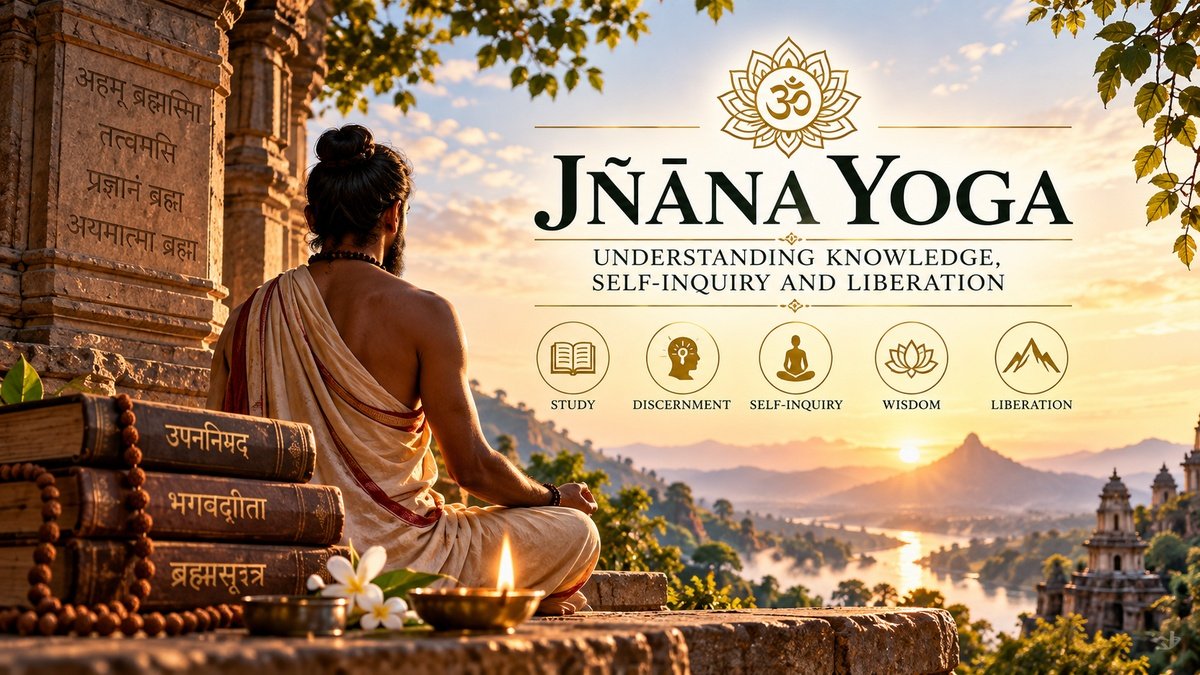
Jñana Yoga begins with a question that appears deceptively simple:
What am I?
Not what is my name, profession, history or personality. Nor simply what do I think or feel.
The question reaches further.
What is the nature of the self? What remains when changing experiences, thoughts and identities are examined carefully? And what relationship, if any, exists between that self and ultimate reality?
Jñāna Yoga approaches such questions through knowledge, discernment and sustained inquiry.
For this reason, it is commonly called the yoga of knowledge.
Yet that description can easily mislead. Jñāna does not simply mean collecting information about philosophy, reading more books or becoming intellectually sophisticated.
Within the traditions most strongly associated with Jñāna Yoga, knowledge becomes transformative because it concerns the nature of reality and the removal of fundamental misunderstanding.
To understand Jñāna Yoga, therefore, we need to distinguish knowing about something from the liberating knowledge these traditions seek.
What Is Jñana Yoga?
Jñana Yoga is commonly described as the path of knowledge or wisdom.
The Sanskrit term jñāna refers broadly to knowledge or knowing.
However, the knowledge sought within Jñāna Yoga is not merely factual information.
Its central concern is liberating knowledge: insight into the nature of self and reality that challenges the ignorance or misunderstanding believed to sustain bondage.
This gives Jñāna Yoga a distinctive orientation.
Rather than asking primarily how the body should move or how a ritual should be performed, it asks what is ultimately true.
Who is the one who experiences?
What changes?
What does not?
What is the relationship between consciousness, the individual self and ultimate reality?
Different Indian philosophical traditions answer these questions differently. Consequently, Jñāna Yoga should not become a generic claim that all Indian philosophies teach exactly the same understanding of the self.
What Does Jñana Mean?
The Sanskrit word jñāna means knowledge, knowing or understanding.
In ordinary usage, knowledge can concern almost anything.
Within a spiritual or philosophical context, however, the object of knowledge becomes crucial.
Knowing the history of yoga is knowledge.
Understanding Sanskrit terminology is also knowledge.
Neither necessarily constitutes liberating insight.
Jñāna Yoga therefore distinguishes, implicitly or explicitly, between information and a deeper recognition concerning the nature of existence.
In traditions such as Advaita Vedānta, liberation depends upon knowledge that removes a fundamental error about who or what we are.
The purpose is not simply to know more. It is to see differently.
Where Does Jñana Yoga Come From?
Jñāna Yoga does not have one historical founder.
Its background reaches into some of the major philosophical questions explored in the Upaniṣads.
These Sanskrit texts developed within the later Vedic world and contain diverse teachings concerning self, consciousness, ultimate reality, death, rebirth, knowledge and liberation.
They do not present one completely uniform philosophy.
Nevertheless, questions concerning Ātman and Brahman became particularly influential in later Vedāntic traditions.
The Bhagavad Gītā subsequently integrated knowledge with action, meditation and devotion.
Centuries later, Vedānta developed into multiple philosophical schools that interpreted the Upaniṣads, Bhagavad Gītā and Brahma Sūtras in different ways.
Among these schools, Advaita Vedānta became especially influential in modern explanations of Jñāna Yoga.
What Are the Upanishads?
The Upaniṣads form an important part of the textual background to later Jñāna traditions.
They belong to the broader Vedic corpus, although individual Upaniṣads come from different historical periods.
The earliest principal Upaniṣads probably developed during the first millennium BCE.
Rather than presenting a single systematic doctrine, they preserve dialogues, teachings, contemplations and philosophical investigations.
Questions repeatedly arise concerning the self, death, consciousness, the source of existence and the possibility of liberation.
Some passages investigate the relationship between Ātman, the self, and Brahman, ultimate reality.
Later Vedānta schools interpreted these passages differently.
Therefore, it would be inaccurate to treat every Upaniṣad as though it simply taught the fully developed philosophy of Advaita Vedānta.
Instead, the Upaniṣads provide a diverse textual inheritance from which later thinkers constructed distinctive philosophical systems.
What Is Atman?
Ātman is commonly translated as self.
However, that English word can create confusion.
In ordinary conversation, “self” may mean personality, personal identity, ego or individual psychology.
Those meanings do not adequately capture how Ātman functions in many Upaniṣadic and Vedāntic discussions.
Within Advaita Vedānta, Ātman ultimately refers to the deepest reality of the self rather than the changing personality or individual biography.
The body changes.
Thoughts change.
Emotions, roles, memories and circumstances also change.
Advaita inquiry asks whether these changing phenomena constitute the ultimate self.
Its answer is no.
The implications of that answer lead directly towards the relationship between Ātman and Brahman.
What Is Brahman?
Brahman is one of the most important concepts in Vedāntic philosophy.
It refers to ultimate reality, although different Vedānta schools understand that reality differently.
Brahman should not be confused with Brahmā, the deity associated with creation in later Hindu traditions.
Nor is Brahman simply another word for an individual god.
Within Advaita Vedānta, Brahman is the non-dual ultimate reality.
The apparent multiplicity of ordinary experience does not represent reality at its deepest level.
Most importantly for Jñāna Yoga, Advaita maintains that the true self, Ātman, is not ultimately separate from Brahman.
Understanding this claim requires us to enter the distinctive non-dual philosophy of Advaita.
What Is Advaita Vedanta?
Advaita Vedānta is a major school of Vedānta philosophy.
The Sanskrit word advaita means “not two” or non-dual.
Its central philosophical claim concerns the non-duality of Ātman and Brahman.
At the level of ordinary experience, individuals appear separate from one another and from the world around them.
Advaita does not simply deny that we experience such distinctions.
Instead, it questions whether those distinctions describe ultimate reality.
According to Advaita, ignorance — avidyā — prevents recognition of the true nature of self and reality.
Liberating knowledge removes that ignorance.
For this reason, knowledge occupies a central position in the path to mokṣa, or liberation.
Who Was Adi Shankara?
Śaṅkara, often called Ādi Śaṅkarācārya, was one of the most influential philosophers associated with Advaita Vedānta.
He probably lived around the eighth century CE, although scholars continue to discuss aspects of his chronology and biography.
Śaṅkara wrote influential commentaries on major Upaniṣads, the Bhagavad Gītā and the Brahma Sūtras.
His work developed a sophisticated account of non-duality, ignorance, knowledge and liberation.
Later traditions also attributed many additional texts and stories to him.
However, scholars do not accept every work carrying Śaṅkara’s name as authentically his.
This distinction matters because popular accounts sometimes combine historically supportable information with much later traditional biographies.
Śaṅkara did not invent every idea associated with non-dual Vedānta.
Nevertheless, his writings became foundational for the subsequent development of Advaita.
What Is Avidya?
The Sanskrit term avidyā means ignorance or lack of knowledge.
In Advaita Vedānta, this is not simply ignorance of facts.
A person can possess extensive education and still remain subject to avidyā.
The fundamental problem concerns mistaken identification.
We take what is changing and conditioned to represent the deepest self.
Body, thought, emotion, memory, social identity and personal history become the basis upon which the sense of “I” is constructed.
Advaita does not claim that these aspects of ordinary life simply disappear.
Rather, it questions the assumption that they constitute ultimate identity.
Jñāna therefore addresses ignorance through discernment and knowledge rather than through the accumulation of more personal information.
What Is Maya?
Māyā is another term frequently associated with Advaita Vedānta.
Popular explanations often translate it simply as “illusion”.
That can be misleading.
Advaita does not require us to imagine that the world is completely nonexistent, like a hallucination with no experiential reality.
Instead, discussions of māyā concern appearance, manifestation and the way multiplicity is experienced despite the non-duality of ultimate reality.
Later Advaita thinkers developed the concept in increasingly sophisticated ways.
Therefore, the statement “the world is an illusion” compresses a complex philosophical framework into a slogan.
A more useful question is:
At what level, and in what sense, are we claiming something to be real?
What Is Moksha?
Mokṣa means liberation or release.
It is one of the major soteriological concepts of Indian philosophy, although traditions differ substantially in how they understand liberation and the path towards it.
Within Advaita Vedānta, liberation is fundamentally connected with knowledge.
If ignorance produces the mistaken identification that sustains bondage, knowledge removes that error.
Mokṣa is therefore not simply a more pleasant emotional state.
Nor should it be reduced to relaxation, wellbeing or psychological confidence.
It concerns liberation from the fundamental ignorance through which the individual misunderstands the nature of self and reality.
This is one reason why translating Jñāna Yoga directly into contemporary self-development language can substantially change its purpose.
What Does the Bhagavad Gita Teach About Jñana?
The Bhagavad Gītā repeatedly discusses knowledge alongside action, meditation and devotion.
Krishna distinguishes the imperishable self from the changing body early in his response to Arjuna’s crisis.
As the dialogue develops, knowledge becomes part of a wider account of liberation.
However, the Gītā does not simply dismiss action in favour of intellectual contemplation.
Instead, it repeatedly examines the relationship between knowledge and disciplined action.
Its teachings also become increasingly devotional as Krishna reveals his divine nature.
Consequently, Karma Yoga, Bhakti Yoga and knowledge cannot always be separated into isolated compartments.
The Gītā presents a more integrated philosophical landscape than the familiar modern division into several independent “types of yoga” might suggest.
What Is Viveka?
Viveka refers to discernment or discrimination.
Within Advaita-oriented practice, discernment helps distinguish what is permanent from what is impermanent and the self from what is not ultimately the self.
This is not discrimination in the modern social sense of prejudicial treatment.
It is philosophical discernment: the capacity to distinguish between categories that ignorance has confused.
The practitioner observes that experiences arise and pass.
Sensations change, thoughts change and emotions change.
Roles and identities also shift throughout a lifetime.
Viveka asks whether that which changes can represent the ultimate nature of the self.
In this way, discernment becomes a method of inquiry rather than merely an abstract philosophical concept.
What Is Vairagya?
Vairāgya refers broadly to dispassion, detachment or freedom from craving.
The term appears across several Indian philosophical and yogic traditions, although its precise role differs between them.
Within Advaita, attachment to impermanent objects can reinforce mistaken identification and desire.
Vairāgya therefore supports the orientation towards liberating knowledge.
However, dispassion does not require emotional numbness.
Nor does it mean neglecting relationships, responsibilities or ethical considerations.
Its philosophical purpose concerns reducing the grip of attachment to what cannot provide ultimate liberation.
As with non-attachment in Karma Yoga, contemporary interpretation requires care so that a spiritual concept does not become an excuse for indifference or avoidance.
What Does Neti Neti Mean?
Neti neti is commonly translated as “not this, not this”.
The expression appears in the Bṛhadāraṇyaka Upaniṣad.
Later non-dual interpretation frequently associates it with a process of negation.
Rather than defining ultimate reality by attaching another limited description to it, inquiry removes inadequate identifications.
I am not simply the body.
I am not simply a thought.
Nor can any passing emotion or social role exhaust what the self ultimately is.
However, neti neti should not become a mechanical affirmation repeated without philosophical context.
Its importance lies in the disciplined refusal to mistake a limited object of experience for ultimate reality.
What Are the Mahavakyas?
Later Advaita tradition gives particular importance to several Upaniṣadic statements commonly called mahāvākyas, or “great sayings”.
Among the best known are:
Tat tvam asi — “That you are” or “You are that”
Aham brahmāsmi — “I am Brahman”
Prajñānam brahma — “Consciousness is Brahman”
Ayam ātmā brahma — “This self is Brahman”
These statements come from different Upaniṣadic contexts.
Advaita Vedānta interprets them as expressing the identity of Ātman and Brahman.
However, simply repeating “I am Brahman” does not automatically constitute the liberating knowledge intended by the tradition.
The statement belongs within a larger discipline of preparation, teaching, inquiry and understanding.
How Is Jñana Yoga Traditionally Practised?
Jñāna Yoga is sometimes portrayed as though a person simply sits alone and asks philosophical questions.
Traditional Advaita presents a more structured process.
A commonly discussed sequence involves śravaṇa, manana and nididhyāsana.
Śravaṇa involves hearing or studying the teaching.
Manana involves reflection and reasoning through doubts.
Nididhyāsana involves sustained contemplation or assimilation of what has been understood.
The process therefore includes teaching, reasoning and contemplative integration.
It is not anti-intellectual, but neither does it stop at intellectual comprehension.
The teaching must move from information towards transformative understanding.
What Is Shravana?
Śravaṇa literally relates to hearing.
Within the Advaita framework, it concerns receiving and studying teachings concerning the nature of Ātman and Brahman.
Historically, this reflects the importance of oral teaching and scriptural interpretation.
The practitioner does not simply invent a personal philosophy through introspection.
Instead, inquiry develops in relationship with a body of teaching.
This matters because modern self-inquiry can sometimes become detached from the philosophical frameworks that originally gave it meaning.
Śravaṇa places knowledge within a tradition of study rather than treating every spontaneous thought as equivalent to philosophical insight.
What Is Manana?
Manana involves reflection.
Hearing a teaching does not guarantee understanding.
Questions arise.
Apparent contradictions need examination, and habitual assumptions may resist the implications of what has been taught.
Reasoning therefore has an important place.
The practitioner examines doubts rather than suppressing them.
In this respect, Jñāna Yoga should not be confused with unquestioning belief.
Within its traditional philosophical framework, inquiry and reasoning help establish understanding.
Manana provides space for that examination.
What Is Nididhyasana?
Nididhyāsana refers to sustained contemplation or deep assimilation of the teaching.
Intellectual agreement may leave habitual identification unchanged.
A person might understand a philosophical argument conceptually while continuing to experience themselves entirely through established patterns of identity.
Nididhyāsana addresses this gap between conceptual understanding and stable recognition.
Different Advaita teachers interpret its precise function in different ways.
Nevertheless, the broad progression remains useful:
hear the teaching, examine it carefully, then contemplate its implications deeply.
This is very different from simply collecting spiritual concepts.
Is Self-Inquiry the Same as Asking “Who Am I?”
The question “Who am I?” has become closely associated with modern presentations of non-dual self-inquiry.
It is especially connected with the twentieth-century Indian teacher Ramana Maharshi.
Ramana emphasised ātma-vicāra, inquiry into the self, as a direct means of investigating the source of the sense of “I”.
The practice does not merely involve repeatedly asking the sentence “Who am I?” and waiting for a verbal answer.
Instead, attention turns towards the apparent subject who claims thoughts and experiences as “mine”.
Who is thinking?
To whom does this experience appear?
What is the source of the sense of “I”?
Ramana’s approach became enormously influential in modern global presentations of Advaita and self-inquiry.
However, we should distinguish his particular method and historical context from every earlier expression of Jñāna Yoga.
Is Jñana Yoga the Same as Advaita Vedanta?
Not exactly.
Modern explanations often present Jñāna Yoga almost entirely through Advaita Vedānta because Advaita gives liberating knowledge a particularly prominent role.
The association is understandable and historically influential.
Nevertheless, jñāna is a broader Sanskrit category than one philosophical school.
The Bhagavad Gītā, for example, discusses knowledge centuries before Śaṅkara’s mature Advaita system.
Other Vedānta traditions also value knowledge while disagreeing with Advaita about the relationship between the individual self, the world and God.
Therefore, Advaita provides one of the most important frameworks for understanding Jñāna Yoga, but the two terms should not automatically become interchangeable.
Does Jñana Yoga Reject Devotion?
No.
Modern diagrams sometimes place Jñāna Yoga and Bhakti Yoga at opposite ends of a spectrum: intellect on one side and love on the other.
Historical traditions are more complicated.
Advaita authors could recognise devotional practices, worship and contemplation while maintaining that liberating knowledge ultimately removes ignorance.
Likewise, the Bhagavad Gītā combines knowledge with profound devotion to Krishna.
A practitioner may therefore engage in devotion while also pursuing philosophical inquiry.
The two orientations can serve different functions within a broader spiritual life.
Knowledge need not eliminate devotion, just as devotion need not eliminate discernment.
Does Jñana Yoga Reject Action?
Again, no simple opposition works.
The relationship between knowledge and action has generated substantial philosophical discussion within Indian traditions.
The Bhagavad Gītā explicitly addresses the tension between renunciation and action.
Its response does not simply tell Arjuna to abandon action.
Instead, the text develops the disciplined action explored in Karma Yoga while also teaching knowledge.
Advaita later gives liberating knowledge a decisive role in overcoming ignorance.
However, ethical discipline and preparation remain important because the condition of the practitioner affects readiness for sustained inquiry.
Jñāna Yoga therefore does not provide a philosophical excuse for avoiding ordinary responsibility.
Does Jñana Yoga Involve Meditation?
Contemplative practice can form an important part of Jñāna-oriented traditions.
However, Jñāna Yoga should not simply be renamed meditation.
Its distinguishing concern is knowledge and discernment.
Contemplation can help stabilise or assimilate understanding, particularly within discussions of nididhyāsana.
Self-inquiry may also involve sustained attention towards the nature of the experiencing subject.
Yet the philosophical framework matters.
Quietly observing thoughts for ten minutes may be a useful contemplative exercise, but that alone does not necessarily constitute Jñāna Yoga.
Does Jñana Yoga Involve Asana?
Jñana Yoga does not have a defining āsana sequence.
There is no Jñāna equivalent of the Primary Series in Ashtanga Yoga or the alignment methodology associated with Iyengar Yoga.
A practitioner may certainly practise āsana as part of a wider spiritual discipline.
However, posture practice does not define Jñāna Yoga.
Its central methods concern knowledge, discernment, study, reflection and contemplation.
This makes Jñāna another useful reminder that the historical category of yoga extends far beyond physical posture practice.
Is Jñana Yoga an Intellectual Path?
Yes and no.
Jñāna Yoga takes philosophy, reasoning and discernment seriously.
For that reason, describing it as entirely non-intellectual would be misleading.
Yet intellectual sophistication alone does not accomplish its stated purpose.
A person could memorise Sanskrit terminology, compare philosophical schools and explain Advaita elegantly while still approaching the subject entirely as information.
The tradition seeks something more fundamental.
Knowledge must address the mistaken identification at the centre of bondage.
Jñāna Yoga uses the intellect, but its goal is not intellectual achievement.
Does Jñana Yoga Mean “I Am Not My Thoughts”?
Not exactly.
The contemporary phrase “you are not your thoughts” can provide an accessible entry into questions about identification.
However, it does not capture the full philosophical claim of Advaita Vedānta.
Jñāna inquiry concerns more than creating psychological distance from mental activity.
It examines the nature of the self and, within Advaita, the non-duality of Ātman and Brahman.
Therefore, we should not reduce a sophisticated metaphysical and soteriological tradition to a modern mindfulness slogan.
Observing thoughts without identifying with every thought may still offer a useful experiential analogy.
It is simply not the whole philosophy.
Is Jñana Yoga the Same as Mindfulness?
No.
Mindfulness practices have their own complex histories, particularly within Buddhist traditions and their modern adaptations.
Jñāna Yoga arises from different philosophical questions and textual traditions.
Both may involve careful observation of experience, but similarity at the level of technique does not make their philosophical aims identical.
Advaita asks questions about Ātman, Brahman, ignorance and liberation that do not define mindfulness as a general category.
Maintaining this distinction prevents contemporary terminology from erasing important differences between traditions.
How Can Jñana Yoga Be Explored Today?
A contemporary exploration of Jñāna Yoga can begin with careful study rather than adopting metaphysical conclusions prematurely.
Reading selected Upaniṣads and the Bhagavad Gītā provides historical and philosophical context.
Advaita texts and commentaries can then introduce more systematic arguments concerning self and reality.
Reflection allows those ideas to be questioned rather than merely accepted.
Contemplation can explore how identification operates within direct experience.
For example, a practitioner might notice the difference between experiencing a thought and assuming that the thought completely defines the person experiencing it.
Such inquiry can illuminate aspects of the tradition without pretending that a short contemporary exercise reproduces the full soteriological path of Advaita Vedānta.
A Common Misunderstanding: Knowledge Is Not the Same as Information
Jñāna Yoga can appear unusually compatible with modern educational culture.
Read the books.
Learn the Sanskrit.
Study the philosophy.
Understand the concepts.
All of these activities can support serious study.
Yet the tradition repeatedly points beyond information.
A person can know the definition of Ātman without knowing Ātman in the sense intended by Advaita.
Likewise, someone can explain non-duality while continuing to organise experience through exactly the identifications that the philosophy asks them to examine.
The difference between knowing the teaching and knowing what the teaching points towards is one of the central tensions of Jñāna Yoga.
An Orenna Perspective: The Question Behind the Answer
Contemporary life gives us an extraordinary number of ways to describe ourselves.
Profession, personality, biography, relationships, preferences, diagnoses, achievements, failures and digital identities can all become parts of the answer to the question “Who am I?”
Many of those descriptions are meaningful.
Jñāna Yoga does not require us to pretend that ordinary identity has no practical significance.
Instead, it introduces a more unsettling question.
Do any of these descriptions completely explain the one who knows them?
A thought can be noticed.
An emotion can be noticed.
The body can also become an object of attention.
So what does it mean to speak of the knower of experience?
Advaita Vedānta develops a very specific philosophical answer to that question. We do not need to adopt its conclusion uncritically in order to recognise the depth of the inquiry.
Perhaps the first movement of Jñāna is not finding another description of ourselves.
It is learning to examine the assumptions hidden inside the descriptions we already possess.
References & Further Reading
Bṛhadāraṇyaka Upaniṣad. One of the oldest principal Upaniṣads and an important source for discussions of Ātman, Brahman and the expression neti neti.
Chāndogya Upaniṣad. An influential early Upaniṣad containing the teaching tat tvam asi within the dialogue between Uddālaka and Śvetaketu.
Bhagavad Gītā. A major source for understanding the relationship between knowledge, action, meditation and devotion.
Olivelle, Patrick. Upaniṣads. Oxford World’s Classics. A scholarly translation of the principal Upaniṣads with historical and textual context.
Śaṅkara. Commentaries on the principal Upaniṣads, Bhagavad Gītā and Brahma Sūtras. Foundational sources for classical Advaita Vedānta.
Mayeda, Sengaku. A Thousand Teachings: The Upadeśasāhasrī of Śaṅkara. An important translation and study of a work widely accepted as an authentic independent text by Śaṅkara.
Deutsch, Eliot. Advaita Vedanta: A Philosophical Reconstruction. A modern philosophical study of central Advaita concepts.
Ramana Maharshi. Teachings on ātma-vicāra, or self-inquiry. Particularly influential in twentieth-century and contemporary presentations of non-dual inquiry.