
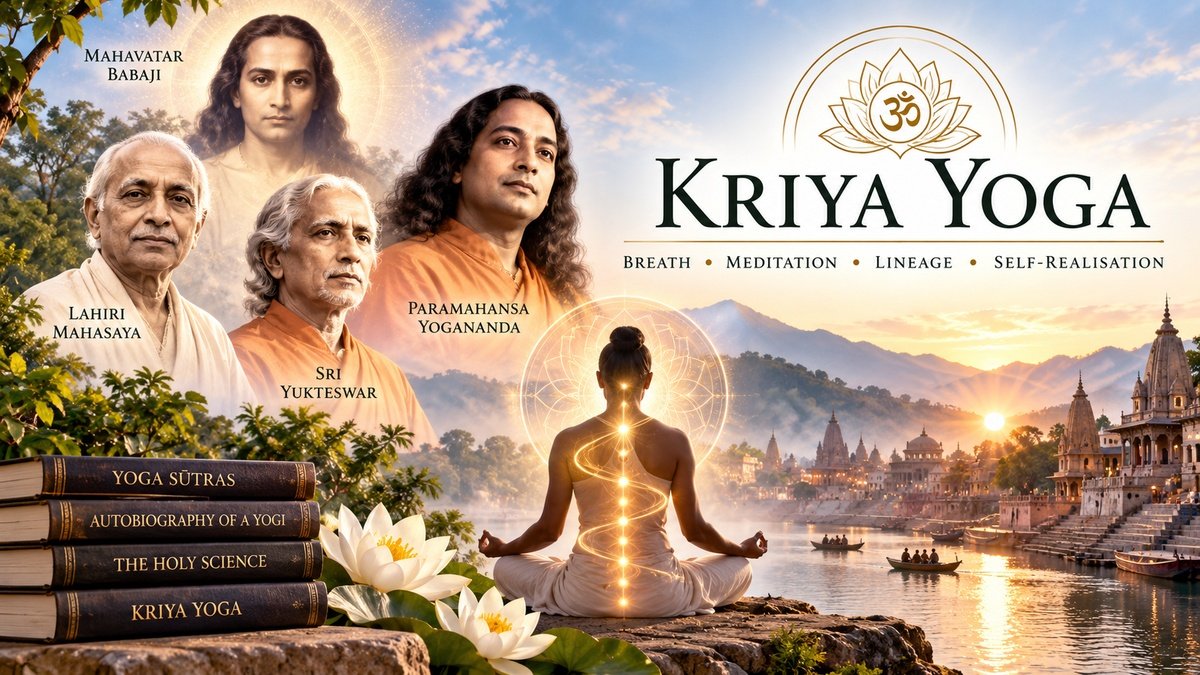
Kriya Yoga is often introduced as an ancient meditation practice centred on breath, subtle energy and the inward movement of awareness.
Yet that description conceals an important historical complication.
The term kriyāyoga appears in Patañjali’s Yoga Sūtras, where it describes a discipline of tapas, svādhyāya and īśvarapraṇidhāna. Centuries later, the same name became associated with a distinctive meditative tradition transmitted through Lahiri Mahasaya and the lineages that developed from him.
Among those lineages, the one carried through Sri Yukteswar and Paramahansa Yogananda became particularly influential internationally.
Consequently, asking “What is Kriya Yoga?” requires more than describing a breathing technique.
We need to distinguish an early textual use of the term from the modern lineage tradition, while also understanding why breath, meditation, initiation and the teacher–student relationship became so important to contemporary Kriya practice.
So what does kriyā mean? What did Patañjali mean by Kriya Yoga? Who was Lahiri Mahasaya? Who was Mahavatar Babaji? How did Paramahansa Yogananda bring Kriya Yoga to an international audience? And why are the detailed techniques still commonly transmitted through initiation rather than fully described in public?
What Is Kriya Yoga?
Kriya Yoga today commonly refers to a family of meditative yoga traditions associated historically with Lahiri Mahasaya and the teachers and organisations that developed from his transmission.
Breath regulation, concentration and meditation occupy central roles within these traditions.
However, Kriya Yoga is not simply another name for breathwork.
Its practices belong to wider spiritual systems concerned with the inward direction of attention, disciplined meditation and, within the traditions themselves, Self-realisation or communion with the Divine.
Many Kriya lineages also preserve specific techniques through direct transmission from an authorised teacher to an initiated practitioner.
For that reason, a responsible introduction can explain the history, principles and broad structure of Kriya Yoga without attempting to reproduce practices that individual traditions reserve for initiation.
What Does Kriya Mean?
The Sanskrit word kriyā broadly concerns action, activity, performance or a particular act or practice.
It shares its verbal root with karma, although the two words are not interchangeable.
Therefore, translating Kriya Yoga simply as “breath yoga” misses the wider meaning of the term.
Its precise significance depends upon context.
This becomes particularly important because kriyāyoga already appears in an influential classical yoga text long before the emergence of the modern Kriya Yoga lineages.
What Does Patañjali Mean by Kriya Yoga?
At the beginning of the second chapter of Patañjali’s Yoga Sūtras, we encounter:
tapaḥsvādhyāyeśvarapraṇidhānāni kriyāyogaḥ
In Yoga Sūtra II.1, Kriya Yoga consists of three elements:
Tapas — disciplined or ascetic practice
Svādhyāya — recitation, study and engagement with sacred teachings
Īśvarapraṇidhāna — dedication or surrender to Īśvara
Translations vary because each of these Sanskrit terms carries a wider semantic and philosophical history than a single English equivalent can capture.
Nevertheless, one distinction is crucial.
Patañjali does not describe the specific modern Kriya Yoga technique later associated with Lahiri Mahasaya and Paramahansa Yogananda in Yoga Sūtra II.1.
Using the same name does not establish that two practices separated by many centuries are technically identical.
Patañjali’s Kriya Yoga belongs to the practical architecture of classical Yoga and prepares the practitioner for the deeper work described in the text.
The modern lineage tradition requires a separate historical explanation.
Where Does Modern Kriya Yoga Begin Historically?
The present-day forms of Kriya Yoga can be traced historically to the nineteenth-century Bengali yogi Shyama Charan Lahiri, better known as Lahiri Mahasaya.
He was born in Bengal in 1828 and later lived in Benares, now Varanasi.
Importantly, Lahiri Mahasaya was not primarily known as a wandering renunciate.
He married, raised a family and worked for the British Indian government’s Military Engineering Department.
His status as a householder became an important feature of his later reputation.
Spiritual practice, in this model, did not necessarily require abandoning family and professional life.
According to Kriya lineage accounts, a decisive event occurred in 1861 when Lahiri Mahasaya was working near Ranikhet in the Himalayan foothills.
There, tradition holds that he encountered the teacher known as Mahavatar Babaji and received initiation into Kriya Yoga.
Afterwards, Lahiri returned to ordinary household life and began transmitting the practice to others.
This moment occupies a foundational position within modern Kriya Yoga traditions.
Who Is Mahavatar Babaji?
Mahavatar Babaji occupies an unusual position in Kriya Yoga history.
Within the lineage tradition, Babaji is described as the Himalayan master who initiated Lahiri Mahasaya into Kriya Yoga in 1861 and authorised its wider transmission.
Paramahansa Yogananda later made Babaji internationally famous through his 1946 book Autobiography of a Yogi.
However, historical method requires an important distinction.
The accounts of Babaji belong principally to lineage testimony and hagiographical tradition. They should not be presented in exactly the same category as independently documented biographical facts about figures such as Lahiri Mahasaya or Yogananda.
Kriya traditions may understand Babaji as an immortal or exceptionally long-lived realised master who has remained physically present for centuries.
Those claims are matters of religious and spiritual belief within the tradition rather than conclusions established through conventional historical evidence.
This distinction does not require dismissing the tradition.
Instead, it allows us to say clearly what Kriya Yoga lineages teach while distinguishing devotional history from independently verifiable biography.
Why Was Lahiri Mahasaya So Important?
Lahiri Mahasaya became the pivotal historical figure through whom modern Kriya Yoga spread.
After the 1861 initiation described by his lineage, he taught practitioners while continuing his household and professional responsibilities.
His students came from different social backgrounds, and numerous later Kriya lineages trace themselves through disciples associated with him.
Among the most consequential was Swami Sri Yukteswar Giri.
Sri Yukteswar subsequently became the guru of Paramahansa Yogananda.
Thus, one of the best-known lines of transmission can be represented as:
Mahavatar Babaji → Lahiri Mahasaya → Sri Yukteswar → Paramahansa Yogananda
That sequence is central to the lineage presented by Yogananda’s Self-Realization Fellowship and Yogoda Satsanga Society of India.
However, it is not the only modern Kriya lineage.
Lahiri Mahasaya had multiple disciples, and different branches developed through them. Consequently, contemporary organisations using the name Kriya Yoga may preserve related but not necessarily identical methods, terminology or initiation structures.
Who Was Sri Yukteswar?
Swami Sri Yukteswar Giri was an Indian yogi and teacher within Lahiri Mahasaya’s lineage.
He became particularly significant internationally because he was the guru of Paramahansa Yogananda.
Yogananda describes Sri Yukteswar as a demanding teacher who placed considerable emphasis on discipline, meditation and direct spiritual experience.
Sri Yukteswar is also associated with The Holy Science, a work that presents correspondences between Indian spiritual philosophy and Christianity.
Within Yogananda’s lineage narrative, Sri Yukteswar prepared him for the work of bringing Kriya Yoga to the West.
Through Yogananda, that branch of the tradition would eventually reach an audience far larger than its nineteenth-century Bengali setting.
How Did Paramahansa Yogananda Bring Kriya Yoga to the West?
Paramahansa Yogananda was born Mukunda Lal Ghosh in India in 1893.
After becoming a disciple of Sri Yukteswar, he entered monastic life and developed educational and spiritual work in India.
A major transition came in 1920, when Yogananda travelled to the United States to attend the International Congress of Religious Liberals in Boston.
He remained in America for most of the rest of his life.
Yogananda subsequently lectured widely, taught meditation and established the organisation that became Self-Realization Fellowship.
Kriya Yoga remained central to his spiritual system.
However, his public teaching was broader than the advanced Kriya technique itself.
It included meditation, concentration, devotional teachings and his own Energization Exercises, alongside a wider philosophy of Self-realisation.
In 1946, publication of Autobiography of a Yogi transformed the international visibility of the lineage.
The book introduced generations of readers to Lahiri Mahasaya, Sri Yukteswar, Babaji and Kriya Yoga, becoming one of the most influential modern books on Indian spirituality published in English.
What Does Kriya Yoga Practice Involve?
The exact answer depends upon the lineage.
In broad terms, contemporary Kriya Yoga traditions commonly emphasise meditation, concentration and forms of prāṇāyāma or breath-related practice.
Within Yogananda’s system, Kriya is described as an advanced Rāja Yoga technique involving prāṇāyāma and the inward direction of attention and prāṇa.
The traditional explanation refers to subtle currents of life energy and centres associated with the spine.
That language belongs to a yogic subtle-body model.
Therefore, prāṇa should not simply be translated as oxygen, electrical current or a scientifically established anatomical energy.
Likewise, chakras and subtle channels belong to historically developed yogic frameworks rather than structures recognised by conventional anatomy.
A practitioner may experience breath regulation, stillness and concentrated attention directly. However, the metaphysical interpretation of those experiences belongs to the tradition’s own explanatory framework.
Why Isn’t the Complete Kriya Technique Usually Described Publicly?
Many Kriya Yoga traditions preserve the detailed technique through initiation and direct instruction.
This is not simply a modern marketing device.
The guru–disciple relationship and controlled transmission of specialised practices have long histories within Indian religious and yogic traditions.
Self-Realization Fellowship, for example, does not publish the complete Kriya technique as an unrestricted public tutorial.
Students first study and practise preparatory methods. Those who subsequently wish to proceed can apply for Kriya Yoga initiation.
Other Kriya lineages also maintain direct teacher-to-student transmission.
Consequently, an educational article about Kriya Yoga does not need to reconstruct an initiation practice from fragments found online.
Understanding the tradition includes understanding why the tradition itself considers context, preparation and transmission significant.
What Comes Before Kriya Yoga in Yogananda’s System?
Within the current Self-Realization Fellowship system, students learn several preparatory practices before becoming eligible to apply for Kriya initiation.
These include Yogananda’s Energization Exercises, the Hong-Sau Technique of Concentration and the Aum Technique of Meditation.
Each has a different role within the organisation’s teaching structure.
The Energization Exercises combine attention, breath and physical tension and relaxation within a system developed by Yogananda.
Hong-Sau is used as a concentration practice, while the Aum technique belongs to the meditative dimension of the path.
Students currently complete the basic series of Self-Realization Fellowship Lessons before becoming eligible to apply for initiation into the Kriya technique.
Therefore, even within the organisation most strongly associated with Yogananda, Kriya Yoga is understood as more than one isolated breathing exercise.
Is Kriya Yoga a Form of Pranayama?
Prāṇāyāma is central to many modern forms of Kriya Yoga, particularly within Yogananda’s lineage.
Nevertheless, saying that Kriya Yoga is simply “a breathing exercise” would be incomplete.
Traditional descriptions concern the relationship between breath, attention, prāṇa, the subtle body and meditative interiorisation.
The practice also exists within a larger discipline that can include devotion, ethical orientation, concentration, meditation and a relationship with a spiritual lineage.
Breathing may therefore be one of the visible mechanisms of practice without being its complete meaning.
Is Kriya Yoga the Same as Kundalini Yoga?
No, although their vocabularies can overlap.
Both may employ concepts involving subtle energy, chakras, the spine, breath and altered states of awareness.
However, Kundalini Yoga describes a much broader family of historical concepts and practices, as well as several distinct modern systems.
Kriya Yoga refers to particular lineages and methods with their own histories of transmission.
Shared subtle-body language therefore does not make the traditions interchangeable.
Is Kriya Yoga the Same as Raja Yoga?
Not exactly.
Yogananda frequently situated Kriya Yoga within Rāja Yoga and presented the Kriya technique as an advanced form of prāṇāyāma.
At the same time, Rāja Yoga is a broader and historically variable category.
It is often associated in modern teaching with Patañjali and the eight limbs of yoga, although the history of the term extends beyond a simple synonym for Patañjali’s system.
Kriya Yoga can therefore be framed as a particular meditative path within a broader Rāja Yoga orientation in Yogananda’s teaching, rather than treating the two terms as universally interchangeable.
Is Kriya Yoga the Same as Ashtanga Yoga?
No.
Modern Ashtanga Yoga refers principally to the dynamic posture system associated with K. Pattabhi Jois and the Mysore tradition.
Kriya Yoga is primarily associated with meditation, prāṇāyāma and lineage transmission rather than a fixed sequence of physically demanding āsanas.
Confusion can arise because both traditions may refer to Patañjali and the eight limbs.
However, sharing philosophical reference points does not make their practical methods identical.
Does Kriya Yoga Have a Fixed Asana Sequence?
Not as its defining feature.
Unlike modern Ashtanga, Sivananda Yoga or other methods recognisable partly through characteristic posture sequences, Kriya Yoga is principally a meditative tradition.
Different lineages may incorporate physical preparation or related yogic practices.
Nevertheless, mastering a particular sequence of postures is not what defines someone as a Kriya practitioner.
This distinction is important in contemporary yoga culture, where the word yoga can automatically suggest an āsana class.
Kriya Yoga reminds us that many influential yoga traditions organise practice around meditation rather than posture.
Is Kriya Yoga Scientific?
Yogananda frequently described Kriya Yoga as a science of spiritual realisation.
Within his teaching, the word communicates ideas of systematic practice, repeatability and direct experience rather than belief alone.
However, historical religious language and contemporary scientific terminology should not be collapsed into one another.
Calling Kriya Yoga a “science” within Yogananda’s spiritual system does not establish every traditional claim about prāṇa, chakras, karma or accelerated spiritual evolution as a finding of modern physiology or neuroscience.
Research can investigate measurable effects of breathing and meditation practices. Even so, those findings should be evaluated according to the specific technique, population and study design involved.
They do not automatically validate an entire metaphysical system.
We can therefore respect Yogananda’s use of the phrase while remaining precise about what modern scientific evidence can and cannot establish.
Does Kriya Yoga Accelerate Spiritual Evolution?
Kriya lineages, particularly Yogananda’s, make strong claims about the capacity of the practice to accelerate spiritual development.
Within that tradition, these claims are central rather than incidental.
They belong to a spiritual model involving karma, reincarnation, prāṇa, subtle anatomy and progressively expanded consciousness.
However, “accelerated spiritual evolution” is not a standard biomedical outcome that can be measured in the same way as heart rate or respiratory frequency.
For that reason, The Orenna Journal treats it as a teaching of the Kriya tradition, not as an independently established clinical fact.
The distinction preserves both historical accuracy and evidence literacy.
Can Anyone Practise Kriya Yoga?
Introductory meditation and philosophical teachings associated with Kriya traditions are widely accessible.
The formal Kriya techniques themselves, however, may be transmitted according to the requirements of a particular lineage.
Self-Realization Fellowship currently requires preliminary study and practice before a student can apply for Kriya Yoga initiation.
Other organisations maintain their own forms of preparation and authorised transmission.
Therefore, “Can anyone practise?” and “Can anyone immediately perform every Kriya technique?” are different questions.
The tradition may be open to sincere seekers while still maintaining a structured process for receiving particular practices.
A Common Misunderstanding: Kriya Yoga Is Not One Universal Technique
It is tempting to speak about the Kriya Yoga technique as though one universally standardised practice has moved unchanged through history.
The reality is more complex.
Patañjali uses kriyāyoga in a particular classical context.
Lahiri Mahasaya stands at the centre of the modern lineage history.
Multiple branches subsequently developed through his disciples.
Yogananda then created an enormously influential international presentation of one branch of that inheritance.
Today, different organisations trace Kriya lineages while maintaining their own teaching structures and methods of transmission.
A shared name can preserve a lineage connection without making every historical use, technique or organisation identical.
An Orenna Perspective: When the Practice Is Not Entirely Public
Contemporary culture encourages immediate access.
Search for a posture and a demonstration appears. Search for a breathing technique and instructions can arrive within seconds.
Kriya Yoga presents a different model.
In many of its lineages, preparation matters. Relationship matters. Context matters. Transmission matters.
We do not have to accept every traditional claim uncritically to recognise what this structure asks us to consider.
Perhaps knowing that a technique exists is not always the same as being prepared to practise it.
Perhaps information and instruction are not identical.
And perhaps understanding a yoga tradition sometimes means respecting the boundaries through which that tradition has chosen to transmit itself.
Not everything withheld is necessarily a secret to be uncovered. Sometimes the manner in which something is learned forms part of the practice itself.
References & Further Reading
Patañjali. Yoga Sūtras, particularly II.1–II.2. The classical use of kriyāyoga in relation to tapas, svādhyāya and īśvarapraṇidhāna.
Yogananda, Paramahansa. (1946). Autobiography of a Yogi. The most influential international presentation of the Kriya lineage through Mahavatar Babaji, Lahiri Mahasaya, Sri Yukteswar and Yogananda.
Yogananda, Paramahansa. God Talks with Arjuna: The Bhagavad Gita. Yogananda’s extensive interpretation of the Bhagavad Gītā and Kriya Yoga.
Self-Realization Fellowship. Official materials on Paramahansa Yogananda, the Kriya Yoga path, meditation techniques, lineage and initiation.
Yogoda Satsanga Society of India. Official historical materials concerning Lahiri Mahasaya, Sri Yukteswar, Paramahansa Yogananda and the Kriya Yoga lineage.
Oxford Bibliographies in Hinduism. Academic overview of Paramahansa Yogananda and the historical development of his Kriya Yoga teachings.
Mallinson, James & Singleton, Mark. (2017). Roots of Yoga. Penguin Classics. Primary-source translations providing broader historical context for prāṇāyāma, meditation and subtle-body practices in Indian yoga traditions.