


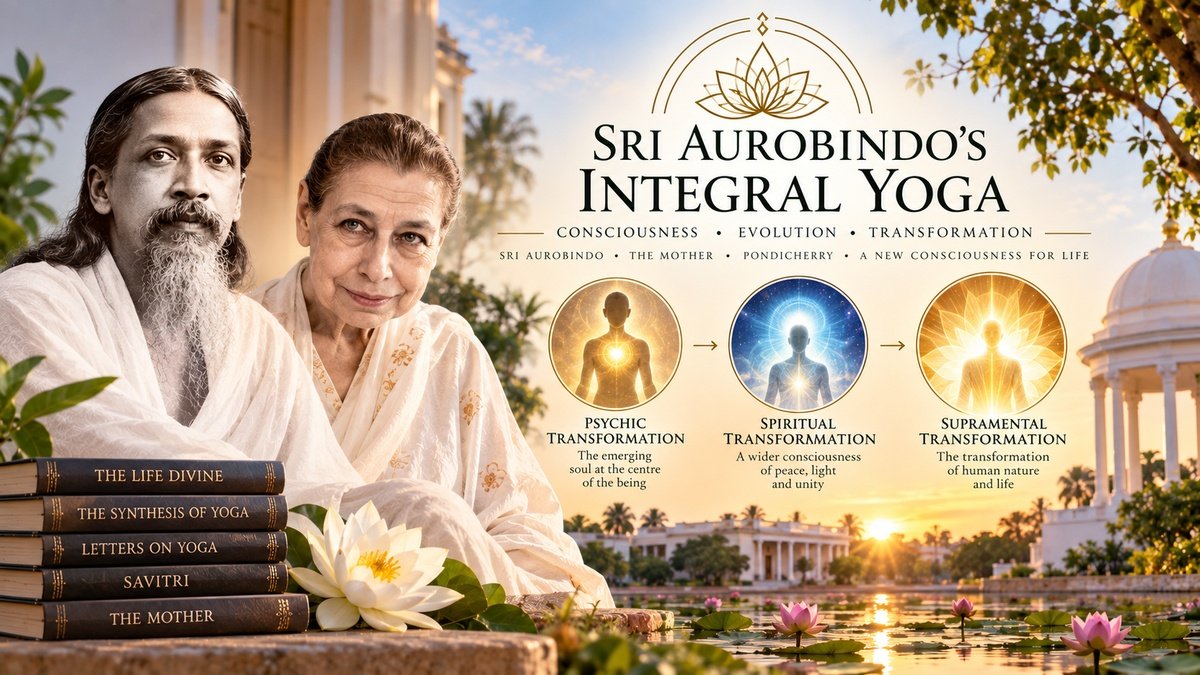
Sri Aurobindo Integral Yoga begins with an unusually ambitious proposition.
Yoga need not culminate solely in liberation from ordinary existence.
Instead, human existence itself might become the field of transformation.
This idea lies at the centre of the Integral Yoga developed by Sri Aurobindo in Pondicherry during the first half of the twentieth century and continued in collaboration with Mirra Alfassa, known as The Mother.
Its language can initially feel unfamiliar.
Terms such as psychic being, Supermind, supramental consciousness, descent and transformation have specific meanings within Sri Aurobindo’s philosophical system. Therefore, they should not simply be translated into contemporary psychological or scientific terminology.
Nor is this Integral Yoga primarily a method of physical postures.
There is no defining āsana sequence, single meditation technique or prescribed class structure.
Instead, Sri Aurobindo developed a spiritual philosophy and discipline concerned with consciousness, evolution and the transformation of the whole being.
So who was Sri Aurobindo? Who was The Mother? Why did he call his approach Integral Yoga? What is the psychic being? What does “supramental” mean? What are the three transformations? And why does this tradition understand life itself as part of yoga?
What Is Sri Aurobindo Integral Yoga?
Sri Aurobindo Integral Yoga is the spiritual philosophy and method developed by Sri Aurobindo and elaborated through his collaboration with The Mother.
Its central aim is transformation.
Many Indian spiritual traditions have explored liberation from ignorance, suffering, attachment or rebirth through knowledge, meditation, devotion, disciplined action or other methods.
Sri Aurobindo accepted the importance of spiritual realisation. However, he argued that liberation need not represent the final possibility.
For him, consciousness could transform human nature itself.
Consequently, mind, emotion, desire, action and even embodied existence could become part of that transformation.
This gives Integral Yoga its distinctive direction.
It does not seek only to discover a spiritual reality beyond ordinary life. Instead, it asks whether that reality can transform life.
Who Was Sri Aurobindo?
Sri Aurobindo was born Aurobindo Ghose in Calcutta in 1872.
At seven years old, he was sent to England for his education. He studied at St Paul’s School in London and later at King’s College, Cambridge.
After returning to India in 1893, he worked in Baroda while becoming increasingly involved in the movement for Indian independence.
By the early twentieth century, Sri Aurobindo had become a prominent nationalist writer and political figure advocating complete independence from British rule.
His life then changed direction.
He began practising yoga in 1905 and experienced a series of significant spiritual realisations during the following years.
In 1908, British authorities arrested him in connection with the Alipore Bomb Case. He spent approximately one year in jail before his acquittal.
Sri Aurobindo later described his imprisonment as a period of profound spiritual experience.
Then, in 1910, he withdrew from active politics and moved to the French colonial territory of Pondicherry, now Puducherry.
There, over the remaining forty years of his life, his work increasingly centred on philosophy, spiritual practice and the development of Integral Yoga.
He died in 1950.
Who Was The Mother?
Mirra Alfassa, known within the tradition as The Mother, became Sri Aurobindo’s spiritual collaborator and a central figure in the development of the community surrounding his work.
Born in Paris in 1878, she spent her early life engaged with art, music, philosophical enquiry and esoteric and occult traditions.
She first travelled to Pondicherry in 1914, where she met Sri Aurobindo.
After periods in France and Japan, she returned permanently to Pondicherry in 1920.
From this point, her role became fundamental.
When Sri Aurobindo withdrew increasingly from public contact in 1926, The Mother organised and guided the community that developed into the Sri Aurobindo Ashram.
Following Sri Aurobindo’s death in 1950, she continued their work for more than two decades.
Among her later initiatives were the Sri Aurobindo International Centre of Education and Auroville, the international township inaugurated in 1968.
Within this tradition, Sri Aurobindo and The Mother therefore cannot be understood simply as philosopher and administrator.
The Mother participated directly in the spiritual work and development of Integral Yoga.
Why Is It Called Integral Yoga?
The word integral is essential.
Sri Aurobindo did not want spiritual practice to concern only one part of the human being.
Knowledge alone was insufficient. Likewise, devotion or action alone could not encompass the complete aim. Nor was spiritual experience intended merely to leave ordinary physical existence untouched.
Integral Yoga seeks to include the whole being and, ultimately, the whole of life.
Sri Aurobindo therefore drew upon established paths including the yogas of knowledge, devotion and works while reorganising them within a larger transformational aim.
Integration does not mean mechanically performing every known yoga technique.
Rather, it means that no fundamental part of human nature is simply excluded from the possibility of spiritual transformation.
Is Sri Aurobindo Integral Yoga the Same as Swami Satchidananda’s Integral Yoga?
No.
The previous article in The Orenna Journal explored the Integral Yoga founded by Sri Swami Satchidananda in the United States during the 1960s.
Satchidananda’s method explicitly synthesises six branches: Haṭha, Rāja, Bhakti, Karma, Jñāna and Japa Yoga.
Sri Aurobindo Integral Yoga is a separate and earlier tradition.
It developed principally in Pondicherry during the first half of the twentieth century and centres on an evolutionary philosophy of consciousness and transformation.
Although the two traditions share an English name and both value integration, they have different founders, histories, philosophical structures and methods.
What Does Evolution Mean in Sri Aurobindo Integral Yoga?
Evolution occupies a central place in Sri Aurobindo’s philosophy.
However, he was not simply restating biological evolutionary theory.
He proposed a spiritual cosmology in which consciousness is involved within material existence and progressively manifests through increasingly complex forms.
Within this framework, matter, life and mind represent stages in a larger process.
Human mentality therefore does not represent the final possible development of consciousness.
According to Sri Aurobindo, a greater consciousness can emerge beyond the ordinary mind.
Integral Yoga attempts to participate consciously in that evolutionary process.
Importantly, this is a metaphysical and spiritual proposition within Sri Aurobindo’s philosophy. It should not be presented as though modern evolutionary biology has demonstrated the existence of supramental consciousness.
What Is the Supermind?
Supermind, or the supramental consciousness, is one of the most distinctive concepts in Sri Aurobindo’s philosophy.
The term does not simply mean an exceptionally intelligent mind.
Nor does it refer to improved concentration, positive thinking or extraordinary cognitive performance.
Sri Aurobindo describes the ordinary human mind as working through division, partial knowledge and limited perspectives.
By contrast, Supermind belongs to a fundamentally different order of consciousness.
Within his philosophy, it is a Truth-Consciousness in which knowledge does not depend upon the fragmentary processes characteristic of ordinary mentality.
The supramental therefore occupies a crucial position between the transcendent Divine and manifested existence.
Its significance for Integral Yoga is profound.
Sri Aurobindo did not seek merely an occasional experience of a higher consciousness. Instead, his larger vision concerned the possibility of that consciousness transforming mind, life and body.
What Is the Psychic Being?
The psychic being is another central concept in Sri Aurobindo Integral Yoga.
Here, psychic does not mean paranormal perception, mediumship or what contemporary English commonly calls “psychic ability”.
Within Sri Aurobindo’s terminology, it refers to the evolving inner soul-personality associated with the Divine presence within the individual.
Ordinary personality consists of many changing movements: thoughts, desires, emotions, impulses, preferences and reactions.
The psychic being, by contrast, lies deeper than these surface movements.
As it becomes more prominent, Sri Aurobindo describes it as increasingly capable of orienting the rest of the nature towards truth, sincerity and the Divine.
This process forms the basis of what he calls psychic transformation.
However, the terminology belongs to Sri Aurobindo’s spiritual psychology. It should not be confused with the modern clinical meaning of psychology or treated as a scientifically identified anatomical structure.
What Are the Three Transformations?
A useful way to understand the larger architecture of Sri Aurobindo Integral Yoga is through three transformations:
Psychic transformation
Spiritual transformation
Supramental transformation
These are not simply three meditation techniques.
Instead, they describe progressively more comprehensive changes in consciousness and nature within Sri Aurobindo’s system.
Understanding their differences therefore prevents the word transformation from becoming vague spiritual language.
1. Psychic Transformation
The first is the psychic transformation.
This involves the emergence of the psychic being from behind the surface personality so that it can increasingly guide thought, emotion and action.
As a result, the emphasis shifts away from ego, desire and habitual reaction towards a deeper orientation to the Divine.
Sincerity becomes particularly important within this process.
The psychic transformation does not mean becoming constantly pleasant or emotionally positive.
Rather, within Sri Aurobindo’s framework, it concerns a reorganisation of the being around its deepest spiritual centre.
2. Spiritual Transformation
The spiritual transformation involves a wider opening beyond ordinary individual consciousness.
Sri Aurobindo describes experiences of peace, silence, light, wideness and a consciousness exceeding the ordinary mental personality.
In this process, the practitioner may increasingly experience consciousness as universal rather than confined to the surface individual self.
Within the language of Integral Yoga, higher consciousness can also be described as descending into mind, life and body.
However, this language of descent belongs to the experiential and metaphysical vocabulary of the tradition.
It should not be interpreted as a measurable physical substance moving through the nervous system.
3. Supramental Transformation
The supramental transformation represents the most radical dimension of Sri Aurobindo’s vision.
Spiritual awakening alone does not complete Integral Yoga in his fullest sense.
Instead, he proposed the possibility of consciousness moving beyond even spiritualised mind into supramental Truth-Consciousness.
The supramental transformation would involve a fundamental transformation of mind, life and body rather than simply an altered inner state.
Sri Aurobindo regarded this as an evolutionary possibility, not an ordinary achievement available through a short course of practice.
Indeed, his writings repeatedly stress the exceptional demands of the aim.
It would therefore seriously misrepresent Integral Yoga to turn “supramental transformation” into a contemporary wellness promise.
What Are Aspiration, Rejection and Surrender?
Integral Yoga is sometimes introduced through three practical movements: aspiration, rejection and surrender.
Aspiration refers to the sincere movement towards the Divine and towards transformation.
Meanwhile, rejection concerns refusing movements understood within the practice as belonging to ignorance, falsehood, ego, desire or other patterns that obstruct transformation.
Finally, surrender means progressively offering the being and its actions to the Divine rather than allowing the ego to remain the central authority.
These principles can sound simple when reduced to three words.
Within the tradition, however, they describe an extensive spiritual discipline rather than a motivational formula.
Surrender in particular belongs to a theological and devotional framework. Therefore, it should not be confused with surrendering personal boundaries, critical judgement or consent to another human being.
Does Sri Aurobindo Integral Yoga Have a Fixed Method?
Not in the sense of a standard sequence practised identically by everyone.
The Sri Aurobindo Ashram explicitly states that its spiritual discipline has no obligatory practices, compulsory rituals or universally prescribed meditation system.
Nevertheless, this does not mean that anything whatsoever becomes Integral Yoga.
The orientation remains specific: opening to the Divine, surrender, discovery of the deeper being and transformation of the nature.
Within that orientation, the route through the work can vary according to the practitioner.
For example, study, meditation, concentration, devotion, work and self-observation may all become relevant.
The absence of a rigid technique therefore reflects the breadth of the aim rather than an absence of direction.
Does Sri Aurobindo Integral Yoga Include Asana?
Physical practice is not the defining method of Sri Aurobindo Integral Yoga.
This distinction is essential for a Journal series devoted largely to modern yoga styles.
Sri Aurobindo’s major writings do not establish a fixed sequence of āsanas comparable with Ashtanga Yoga, Sivananda Yoga or other modern posture systems.
Nevertheless, the body matters profoundly.
Indeed, because Integral Yoga ultimately seeks transformation rather than escape from embodied existence, physical nature occupies an unusually important place in its larger philosophy.
But valuing the body is not the same as making āsana the centre of the method.
A modern posture class called “Integral Yoga” should therefore not automatically be assumed to represent Sri Aurobindo’s system.
What Role Does Work Play in Integral Yoga?
Work can become part of spiritual practice.
This principle remains visible in the organisation of the Sri Aurobindo Ashram, where daily work forms an important part of community life.
Within this context, practice involves offering action to the Divine rather than treating spiritual life as something confined to meditation.
Ordinary activity can reveal desire, ego, attachment, preference, frustration and resistance.
Consequently, it can become material for transformation.
This life-affirming orientation distinguishes Integral Yoga from approaches that understand spiritual fulfilment primarily through withdrawal from worldly activity.
The question becomes not simply how to escape action, but whether consciousness within action can change.
What Is The Synthesis of Yoga?
The Synthesis of Yoga is one of Sri Aurobindo’s major works and an essential source for understanding Integral Yoga.
Its chapters originally appeared in the philosophical journal Arya, which Sri Aurobindo began publishing in 1914.
The work examines established yogic paths, particularly the yogas of works, knowledge and divine love, before considering their synthesis within a more comprehensive spiritual discipline.
However, Sri Aurobindo does not simply place traditional paths side by side.
Instead, he asks how their central principles might contribute to an integral transformation of human nature.
The book therefore provides both an engagement with earlier yoga traditions and a foundation for Sri Aurobindo’s distinctive system.
What Is The Life Divine?
The Life Divine presents the larger philosophical architecture behind Sri Aurobindo Integral Yoga.
It explores consciousness, matter, evolution, ignorance, knowledge, the nature of reality and the possibility of a transformed existence.
In broad terms, if The Synthesis of Yoga helps explain the discipline, The Life Divine helps explain why Sri Aurobindo believed such a transformation was philosophically possible.
The work is extensive and conceptually demanding.
Consequently, terms such as involution, evolution, Supermind and divine life belong to an interconnected metaphysical system and can become misleading when extracted as isolated inspirational ideas.
What Is the Sri Aurobindo Ashram?
The Sri Aurobindo Ashram developed in Pondicherry around Sri Aurobindo and The Mother.
A community of disciples had gradually gathered around them during the 1920s.
Then, in November 1926, after a significant development in Sri Aurobindo’s spiritual work, he withdrew substantially from ordinary public contact.
The Mother subsequently assumed responsibility for organising and guiding the growing community.
This period is generally regarded as the formal beginning of the Ashram.
Importantly, the Ashram did not develop as a secluded monastic retreat detached from everyday activity.
Its departments incorporated education, publishing, physical education, crafts, agriculture and numerous forms of work.
That structure reflects the Integral Yoga principle that life itself can become part of spiritual practice.
What Is Auroville?
Auroville is an international township near Puducherry founded by The Mother and inaugurated in 1968.
Its history belongs to the continuation of the wider vision associated with Sri Aurobindo and The Mother. However, Auroville and the Sri Aurobindo Ashram are not the same institution.
The Mother envisioned Auroville as a place dedicated to human unity and experimentation with new forms of collective life.
People from many countries participated in its inauguration.
Integral Yoga has significantly influenced Auroville’s philosophical environment, and some Aurovilians explicitly practise Sri Aurobindo’s Yoga.
Nevertheless, living in Auroville does not automatically mean that someone practises Integral Yoga.
The distinction between the spiritual tradition, the Ashram and the international township should therefore remain clear.
Is Sri Aurobindo Integral Yoga a Religion?
Integral Yoga contains an explicitly spiritual and metaphysical understanding of reality.
The Divine, surrender, soul, spiritual consciousness and transformation are central concepts.
For that reason, it cannot be accurately reduced to a secular wellbeing technique.
At the same time, Sri Aurobindo did not construct Integral Yoga simply as a new denominational religion with a mandatory creed and uniform ritual system.
The Ashram itself does not prescribe obligatory rituals or a compulsory method of meditation.
It is therefore more accurate to encounter Integral Yoga on its own terms as a spiritual philosophy and discipline rather than forcing it entirely into either the category of modern exercise or institutional religion.
Is Integral Yoga About Escaping the World?
No. This is one of the clearest distinctions Sri Aurobindo made about his approach.
Renunciation and liberation have important histories within Indian yoga traditions.
Sri Aurobindo did not simply reject those traditions. However, his own project moved in another direction.
The goal was not merely departure from worldly existence into a transcendent state.
Instead, Integral Yoga accepts life as part of the field of spiritual transformation.
This affirmation of life does not mean satisfying every desire or treating ordinary existence as already transformed.
Quite the opposite: the ordinary nature becomes precisely what the yoga seeks to change.
Is Supramental Consciousness Scientifically Proven?
No scientific consensus establishes Sri Aurobindo’s Supermind as an empirically demonstrated stage of biological or neurological evolution.
The concept belongs to his metaphysical and spiritual philosophy.
Nevertheless, that does not make it unimportant within the tradition.
It simply tells us what kind of claim we are examining.
A historically responsible discussion can therefore explain what Sri Aurobindo meant by consciousness, evolution and the supramental without presenting those concepts as findings of neuroscience or evolutionary biology.
This distinction allows the philosophy to remain intellectually interesting without borrowing scientific authority that it does not require.
A Common Misunderstanding: Integral Does Not Mean Combining Every Yoga Style
The name can easily suggest a mixture.
A little Haṭha. Some meditation. Perhaps mantra, philosophy, breathwork and several other techniques assembled into one programme.
That is not what makes Sri Aurobindo’s Yoga integral.
Instead, its integrality lies principally in the scope of transformation.
Mind, emotion and action are included. So too are the inner life and, ultimately, the physical nature.
Even ordinary existence is not simply discarded as irrelevant to spiritual realisation.
Integral Yoga is integral not because it collects everything called yoga, but because it refuses to leave the fundamental dimensions of being permanently outside transformation.
An Orenna Perspective: What If Practice Does Not End with Transcendence?
Sri Aurobindo Integral Yoga asks one of the largest questions we have encountered in this Journal series.
What is spiritual practice ultimately for?
Different traditions have answered that question in different ways: through liberation, knowledge, devotion, meditative absorption, freedom from suffering or release from cycles of rebirth.
Sri Aurobindo introduces another possibility.
What if discovering a consciousness beyond our ordinary mentality is not the conclusion?
What if the question then becomes what that discovery changes?
How do we think and act? How do we relate? What happens to the parts of ourselves that have not yet caught up with what we understand?
Integral Yoga takes that question to a metaphysical scale far beyond the purposes of ordinary contemporary yoga practice.
Yet its underlying challenge remains striking.
Perhaps transformation is not measured only by where consciousness can go, but by what changes when it returns to life.
References & Further Reading
Sri Aurobindo. The Synthesis of Yoga. A central work exploring established paths of yoga and their transformation within Sri Aurobindo’s Integral Yoga.
Sri Aurobindo. The Life Divine. His major philosophical work on consciousness, evolution, involution, Supermind and the possibility of divine life.
Sri Aurobindo. Letters on Yoga. Extensive correspondence explaining the philosophy, terminology and practical questions of Integral Yoga.
Sri Aurobindo. Savitri: A Legend and a Symbol. Sri Aurobindo’s major poetic work, developed over decades and deeply connected with his spiritual vision.
The Mother. Questions and Answers. Conversations and teachings addressing Integral Yoga, spiritual practice, consciousness and transformation.
Sri Aurobindo Ashram. Official biographical, historical and archival materials on Sri Aurobindo, The Mother, Integral Yoga and the development of the Ashram.
Auroville. Official materials on The Mother, Sri Aurobindo, Integral Yoga and the founding and vision of Auroville.



