


Power Yoga sounds unusually straightforward. The name suggests strength, effort and a physically demanding form of yoga.
Walk into a class carrying that label, however, and the practice can be surprisingly difficult to predict.
One teacher may offer a vigorous sequence strongly influenced by Ashtanga Yoga. Another may teach something closer to an athletic Vinyasa class. Some classes use heat. Others do not. Sequences may change every session, and different teachers can interpret the word power in very different ways.
This variation is not accidental.
Unlike methods organised around one established sequence or central teaching institution, Power Yoga developed as a broad modern approach to vigorous, flowing yoga.
So what is Power Yoga? Who developed it? Where and when did the name appear? Why was power chosen? What happens in a class? And does a powerful yoga practice necessarily have to be physically intense?
What Is Power Yoga?
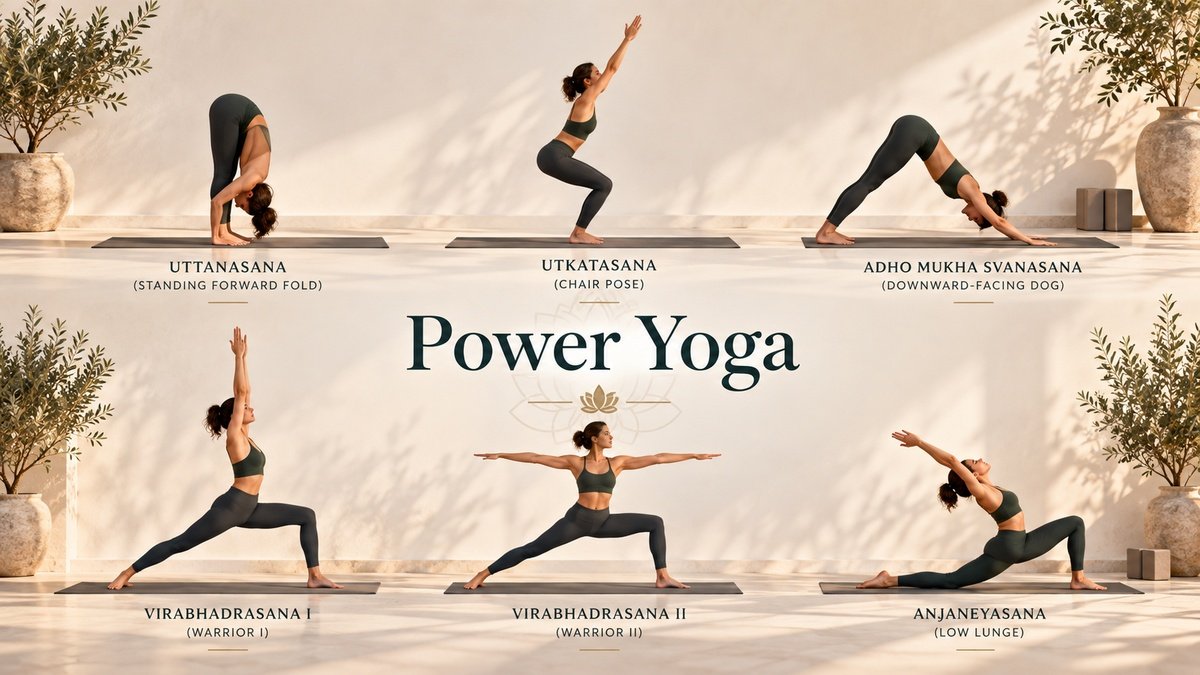
Power Yoga is a broad term for dynamic, physically active forms of modern postural yoga, commonly taught through flowing sequences of āsanas.
The practice often incorporates elements associated with Vinyasa: movement and breathing are coordinated, postures connect through transitions and sequences create continuity rather than treating every āsana as an isolated exercise.
Strength, mobility, balance and physical stamina may all form part of the experience.
However, there is no single Power Yoga sequence.
Nor is there one universally recognised organisation determining exactly what every Power Yoga class must contain.
The name therefore describes a family of contemporary approaches rather than one completely standardised method.
Power Yoga tells us something about the character of a practice, but not necessarily its exact contents.
Where Did Power Yoga Come From?
Power Yoga developed primarily in the United States within the rapidly changing yoga culture of the late twentieth century.
Its emergence cannot be separated from the growing international influence of modern Ashtanga Yoga.
During the 1970s and 1980s, a small number of Western practitioners studied the dynamic Ashtanga method associated with K. Pattabhi Jois. Its recurring sequences, flowing transitions and physically demanding practice differed considerably from many of the yoga classes then familiar to American students.
Several teachers subsequently adapted those influences for different communities.
Power Yoga emerged from this environment.
Rather than reproducing the Ashtanga system exactly, teachers began creating dynamic practices that retained elements of its physical vocabulary while allowing considerably greater freedom in sequencing and presentation.
When Did Power Yoga Develop?
The term became increasingly visible during the late 1980s and particularly the 1990s.
This was also a period when yoga was expanding rapidly within American fitness and wellness culture.
In 1995, Beryl Bender Birch published Power Yoga: The Total Strength and Flexibility Workout. The book presented a dynamic practice rooted substantially in her experience of Ashtanga Yoga and helped bring the expression Power Yoga to a much wider audience.
On the opposite side of the United States, Bryan Kest had independently developed his own approach to Power Yoga in California.
Other teachers subsequently created further interpretations.
Consequently, Power Yoga did not emerge from one definitive syllabus published by a single founder.
Who Invented Power Yoga?
There is no completely satisfactory answer involving one person.
Beryl Bender Birch and Bryan Kest are two of the figures most closely associated with the early development and naming of Power Yoga in the United States.
Both had significant connections with Ashtanga Yoga, yet they developed their approaches independently.
Bender Birch began studying Ashtanga with Norman Allen and later studied with K. Pattabhi Jois. While working with runners and athletes in New York, she adapted aspects of the practice for students whose bodies and training backgrounds varied considerably.
Kest also encountered Ashtanga through David Williams before travelling to Mysore to study with Pattabhi Jois. He later developed his teaching in California.
Other influential teachers, including Baron Baptiste, subsequently developed distinctive forms of vigorous yoga that became associated with the broader Power Yoga movement.
It is therefore more accurate to describe Power Yoga as a development involving several influential teachers than to assign the entire category to one inventor.
Who Is Beryl Bender Birch?
Beryl Bender Birch occupies an important place in the history of Power Yoga.
She had already been teaching yoga before encountering Ashtanga practice around the end of the 1970s.
Her work with the New York Road Runners Club brought her into contact with athletes who often required adaptations rather than straightforward reproduction of the Ashtanga sequence.
Over time, she used the name Power Yoga for the approach she was teaching.
Her 1995 book brought that terminology into mainstream publishing and explicitly presented the practice in language likely to make sense within contemporary American fitness culture.
Yet Bender Birch’s presentation was not concerned exclusively with physical conditioning. Her writing also discussed attention, discipline and the wider context of yoga.
That complexity is useful because it challenges the assumption that Power Yoga was intended simply as yoga converted into a workout.
Who Is Bryan Kest?
Bryan Kest is another major figure in the development of Power Yoga.
He began practising yoga as a teenager, later studying with David Williams and travelling to Mysore to study with K. Pattabhi Jois.
Kest began teaching in Los Angeles during the 1980s and subsequently became closely associated with Power Yoga in Santa Monica.
Although his classes could be physically demanding, Kest has consistently resisted defining power simply through physical achievement.
His teaching places considerable emphasis on attention, moderation and the quality of the practitioner’s relationship with the practice.
This creates an interesting tension within the name itself.
A class called Power Yoga may look physically powerful from the outside while asking the practitioner to question competitiveness, excess and the urge to prove something through the body.
Why Was It Called Power Yoga?
The terminology needs to be understood within its historical setting.
Yoga in the United States was expanding into a culture strongly interested in fitness, exercise and physical conditioning.
The word power communicated immediately that this was not necessarily a quiet stretching class.
Beryl Bender Birch has explained that the terminology helped her communicate dynamic yoga to runners and athletes who might otherwise have held very different assumptions about what yoga involved.
In that context, the name functioned partly as translation.
It presented a vigorous yoga practice using terminology that made sense to a particular audience at a particular historical moment.
Yet the consequences of that language are still visible today.
Power can easily become associated with performance, difficulty and physical accomplishment, even when the teachers who developed these approaches intended something more nuanced.
Is Power Yoga the Same as Ashtanga Yoga?
No, although the historical relationship is important.
Modern Ashtanga Yoga centres on established sequences that practitioners progressively learn and repeat.
Power Yoga generally removes that requirement.
A teacher can select postures, reorganise them and construct different sequences according to the purpose of a particular class.
Elements familiar from Ashtanga may still appear. Sun salutations, standing postures, flowing transitions and physically demanding sequences are common examples.
However, borrowing this vocabulary does not make Power Yoga another name for Ashtanga.
Indeed, K. Pattabhi Jois himself objected to conflating the emerging Power Yoga movement with the Ashtanga method he taught.
Power Yoga was influenced by Ashtanga Yoga; it is not synonymous with it.
Is Power Yoga the Same as Vinyasa Yoga?
The boundary is considerably less clear.
Vinyasa Yoga is itself a broad contemporary category in which teachers construct sequences that connect movement and breathing.
Power Yoga commonly works in much the same way.
In studio language, Power often signals that the class is likely to be physically stronger or more demanding than a general Vinyasa class.
That distinction is a convention rather than a universal rule.
A challenging Vinyasa class could resemble another studio’s Power Yoga class almost exactly.
For students choosing between them, the teacher’s description, pace and stated level may therefore provide more useful information than the class name alone.
What Happens in a Power Yoga Class?
No universal sequence exists, but several characteristics appear frequently.
A class may begin with a short period of orientation or breath awareness before moving into dynamic warm-up movements or sun salutations.
Standing postures can then develop into longer flowing sequences.
Teachers may incorporate balances, lunges, twists, plank-based movements, backbends or other āsanas according to the level and purpose of the class.
Transitions often contribute substantially to the physical demand rather than merely moving the practitioner from one posture to another.
The practice may eventually slow towards floor-based postures and a concluding period of stillness.
Another Power Yoga teacher could organise the class quite differently.
That variability is part of the method’s contemporary identity.
Does Power Yoga Have a Fixed Sequence?
Generally, no.
This is one of the clearest distinctions between Power Yoga and traditional modern Ashtanga practice.
Ashtanga practitioners learn recurring series in a defined order.
Power Yoga teachers usually have considerably greater freedom to construct sequences.
That freedom can allow a teacher to change emphasis according to the class. One session might concentrate on standing balance; another could explore backbending, strength or transitions.
Variation also means that the experience depends heavily on the individual teacher.
Knowing one Power Yoga class does not necessarily tell you what another will contain.
Does Power Yoga Have to Be Fast?
No.
Dynamic practice and rapid practice are not identical.
A physically demanding sequence can move at a measured pace, while a relatively simple sequence can move quickly.
Speed also changes the nature of the challenge. Moving rapidly may increase cardiovascular demand and reduce the time available to organise or reconsider a posture.
A slower pace can create substantial muscular effort when positions are sustained.
For this reason, defining Power Yoga simply as fast yoga is inadequate.
The more consistent characteristic is an emphasis on active, physically engaged practice rather than one prescribed tempo.
Is Power Yoga Heated?
Sometimes.
Heat is not an inherent requirement of Power Yoga.
Some studios deliberately combine dynamic sequencing with a heated environment, producing classes that could reasonably be described as both Power Yoga and Hot Yoga.
Others teach Power Yoga at ordinary room temperature.
The two terms describe different aspects of the practice.
Power Yoga generally describes the style or character of the movement practice, while Hot Yoga describes the environmental condition in which practice occurs.
A class can therefore be one, both or neither.
Does Power Yoga Use Props?
It can.
Nothing about Power Yoga requires practitioners to avoid blocks, belts, blankets or other supports.
Nevertheless, some fast-moving classes use fewer props simply because the sequencing leaves less time to organise them.
That should not turn practising without support into a measure of accomplishment.
A block can change distance, provide contact with the floor or create another option within a posture. Used appropriately, a prop may make a dynamic sequence more workable for a particular practitioner.
As we explored in our article on Iyengar Yoga, using support does not automatically make a practice less sophisticated.
The relevant question is whether the prop serves the intended practice.
Who Can Practise Power Yoga?
People with many different levels of experience can practise dynamically, but not every Power Yoga class suits every practitioner.
The label often indicates a degree of physical demand.
Some classes also assume familiarity with common yoga postures and transitions because the teacher may provide less introductory explanation while the sequence is moving.
Other teachers deliberately make Power Yoga adaptable and offer several ways of approaching the same movement.
For someone new to yoga, the class description matters.
A beginner-specific Power Yoga session may provide a suitable introduction. An advanced dynamic class using the same label may assume considerable previous experience.
The word power should not require everyone in the room to perform the same version of the practice.
Is Power Yoga Good for Beginners?
It can be, provided the teaching is designed accordingly.
Beginners need enough time and information to understand what they are being asked to do.
When a class moves continuously through unfamiliar postures, processing the teacher’s instructions while simultaneously coordinating movement and breathing can become demanding.
A suitable introductory class can reduce that complexity.
The teacher might slow transitions, teach recurring movements separately, provide alternatives and allow students to become familiar with the vocabulary before increasing continuity.
Starting with less complexity is not the same as practising lesser yoga.
It is simply a way of learning progressively.
What Are the Benefits of Power Yoga?
Because Power Yoga commonly contains sustained physical activity, it can provide opportunities to develop strength, balance, mobility, coordination and physical endurance.
Flowing sequences may also require substantial concentration as practitioners coordinate movement, breathing and changing spatial relationships.
Exactly what someone experiences depends on the class itself.
The term Power Yoga covers sufficiently varied practices that broad health claims require caution. A sixty-minute vigorous heated class and a measured dynamic class with substantial adaptation may place very different demands on the practitioner.
Research into yoga and physical activity has explored many potential physical and psychological outcomes, but evidence should not be stretched into promises that Power Yoga will produce particular medical results.
Its physical character can be described without turning the practice into a treatment.
Is Power Yoga Mainly a Workout?
It can certainly function as physical exercise.
For some practitioners, that may be their primary reason for attending.
Yet defining the entire approach as a workout overlooks an important part of its history.
Both Beryl Bender Birch and Bryan Kest developed their teaching from substantial engagement with yoga traditions rather than simply adding yoga-shaped movements to a fitness programme.
The physical intensity can itself become a context for attention.
How does someone respond when effort increases? Do they stop noticing the breath? Does comparison enter the practice? Does the desire to complete a difficult transition override information coming from the body?
These questions move the practice beyond physical performance.
Whether a particular class explores them depends on the teacher.
Why Has Power Yoga Become Popular?
The format fits easily within contemporary movement culture.
It can feel energetic, physically substantial and immediately recognisable as exercise while retaining familiar elements of yoga practice.
Teachers also have considerable creative freedom.
Without a mandatory sequence, they can construct classes around particular movements, themes or levels of intensity.
For practitioners who enjoy continuity and physical challenge, that combination can be appealing.
Power Yoga also played a historical role in changing perceptions of yoga within Western fitness culture.
Its name directly challenged the assumption that yoga consisted only of gentle stretching or passive relaxation.
At the same time, its success contributed to another simplification: the idea that yoga becomes more valuable when it becomes more physically demanding.
Both assumptions deserve questioning.
Is Power Yoga More Advanced?
No.
Physical intensity and advancement are different concepts.
A practitioner may possess considerable strength and perform demanding transitions while paying very little attention to how they are practising.
Another person may modify the same sequence while demonstrating careful observation, restraint and understanding.
Neither the complexity of a posture nor the amount of effort required provides a complete measure of yogic development.
This distinction becomes particularly relevant in a practice carrying the word power.
If power means always doing more, the practice can easily become another arena for performance.
If it includes the capacity to choose, adapt and sometimes do less, the word begins to acquire a different meaning.
A Common Misunderstanding: Power Does Not Mean Maximum Effort
Intensity is easy to recognise.
A trembling muscle, rapid transition or difficult balance makes effort visible.
Restraint is quieter.
Choosing not to take the deepest version of a posture may require more awareness than automatically following the person beside you.
Resting while a sequence continues can be an active decision. Using a block can be an intelligent response to the relationship between a particular body and a particular movement.
Power therefore does not need to mean domination over the body.
Sometimes the more meaningful expression of power is having enough agency to choose how you participate.
An Orenna Perspective: Where Is the Power?
The name invites a useful question.
Where, exactly, is the power in Power Yoga?
Perhaps it appears in physical strength. There is nothing inherently wrong with enjoying the experience of becoming stronger.
But power might also appear elsewhere.
It may be the ability to remain attentive when effort increases. To notice when determination has become competition. To distinguish challenge from unnecessary strain. To adapt a movement without interpreting adaptation as failure.
A dynamic practice can reveal these decisions particularly clearly because there is often less time to make them.
That may be one of Power Yoga’s more interesting possibilities.
The strongest practice is not necessarily the one in which we do the most. It may be the one in which we remain able to choose.
References & Further Reading
Bender Birch, Beryl. (1995). Power Yoga: The Total Strength and Flexibility Workout. Fireside/Simon & Schuster. One of the key publications associated with the emergence of Power Yoga as a recognisable modern yoga category.
Simon & Schuster — Beryl Bender Birch, Power Yoga. Publisher material includes Bender Birch’s account of studying Ashtanga with Norman Allen and K. Pattabhi Jois and subsequently teaching the practice to runners in New York. Explore the publisher’s edition.
Singleton, Mark. (2010). Yoga Body: The Origins of Modern Posture Practice. Oxford University Press. A scholarly examination of the development of modern postural yoga and its relationship with wider physical culture.
Mallinson, James & Singleton, Mark. (2017). Roots of Yoga. Penguin Classics. A collection of primary-source translations illustrating the diversity of yoga practices before the development of modern postural systems.



