


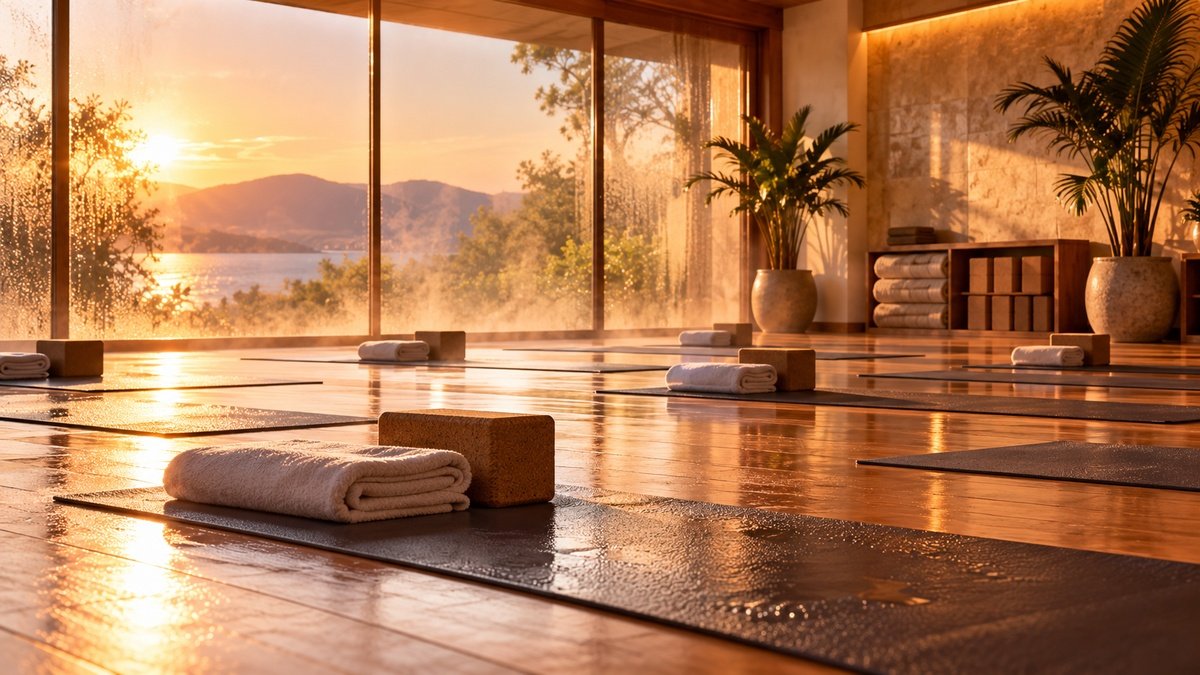
Walk into a Hot Yoga class and the difference can be apparent before the first posture begins. The room is warm — sometimes intensely so — and that heat becomes part of the conditions in which the practice takes place.
Yet Hot Yoga is not one single method.
Some classes follow a predetermined sequence. Others resemble a heated Vinyasa class. Temperatures, humidity, duration, pace and teaching methods can all vary considerably.
The practice is also surrounded by persistent assumptions: that sweating removes toxins, that heat automatically makes stretching safer or that a hotter class must somehow provide a more powerful form of yoga.
Those ideas deserve closer examination.
So what exactly is Hot Yoga? Where did it come from? Why heat a yoga studio? How is it different from Bikram Yoga? And what actually changes when yoga takes place in a hot environment?
What Is Hot Yoga?
Hot Yoga is a broad contemporary term for yoga practised in an intentionally heated environment.
That definition is deliberately broad because there is no single temperature, sequence or teaching system shared by every Hot Yoga class.
A studio might offer heated Vinyasa, a fixed-sequence practice, a slower āsana class or another movement-based format. Some rooms feel moderately warm; others operate at substantially higher temperatures.
Humidity can also affect the experience. A humid room reduces the rate at which sweat evaporates from the skin, changing how effectively the body can dissipate heat.
For that reason, knowing that a class is described as hot tells us something important about its environment, but not everything about its method.
Heat describes a condition of practice rather than one universal system of yoga.
Is Hot Yoga the Same as Bikram Yoga?
No.
The two terms are closely connected historically, but they should not be treated as synonyms.
Bikram Yoga refers to the system popularised by Bikram Choudhury. Traditionally, its classes follow a standardised sequence of 26 āsanas and two breathing exercises over approximately 90 minutes.
The traditional Bikram environment is heated to approximately 40°C, with humidity also forming part of the prescribed conditions.
Hot Yoga is the wider category.
A heated class can therefore be Hot Yoga without being Bikram Yoga. It may use different postures, a different sequence, a different duration, another temperature or an entirely different teaching approach.
This distinction has become particularly important as many studios have developed heated practices independently of the Bikram name.
Where Did Modern Hot Yoga Come From?
The history of modern Hot Yoga is closely associated with Bikram Choudhury and the physical-culture yoga tradition in which he trained.
Choudhury studied in Calcutta, now Kolkata, within the teaching environment associated with Bishnu Charan Ghosh.
Ghosh was an influential figure in twentieth-century Indian physical culture and postural yoga. His approach combined āsana with wider interests in physical training and bodily development.
Choudhury later developed and promoted the system that became known internationally as Bikram Yoga.
As the method expanded, the heated room became one of its defining characteristics.
However, the wider history should not be reduced to the claim that all yoga practised in heat originated with one individual. Contemporary Hot Yoga now encompasses multiple systems, organisations and independently developed teaching approaches.
When Did Hot Yoga Become Popular?
Bikram Choudhury established his teaching presence in the United States during the 1970s, and his method subsequently attracted an increasingly international following.
Over the following decades, Bikram Yoga developed into a highly recognisable global brand.
Its standardised format made the method particularly distinctive. Practitioners could enter different affiliated studios and encounter essentially the same 26-posture sequence, breathing exercises and heated conditions.
As heated yoga became more familiar, other forms also developed.
Today, a class advertised as Hot Yoga may have little connection with the traditional Bikram sequence beyond the deliberate use of heat.
This is why contemporary Hot Yoga is better understood as a category rather than a single lineage.
Who Was Bikram Choudhury?
Bikram Choudhury became one of the most internationally prominent figures associated with heated yoga.
His system combined a fixed sequence of postures and breathing exercises with a highly heated teaching environment. Through studios and large-scale teacher-training programmes, the Bikram name became internationally recognised.
Any contemporary account of that history also requires acknowledgement of the serious controversies surrounding Choudhury.
Multiple women brought civil lawsuits accusing him of sexual harassment and sexual assault. Choudhury denied allegations of sexual assault. In a separate civil case brought by his former legal adviser Minakshi Jafa-Bodden, a Los Angeles jury found him liable for sexual harassment, retaliation and wrongful termination and awarded damages.
These events contributed to substantial changes within the wider Bikram community, and many studios subsequently distanced themselves from his name.
The history therefore raises a broader question that extends beyond Hot Yoga: how should a practice community respond when authority, teaching and institutional power become concentrated around a charismatic individual?
What Is 26 and 2 Yoga?
You may now encounter the terms 26 and 2 or 26+2 in place of Bikram Yoga.
The numbers refer to the 26 postures and two breathing exercises associated with the traditional sequence.
Using this terminology can describe the practice structure without necessarily identifying a studio or teacher with Bikram Choudhury personally.
However, naming conventions vary between organisations and studios.
Hot Yoga remains broader still. A Hot Yoga class does not need to use the 26 and 2 sequence at all.
Why Is Hot Yoga Heated?
This question sounds simple, but several different explanations have circulated within Hot Yoga culture.
Heat changes the physical environment in which movement takes place. It increases the thermal demand placed on the body and usually produces substantial sweating.
A warm environment can also change how movement feels. Practitioners may experience a greater sense of ease or available range in certain movements once they become warm.
However, feeling more mobile does not necessarily mean that every deeper position is appropriate.
Heat may alter perception as well as movement. Consequently, the sensation that the body can move further should not automatically become an instruction to do so.
The heated environment is therefore best understood as an additional variable within the practice rather than proof that the practice has become safer, deeper or more effective.
How Hot Is Hot Yoga?
There is no universal Hot Yoga temperature.
Traditional Bikram practice is commonly associated with temperatures around 40°C. Other heated classes may operate at lower temperatures, while studio conditions can also vary according to humidity, ventilation and the number of people in the room.
This means temperature alone cannot fully describe the thermal experience.
A moderately heated but humid and crowded studio may feel very different from a room at the same measured temperature with greater air movement and lower humidity.
Class intensity matters too.
The body produces its own heat during physical activity. Environmental heat therefore combines with the heat generated through movement.
The room temperature is only one part of the total heat load experienced by the practitioner.
What Happens to the Body in Hot Yoga?
The human body continuously regulates its internal temperature.
In a hot environment, blood flow towards the skin and sweating become important mechanisms for dissipating heat. As exercise intensity and environmental temperature increase, thermoregulation becomes more demanding.
Sweat evaporating from the skin can help remove heat. However, humidity, clothing and air movement influence how effectively evaporation occurs.
Sweating also means losing fluid.
For that reason, heat introduces physiological demands that do not disappear simply because the activity taking place is yoga rather than another form of exercise.
This does not mean that Hot Yoga is inherently unsafe. It means that heat is physiologically meaningful and deserves to be treated accordingly.
Does Sweating in Hot Yoga Detox the Body?
This is one of the most persistent claims surrounding heated exercise.
Sweating serves an important physiological purpose, but its primary role is thermoregulation: helping the body dissipate heat.
The body already has sophisticated systems for processing and eliminating substances, particularly through organs including the liver and kidneys.
Describing heavy sweating as a special process of removing unspecified toxins therefore goes beyond what the evidence supports.
A practitioner may enjoy sweating. It can contribute to the distinctive sensory experience of a heated class and create a strong perception of physical exertion.
But sweating more does not demonstrate that the body has undergone a greater detoxification process.
Sweat is evidence that the body is responding to heat, not evidence that yoga is removing toxins.
Does Heat Make You More Flexible?
Many practitioners report feeling more mobile in a heated room.
That experience should be distinguished from the claim that heat permanently makes someone flexible.
Warm conditions and physical activity can influence how movement feels and may temporarily affect the range that feels available. Yet flexibility is influenced by many factors, and greater immediate range does not automatically represent a desirable long-term adaptation.
This distinction becomes particularly important in Hot Yoga because the sensation of warmth may encourage someone to move further than they normally would.
The relevant question is not simply Can I go further?
It is also Do I need to?
Greater range is a possibility, not an obligation.
Does Hot Yoga Burn More Calories?
Heat can make exercise feel particularly intense, and heart rate may increase as the body works to manage both movement and thermal stress.
That does not mean perspiration provides a reliable measure of energy expenditure.
How much energy someone uses during a class depends on numerous factors, including body size, movement intensity, duration, individual physiology and the actual practice being performed.
A large change on the scales immediately after a very sweaty class primarily reflects fluid loss rather than an equivalent reduction in body fat.
Hot Yoga therefore does not need exaggerated calorie or weight-loss claims to justify its existence as a movement practice.
What Are the Benefits of Hot Yoga?
Research has investigated possible effects of heated yoga on areas including strength, balance, range of motion, cardiovascular measures and psychological outcomes.
Some findings are promising, but interpretation requires care.
Research specifically examining Hot Yoga remains considerably smaller than the evidence base for physical activity more generally. Study designs, participant populations and forms of heated yoga also vary.
A recent systematic review concluded that research has identified potentially beneficial physiological, functional and psychological responses. However, the authors also found important methodological limitations.
Crucially, current evidence does not establish that Hot Yoga provides greater health benefits than comparable unheated yoga or other forms of physical activity.
This distinction matters.
A person can value Hot Yoga because they enjoy its particular environment and practice without needing to claim that heat transforms yoga into a superior health intervention.
Is Hot Yoga Better Than Unheated Yoga?
There is currently no good basis for declaring one universally better than the other.
Heat changes the experience and physiological demands of practice, but different does not automatically mean better.
Some people enjoy the warmth and intensity. Others find heat distracting, unpleasant or physically difficult to tolerate.
An unheated environment may allow another practitioner to concentrate more effectively, regulate effort differently or remain comfortable for longer.
The appropriate environment therefore depends partly on the individual and the purpose of the practice.
Temperature is a variable, not a hierarchy.
Who Can Practise Hot Yoga?
Many adults can participate in heated exercise, but tolerance varies substantially between individuals.
Previous experience, acclimatisation to heat, hydration, physical effort, medication, health circumstances and environmental conditions can all affect how someone responds.
Being experienced at yoga does not necessarily mean being accustomed to exercising in substantial heat.
Likewise, finding a first class difficult does not indicate failure.
Someone new to Hot Yoga may need time to understand how their body responds to the environment and to recognise when reducing effort, resting or leaving the heated room is the appropriate decision.
When Might Hot Yoga Require Additional Caution?
Heat adds physiological stress, so individual circumstances matter.
People with relevant medical conditions, those taking medications that may affect temperature regulation or fluid balance, pregnant practitioners and anyone uncertain about exercising in substantial heat may need individual guidance from an appropriate healthcare professional.
During practice, symptoms such as unusual dizziness, light-headedness, nausea, confusion or feeling significantly unwell should not become tests of determination.
Research into Hot Yoga has documented reports of dizziness, light-headedness, nausea and dehydration among participants. These symptoms deserve attention because they can also occur in heat-related illness.
A responsible teaching environment should therefore allow someone to reduce intensity, rest or leave the room without framing that choice as weakness.
Heat tolerance is not a measure of commitment to yoga.
Why Does Hydration Matter in Hot Yoga?
Sweating increases fluid loss, making hydration particularly relevant in heated practice.
It is generally more useful to arrive appropriately hydrated than to begin a demanding heated class already thirsty and attempt to compensate afterwards.
At the same time, more water is not automatically better.
Excessive fluid consumption can also create problems. Published case literature has documented severe hyponatraemia following excessive water intake after a Bikram Yoga class.
The practical lesson is therefore more nuanced than simply telling practitioners to drink as much as possible.
Hydration should respond appropriately to the individual, the environment, the duration and intensity of activity, and thirst.
What Should You Bring to Hot Yoga?
Studio requirements vary, but the practical demands of sweating influence what many practitioners choose to bring.
A yoga mat with sufficient grip can be useful as surfaces become wet. Some people use a purpose-designed mat towel, while a smaller towel may help manage perspiration.
Water should normally be accessible according to the studio’s guidance and individual needs.
Light, comfortable clothing may also help practitioners manage the heated environment.
More important than any particular accessory, however, is knowing the conditions before attending.
A useful class description should tell prospective students the approximate temperature, style, duration and level of physical demand they can expect.
Why Do People Practise Hot Yoga?
Not every reason needs to be physiological.
Some people enjoy warmth. Others appreciate the intensity, concentration or consistency of a particular heated practice.
The environment can demand attention because heat is difficult to ignore. For some practitioners, this creates a strong sense of immersion in the immediate experience.
Others simply prefer how movement feels when they are warm.
These are legitimate experiential reasons for choosing a practice.
They do not require a claim that heat detoxifies the body, prevents injury or makes yoga objectively more effective.
Is Hot Yoga More Advanced?
No.
A hotter room creates greater thermal demand. It does not create a higher level of yoga.
Likewise, tolerating a 40°C room does not demonstrate greater awareness, discipline or philosophical understanding than practising in an ordinary-temperature studio.
This distinction matters because intensity can easily become confused with progression.
A demanding experience may require considerable effort, but effort and advancement are not identical.
The same principle applies elsewhere in yoga: a more complex posture is not automatically a more advanced practice, and a more extreme environment does not necessarily create a deeper one.
A Common Misunderstanding: More Sweat Does Not Mean More Yoga
Sweat is highly visible.
That visibility makes it easy to interpret perspiration as evidence that something significant has happened.
But the amount someone sweats depends on many factors, including temperature, humidity, exertion, acclimatisation and individual physiology.
Two people can therefore complete the same class and sweat very differently.
Neither response tells us how carefully they were paying attention, how appropriately they adapted the practice or what they understood from it.
Sweat measures neither effort perfectly nor the depth of a yoga practice.
An Orenna Perspective: Heat Changes the Conditions, Not the Purpose
Every yoga practice takes place under particular conditions.
The floor has a texture. The room has a temperature. Props change our relationship with support. A sequence changes what comes before and after each movement.
Heat is another condition.
It can change sensation, effort, attention and the way movement feels. For someone who enjoys heated practice, those differences may become a meaningful part of the experience.
Yet the temperature does not need to become the achievement.
We do not have to remain in a posture because the room is hot enough to make greater range available. Nor do we have to interpret discomfort as evidence that practice is working.
The more useful question may be simpler: what does this environment allow me to notice?
Heat can intensify an experience. Awareness determines how we respond to it.
References & Further Reading
Willmott et al. — Hot Yoga: A Systematic Review of the Physiological, Functional and Psychological Responses and Adaptations. A recent systematic review examining research into Hot Yoga, including physiological responses, potential adaptations and limitations in the current evidence base.
Hewett, Cheema, Pumpa & Smith — The Effects of Bikram Yoga on Health. A critical review examining research into Bikram Yoga and highlighting both preliminary findings and limitations in study quality.
Firebaugh et al. — Hydration and Hot Yoga. Research examining hydration behaviours, instructor encouragement and self-reported adverse experiences among Hot Yoga participants.
Singleton, Mark. Yoga Body: The Origins of Modern Posture Practice. A scholarly examination of the development of modern postural yoga within wider Indian and international physical-culture contexts.



