
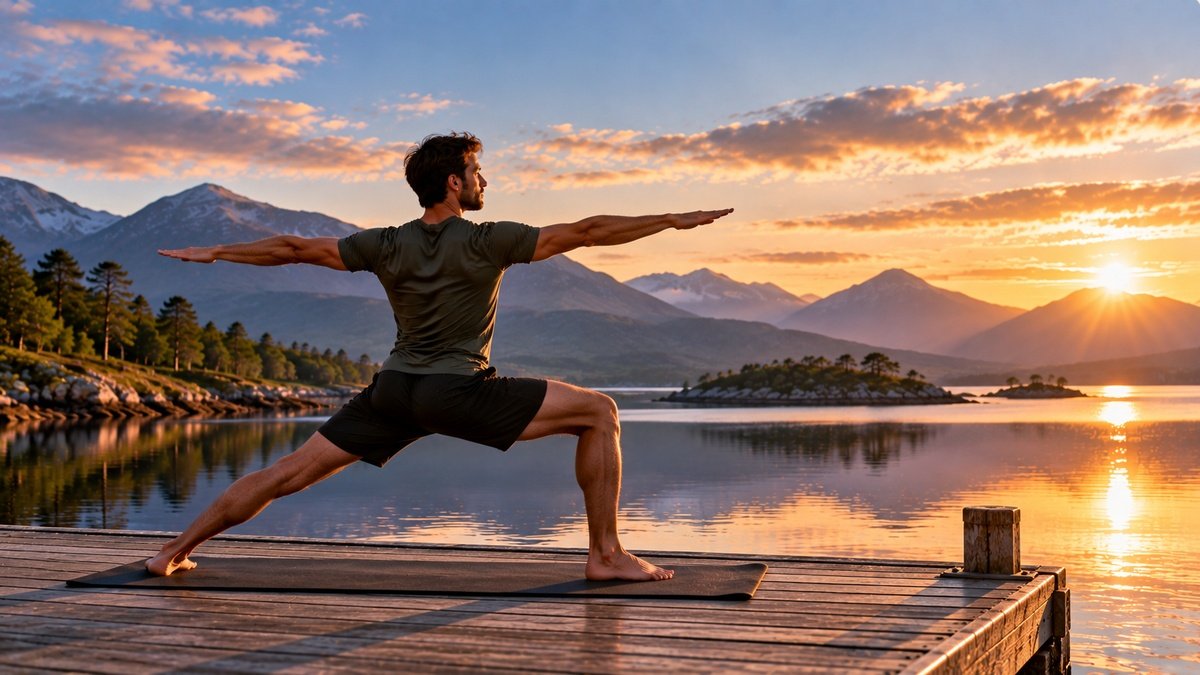
Vinyasa Yoga is one of the most familiar forms of contemporary postural yoga. Walk into a modern yoga studio and a class described as Vinyasa, Vinyasa Flow or simply Flow is likely to appear somewhere on the timetable.
Yet the name does not describe one fixed sequence.
One Vinyasa class may feel slow, spacious and deliberately paced. Another may move continuously through standing postures, balances and transitions. A third may build progressively towards a particular movement or posture.
So what actually makes all of these practices Vinyasa Yoga?
The answer lies less in one collection of postures and more in the relationship between sequence, transition, movement and breath.
Understanding Vinyasa also requires some history. The word did not originally mean a modern “flow class”, and the contemporary practice did not appear fully formed in an ancient yoga text.
Instead, Vinyasa Yoga belongs to the evolving history of modern postural yoga.
What Is Vinyasa Yoga?
Vinyasa Yoga usually describes a contemporary style of yoga in which postures and movements are organised into sequences and transitions often coordinate with breathing.
Rather than treating every posture as an isolated shape, Vinyasa gives attention to how a practitioner arrives, moves, transitions and continues.
This creates the characteristic sense of “flow” associated with many Vinyasa classes.
However, flow does not have to mean speed.
A sequence can unfold slowly. A teacher can include pauses. Some postures may remain for several breaths, while others form part of a continuous transition.
For that reason, movement alone does not adequately define Vinyasa. How movements are organised in relation to one another matters too.
What Does the Word Vinyāsa Mean?
Vinyāsa is a Sanskrit word, but its meaning within modern yoga deserves careful explanation.
Modern yoga teachers commonly use the term to describe the linking of movement and breath, the progression from one posture to another, or a deliberately organised sequence.
Teachers sometimes explain the word more broadly as placing or arranging something in a particular way.
However, the modern postural meaning should not automatically be projected backwards into ancient yoga literature.
Historical scholarship has shown that premodern yoga texts did not generally use vinyāsa in the modern sense of a breath-coordinated sequence of postures.
The contemporary meaning developed much later.
Where Did Modern Vinyasa Yoga Come From?
The history of modern Vinyasa Yoga leads particularly towards twentieth-century South India and the influential teacher T. Krishnamacharya.
During the 1930s and 1940s, Krishnamacharya taught yoga at the Mysore Palace under the patronage of the Maharaja of Mysore.
Research into modern yoga history shows that during this period he taught postures through dynamic sequences in which movements connected one position with another. His approach became enormously influential through the students who later developed distinctive methods of their own.
Those students included K. Pattabhi Jois, B.K.S. Iyengar, Indra Devi and, later, Krishnamacharya’s son T.K.V. Desikachar.
They did not all teach the same yoga.
Indeed, the differences among their approaches demonstrate how much Krishnamacharya’s teaching itself changed according to student, period and context.
Our article One Teacher, Many Directions: Krishnamacharya and the Shaping of Modern Yoga explores that history in greater depth.
What Does Pattabhi Jois Have to Do With Vinyasa?
K. Pattabhi Jois became particularly important to the development and international transmission of dynamic, breath-linked postural practice.
Jois studied with Krishnamacharya and later taught the method now widely known as Ashtanga Vinyasa Yoga.
In this system, practitioners follow established series of postures. Specific movements link the postures, while breathing, gaze and other elements organise the practice.
Ashtanga Vinyasa became highly influential internationally. Teachers who encountered it later developed other forms of dynamic yoga, contributing to the broader landscape from which contemporary Vinyasa and Flow classes emerged.
However, modern Vinyasa Yoga and Ashtanga Vinyasa Yoga are not interchangeable terms.
Vinyasa Yoga and Ashtanga Vinyasa: What Is the Difference?
The difference largely concerns structure.
Ashtanga Vinyasa Yoga follows established sequences. Practitioners learn defined series and generally repeat the same progression rather than receiving a completely new sequence at every class.
Contemporary Vinyasa Yoga usually gives the teacher considerably more freedom to design the sequence.
A teacher might organise a class around spinal movement, balance, a particular family of postures, a theme, a gradual progression or simply a balanced movement practice.
Consequently, two Vinyasa classes taught by different teachers may share relatively little beyond their emphasis on sequencing and connected movement.
Does Vinyasa Mean Sun Salutations?
No, although Sun Salutations frequently appear in Vinyasa classes.
Sūrya Namaskāra, or Sun Salutation, provides a familiar example of linked movement. A sequence progresses through several positions while the practitioner coordinates movement with inhalation and exhalation.
For that reason, Sun Salutations can provide a useful structural foundation for a flowing class.
Nevertheless, Vinyasa Yoga can include many other ways of sequencing movement. A class does not need repeated Sun Salutations in order to qualify as Vinyasa.
What Does “Take a Vinyasa” Mean?
This phrase causes considerable confusion because the word vinyasa is being used in a narrower way.
In many contemporary classes, a teacher may say:
Take a vinyasa.
Usually, the teacher means a short transitional sequence such as Plank or a similar position, Chaturanga Daṇḍāsana, Upward-Facing Dog or Cobra, and Downward-Facing Dog.
That sequence is a vinyasa in common studio language.
It is not the definition of Vinyasa Yoga itself.
A practitioner can therefore skip or adapt that particular transition and still participate in a Vinyasa practice.
Why Is Breath Important in Vinyasa Yoga?
Breathing often provides part of the organisational structure of Vinyasa.
A teacher may invite an inhalation during one movement and an exhalation during another. In a simple sequence, for example, an inhalation might accompany lifting the arms while an exhalation accompanies folding forward.
This creates a relationship between movement and breathing rather than treating them as completely separate activities.
However, “one breath, one movement” should not become an inflexible rule.
People breathe at different rates. Movement may also require more time than a single comfortable breath allows. A well-designed practice can make space for those differences rather than asking someone to hurry their breathing to keep pace with choreography.
Breath can guide movement without becoming a performance target.
Is Ujjāyī Breathing Required?
No universal rule requires every Vinyasa practitioner to use Ujjāyī breathing.
Ujjāyī is strongly associated with Ashtanga Vinyasa and has consequently influenced many contemporary Vinyasa classes. Teachers may use the term for a controlled, audible form of breathing during movement practice.
Yet Vinyasa Yoga exists across a wide range of teaching traditions. Some teachers emphasise Ujjāyī, while others simply encourage comfortable nasal breathing or awareness of the natural breath.
Our article More Than Breathing: Understanding Prāṇāyāma in Yoga explores the wider history and meaning of yogic breathing practices.
How Is a Vinyasa Yoga Class Usually Structured?
No universal template exists, but many contemporary classes follow a recognisable progression.
A session may begin with a quieter arrival period before introducing simple movements. The sequence can then become progressively more complex or active.
Standing postures, lunges, balances, twists or other movements may follow. Later, the pace often reduces before the class concludes with floor-based postures and rest.
Another teacher might structure the same amount of time completely differently.
The important feature is not adherence to one template but the logic connecting one part of the practice with the next.
What Does Sequencing Actually Mean?
Sequencing is more than placing several attractive postures next to one another.
A sequence creates relationships among movements.
A teacher may introduce a simple movement and revisit it later in a more complex context. One posture can prepare for another. Repeated movement patterns may gradually become more familiar, while transitions can help connect different orientations of the body.
Good sequencing also considers how much demand accumulates through the practice.
Repeating weight-bearing transitions, for example, creates a different experience from repeating gentle standing movements. Frequency matters alongside the individual posture.
In this sense, the architecture of a Vinyasa class matters as much as its individual components.
Does Vinyasa Yoga Have to Be Fast?
No.
This is one of the most persistent misunderstandings surrounding Vinyasa Yoga.
Continuous movement can happen slowly.
A practitioner might take several breaths in one posture, move deliberately into the next position and pause whenever more time is useful.
Speed is therefore a teaching choice, not an essential definition of Vinyasa.
In fact, slowing a sequence down can make transitions more noticeable. It may give someone more time to choose hand or foot placement, change the range of movement or decide whether a particular transition suits them.
Does Vinyasa Have to Be Physically Demanding?
No single intensity defines Vinyasa Yoga.
Some classes are physically demanding. They may contain repeated transitions, long standing sequences, weight-bearing movements and balances.
Others use the same principle of connected sequencing with considerably less physical demand.
A Vinyasa practice can take place standing, seated, lying down or through a combination of positions. Teachers can use chairs, walls, blocks and other supports when those options make the practice more appropriate for the individual or context.
The principle of sequencing does not depend on demonstrating the most difficult version of a posture.
Our article There Is More Than One Way to Practise: Adaptive & Chair Yoga explores this broader principle of adaptation.
Do You Need to Be Flexible to Practise Vinyasa Yoga?
No particular level of flexibility qualifies someone to begin a Vinyasa practice.
Flexibility varies among people and across different joints within the same person. Previous activity, anatomy, age, mobility, injury history and many other factors can influence how a movement looks.
Yoga postures do not need to look identical across different bodies.
A useful Vinyasa class can therefore offer choices in stance, range, support, transition and pace rather than treating one visual expression as the only correct destination.
What Is a “Peak Pose” Vinyasa Class?
Some contemporary teachers organise Vinyasa around a so-called peak pose.
The teacher selects a posture and builds a sequence intended to introduce movements related to it before offering the posture later in the class.
This can provide useful sequencing logic, but the language of a “peak” can also imply that everything before it merely prepares for one superior achievement.
That hierarchy is not necessary.
A sequence can explore a movement family without requiring every participant to perform its most complex expression. The purpose may lie in the progression itself rather than reaching one final shape.
Vinyasa Yoga and Haṭha Yoga: Are They Different?
The answer depends on how we use the term Haṭha Yoga.
Historically, Haṭha Yoga refers to traditions that developed in medieval India and included a range of physical and subtle-body practices. Modern postural yoga inherited important elements from that much broader history.
In contemporary studio timetables, however, “Hatha” often describes a class that moves more slowly and treats postures more individually, while “Vinyasa” suggests greater emphasis on linked sequences.
That studio distinction can help participants choose a class, but it should not be mistaken for a complete account of yoga history.
Our article Beyond the Pose: Understanding Haṭha Yoga and Its Origins explores the historical meaning in more detail.
Is Vinyasa Yoga the Same as Power Yoga?
No, although their histories overlap.
Power Yoga developed as a modern, predominantly Western approach influenced strongly by Ashtanga Vinyasa. Teachers used the term for physically demanding practices without necessarily following the fixed Ashtanga series.
Many Power Yoga classes therefore use Vinyasa-style sequencing.
Yet Vinyasa does not have to be vigorous enough to qualify as Power Yoga, and not every teacher using Vinyasa methods describes their work as Power Yoga.
Is Vinyasa Yoga Meditation?
Vinyasa can involve sustained attention, but describing all Vinyasa practice as meditation can blur useful distinctions.
Following breath, noticing transitions and maintaining attention during movement may create a concentrated practice. Some teachers deliberately frame this as moving meditation.
However, yoga traditions have developed specific concepts and practices of concentration and meditation that should not automatically be reduced to any activity performed attentively.
Within Patañjali’s system, for example, dhāraṇā and dhyāna have particular meanings within a larger philosophical structure.
Our article From Concentration to Meditation: Understanding Dhāraṇā, Dhyāna and Samādhi examines those distinctions.
What Are the Benefits of Vinyasa Yoga?
This question needs more precision than a list of universal promises.
Vinyasa classes can involve movement, strength, mobility, balance, coordination and sustained attention. The exact physical demand depends on the sequence, pace, duration, teacher and individual practitioner.
People may also value the rhythm of moving with breath, the concentration involved in following a sequence or simply the experience of practising movement in a structured setting.
Those experiences are individual.
Vinyasa Yoga should not be presented as guaranteed to detoxify the body, correct hormones, release trauma, regulate everyone’s nervous system or treat a medical condition. Such claims go beyond what the name of a yoga style can establish.
Is Vinyasa Yoga Suitable for Everyone?
There is no single Vinyasa class for which one answer would apply to everyone.
The label covers too much variation.
A slow, well-supported sequence with several options creates very different demands from a fast class containing repeated Chaturanga transitions, deep ranges of movement and weight-bearing balances.
For this reason, class description and teaching approach matter.
Someone who wants more time to transition may prefer a slower format. Another person may enjoy continuous movement. A practitioner might choose to use props, reduce repetitions, omit particular movements or rest while the wider class continues.
Pregnancy, injury, health conditions or significant changes in physical capacity may also affect which movements and levels of demand are appropriate. Where relevant, individual healthcare advice should take priority over generic class guidance.
A Common Misunderstanding: More Flow Does Not Mean More Yoga
Modern Vinyasa culture can sometimes reward visible complexity.
Fast transitions, difficult balances and elaborate sequences can look impressive, particularly in photographs and short videos.
Yet complexity does not determine whether a practice is meaningful.
A sequence of three simple movements can involve careful attention to breathing, transition, sensation and choice. A complicated sequence can become primarily an exercise in remembering choreography.
Neither experience needs to be dismissed. They simply ask different things of the practitioner.
Vinyasa offers a way of organising movement. It does not create a hierarchy in which the fastest, deepest or most elaborate sequence represents the highest form of yoga.
The Orenna Perspective — What Happens Between the Postures Matters
Postural yoga often directs attention towards shapes.
We name one posture, arrive in it and then name the next.
Vinyasa Yoga invites another question:
What happens between them?
The transition is not empty space.
It contains movement, breathing, attention and decisions. A person shifts weight, changes direction, chooses a range and responds to what is happening in that moment.
Seen this way, Vinyasa does not have to mean performing an uninterrupted stream of increasingly difficult postures.
It can mean recognising that the way we move from one place to another forms part of the practice itself.
Sometimes the transition may be continuous. At another moment, it may include a pause. A prop may change the route. The next movement may become smaller, slower or different from the one originally planned.
The sequence remains a sequence because its parts continue to relate to one another.
Perhaps that is one of the most useful ways to understand Vinyasa.
The practice is not only where we arrive. It also includes how we move from here to there.
References & Further Reading
Birch, Jason & Singleton, Mark. The Yoga of the Haṭhābhyāsapaddhati: Haṭhayoga on the Cusp of Modernity. Journal of Yoga Studies. Includes historical discussion of Krishnamacharya, Mysore and the development of dynamically linked postural sequences.
Birch, Jason & Hargreaves, Jacqueline. Premodern Yogāsanas and Modern Postural Practice. Journal of Yoga Studies. Research examining relationships between premodern postural material and modern yoga.
SOAS University of London. The Haṭha Yoga Project. Academic research into the history of physical yoga practices and their relationship with modern yoga.
Orenna Journal. One Teacher, Many Directions: Krishnamacharya and the Shaping of Modern Yoga.
Orenna Journal. Beyond the Pose: Understanding Haṭha Yoga and Its Origins.
Orenna Journal. More Than Breathing: Understanding Prāṇāyāma in Yoga.
The Orenna Journal approaches yoga through historical context, contemporary practice and evidence-informed discussion. Modern Vinyasa Yoga is diverse, and the content, pace and physical demands of individual classes vary considerably between teachers and schools.