


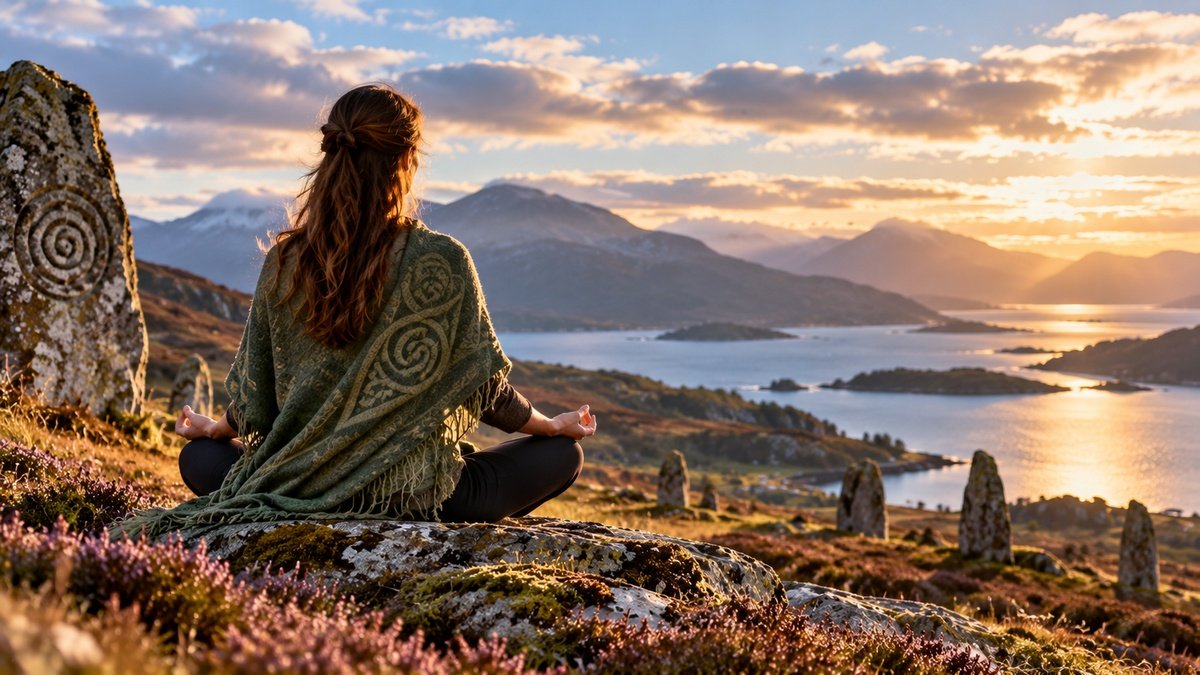
Celtic Yoga sounds as though it might describe an ancient form of yoga practised by Celtic peoples.
History tells a more complicated story.
Yoga developed over many centuries within the religious, philosophical and ascetic cultures of the Indian subcontinent. Celtic-language cultures developed in different parts of Europe, including Ireland, Scotland, Wales, Cornwall, the Isle of Man and Brittany. Historical evidence does not establish an ancient Celtic yoga tradition equivalent to the yoga traditions documented in India.
So why do people now use the term Celtic Yoga?
Today, some practitioners use it to describe a contemporary meeting between traditions. Recognisable yoga practices may enter into conversation with Irish, Scottish or other Celtic cultural material, including poetry, story, mythology, language, landscape and seasonal observance.
However, no single definition, curriculum or universally recognised lineage defines Celtic Yoga. Different teachers use the term in different ways.
Understanding it therefore requires several questions: What is Celtic Yoga? Where did the term come from? What does “Celtic” mean? Which elements come from yoga? Which come from Celtic traditions? And how can contemporary practitioners bring them together without confusing their histories?
What Is Celtic Yoga?
Celtic Yoga is best understood as a contemporary term rather than the name of one ancient yoga system.
Some approaches combine established yoga practices with Celtic mythology, poetry, storytelling, song, landscape or seasonal themes. A session might therefore include āsana, breathing practices or meditation alongside a poem, story or reflection connected with place.
Other teachers organise practices around seasonal festivals. Some focus particularly on Irish traditions, while others draw from Scottish, Welsh or broader Celtic material.
Elsewhere, people have used terms such as “Druid Yoga” or Wyda for systems presented as European or Druidic counterparts to yoga. Those practices involve different historical claims and should not automatically be treated as another name for the same thing.
Consequently, a class labelled Celtic Yoga may differ substantially from another class using exactly the same name.
Where Does Yoga Come From?
Before exploring the Celtic dimension, we need to retain the historical context of yoga itself.
Yoga has deep roots in the Indian subcontinent. Across many centuries, different communities developed different ideas about what yoga meant, how people should practise it and what practice sought to accomplish.
Important developments appear across sources and traditions associated with the Upaniṣads, the Bhagavad Gītā, Buddhist and Jain communities, Patañjali’s Yoga Sūtras, Tantra and later Haṭha Yoga.
These traditions do not present one timeless definition of yoga. Instead, they reveal multiple formulations that changed across historical periods and communities.
Our article Beyond the Posture: What Does Yoga Actually Mean? explores this wider history.
Bringing Celtic material into a modern yoga practice therefore does not relocate yoga’s historical origins from India to Europe.
What Does “Celtic” Mean?
The word “Celtic” also requires some care.
Popular culture sometimes presents “the Celts” as one ancient people who shared a single religion, mythology and spiritual system across Europe. The historical picture is much more diverse.
Today, the term has particular value in relation to Celtic languages and the cultures connected with them.
The surviving Celtic languages fall into two principal branches.
- Goidelic: Irish, Scottish Gaelic and Manx.
- Brittonic: Welsh, Breton and Cornish.
These languages share historical relationships, but the communities that speak or historically spoke them developed distinct cultures, literatures and experiences.
For that reason, “Celtic tradition” should not become shorthand for one unchanged spiritual system extending from antiquity into the present.
Was There an Ancient Celtic Yoga?
This question sits at the centre of the subject.
Current historical evidence does not demonstrate that ancient Celtic peoples practised a system called yoga or maintained a documented Celtic yoga lineage comparable with the traditions found in Indian sources.
That statement does not suggest that Celtic societies lacked ritual, contemplative activity, disciplined training, poetry, philosophy or complex relationships with landscape.
Instead, it establishes an important historical distinction.
Similarity between practices does not, by itself, establish shared historical origin.
Across the world, human communities have developed practices involving movement, breath, chanting, fasting, ritual, contemplation, storytelling and engagement with the natural environment.
Comparing those practices can reveal interesting similarities and differences. Demonstrating direct historical transmission, however, requires evidence.
What About the Druids?
Discussions of Celtic spirituality frequently turn to the druids.
Ancient Greek and Roman authors wrote about druids among some communities in Gaul and Britain. Later Irish literature also contains references to druids, although medieval Christian writers recorded those texts centuries after some of the periods they describe.
As a result, reconstructing ancient Druidic practice presents significant challenges.
No surviving ancient Druidic instructional text provides a complete system of physical postures, breathing exercises and meditation comparable with the documentary traditions available for Indian yoga.
Modern Druidry also has its own history. Revival, reconstruction, scholarship and contemporary spirituality have all contributed to its development.
This does not make modern Druidry less meaningful to the people who practise it. It simply distinguishes a living contemporary tradition from claims of uninterrupted ancient continuity.
What About Wyda or “Druid Yoga”?
The name Wyda sometimes appears alongside discussions of Celtic Yoga. Contemporary practitioners have described it as “Druid Yoga” or as a European counterpart to yoga.
Accounts of Wyda include claims about exercises connected with Druidic knowledge and later transmission. Those historical claims require separate evaluation from the contemporary practice itself.
At present, the available historical record does not place Wyda on the same evidential footing as the documented development of yoga traditions in India.
Someone may nevertheless practise a modern system and find personal meaning in it. Historical provenance asks a different question.
Practice and provenance are not the same thing.
Where Does Modern Celtic Yoga Come From?
Rather than searching for one ancient founder, it is more useful to examine contemporary teachers who have explicitly brought yoga into conversation with Celtic cultural material.
One notable example is the Celtic School of Yoga, associated with yoga teacher and writer Uma Dinsmore-Tuli and musician, storyteller and teacher Jack Harrison.
Their work has explored regionally and seasonally situated yoga through Celtic and particularly Irish story, poetry, song, landscape and cultural imagination.
Dinsmore-Tuli and Harrison published The Celtic School of Yoga: An Aisling for the Twenty-First Century, presenting their approach as a contemporary vision rather than an archaeological manual for ancient Celtic yoga.
Other teachers use the term Celtic Yoga differently. Some emphasise seasonal observance, while others focus on mythology, poetry, landscape or particular Celtic-language traditions.
For this reason, modern Celtic Yoga is better understood as a field of contemporary interpretation than as one standardised historical school.
What Might a Celtic Yoga Practice Include?
No universal sequence defines a Celtic Yoga class.
Depending on the teacher and context, a contemporary practice might include:
- āsana or other forms of movement;
- prāṇāyāma or breath practice;
- meditation;
- relaxation or Yoga Nidra;
- poetry;
- storytelling and mythology;
- song, chanting or voice;
- reflection on landscape and place;
- seasonal themes;
- Irish, Scottish or other Celtic-language material;
- contemplative engagement with the natural world.
One teacher may use several of these elements, while another may concentrate on only one or two.
The label therefore describes a broad contemporary direction rather than a fixed sequence of techniques.
Why Do Story and Poetry Appear in Celtic Yoga?
Story and poetry provide one of the more distinctive features of some Celtic Yoga approaches.
Irish, Scottish Gaelic and Welsh traditions contain extensive bodies of poetry, narrative and mythology. Contemporary teachers may bring selected material into a practice as a subject for reflection or as a way of exploring relationships among language, identity, imagination and place.
The Celtic School of Yoga has particularly emphasised story, poetry, song and embodied practice.
Used carefully, these elements do not need to replace or obscure yoga’s Indian history. Instead, they can provide cultural material with which a contemporary yoga practice enters into dialogue.
What Is the Celtic Wheel of the Year?
Some Celtic-inspired yoga and wellness practices use a seasonal framework commonly called the Wheel of the Year.
Modern versions usually arrange eight observances around the annual cycle.
Four have roots in Gaelic seasonal festivals:
- Samhain — traditionally associated with the beginning of winter;
- Imbolc — associated with the transition towards spring;
- Bealtaine / Beltane — associated with the beginning of summer;
- Lughnasa / Lughnasadh — associated with the harvest season.
Contemporary eightfold systems usually place the two solstices and two equinoxes between these four seasonal festivals.
However, the familiar eight-spoked Wheel of the Year represents a modern synthesis. Modern Pagan and Druidic movements brought older seasonal observances and the solar points together into the unified cycle now widely used.
Therefore, it is more accurate to distinguish the older histories of individual festivals from the modern framework that combines all eight.
Does Celtic Yoga Have to Follow the Wheel of the Year?
No. Seasonal practice represents one contemporary approach rather than a requirement.
For example, one teacher might build a practice around Samhain or Imbolc. Another could work with Irish poetry, while someone practising in Scotland might explore Gaelic language, local stories or the changing Highland landscape.
Some teachers may prefer the description “Celtic-inspired yoga” because it makes the relationship between the traditions more explicit.
Again, the name of a class cannot tell us everything about its content.
What Does Nature Have to Do With Celtic Yoga?
Landscape and season feature strongly in many contemporary Celtic Yoga approaches.
A practice may invite participants to notice changing light, weather, plants or seasons. Others may use poetry and stories associated with particular landscapes.
Nevertheless, romantic claims about ancient Celtic people living in perfect harmony with nature deserve caution.
Historical communities depended closely on land, animals, agriculture, weather and seasonal cycles. Their relationships with environments also involved food, work, property, survival, ritual, politics and social organisation.
Modern ecological interpretations can hold contemporary meaning without presenting them as exact reconstructions of ancient belief.
Similarly, spending time outdoors does not produce one universal emotional response. People experience landscapes differently according to environment, accessibility, weather, safety, sensory preferences and personal circumstances.
Our article Why Place Matters: Nature, Attention and the Experience of Being Outdoors explores that relationship in greater depth.
Does Celtic Yoga Belong Only to Ireland?
No. However, some influential contemporary expressions draw particularly strongly from Irish traditions.
The wider term “Celtic” includes several related but distinct linguistic and cultural traditions. Treating all of them as interchangeable can erase important differences.
For Orenna, situated in the Scottish Highlands, that distinction matters.
Scotland has its own Gaelic language, literature, oral traditions, place names and cultural relationships with landscape. A practice interested in Scottish place can engage with those sources specifically rather than assembling generic symbols simply because someone has labelled them “Celtic”.
Our exploration of Gaelic place names, for example, considers how language can preserve traces of landscape, history and relationships with place.
Irish and Scottish Gaelic cultures share historical connections, but they are not identical.
Specificity can create a more thoughtful encounter than treating Celtic culture as one undifferentiated tradition.
Is Celtic Yoga a Religion?
Not inherently.
Celtic Yoga has no single institution, creed or doctrine that would make every practice part of one religion.
Individual practitioners may approach mythology or seasonal observances spiritually. Others may engage with the same material through history, literature, culture or personal reflection.
Similarly, studying a philosophical or religious text does not automatically determine someone’s personal beliefs.
A clearly described class should give participants enough information to decide whether its content and approach suit them.
What About Cultural Appropriation?
Bringing traditions into conversation raises legitimate questions about representation, attribution and power.
Rather than assuming that traditions must remain completely separate, we can ask more specific questions.
- Does the practice acknowledge yoga’s Indian origins?
- Does it identify particular Celtic traditions rather than presenting “the Celts” as one timeless culture?
- Does the teacher distinguish modern interpretation from documented historical practice?
- Are sources and influences credited?
- Does the teacher acknowledge uncertainty where evidence remains limited?
These questions encourage transparency without assuming that cultural exchange itself is inherently inappropriate.
They also allow participants to understand which parts of a practice come from established traditions and which parts represent contemporary creative interpretation.
A Common Misunderstanding: Similarity Does Not Prove Shared Origin
Comparisons between Indian and Celtic traditions can reveal fascinating parallels.
Both contain rich bodies of sacred or culturally significant poetry. Oral transmission played important roles in different periods and contexts. Ritual, cosmology, disciplined practice and reflection on human existence also appear in both cultural worlds.
At a much deeper historical level, Celtic and Indo-Aryan languages belong to branches of the Indo-European language family.
None of these connections, however, demonstrates that ancient druids practised Indian yoga or preserved another version of the same yoga system.
Comparative similarity and historical transmission are different propositions.
Keeping that distinction visible allows comparison to remain interesting without asking it to prove more than the evidence supports.
Can Celtic Yoga Be Meaningful If It Is Modern?
Yes.
A contemporary practice does not need an invented ancient pedigree in order to hold cultural, contemplative or personal meaning.
In fact, acknowledging modern development can make its intentions clearer.
A teacher might explain that they offer a modern yoga practice rooted in Indian yoga traditions while drawing thoughtfully from selected Irish, Scottish Gaelic or other Celtic cultural sources.
Such a description identifies both influence and difference.
It also gives participants a clearer basis for understanding what they are practising.
History does not need to be made older for contemporary practice to become meaningful.
The Orenna Perspective — Traditions Can Meet Without Becoming the Same
Considering Celtic Yoga from the Scottish Highlands creates an interesting meeting of histories.
Yoga did not originate here. Its historical roots lead towards the Indian subcontinent and centuries of philosophical, contemplative and embodied traditions.
At the same time, every contemporary yoga practice takes place somewhere.
Here, that place may include Gaelic names, long summer evenings, winter darkness, Atlantic weather, pinewoods, peatlands, mountains and lochs.
Practising yoga within this landscape does not make yoga historically Celtic. Equally, respecting yoga’s Indian origins does not require us to pretend that the place where we practise has no language, culture or history of its own.
A more thoughtful possibility exists between those positions.
We can study where yoga came from while also learning where we are. We can distinguish evidence from interpretation and recognise when a practice represents a contemporary meeting rather than an ancient continuity.
With those distinctions intact, story, landscape, season and yoga can enter into conversation without needing to become the same tradition.
Traditions do not need to share the same origin in order to meet meaningfully.
References & Further Reading
Dinsmore-Tuli, Uma & Harrison, Jack. The Celtic School of Yoga: An Aisling for the Twenty-First Century. A contemporary presentation of a regionally and seasonally situated approach to yoga in conversation with Celtic cultural material.
Uma Dinsmore-Tuli. The Celtic School of Yoga and related work. Contemporary material relating to Dinsmore-Tuli’s yoga teaching and publications.
Orenna Journal. Beyond the Posture: What Does Yoga Actually Mean?. An introduction to yoga as a diverse historical phenomenon with roots in the Indian subcontinent.
Orenna Journal. From Tradition to Transformation: How Modern Yoga Took Shape. Further exploration of the transformations that contributed to contemporary yoga.
Orenna Journal. More Than a Name: Gaelic Place Names and the Highland Landscape. An exploration of Gaelic language, landscape and place in the Scottish Highlands.
The Orenna Journal distinguishes documented history from contemporary interpretation. Celtic Yoga does not describe one universally defined historical lineage, and individual teachers may use the term differently.



