


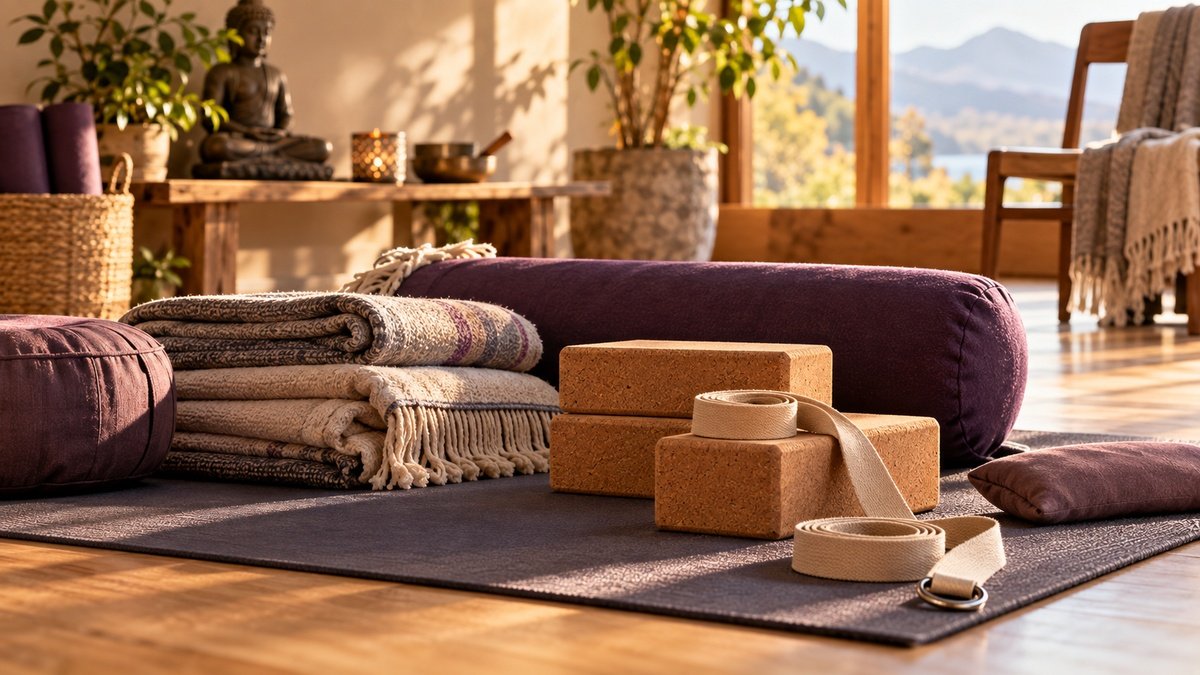
A yoga block beneath a hand. A blanket beneath the head. A strap extending the reach of the arms. A bolster supporting the body. A chair providing another relationship with gravity. Yoga props can change a practice in ways that extend far beyond making a posture easier.
Yet props are still sometimes treated as signs of limitation. A practitioner may be encouraged to use one until they can perform the “full” posture, as though the eventual goal should always be to practise without support.
That assumption overlooks something important.
A prop does not necessarily replace the posture. It can become part of how the posture is explored.
Used with intention, props can alter height, distance, load, stability, orientation, contact and sensory feedback. They can change the relationship between the body and the floor, or between one part of the body and another.
The more useful question is therefore not always, “Can I do this without the prop?”
Sometimes it is, “What changes when support is introduced?”
What Is a Yoga Prop?
In contemporary yoga, the word prop can describe almost any external object used purposefully within practice.
Blocks, bricks, straps, belts, blankets and bolsters are familiar examples. Chairs, walls, cushions, sandbags and eye pillows may also be used in particular contexts.
Even the floor provides support.
What makes something useful as a prop is not simply the object itself. Its value comes from what it changes within the practice.
A block can provide height. A strap can change distance. A wall can offer contact or stability. A blanket can alter pressure, warmth or the relationship between the body and a surface.
For that reason, the same prop may serve very different purposes for different people, practices or postures.
Why Do We Use Yoga Props?
There is no single reason to use a prop.
A teacher might introduce one to change the height of a surface, reduce the distance required to reach it or provide a clearer point of contact.
Another setup might use support to alter weight distribution or make a position sustainable for longer.
Props can also provide information.
Contact with a wall, for example, may help someone notice where the body is in space. A block between two points of contact can create another reference for attention. A strap can establish a relationship between the hands without requiring them to meet.
In other situations, support may simply create a version of the practice that feels more appropriate for that person on that particular day.
None of these purposes makes the resulting practice incomplete.
The Problem With Calling Everything a Modification
The word modification can be useful. It tells us that something about a practice has changed.
However, the word can also create an unintended hierarchy.
If one version becomes the “full pose,” every other version can begin to sound like a reduced substitute. The practitioner may then assume that progress means gradually removing support until the body matches the preferred external shape.
Yoga does not need to be organised that way.
Changing a posture does not automatically reduce its value. Sometimes the adaptation allows a different aspect of practice to become available.
The purpose of the practice should help determine the arrangement — not an assumption that everyone should eventually perform the same shape.
Support Is Not a Measure of Ability
The amount of support someone uses tells us very little about the value, seriousness or sophistication of their yoga practice.
A highly experienced practitioner may deliberately use several props. Someone new to yoga may prefer none. Another person may use a chair for one part of practice and move to the floor for another.
Needs can also change from day to day.
Energy, environment, comfort, familiarity and the intention of the practice can all influence what feels appropriate.
For this reason, it is more inclusive to understand support as a practice choice rather than as evidence about someone’s body or ability.
The practitioner does not need to earn the right to use a prop.
B.K.S. Iyengar and the Development of Prop-Based Practice
Props have become particularly associated with the teaching of B.K.S. Iyengar, one of the major figures in twentieth-century modern yoga.
Across decades of practice and teaching, Iyengar developed extensive ways of working with blocks, belts, blankets, bolsters, chairs, walls, ropes and other forms of external support.
The purpose was not simply to make difficult postures easier.
Different forms of support could change alignment, orientation, stability, duration and the experience of an āsana. Props also allowed practitioners to investigate postures under different conditions.
This approach became highly influential within Iyengar Yoga and contributed to the development of supported practices beyond it.
Its relationship with contemporary Restorative Yoga is explored more fully in From Support to Stillness: How Restorative Yoga Developed.
A Block Can Change More Than Reach
Yoga blocks often appear beneath the hands when the floor feels too far away.
That is useful, but it is only one possibility.
A block changes space.
Placed beneath a hand, it changes the height of the surface. Positioned beneath another part of the body, it can alter orientation or provide a point of contact. Used beside the body, it may act as a reference rather than a support.
Different block heights also create different relationships.
Instead of thinking of the block as something that compensates for a body that cannot reach the floor, we can reverse the question.
Perhaps the floor does not need to be the destination.
Perhaps the surface can come towards the practitioner.
Blankets Are More Than Padding
A folded blanket can change height by a small amount, and sometimes a small amount matters.
Blankets can soften contact with the floor, provide warmth or support part of the body without creating the height of a bolster.
They can also be folded, rolled or layered, which makes them unusually adaptable.
However, more softness is not automatically more comfortable.
A thick arrangement may feel supportive for one person and unstable for another. Warmth can be welcome, unnecessary or uncomfortable depending on the individual and environment.
The blanket therefore has no universal purpose.
Its usefulness depends on what the practice requires.
Bolsters and the Architecture of Support
Bolsters are closely associated with Restorative Yoga because they can support a relatively large area of the body.
Yet a bolster does more than create softness.
Its height, width, density and orientation all matter. A firm rectangular bolster creates a different relationship from a softer cylindrical one. Turning the same bolster can change the angle of support.
The position of the bolster matters too.
Moving it only a few centimetres may change where pressure appears or how the body settles.
For this reason, a restorative setup should not be treated as a fixed construction copied from a photograph.
The architecture needs to respond to the person using it.
Straps Can Change Distance
A yoga strap can extend the functional distance between two points.
For example, the hands do not need to reach the feet directly if a strap can establish the connection between them.
This can change how someone organises the rest of the posture.
Instead of using additional effort simply to maintain contact, the practitioner may have another way to explore the intended action.
Straps can serve other purposes too. Depending on the practice, they may provide a boundary, connection or reference point.
As with every prop, the reason for using one should remain clear.
A Chair Is Not a Lesser Version of the Floor
A chair changes the relationship between the body, gravity and the ground.
That makes it a remarkably versatile yoga prop.
Someone can practise seated movement, standing work with support, breathing practices, meditation or other forms of yoga with a chair as part of the arrangement.
The chair does not need to function as a temporary substitute until floor-based practice becomes possible.
For some people, chair-based practice may be their preferred form of yoga. Others may move between chair, standing and floor-based practices according to context.
Neither approach needs to be ranked above the other.
This principle is explored further in There Is More Than One Way to Practise: Adaptive & Chair Yoga.
The Wall Can Become Part of the Practice
A wall is easy to overlook because it is already part of the room.
Yet it can function as a substantial yoga prop.
Contact with a wall may provide support, stability or information about where the body is positioned in space. It can also change how much effort a particular arrangement requires.
Sometimes the wall supports the hands. In another practice, it may receive the feet, back or another point of contact.
Once again, the object itself does not determine the purpose.
The way it is used does.
The Floor Is a Prop Too
The floor may be the most frequently used support in yoga, yet we rarely describe it as a prop.
Every time the body rests against the ground, the surface participates in the posture.
It provides resistance, contact and orientation.
This observation reveals something important about the idea of unsupported practice.
Very little physical yoga is truly unsupported.
Hands meet mats. Feet meet floors. Bodies interact with gravity and surfaces continuously.
Adding a block or bolster does not suddenly make support appear. It changes the support that was already present.
Yoga Props in Restorative Practice
Restorative Yoga makes the role of support particularly visible.
Bolsters, blankets, blocks and other supports may form an intentional structure around the body. Their arrangement can help reduce unnecessary muscular effort and make a position sustainable for a period of stillness.
However, simply adding several props does not automatically create a restorative posture.
A beautifully arranged setup may still feel uncomfortable to the person inside it.
The practitioner therefore remains the most important source of information.
Support may need to move. A blanket may need to disappear. A bolster may need to turn. The entire position may need to change.
Restorative practice depends on responsive support rather than decorative complexity.
Read more in The Art of Supported Rest: Understanding Restorative Yoga.
Yoga Props in Adaptive Practice
Adaptive yoga begins with the recognition that the practice can respond to the person.
Props can support that process, but adaptation does not mean assigning particular equipment to particular categories of people.
A chair is not inherently a prop for older adults. Blocks are not inherently for beginners. Bolsters do not belong only to people with limited mobility.
Those assumptions can unintentionally attach ability labels to ordinary practice tools.
A more individual approach asks what the person wants to explore and what arrangement supports that intention.
The adaptation then belongs to the practice rather than becoming a judgement about the practitioner.
Yoga Props During Pregnancy
Props may also form part of yoga during pregnancy, but pregnancy does not automatically require a particular prop or a predetermined version of practice.
As pregnancy progresses, comfort, balance and preferences may change. An arrangement that felt appropriate earlier may no longer feel useful later.
Blocks, chairs, bolsters, walls and blankets can provide additional options when those options serve the individual practitioner.
However, props do not replace appropriate pregnancy-specific guidance or healthcare advice where that is needed.
The principle remains the same: the practice can change as the person and circumstances change.
Explore this further in Yoga During Pregnancy: A Practice That Changes With You.
When More Support Is Not Better
If support is useful, it can be tempting to assume that more support must be even better.
That is not necessarily the case.
An additional bolster may create unwanted height. A thick blanket can introduce instability. Too many objects may make transitions unnecessarily complicated or leave someone feeling constrained.
Props can also become distracting when no clear purpose guides their use.
Good support is therefore not measured by the number of objects surrounding the body.
Sometimes one carefully positioned blanket does more useful work than an elaborate arrangement of equipment.
The question is not, “How much support can we add?”
It is, “What does this support change, and is that change useful?”
A Common Misunderstanding: The Goal Is Eventually to Remove the Props
In some contexts, a practitioner may choose to explore a posture with progressively less external support.
That can be a valid direction when it serves their intention.
It is not a universal definition of progress.
A person may practise with the same prop for years because it continues to serve a purpose. An experienced practitioner may deliberately add support to investigate something new.
In Restorative Yoga, removing support could even move the practice away from its intended purpose.
Progress in yoga cannot always be measured by how little assistance the body appears to need.
Sometimes greater experience produces a more precise understanding of when support is useful.
The Prop Should Not Decide the Practice
A studio full of beautiful equipment can invite experimentation, but the presence of a prop does not create a reason to use it.
The intention comes first.
What are we exploring? What does the current arrangement ask of the practitioner? Is that demand useful? Would changing height, contact, orientation or stability alter the experience in a meaningful way?
These questions move prop use away from decoration and towards purposeful practice.
They also prevent a particular setup from becoming another ideal shape that every practitioner is expected to reproduce.
The Orenna Perspective — Support With Intention
At Orenna, a prop earns its place.
It does not need to appear because a particular photograph, tradition or sequence says it should. Nor does an arrangement become more restorative simply because it contains more equipment.
Instead, each form of support should have a reason.
Perhaps a block changes height. A bolster redistributes support. A blanket changes contact or warmth. A wall provides orientation. A chair creates another relationship with gravity.
The effect also needs to be considered over time.
What feels appropriate when entering a posture may change several minutes later. Temperature can shift. Pressure can become more noticeable. The practitioner may simply decide that another arrangement would feel better.
Transitions matter as well. An elaborate setup that feels comfortable once established may not be useful if entering or leaving it creates unnecessary difficulty.
Above all, support should not remove choice.
The practitioner remains free to move, adjust, decline a prop, request another option or leave a position.
This approach changes the question we ask about props.
Instead of asking, “Can you do the posture without this?”, we can ask:
“What changes when we introduce support?”
Sometimes the answer will be that no prop is needed.
Sometimes a small adjustment changes the entire experience.
Neither choice is inherently more advanced.
The practice should respond to the person.
References & Further Reading
Iyengar, B.K.S. Light on Yoga. A major twentieth-century presentation of Iyengar’s approach to āsana and yoga practice.
Iyengar, B.K.S. Yoga: The Path to Holistic Health. Includes extensive examples of supported āsana and the use of props within Iyengar’s approach to practice.
Lasater, Judith Hanson. Relax and Renew: Restful Yoga for Stressful Times. An influential contemporary work on supported Restorative Yoga practice.
Singleton, Mark. Yoga Body: The Origins of Modern Posture Practice. Oxford University Press, 2010. Historical context for the development of modern posture-centred yoga.
Mallinson, James & Singleton, Mark. Roots of Yoga. Penguin Classics, 2017. A sourcebook illustrating the diversity of yoga practices across premodern textual traditions.
For broader historical context, explore From Tradition to Transformation: How Modern Yoga Took Shape.
The Orenna Journal explores yoga from historical, philosophical and contemporary perspectives. This article is educational and does not provide individual medical advice. The usefulness of any yoga prop or position depends on the individual, context and purpose of practice. Where a health condition, injury, pregnancy-related concern or other clinical consideration affects participation, appropriate guidance from a qualified healthcare professional may be needed.



