


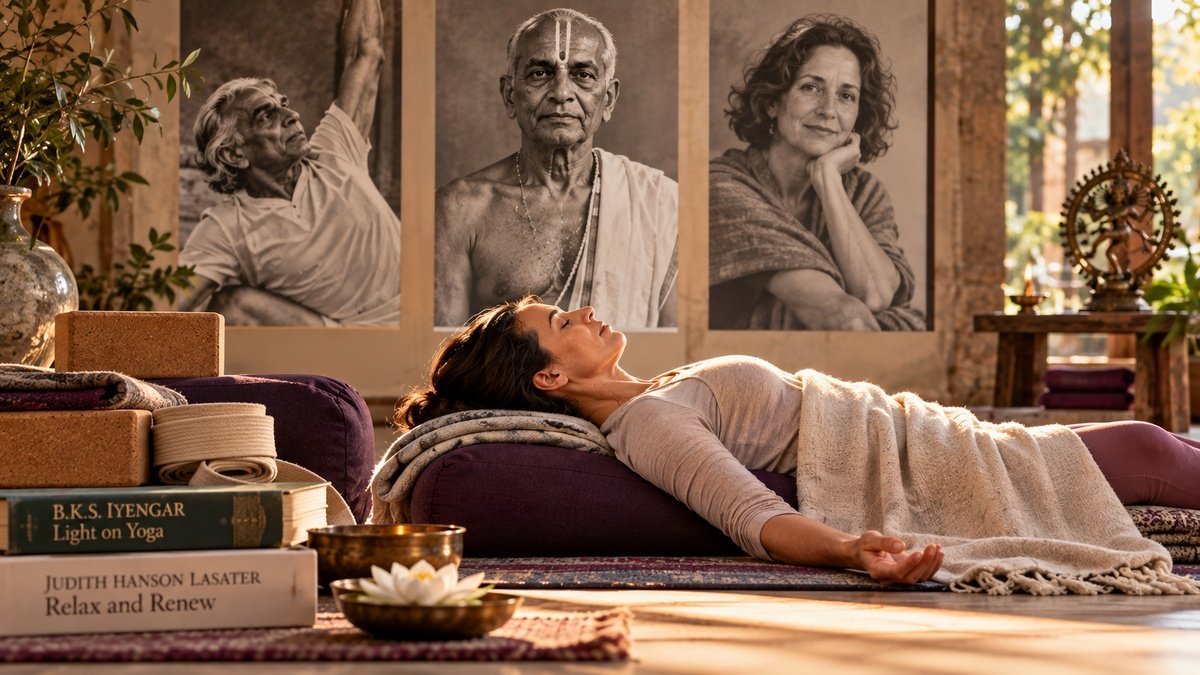
Restorative Yoga can appear remarkably simple: the body receives support, movement becomes minimal and time begins to slow. Yet behind that apparent simplicity lies a carefully developed contemporary approach to yoga and a history that deserves more precision than the familiar claim that it is simply an “ancient practice of rest.”
The history of Restorative Yoga is better understood as a story of influence, experimentation and development. Older yoga traditions provide a much wider background, while B.K.S. Iyengar’s exploration of props and supported āsana became particularly influential. Judith Hanson Lasater later became one of the principal figures associated with developing, teaching and popularising Restorative Yoga as a recognisable contemporary practice.
That history also helps explain an important principle: support is not simply something added when a person cannot perform a supposedly “full” posture.
Support can change the practice itself.
What Do We Mean by Restorative Yoga?
Contemporary Restorative Yoga generally uses carefully arranged support to allow a person to remain in a position with relatively little unnecessary muscular effort.
Bolsters, blankets, blocks, straps, chairs, walls and the floor may all become part of the architecture of a posture.
However, the presence of props alone does not make a practice restorative.
The arrangement of the body, degree of support, duration, transitions and surrounding environment all influence the experience. So do individual preferences and responses.
A restorative practice therefore involves more than placing a bolster beneath the body and waiting.
It involves creating conditions in which effort can reduce without requiring the practitioner to force relaxation.
For an introduction to the practice itself, read The Art of Supported Rest: Understanding Restorative Yoga.
Did Ancient Yogis Practise Restorative Yoga?
Yoga has a long history, but we should be careful about projecting contemporary categories backwards through time.
Premodern yoga traditions included āsana, breath practices, meditation, periods of stillness and many other techniques. Historical sources also show that yoga practitioners worked with the body in diverse ways.
That evidence does not establish that contemporary Restorative Yoga existed as a distinct named system thousands of years ago.
The distinction matters.
A modern practice can have meaningful relationships with older traditions without every part of that practice being ancient.
Recognising this does not diminish Restorative Yoga. Instead, it allows us to appreciate how yoga practices develop while remaining historically transparent.
The Importance of B.K.S. Iyengar
B.K.S. Iyengar occupies an important place in the history of Restorative Yoga, although describing him simply as its founder would make the historical relationship appear more straightforward than it was.
Iyengar developed an extensive approach to āsana through decades of practice and teaching. Detailed observation, alignment, sequencing and the purposeful use of external support became notable features of his methodology.
He worked with blocks, belts, blankets, bolsters, chairs, walls, ropes and other forms of support.
These tools expanded what could happen within an āsana.
A practitioner could approach a familiar posture differently. Support could change balance, load, orientation, duration or the amount of muscular effort required.
In some contexts, support also allowed quieter and more sustained forms of practice.
That work became an important influence on later restorative approaches.
Why Props Changed the Possibilities of Āsana
A prop can do more than make a posture physically possible.
Consider a blanket beneath the head. Its purpose may be to change the relationship between the head, neck and floor.
A bolster beneath the legs can alter how the lower body rests. Blocks may raise a surface to meet the body rather than requiring the body to travel towards the floor.
A chair can provide another relationship with gravity altogether.
None of these choices needs to represent failure, limitation or a lesser version of practice.
Instead, the prop changes the conditions in which the posture takes place.
This shift becomes particularly important in Restorative Yoga, where the quality and distribution of support can determine whether a position actually allows unnecessary effort to soften.
Supported Practice Is Not Simply an Easier Pose
Yoga culture can sometimes organise postures into an unspoken hierarchy.
The unsupported version appears “advanced,” while the supported version becomes a modification for someone who cannot yet perform it.
Restorative practice challenges that assumption.
If the intention changes, the architecture of the posture may need to change with it.
A person practising with several blankets and bolsters is not necessarily working towards removing them.
The support may be integral to the purpose of the practice.
In that context, “more difficult” does not automatically mean “more effective,” and using fewer props does not necessarily represent progression.
Was Iyengar the Founder of Restorative Yoga?
A simple yes or no obscures the more interesting history.
Iyengar’s development of prop-based and supported āsana provides an important foundation for understanding contemporary Restorative Yoga.
However, Iyengar Yoga encompasses much more than restorative practice. It includes active āsana, detailed technical work, prāṇāyāma and broader dimensions of yoga.
It would therefore be misleading to treat Iyengar Yoga and contemporary Restorative Yoga as interchangeable systems.
A more precise description recognises Iyengar’s supported work as a major influence while also acknowledging the teachers who subsequently developed restorative practice in distinctive directions.
Among those teachers, Judith Hanson Lasater has been particularly influential.
Judith Hanson Lasater and the Development of Restorative Yoga
Judith Hanson Lasater began teaching yoga in the early 1970s and studied within the Iyengar tradition.
Across decades of teaching and personal practice, she became strongly associated with Restorative Yoga and with the deliberate cultivation of supported rest.
Her work helped articulate Restorative Yoga as more than an occasional supported posture at the end of an active class.
Instead, supported stillness could become the central practice.
Lasater’s teaching, teacher education and writing helped this approach reach a much wider audience. Her book Relax and Renew: Restful Yoga for Stressful Times became particularly influential in the contemporary teaching of Restorative Yoga.
Her own reflections also illustrate a broader principle within yoga: practice does not have to remain identical throughout a person’s life. It can change as circumstances, bodies and priorities change.
From Supported Āsana to a Practice Centred on Rest
This development represents an important conceptual shift.
Support can serve many purposes in yoga. A teacher may use a block to explore alignment, a wall to provide feedback or a chair to change access to a posture.
In Restorative Yoga, support takes on a particularly central role.
The arrangement seeks to reduce demands that are unnecessary for the intended experience. Once the body settles, the practitioner may remain relatively still for a sustained period.
This does not require someone to become completely passive or unaware.
Attention remains part of the practice.
The person can notice contact, breath, sensation, thought and the changing experience of remaining still without needing to manufacture a particular state.
Why Duration Matters
Time changes a posture.
A position that feels comfortable for thirty seconds may feel quite different after several minutes.
For that reason, entering a restorative position is only the beginning.
Support needs to remain appropriate as time passes. Pressure may become more noticeable. Temperature can change. A limb may begin to feel uncomfortable. The person’s attention may also shift.
A well-supported practice therefore allows adjustment.
Remaining still is not a rule that overrides discomfort.
A practitioner can change position, add support or leave the posture when needed.
Duration has value only when it serves the practice rather than becoming an endurance target.
Less Doing Does Not Mean Nothing Is Happening
Restorative Yoga contains relatively little visible movement, which can make the practice appear uneventful from the outside.
The internal experience may be different.
Stillness can make previously unnoticed sensations more apparent. Thoughts may continue. Attention may wander and return. A person may feel settled, restless, comfortable, bored or something else entirely.
No single response proves that the practice is working correctly.
This is particularly important in an inclusive approach to rest.
Not everyone experiences stillness as immediately calming. Closing the eyes may feel comfortable for one person and undesirable for another. Silence can feel spacious to some practitioners while others prefer gentle sound.
Choice therefore remains part of the practice.
Restorative Yoga Is Not Yin Yoga
Restorative Yoga and Yin Yoga can look similar in photographs.
Both may involve floor-based positions, props, stillness and longer holds.
Yet visual similarity does not make the practices identical.
Yin Yoga commonly works with sustained positions and an intentional relationship with sensation. Restorative Yoga generally uses sufficient support to reduce unnecessary effort and create conditions for rest.
The distinction is not simply whether a bolster appears in the photograph.
Purpose, support, sensation and the architecture of the position all matter.
Explore the distinction further in A Different Pace: Understanding Yin Yoga.
Restorative Yoga Is Not Yoga Nidra
Yoga Nidra can also involve lying still with blankets, bolsters or other forms of support.
Again, the outward appearance can conceal an important difference.
Yoga Nidra is principally a guided practice of awareness. A teacher or recording usually leads attention through a structured process while the body remains relatively still.
Restorative Yoga centres more directly on the supported position itself and the conditions created for remaining there.
The two practices can complement one another, but they should not become interchangeable simply because both may involve lying down.
Read more in Between Wakefulness and Sleep: Exploring Yoga Nidra.
What About the Nervous System?
Modern descriptions of Restorative Yoga often make confident statements about the autonomic nervous system.
One common claim says that a restorative posture “activates the parasympathetic nervous system” or “switches the body from fight-or-flight into rest-and-digest.”
That language is more certain than the evidence allows.
The autonomic nervous system continuously regulates many bodily processes. Its sympathetic and parasympathetic divisions do not function as a simple two-position switch, and a particular posture cannot guarantee one predetermined autonomic response in every person.
Research on yoga more broadly has reported changes in some physiological and psychological measures related to stress and autonomic regulation. However, studies vary substantially in the practices tested, populations studied, methods used and quality of evidence.
Research specifically on contemporary Restorative Yoga remains much more limited than broad claims about the practice sometimes suggest.
A more proportionate description is therefore appropriate.
Quiet, comfortable and supported practices may create conditions associated with reduced arousal or a subjective sense of relaxation for some people. Individual responses can differ, and the experience should not be treated as a guaranteed physiological outcome.
Relaxation Cannot Be Forced
The instruction to “just relax” can create its own pressure.
A person may enter a beautifully supported posture and still experience thoughts, restlessness, discomfort or alertness.
That response does not represent failure.
Rather than demanding a particular internal state, restorative practice can focus on creating supportive external conditions.
The body can receive support. The environment can become quieter. Unnecessary physical demands can reduce. The practitioner can have permission to move, adjust, keep the eyes open or change the arrangement.
What follows may be relaxation, but the practice does not need to force it.
Is Restorative Yoga a Therapy?
Restorative Yoga may support rest and well-being, but those possibilities do not automatically make a yoga session a medical or psychological treatment.
Yoga teachers can teach yoga within their training and professional competence. They can offer options, adapt positions and help practitioners explore support.
They should not diagnose health conditions or present Restorative Yoga as a substitute for appropriate medical or mental-health care unless they hold separate relevant professional qualifications and are working explicitly within that scope.
This distinction protects both the practitioner and the integrity of the practice.
Rest does not need a medical claim in order to have value.
A Common Misunderstanding: Restorative Yoga Is Just Lying Down
From the outside, a restorative posture can resemble ordinary reclining or resting.
The distinction lies in how deliberately the practice is constructed.
Where is the body carrying unnecessary effort? Does the head feel adequately supported? Is there strain at a joint? Can the person breathe without feeling compressed? Will the arrangement remain suitable over time?
Then there are the transitions.
How someone enters a posture can influence the experience of being there. How they leave it matters too.
Lighting, sound, temperature and sensory preference can also affect whether the environment feels supportive.
Restorative Yoga therefore involves less visible activity, but it does not require less attention from the teacher or practitioner.
Rest Does Not Have to Look the Same for Everyone
There is no single arrangement that every body must find restorative.
One practitioner may prefer more elevation beneath the torso. Another may dislike reclining altogether and feel more comfortable with a supported seated position.
Someone may want a blanket for warmth while another person does not. Some people prefer silence; others settle more easily with quiet music. Closing the eyes can be welcome, optional or unwanted.
These differences are not obstacles to a “correct” restorative experience.
They are information.
An inclusive practice uses that information to make considered choices rather than asking every person to fit the same arrangement.
Why the History of Restorative Yoga Matters
Understanding the history of Restorative Yoga allows us to appreciate the practice without creating an imaginary ancient origin for it.
Its modern development does not make it less meaningful.
Instead, the history shows yoga practitioners and teachers responding to changing needs and asking different questions about what āsana can be.
What happens when support becomes central rather than secondary?
What changes when duration matters more than visible complexity?
What becomes possible when a posture is not organised around achieving its most demanding external shape?
Those questions helped create space for a form of yoga in which stillness and support could become practices in their own right.
The Orenna Perspective — Support With Purpose
At Orenna, support is not added simply to make a posture comfortable.
Support has a purpose.
That purpose begins with the person rather than with an ideal photograph of the posture.
The position of the body matters. So do the distribution of support, temperature, duration, transitions and sensory environment.
A blanket can change warmth as well as physical support. A bolster can alter the relationship between the body and gravity. Light may need to soften. Sound may be welcome or unnecessary.
The amount of support may also need to change during the practice.
None of these choices should remove the practitioner’s agency.
A person remains free to adjust, decline an option, keep their eyes open, move or leave a posture.
This is why Restorative Yoga can look deceptively simple.
The visible posture may contain very little movement, while the practice behind it involves careful observation, selection and adaptation.
Rest is not something a teacher can impose.
What we can do is create thoughtful conditions in which less effort may become possible — and allow the person experiencing those conditions to determine what support means for them.
References & Further Reading
Iyengar, B.K.S. Light on Yoga. A major twentieth-century presentation of Iyengar’s approach to āsana and yoga practice.
Iyengar, B.K.S. Light on Pranayama. Iyengar’s detailed presentation of prāṇāyāma within his wider approach to yoga.
Lasater, Judith Hanson. Relax and Renew: Restful Yoga for Stressful Times. An influential modern work on Restorative Yoga and supported rest.
Lasater, Judith Hanson. Judith Hanson Lasater — Official Website. Biographical information, writing and material relating to her Restorative Yoga teaching and training.
Singleton, Mark. Yoga Body: The Origins of Modern Posture Practice. Oxford University Press, 2010. Historical context for the development of modern posture-centred yoga.
Mallinson, James & Singleton, Mark. Roots of Yoga. Penguin Classics, 2017. A sourcebook documenting the diversity of premodern yoga practices and texts.
Pascoe, Michaela C. et al. Research reviewing yoga, stress-related physiological measures and autonomic regulation. The wider evidence suggests possible associations between yoga practice and stress regulation, while variation between interventions and study methods requires cautious interpretation.
The Orenna Journal explores yoga from historical, philosophical and contemporary perspectives. This article is educational and does not present Restorative Yoga as medical or psychological treatment. Historical accounts of modern yoga can vary between scholarly, biographical and lineage-based sources, while research on physiological responses to yoga continues to develop. Individual experiences of restorative practice may differ.



