


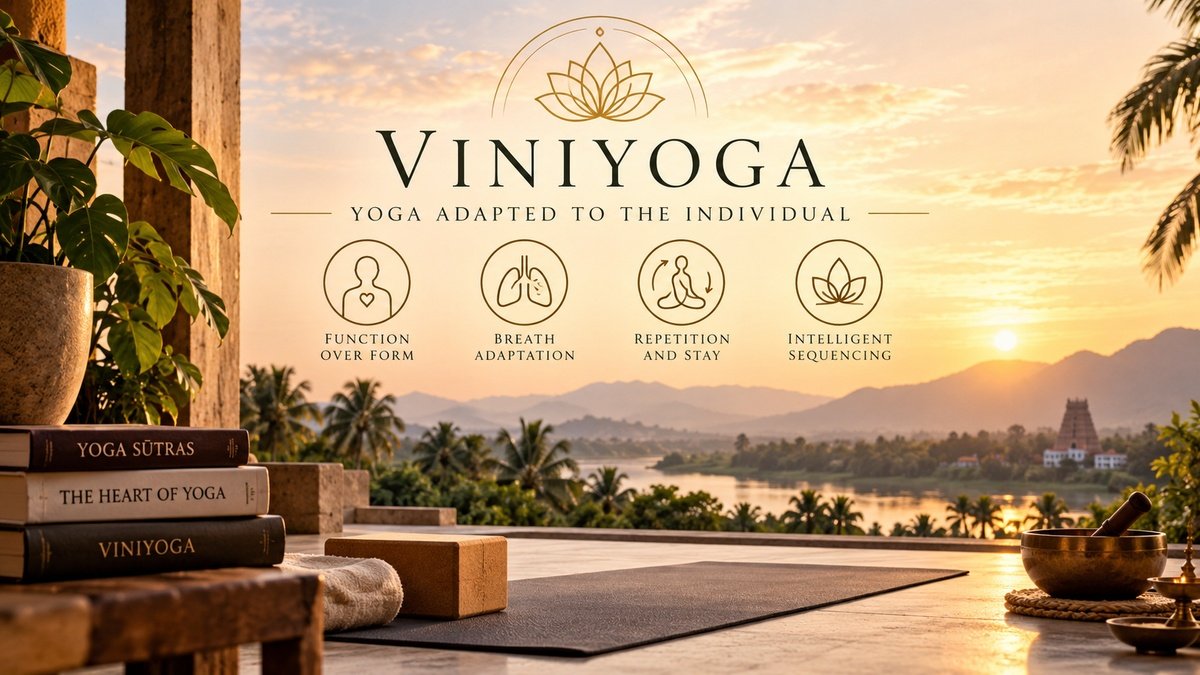
Viniyoga begins with a principle that can fundamentally change how we understand yoga practice: the practice should adapt to the person, rather than asking the person to conform to a predetermined practice.
That sounds straightforward. Yet it challenges several assumptions that have become familiar within modern yoga.
The most recognisable posture is not necessarily the most useful one. Two people do not necessarily need the same sequence. Repetition may sometimes serve a practitioner better than remaining still. Breath can influence how movement unfolds.
Age, experience, capacity, intention and changing circumstances can all shape what makes sense in practice.
For this reason, Viniyoga is less easily understood as a particular collection of postures than as an approach to applying yoga intelligently.
Its modern history is closely connected with T. Krishnamacharya and his son and long-term student T.K.V. Desikachar. Gary Kraftsow later became particularly influential in developing and transmitting Viniyoga in the United States.
So what is Viniyoga? Where did the term come from? How does it relate to Krishnamacharya and Desikachar? Why are breath, repetition and sequencing so important? And what does it actually mean to adapt yoga to an individual?
What Is Viniyoga?
Viniyoga is an adaptive approach to yoga in which teachers select and modify practices according to the needs, capacities, interests and circumstances of the practitioner.
Rather than defining the method through one fixed sequence, Viniyoga places considerable emphasis on how and why yoga is applied.
Āsana may change according to the individual. Movement often follows the rhythm of the breath. Practitioners may enter and leave a posture repeatedly before staying in it. Teachers can also change a sequence according to its purpose.
Practice may extend beyond āsana to include prāṇāyāma, meditation, chanting and philosophical study.
The American Viniyoga Institute identifies several characteristics within its approach: function over form, breath and adaptation, repetition and stay, and careful sequencing.
These principles help explain why we cannot identify Viniyoga simply by looking at one posture.
The same posture may look different from one practitioner to another. Even the same person may practise it differently as circumstances change.
What Does the Word Viniyoga Mean?
The Sanskrit term viniyoga carries meanings associated with application, employment or appropriate use.
Importantly, the word did not originate as the name of a twentieth-century yoga style.
It appears in older Sanskrit contexts, including Patañjali’s Yoga Sūtras. Yoga Sūtra III.6 contains the expression tasya bhūmiṣu viniyogaḥ, in a discussion concerning the application of practice in stages or appropriate contexts.
Teachers associated with Krishnamacharya’s lineage later used the term when discussing the appropriate application of yoga.
Consequently, the underlying idea is more nuanced than simply describing “a type of yoga called Viniyoga”.
It directs attention towards how yoga can be applied appropriately to a particular person and situation.
Who Developed Viniyoga?
Identifying one person as the inventor of Viniyoga would oversimplify its history.
The modern approach developed through a lineage of teaching most closely associated with T. Krishnamacharya and T.K.V. Desikachar.
Krishnamacharya became one of the most influential figures in twentieth-century yoga. During his long teaching career, his methods evolved considerably.
Rather than teaching every student identically, he increasingly adapted yoga according to the individual and the circumstances in which that person practised.
His son, T.K.V. Desikachar, studied closely with him for several decades and became an important transmitter of this adaptive approach.
Teachers who studied with Desikachar subsequently carried aspects of the methodology internationally.
Among them, Gary Kraftsow became particularly influential in North America. He continues to use Viniyoga as the name for the methodology taught through the American Viniyoga Institute.
Who Was T. Krishnamacharya?
Tirumalai Krishnamacharya was an Indian yoga teacher and scholar whose long career spanned much of the twentieth century.
His influence on modern yoga is substantial.
B.K.S. Iyengar, K. Pattabhi Jois, Indra Devi and his son T.K.V. Desikachar all studied with him. Yet they did not emerge teaching identical systems.
That difference tells us something important about Krishnamacharya’s work.
His teaching changed across different periods and contexts. The vigorous group practices associated with his years teaching young men in Mysore represent only one part of a much longer career.
Later, particularly during his years in Chennai, individual teaching became increasingly significant.
Krishnamacharya could take account of factors such as age, occupation, capacity and purpose when determining what and how someone should practise.
This adaptive dimension became especially important in Desikachar’s transmission of his father’s teaching.
Who Was T.K.V. Desikachar?
T.K.V. Desikachar was Krishnamacharya’s son and one of his longest-standing students.
Born in Mysore in 1938, Desikachar initially trained as an engineer. He later became increasingly interested in his father’s work and began studying yoga closely with him during the 1960s.
Their teacher-student relationship continued for nearly three decades, until Krishnamacharya’s death in 1989.
Desikachar became internationally known for an approach that placed the individual practitioner at the centre of teaching.
In 1976, he established the Krishnamacharya Yoga Mandiram in Chennai in honour of his father.
His influential book The Heart of Yoga later introduced many international readers to this understanding of yoga and to Krishnamacharya’s teaching.
Desikachar’s contribution did not centre on creating one standard sequence. Instead, he emphasised an approach in which teaching responds to the person receiving it.
Did Desikachar Call His Yoga Viniyoga?
This question requires some historical nuance.
The term Viniyoga became strongly associated internationally with Desikachar’s teaching and with teachers influenced by him.
However, Desikachar later moved away from using Viniyoga as the name of a particular yoga system. He preferred to speak more broadly about yoga and the appropriate application of its tools.
Descriptions such as “Desikachar invented Viniyoga” or “Krishnamacharya created the Viniyoga style” therefore simplify a more complicated history.
It is more useful to understand Viniyoga as a modern term associated with an adaptive methodology that emerged from this teaching lineage.
Some contemporary organisations continue to use the name. Others working within the wider Krishnamacharya–Desikachar tradition do not.
The principles can therefore extend beyond the label.
Who Is Gary Kraftsow?
Gary Kraftsow is an American yoga teacher who began studying with T.K.V. Desikachar in India in 1974.
He continued studying within the Krishnamacharya–Desikachar tradition and became an important transmitter of the approach in North America.
In 1999, Kraftsow founded the American Viniyoga Institute.
Through teacher education, yoga therapy training, books and other programmes, he developed a systematic presentation of Viniyoga for contemporary practitioners and professionals.
The American Viniyoga Institute continues to use the term explicitly. It describes an approach that adapts practice to the condition, needs and interests of individuals and groups.
This American expression represents one significant development within the wider Krishnamacharya–Desikachar teaching heritage rather than the only possible expression of it.
What Does “Function Over Form” Mean in Viniyoga?
Function over form is one of the clearest principles associated with contemporary Viniyoga.
In many forms of posture teaching, an āsana can appear to have one ideal shape. The practitioner then works towards reproducing that form as accurately as possible.
Viniyoga asks another question first:
What is this posture intended to do within this practice for this person?
Once the function becomes clear, the form can respond accordingly.
A practitioner might shorten a stance, keep a knee bent, alter an arm position or reduce the range of movement. Someone else might repeat the posture dynamically rather than remain in it.
At times, another posture may serve the intended function more appropriately.
None of this makes alignment irrelevant.
Instead, alignment serves the purpose and practitioner rather than operating as a single visual standard independent of context.
Why Is Breath Important in Viniyoga?
Breath plays a central organisational role in Viniyoga practice.
Practitioners frequently coordinate movement with inhalation and exhalation. The breath helps establish rhythm and can also influence the range and quality of movement.
For example, someone might enter a movement while inhaling and return while exhaling. Repeating that relationship several times can precede a longer stay in the posture.
Teachers can also adapt the breathing pattern itself.
Different practices may emphasise inhalation, exhalation, pauses or particular ratios according to their purpose. Prāṇāyāma can then become a distinct practice rather than merely an accompaniment to āsana.
Traditional yoga provides sophisticated frameworks for understanding breath and prāṇa. Contemporary physiology offers another language for discussing respiration.
Both can contribute to discussion, but we should not assume that they provide interchangeable explanations of the same concepts.
Why Does Viniyoga Repeat Postures?
One distinctive characteristic of many Viniyoga practices is the use of repetition.
Instead of entering an āsana and immediately remaining there, practitioners may move into and out of it several times with the breath. A static stay may follow.
Within the methodology, repetition can serve several purposes.
It can introduce movement progressively, provide opportunities to observe coordination and prepare for a subsequent stay or another posture.
This approach also challenges the assumption that an āsana exists only when the body becomes still.
In Viniyoga, moving into and out of a posture can form an intentional part of the āsana practice itself.
How Does Sequencing Work in Viniyoga?
Sequence is more than an attractive arrangement of postures.
Each element can prepare for, influence or respond to what surrounds it.
A teacher may therefore design a Viniyoga sequence around a particular intention, practitioner, available time and wider context.
Preparatory movements can make a later posture more accessible. Counterposes may follow where appropriate. Intensity can rise and fall deliberately. Prāṇāyāma may follow āsana, while meditation or another contemplative practice can complete the sequence.
Changing the order can change the experience.
Sequencing therefore becomes a form of reasoning rather than simply choreography.
Does Viniyoga Use Fixed Sequences?
Fixed sequences do not define Viniyoga.
A teacher may certainly repeat a sequence when repetition serves the practitioner. However, the method does not depend on one universal series that everyone progressively learns.
The sequence can change because the person changes. It may also change because the purpose changes.
A short morning practice may differ from a longer evening practice. Someone beginning yoga may need something different after several months of experience. A practice designed for one individual may not suit another.
Consistency therefore remains possible without requiring uniformity.
What Happens in a Viniyoga Class?
No single sequence identifies every Viniyoga class.
A group class may combine repeated movements with breathing, adapted āsanas, carefully constructed sequences, prāṇāyāma, meditation or chanting.
Because breath often determines the rhythm, the pace can appear measured.
However, measured does not necessarily mean physically easy.
The purpose and the people practising determine whether a particular practice feels gentle or demanding.
Individual teaching can look different again.
A teacher may explore the student’s circumstances and aims before developing a practice for that person to use independently.
In this context, personal practice becomes especially important.
Why Is Individual Teaching Important in Viniyoga?
One-to-one teaching has an important place within the Krishnamacharya–Desikachar tradition.
Working individually allows a teacher to respond more specifically to the practitioner.
Experience, capacity, available time, interests and purpose can all influence the practice instead of requiring the teacher to design around the average needs of a group.
The resulting sequence may become a personal practice that the student learns, repeats and develops over time.
This approach also changes the teacher’s role.
The aim is not necessarily to keep someone permanently dependent on teacher-led classes. Instead, teaching can give practitioners tools that they gradually understand and use for themselves.
Is Viniyoga the Same as Yoga Therapy?
No. Viniyoga and yoga therapy are not interchangeable terms.
The adaptive principles associated with Viniyoga have influenced modern yoga therapy. Organisations such as the American Viniyoga Institute also provide specialist training in this area.
However, a general yoga class can use Viniyoga principles without becoming clinical or therapeutic treatment.
Similarly, adapting a posture to someone’s comfort or movement capacity forms part of responsible yoga teaching. Adaptation alone does not turn a yoga session into healthcare.
Applying yoga specifically to diagnosed health conditions, rehabilitation or therapeutic management introduces additional questions of training, competence and professional scope.
For general yoga practice, the underlying principle is simpler: teach the person who is present rather than an imagined ideal practitioner.
Is Viniyoga Gentle Yoga?
Not necessarily.
Its association with adaptation, individual teaching and therapeutic applications sometimes leads people to describe Viniyoga as inherently gentle.
That description misses the central principle.
If practice adapts to the practitioner, intensity can adapt as well.
One person may benefit from a quiet and highly supported practice. Another may explore substantial strength, mobility and physical effort.
The defining question is not whether the practice looks gentle.
Instead, Viniyoga asks whether the practice is appropriate for its purpose, practitioner and context.
Is Viniyoga the Same as Restorative Yoga?
No. Both approaches can involve adaptation, but they use adaptation in different ways.
Restorative Yoga generally uses substantial external support to allow positions to remain comfortable with minimal unnecessary effort.
Viniyoga offers a broader methodology for adapting yoga practice.
Its practices may contain active movement, repeated āsanas, strength, prāṇāyāma, meditation and other techniques. They do not need to be passive or predominantly supported.
The overlap lies in responsiveness to the practitioner, not in identical methods.
How Is Viniyoga Different from Iyengar Yoga?
Both traditions developed from Krishnamacharya’s teaching, yet they demonstrate how differently that inheritance could evolve.
Iyengar Yoga became particularly known for detailed work with alignment, progressive study of āsana and prāṇāyāma, and sophisticated use of props.
Viniyoga places particularly explicit emphasis on adapting form according to function, coordinating movement with breath, using repetition alongside static stays, and designing sequences around the individual.
However, this does not mean Iyengar Yoga never adapts or Viniyoga ignores alignment.
Those would be false oppositions.
The distinction concerns emphasis and methodology rather than an absolute division.
How Is Viniyoga Different from Ashtanga Yoga?
The contrast becomes particularly visible in sequencing.
Modern Ashtanga Yoga organises practice around established series that practitioners progressively learn.
Viniyoga does not begin with one predetermined series. Instead, teachers can construct sequences around the person and purpose.
Both approaches nevertheless value breathing, repetition and disciplined practice.
The difference lies partly in where adaptation occurs.
In Ashtanga, practitioners work within a recognisable sequence that teachers can modify or introduce progressively. In Viniyoga, designing or changing the sequence according to the practitioner forms a fundamental part of the methodology.
Is Viniyoga Suitable for Beginners?
Its principles can work particularly well for beginners because the practice does not assume that everyone arrives with the same capacity or experience.
Teachers can introduce movements progressively and coordinate them with breathing. Repetition also gives practitioners opportunities to become familiar with an action before remaining in a posture.
However, Viniyoga should not become shorthand for “easy yoga for beginners”.
The methodology can support people across different levels of experience.
What changes is not necessarily the seriousness of the practice, but how teachers select and apply its tools.
Can Older Adults Practise Viniyoga?
The methodology does not require a particular age or body type.
Indeed, adaptation sits at the centre of the approach.
Yet age alone cannot tell a teacher what someone can or cannot do.
Two people of the same age may have very different levels of experience, mobility, strength, health circumstances and personal preferences.
An individual approach therefore avoids replacing one stereotype with another.
The useful question remains: what form of practice is appropriate for this particular person?
Does Viniyoga Include Meditation and Philosophy?
Yes. Reducing Viniyoga to adaptive āsana would substantially narrow the tradition from which it emerged.
Krishnamacharya and Desikachar understood yoga as a much broader discipline incorporating prāṇāyāma, meditation, chanting, philosophical study and other practices.
Patañjali’s Yoga Sūtras became particularly important within Desikachar’s teaching.
Selecting a practice can therefore involve more than deciding which physical posture suits an individual.
The broader question becomes: which yogic tools serve the purpose of this practice?
What Are the Potential Benefits of Viniyoga?
The adaptive nature of Viniyoga can make yoga practice accessible across a wide range of circumstances.
Movement, breathing, attention and meditation may each contribute differently to an individual’s experience.
Researchers have also studied yoga programmes informed by Viniyoga principles in specific health contexts. However, results from defined research programmes should not become broad claims that Viniyoga treats medical or psychological conditions.
Research interventions involve particular populations, methods and outcomes. General yoga teaching and clinical yoga therapy are not the same activity.
Perhaps the clearest strength of the Viniyoga principle is methodological rather than medical.
It encourages teachers and practitioners to consider the individual instead of assuming that one practice is universally appropriate.
A Common Misunderstanding: Adaptation Is Not a Lesser Version of the Pose
Modern yoga imagery can make adaptation look like compromise.
We see the “full pose”, followed by modifications for people who cannot yet perform it.
Viniyoga offers another way of thinking.
If function comes before form, there may not be one universally correct external expression against which every adaptation should be judged.
A changed stance, smaller movement or different arm position may not simply prepare someone for the “real” posture.
It may already be the appropriate posture for that practitioner and purpose.
This distinction is substantial.
Adaptation stops being evidence of what someone cannot do and becomes part of the intelligence through which practice is designed.
An Orenna Perspective: Begin with the Person
There is something quietly significant about beginning with the practitioner rather than the posture.
Modern yoga can easily organise itself around external forms: this is the pose, this is the sequence, this is how long it should be held, and this is what comes next.
Viniyoga changes the direction of the enquiry.
Who is practising? Why are they practising? What is appropriate today?
From there, another set of questions becomes possible. What should remain? What could change? What needs to be removed? What might be introduced?
The answers need not remain fixed because the practitioner does not remain fixed.
Capacity changes. Experience develops. Circumstances shift. Even the same person arriving on another day may need a different relationship with practice.
This does not make yoga arbitrary. Instead, it makes observation part of the method.
A practice can retain its principles without demanding that every person take the same shape.
References & Further Reading
American Viniyoga Institute. What Is Viniyoga? The Institute describes function over form, breath and adaptation, repetition and stay, and sequencing as distinguishing characteristics of its Viniyoga methodology. Explore Viniyoga.
American Viniyoga Institute. About. The Institute describes its adaptive approach and traces its teaching through Gary Kraftsow to T.K.V. Desikachar and T. Krishnamacharya. Explore the Institute.
Desikachar, T.K.V. (1995). The Heart of Yoga: Developing a Personal Practice. Inner Traditions. An influential English-language presentation of Desikachar’s teaching and his understanding of Krishnamacharya’s approach.
Kraftsow, Gary. (1999). Yoga for Wellness: Healing with the Timeless Teachings of Viniyoga. Penguin/Arkana.
Kraftsow, Gary. (2002). Yoga for Transformation: Ancient Teachings and Holistic Practices for Healing Body, Mind, and Heart. Penguin Compass.
Singleton, Mark & Goldberg, Ellen, eds. (2014). Gurus of Modern Yoga. Oxford University Press. Provides wider scholarly context for modern yoga lineages and the transmission of twentieth-century yoga.



