


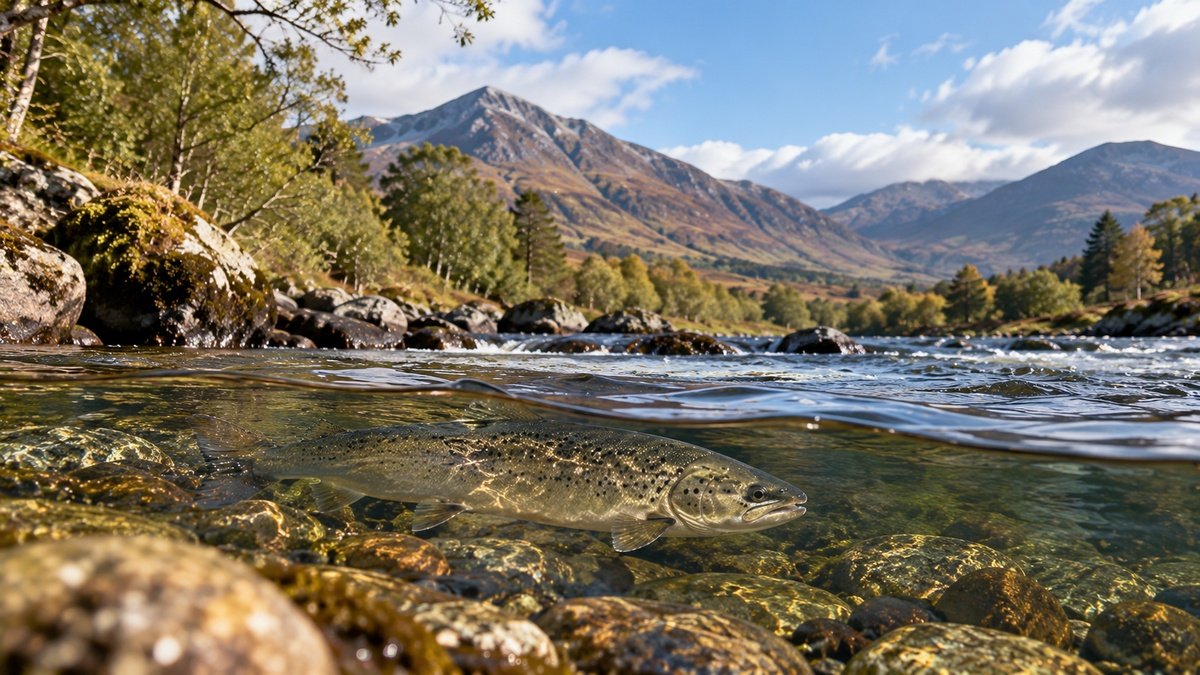
Atlantic salmon in Scotland connect landscapes that can appear, from our perspective, to be far apart. A fish beginning life in a Highland stream may eventually leave freshwater, enter the Atlantic Ocean and later return towards the river system from which its journey began.
Few animals reveal the connections between river and ocean quite so clearly.
For Atlantic salmon, a river is not simply somewhere to live. It can be a nursery, a migration route and, eventually, a place to reproduce.
The sea forms another essential part of the same life cycle. There, salmon feed and grow before some return towards freshwater.
Understanding the species therefore requires us to follow a much larger landscape:
stream → river → estuary → ocean → estuary → river → spawning habitat
Seen in this way, a salmon moving through a Highland river carries a story that extends far beyond its banks.
Atlantic Salmon in Scotland
The Atlantic salmon, Salmo salar, occurs naturally across rivers connected with the North Atlantic.
Scotland supports many distinct salmon populations. Although people commonly speak about Scottish salmon collectively, fish returning to different rivers — and sometimes different parts of the same river system — can form genetically differentiated populations.
This local connection matters.
Adult salmon show a strong tendency to return towards their natal waters when they reproduce. As a result, what happens within an individual river system can matter to the salmon population associated with it.
At the same time, these fish spend an important part of their lives beyond Scotland’s rivers.
Their conservation therefore cannot stop where freshwater reaches the sea.
A Life Between Freshwater and the Ocean
Atlantic salmon are described as anadromous.
The term describes fish that begin life in freshwater, migrate to the marine environment and later return to freshwater to reproduce.
That movement exposes salmon to remarkably different conditions during a single life cycle.
Young fish must develop within streams and rivers. Later, they undergo physiological changes that prepare them for seawater. At sea, they encounter a much larger marine ecosystem before returning adults attempt another transition from salt water into freshwater.
Consequently, the Atlantic salmon is neither simply a freshwater fish nor simply an ocean fish.
Its life depends upon both environments and upon the connections between them.
From Egg to Ocean — The Atlantic Salmon Life Cycle
The salmon life cycle contains a series of stages, each associated with different requirements.
Egg → Alevin → Fry → Parr → Smolt → Adult at sea → Returning adult → Spawning
Adult salmon generally spawn in flowing freshwater, often where suitable gravel provides conditions for their eggs.
After hatching, the young fish initially remain associated with the gravel. At this stage they are known as alevins and continue to obtain nourishment from an attached yolk sac.
Once they emerge and begin feeding independently, they enter the fry stage. As they grow and develop characteristic markings, they become known as parr.
Juvenile salmon may spend several years within freshwater before another remarkable transformation begins.
Becoming a Smolt
A young salmon cannot simply leave a river and begin living in seawater without physiological preparation.
During a process known as smoltification, the fish undergoes changes that prepare its body for migration and life in the marine environment.
The resulting young fish is called a smolt.
Smolts migrate downstream, moving from their freshwater nursery towards estuaries and eventually the sea.
This transition illustrates something fundamental about the Atlantic salmon life cycle.
Migration is not simply movement from one geographical location to another. The animal itself must change as the environment changes around it.
The Journey Into the Atlantic
After entering the marine environment, salmon may travel considerable distances while feeding and growing.
The Scottish Government notes that salmon can spend between one and three years at sea before returning to freshwater, although individual life histories vary.
This marine stage changes the geographical scale of the animal’s story.
A fish associated with one Scottish river can spend part of its life within the much larger North Atlantic ecosystem. Food availability, temperature, predators, parasites, fisheries and changing marine conditions can therefore influence whether that salmon eventually returns.
By the time an adult salmon reappears in a Highland river, its life has connected local freshwater habitat with processes occurring far beyond Scotland.
How Does a Salmon Find Its Way Home?
One of the most remarkable features of Atlantic salmon biology is natal homing.
Returning adults can navigate towards the river associated with their early life with considerable accuracy.
The process is complex. Salmon can use several forms of environmental information during migration, while their sense of smell plays an important role as they identify familiar chemical characteristics associated with freshwater.
However, natal homing should not be turned into the idea that every salmon inevitably returns to one exact stone or pool.
Some fish stray into other river systems. That variation can have ecological and evolutionary significance because movement between populations can contribute to gene flow and may help salmon colonise accessible habitat.
Nature is often more interesting than the simplified version of the story.
A Common Misunderstanding: Salmon Simply Live in Rivers
Rivers dominate many familiar images of Atlantic salmon.
We see fish moving through rapids, resting in pools or attempting to pass waterfalls. As a result, it is easy to think of salmon primarily as river animals.
Yet the marine stage is fundamental to their life cycle.
Conditions encountered at sea can influence survival and the number of adults that eventually return to Scotland.
Likewise, a salmon surviving its marine migration still needs suitable freshwater conditions when it returns.
Protecting Atlantic salmon in Scotland therefore requires a source-to-sea perspective rather than treating rivers, estuaries, coastlines and oceans as unrelated environments.
Atlantic Salmon and Sea Trout Are Not the Same Fish
Another distinction is useful when exploring Scotland’s migratory fish.
Atlantic salmon belong to the species Salmo salar.
Brown trout belong to Salmo trutta. Some brown trout remain within freshwater, while others migrate to sea and return. Those migratory individuals are commonly known as sea trout.
A sea trout is therefore not an Atlantic salmon, nor is it a completely separate species from a brown trout.
The comparison reveals how different life strategies can exist even among closely related fish.
Once again, movement between freshwater and sea complicates the categories we use to describe wildlife.
A River Is More Than Water
A river suitable for salmon requires more than the presence of flowing water.
Different stages of the life cycle use different physical conditions. Spawning adults need access to suitable habitat, while eggs develop within the riverbed. Juveniles require places where they can feed and find shelter, and migrating fish need routes that allow movement upstream and downstream.
Water quality matters too. Atlantic salmon require clean, well-oxygenated water, while pollution and excessive fine sediment can damage freshwater habitat.
Flow is equally important. Too little water can reduce available habitat and restrict migration, whereas extreme high flows can also alter conditions for fish.
Consequently, the health of a salmon river depends upon processes occurring throughout its catchment.
Why the Land Beside a River Matters
The vegetation surrounding a river can influence conditions within it.
Riparian woodland — trees and other vegetation growing beside waterways — can provide shade, contribute organic material and influence bank structure. Tree roots can also create physical complexity and places of shelter within suitable settings.
Shade has become particularly important in discussions about climate change because Atlantic salmon are adapted to relatively cool water.
However, the principle should not be simplified into the idea that planting as many trees as possible beside every river will automatically create ideal salmon habitat.
River restoration depends upon local ecology, existing habitats, land use and the characteristics of the catchment.
The right intervention depends upon the place.
From Peatlands to Rivers
Water reaching a Highland river has already travelled through a wider landscape.
Rain falls across hills, woodland, grassland and wetlands before moving through soils, burns and tributaries towards larger rivers.
Our article on Highland peatlands explored how water, vegetation and accumulated peat interact across extensive areas of northern Scotland.
Healthy peatlands can form part of functioning catchments, while damaged peat can contribute to wider changes in water movement and water quality.
NatureScot includes peatland restoration among the landscape-scale actions that can contribute to the recovery of salmon habitat in appropriate catchments.
Still, not every peatland affects every salmon river in the same way.
The broader lesson is more useful: what happens upstream can influence conditions downstream.
When a Barrier Interrupts a Migration
Migration depends upon connection.
Dams, weirs, culverts and other structures can obstruct the routes salmon use as they move through river systems.
Some barriers completely prevent passage. Others make migration more difficult, delay fish or require additional energy to negotiate.
That distinction matters because a river can appear physically continuous on a map while functioning very differently for a migrating fish.
Removing unnecessary barriers or improving fish passage can reconnect previously inaccessible habitat.
NatureScot reports that barrier-removal work between 2021 and 2024 opened approximately 1,400 kilometres of additional catchment in Scotland.
For a migratory species, connectivity is not an abstract conservation principle. It is part of completing the life cycle.
Atlantic Salmon in Scotland Are Under Pressure
The conservation story of Atlantic salmon in Scotland is increasingly serious.
NatureScot reports a long-term decline in the estimated number of salmon returning to Scottish rivers. The Scottish Government’s 2026 assessment also found widespread concerns among the individual salmon stocks it monitors.
However, national figures require careful interpretation.
For the proposed 2027 angling season, 123 of the 173 assessed stocks were classified as being in poor conservation status. That means around 71% of the assessed stocks, not 71% of all individual salmon.
Scotland’s larger east-coast rivers contain a substantial proportion of the country’s salmon. Consequently, the relatively small number of stocks assessed as being in good conservation status are estimated to contain most individual Scottish salmon.
Nevertheless, the longer-term direction remains concerning. The number of stocks assessed as good has fallen substantially since the current conservation assessment system began, while declines have been detected across many parts of Scotland.
The picture is therefore neither uniform nor reassuringly simple.
There Is No Single Cause
Searching for one explanation for salmon decline can obscure the complexity of the problem.
The Scottish Wild Salmon Strategy identifies pressures across freshwater, estuarine, coastal and marine environments.
These include water quality and quantity, rising river temperatures, physical barriers, changes to river and riparian habitat, exploitation, disease and parasites, predation, invasive species, marine development and conditions affecting survival at sea.
Interactions with aquaculture are also relevant in areas where wild and farmed salmon environments overlap, including concerns associated with sea lice and escaped farmed fish.
Importantly, these pressures do not necessarily operate independently. One pressure can alter how strongly another affects a population.
Climate change adds another layer because changing temperatures, rainfall, drought and marine conditions can influence several stages of the salmon life cycle.
Effective conservation therefore requires more than identifying one convenient cause.
Predators Are Part of the Ecosystem Too
Salmon are prey as well as predators.
At different stages of their lives, they may be eaten by other fish, birds and mammals. The otters in Scotland explored in our previous Journal article are among the animals that can feed on fish, including salmon.
Predation can influence salmon survival and is included among the pressures considered by fisheries managers.
However, describing predation as a pressure does not make predators ecological villains.
Predator-prey relationships are normal parts of functioning ecosystems. Their effects can also change where human activity has altered habitat, migration routes, population sizes or the places where predators and prey encounter one another.
Understanding those relationships requires evidence and context rather than assigning blame to another species.
Climate Change and a Cold-Water Fish
Atlantic salmon are adapted to cool water.
As the climate changes, river temperature has become an important concern for salmon conservation in Scotland.
Hotter conditions can expose fish to temperatures that create physiological stress. At the same time, changes in rainfall can produce both periods of low flow and episodes of unusually high water.
Drought can restrict migration and reduce available habitat. Conversely, extreme flows can alter river conditions in different ways.
Our exploration of Highland weather considered weather as part of the landscape rather than something happening separately from it.
For salmon, that relationship becomes particularly tangible. Rainfall and temperature can influence the water through which the fish must move.
Salmon and Highland Culture
Atlantic salmon have occupied more than an ecological role in Scotland.
They have long been connected with food, fisheries, employment, angling, estates, rural economies, stories and cultural identity.
That history means salmon conservation involves relationships between people as well as relationships between species and habitats.
Different communities may encounter salmon through fisheries management, conservation work, research, recreation, tourism or simply through living beside a river.
Contemporary management also changes as evidence changes. Scotland assesses salmon stocks annually and uses those assessments to inform conservation measures, including whether caught fish may be retained in particular areas.
Therefore, the human relationship with salmon continues to evolve alongside the ecological one.
You Do Not Need to Follow the Whole Migration
The scale of the salmon’s journey can make its story sound accessible only to people able to explore remote rivers.
It is not.
Rivers pass through towns and settlements as well as remote landscapes. Depending on the location, people may encounter salmon habitats from accessible riverside paths, bridges, established viewpoints, visitor facilities or interpretation sites.
Research projects, conservation organisations, films and monitoring technologies can offer other ways to understand the migration without requiring direct physical access to a river.
Mobility, health, balance, sensory preferences, transport, weather, work, caring responsibilities and available time can all influence how someone engages with the Highland landscape.
A physically demanding journey does not create a more legitimate understanding of nature.
Understanding a migration does not require following every mile of it.
Watching Salmon Responsibly
In some places and seasons, people may have opportunities to watch salmon moving through rivers.
Established paths, bridges and recognised viewing locations can allow observation without entering the water or interfering with fish.
River conditions can change rapidly, particularly after rainfall. Therefore, personal safety and local access guidance should take priority over obtaining a closer view.
Likewise, spawning areas and other sensitive habitat should be treated carefully rather than approached simply to obtain photographs.
A wildlife encounter does not become more valuable because the observer moved closer.
Sometimes the most responsible form of attention happens from the riverbank.
The Great Glen — Water as a Route
The Highlands repeatedly show us that water can be both habitat and route.
Our article on the Great Glen explored a landscape shaped by geology, glaciation, lochs and centuries of human movement.
Salmon invite us to consider movement on another scale.
A river is not simply water passing through a landscape. For migratory fish, it can provide a pathway connecting habitats required at different stages of life.
A blocked pathway changes what lies upstream. A degraded estuary can affect the transition between river and sea. Conditions in the ocean may determine how many adults eventually return.
Each part belongs to a larger system.
The Orenna Perspective — A River Is Part of Something Larger
Standing beside a Highland river can make the landscape feel intensely local.
Water moves between two banks. Stones lie beneath the surface. Trees, grasses and other vegetation follow its edges.
Then a salmon changes the scale.
The fish moving through that water may have begun life farther upstream, travelled through an estuary and crossed into the North Atlantic before returning towards freshwater.
Suddenly, the river is not simply a place.
It is a route.
That route also connects processes we may otherwise consider separately: rainfall over hills, vegetation beside streams, gravel beneath water, barriers across rivers, changing ocean conditions and decisions made by people.
The story of Atlantic salmon in Scotland therefore asks us to look beyond the animal itself.
Like the Highland lochs, peatlands, forests and wildlife explored elsewhere in The Orenna Journal, the salmon becomes another way of seeing connection within the landscape.
No single stretch of river tells the entire story.
Sometimes understanding one place means following the connections that lead far beyond it.
References & Further Reading
NatureScot. Atlantic Salmon. An introduction to Atlantic salmon biology, distribution and life cycle in Scotland.
NatureScot. Scotland’s Changing Nature — Atlantic Salmon. Current information on salmon decline, habitat, climate pressures and source-to-sea conservation.
Scottish Government. The Status of Salmon in Scotland: 2026. The Marine Directorate’s current assessment of wild Atlantic salmon stocks in Scotland.
Scottish Government. Scottish Wild Salmon Strategy. Scotland’s framework for understanding and responding to pressures affecting wild Atlantic salmon.
North Atlantic Salmon Conservation Organization. Pressures Facing Salmon. An international overview of pressures affecting Atlantic salmon throughout their range.
The Orenna Journal explores yoga, well-being, philosophy and place from historical, evidence-informed and contemporary perspectives. Salmon populations, conservation assessments and fisheries regulations can change over time and differ between rivers. This article provides a general introduction to Atlantic salmon in Scotland rather than fishing, fisheries-management or site-specific ecological advice.



