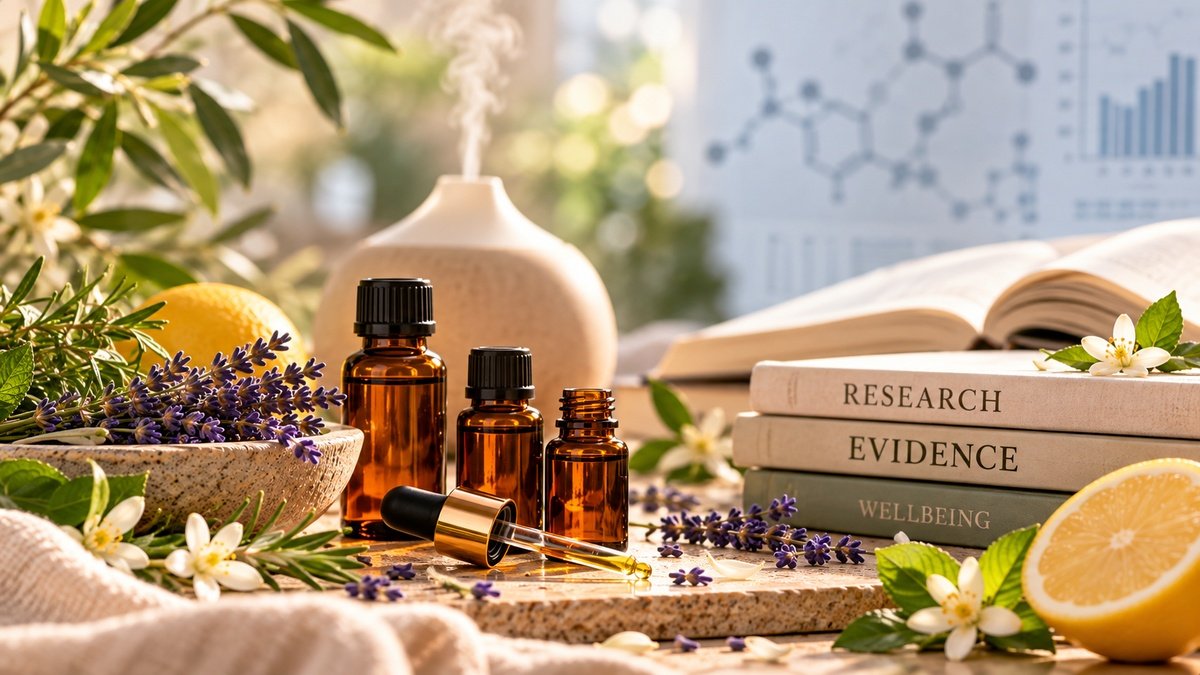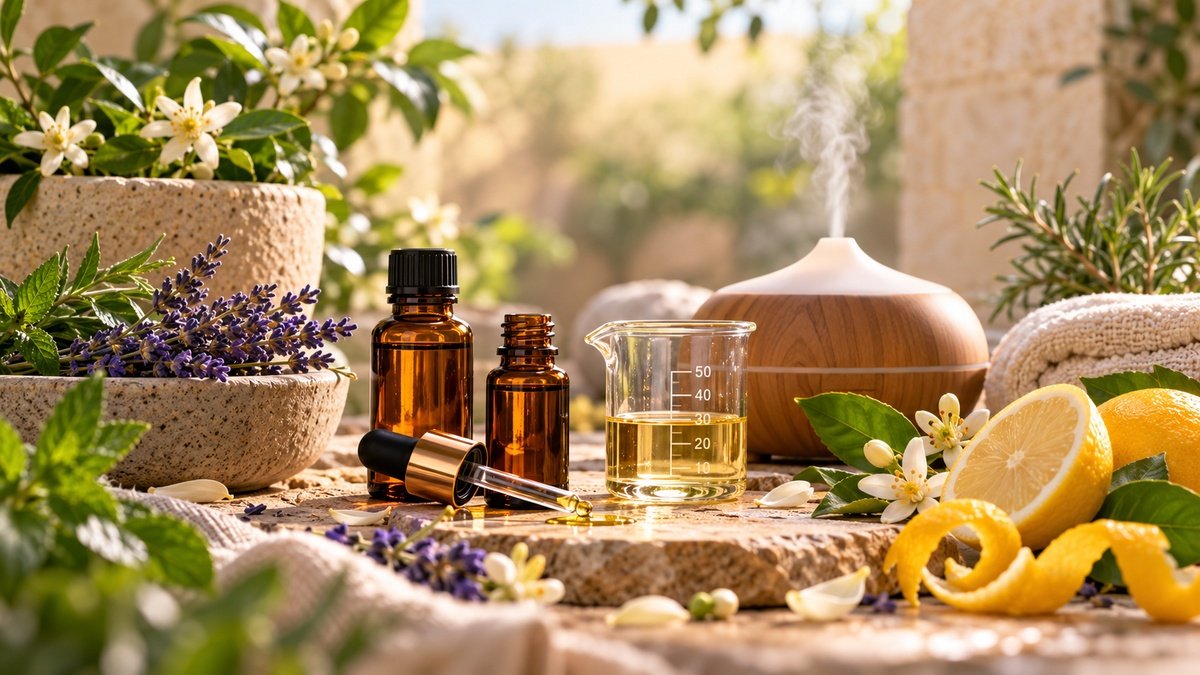

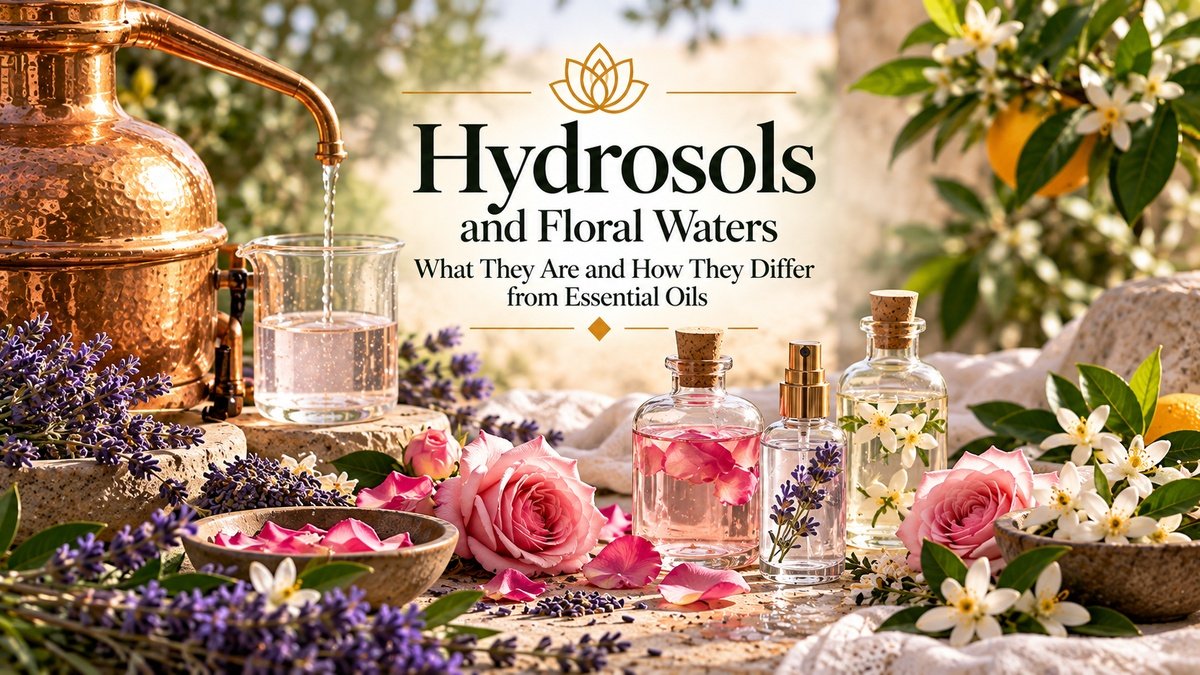
Rose water may smell unmistakably of roses. Lavender hydrosol carries the aromatic character of lavender. Orange blossom water can transform the scent of a room, a cosmetic preparation or a culinary dish.
It is easy, therefore, to imagine these fragrant waters as very weak versions of essential oils.
They are not.
Hydrosols are aromatic water-based products obtained during the distillation of botanical material. They share a botanical origin with essential oils, but their composition, concentration, behaviour and storage requirements are different.
Some are delicate and floral. Others smell green, earthy, herbal or surprisingly unlike the essential oil produced from the same plant.
They also have a history extending beyond the contemporary aromatherapy bottle.
Rose water and orange blossom water, for example, belong to longstanding traditions of perfumery, food preparation, cosmetics and personal care.
So what exactly is a hydrosol — and when is a “floral water” actually something else?
What Are Hydrosols?
A hydrosol is an aromatic aqueous product of botanical distillation.
You may also encounter terms such as hydrolat, hydrolate, aromatic water, floral water or flower water.
These terms are sometimes used interchangeably in retail settings, although they do not always guarantee that manufacturers have produced the products in the same way.
A genuine distilled hydrosol contains water-soluble volatile compounds and small amounts of other aromatic material carried into the aqueous phase during distillation.
That gives it a recognisable botanical aroma.
However, the chemistry of the hydrosol does not simply reproduce the corresponding essential oil at a lower concentration.
Water changes what remains in the product.
How Are Hydrosols Made?
To understand hydrosols, it helps to return to distillation.
As we explored in our article on essential oils, steam or water-based distillation encourages volatile compounds within aromatic plant material to evaporate.
The vapours travel through the distillation apparatus and enter a condenser.
Cooling converts them back into liquid.
That condensed liquid contains water together with aromatic plant constituents.
Where a plant produces a sufficient quantity of essential oil, much of the oil separates from the aqueous phase because essential oils do not dissolve freely in water.
The producer can collect that oily phase as essential oil.
The aromatic water beneath it is the hydrosol.
Two materials can therefore emerge from the same distillation.
They share an origin but are not chemically identical.
Are Hydrosols Just a By-product of Essential Oils?
Sometimes people describe a hydrosol as the “waste water” or secondary by-product left after essential-oil production.
That description is too simplistic.
In some commercial distillation systems, essential oil may indeed be the principal product and the aromatic water a secondary output.
However, producers can also distil botanical material specifically to create a high-quality hydrosol.
In those circumstances, the hydrosol is not an accidental leftover.
It is the intended product.
The producer may adjust the ratio of plant material to water, distillation duration, collection fractions and other variables according to the aromatic water they want to obtain.
This is one reason two products carrying the same botanical name can differ noticeably in aroma and composition.
Hydrosol vs Essential Oil: What Is the Difference?
The most obvious difference is the medium.
An essential oil is a concentrated, predominantly lipophilic mixture of volatile botanical compounds.
A hydrosol is overwhelmingly water.
That difference affects which plant constituents remain within each product.
Some aromatic compounds have greater affinity for the oil phase. Others have greater water solubility and appear proportionally more strongly within the hydrosol.
As a result, a hydrosol is not chemically equivalent to taking the corresponding essential oil and adding a large quantity of water.
The two products can have different constituent profiles.
They can also smell different.
Why Can a Hydrosol Smell Different from Its Essential Oil?
Anyone expecting a hydrosol to smell exactly like its corresponding essential oil may be surprised.
Lavender hydrosol, for example, does not necessarily smell like a diluted bottle of lavender essential oil.
The distillation process distributes aromatic compounds differently between the oil and water phases.
Consequently, the relative proportions reaching the nose change.
A hydrosol may smell softer, greener, more herbaceous or less conventionally perfumed than expected.
Freshly distilled products can also change as they settle and mature after production.
The difference does not necessarily indicate poor quality.
It can simply reflect the chemistry of the material.
Does a Hydrosol Contain Essential Oil?
Very small quantities of dispersed essential-oil components may remain within a hydrosol.
However, describing the product simply as “essential oil in water” remains misleading.
Hydrosols contain volatile constituents that have partitioned into the aqueous distillate, including compounds with greater water solubility.
The resulting chemical balance differs from the separated essential oil.
This distinction matters whenever we discuss aroma, formulation or safety.
One product cannot automatically substitute for the other merely because both came from the same plant.
What Does “Floral Water” Mean?
This is where terminology becomes less tidy.
Floral water sounds as though it should mean water distilled directly from flowers.
Sometimes it does.
Rose water and orange blossom water are obvious examples.
However, the commercial term floral water can also appear on products made through other methods.
A manufacturer might formulate an aromatic water using essential oils, fragrance materials, solubilisers, preservatives or other ingredients.
That product may still be marketed as a floral water.
Therefore, the words on the front of the bottle do not necessarily tell us how the product was produced.
The ingredient list and manufacturer information matter.
Hydrosol, Hydrolat, Flower Water or Aromatic Water?
Different traditions and industries favour different terminology.
Hydrosol has become common within contemporary aromatherapy and botanical distillation.
Hydrolat or hydrolate also appears, particularly within European contexts.
Flower water and floral water are familiar consumer terms, especially for products such as rose and orange blossom water.
Aromatic water is broader and can describe fragrant aqueous preparations.
None of these words should replace reading the actual product information.
When provenance matters, the more useful questions are: Which plant was used? Which part? Was it distilled? Is anything else added?
Rose Water: One of the Most Familiar Aromatic Waters
Rose water is probably the best-known floral water in the world.
Its history reaches across perfumery, culinary traditions, cosmetics, hospitality and personal care.
Roses have been cultivated for their fragrance across parts of the Middle East, Central and South Asia, North Africa and Europe, with aromatic products moving between regions through trade and cultural exchange.
Distillation made fragrant rose water particularly significant.
Today, rose water still appears in foods and drinks, cosmetic formulations, religious and cultural practices, and contemporary well-being products.
Yet products labelled rose water can differ substantially.
A traditionally distilled rose hydrosol is not necessarily identical to water formulated with rose aroma or other ingredients.
Orange Blossom Water
Orange blossom water offers another important example.
It is traditionally associated with the fragrant blossoms of bitter orange, Citrus aurantium.
The flowers can yield neroli essential oil through distillation while the aqueous distillate becomes orange blossom water.
Its distinctive aroma has long found a place in culinary traditions, particularly around the Mediterranean, Middle East and North Africa.
It also appears in perfumery, cosmetics and personal care.
Once again, the aromatic water and the essential oil share botanical material but remain different products.
Neroli essential oil is not simply concentrated orange blossom water.
Lavender Hydrosol
Lavender hydrosol has become familiar within modern aromatherapy and natural skin-care markets.
It usually comes from the distillation of lavender plant material, often alongside lavender essential oil.
Its aroma can be noticeably more herbaceous than consumers expect from conventional lavender fragrance.
Like other hydrosols, its exact character depends on botanical identity, growing conditions, distillation and storage.
The word lavender alone is not always sufficiently precise.
Identifying the species — such as Lavandula angustifolia — gives us more useful information about the source material.
Are Hydrosols Always Made from Flowers?
No.
The term floral water can create that impression, but aromatic distillates can come from many plant parts.
Depending on the botanical species, producers may distil leaves, needles, flowering tops, herbs, woods or other aromatic materials.
Peppermint, rosemary and various coniferous plants can all produce aromatic waters.
For this reason, hydrosol is often the more useful general term.
It describes the distilled aqueous product without implying that flowers must have been involved.
Are Hydrosols More Dilute Than Essential Oils?
In terms of volatile aromatic concentration, hydrosols generally contain far less aromatic material than essential oils.
That makes them very different products in practical use.
However, “more dilute” can still encourage the wrong mental model.
Imagine taking lavender essential oil and repeatedly adding water until almost nothing remains.
That would not recreate genuine lavender hydrosol.
The distillation process itself determines which constituents move into the aqueous phase.
It is more accurate to describe hydrosols as distinct aromatic distillates with a water-based chemical profile.
Does “Gentler” Mean Completely Safe?
No botanical product becomes universally safe simply because it is less concentrated.
Hydrosols generally expose a person to substantially lower concentrations of volatile compounds than neat essential oils.
That can make them useful where a lighter aromatic experience is desired.
Nevertheless, botanical identity, product quality, route of use, individual sensitivity and contamination still matter.
A person may also dislike or react poorly to a particular fragrance even when the product is correctly manufactured.
Lower concentration should therefore encourage proportionate thinking, not the assumption that precautions no longer apply.
Why Water Changes the Safety Question
Water creates a challenge that essential oils themselves largely avoid: it can support microbial growth.
Bacteria, yeasts and moulds require suitable environmental conditions, and an aqueous botanical product can become vulnerable if manufacturing, packaging or storage allows contamination.
This makes microbiological quality particularly important for hydrosols.
A product may smell botanical and appear perfectly natural while still requiring careful hygienic production and storage.
The idea that a natural product should remain unpreserved indefinitely can therefore conflict with basic microbiology.
Do Hydrosols Need Preservatives?
There is no universal answer for every commercial product.
Some producers sell carefully distilled and packaged hydrosols without added preservatives, using controlled manufacturing, appropriate packaging and defined storage and shelf-life recommendations.
Other formulations include preservatives to improve microbiological stability.
Products formulated from hydrosols together with other aqueous ingredients may present different preservation requirements again.
Preservatives should not automatically be treated as evidence of poor quality.
In water-based cosmetics, appropriate preservation can serve an important safety function.
The formulation needs to be considered as a whole.
How Long Do Hydrosols Last?
Hydrosols generally demand more attention to shelf life than many essential oils because they are water-based and microbiologically vulnerable.
There is no reliable universal expiry period for every hydrosol.
Botanical material, distillation hygiene, packaging, preservation, storage conditions and handling can all influence stability.
Manufacturer guidance therefore matters.
A bottle should also carry enough information to allow sensible traceability, such as batch or production details where appropriate.
If a product changes unexpectedly in smell, appearance or clarity, it should not simply be assumed that “natural products vary”.
Unexpected change can justify discontinuing use and checking with the supplier.
Should Hydrosols Be Refrigerated?
Recommendations vary between products and manufacturers.
Cool storage away from heat and direct sunlight generally helps protect aromatic botanical products.
Some producers recommend refrigeration for particular hydrosols, especially after opening.
Others specify a cool storage environment rather than refrigeration.
Following the supplier’s storage instructions is more reliable than applying one rule to every aromatic water.
Clean handling matters too.
Repeatedly opening a container, touching dispensing components or transferring the product into poorly cleaned bottles can introduce contamination.
Can You Make a Hydrosol by Adding Essential Oil to Water?
No.
Adding essential oil to water creates a different preparation.
Essential oils do not dissolve uniformly in plain water.
Droplets can remain concentrated even when the overall volume of water appears large.
A properly formulated aromatic mist may use suitable solubilising ingredients to disperse aromatic material more consistently.
That can be a perfectly legitimate product.
It simply is not the same thing as a distilled hydrosol.
The distinction is about accuracy, not superiority.
How Can You Tell What You Are Buying?
Begin with the ingredient list rather than the imagery on the label.
A useful product description may identify the botanical species, plant part and method of production.
For a genuine single-plant hydrosol, the supplier should be able to explain whether the product comes directly from distillation.
Check whether the manufacturer has added fragrance, essential oil, alcohol, preservatives or other ingredients.
Those additions are not automatically undesirable.
They simply change what the product is.
Transparency allows the consumer to distinguish a distilled botanical water from a formulated scented mist.
Are Expensive Hydrosols Better?
Price alone cannot establish quality.
Botanical species, cultivation, harvest, geographical origin, production scale, distillation method, packaging and distribution all influence cost.
Some aromatic plants are also more expensive to grow and process than others.
However, luxury presentation does not prove botanical authenticity.
Likewise, an inexpensive product is not automatically poor.
Useful indicators include transparent sourcing, botanical identification, clear ingredients, appropriate packaging and credible manufacturing information.
Can Hydrosols Be Used on the Skin?
Hydrosols commonly appear in skin-care products, facial mists and other topical preparations.
Their lower concentration of volatile aromatic compounds can make them different to work with from neat essential oils.
However, suitability still depends on the specific product and person.
Cosmetic formulation also involves more than selecting a pleasant botanical ingredient.
Microbiological stability, packaging, preservation, intended use and regulatory requirements matter.
For personal use, following reputable product instructions is preferable to assuming that every hydrosol can be applied everywhere without consideration.
What About Drinking Hydrosols?
Some aromatic waters have longstanding culinary uses.
Rose water and orange blossom water, for example, appear in established food traditions.
That does not mean every bottle sold as an aromatherapy hydrosol is manufactured or labelled for consumption.
Food-grade products and cosmetic or aromatherapy products may operate under different manufacturing and regulatory expectations.
Therefore, a product intended for external aromatic use should not automatically be consumed simply because the plant itself has culinary associations.
Intended use and product labelling matter.
Do Hydrosols Have Therapeutic Benefits?
Traditional use, professional aromatherapy literature and contemporary marketing attribute many properties to different hydrosols.
Rose may be described as calming. Lavender may be presented as soothing. Peppermint may be associated with cooling or refreshing qualities.
These descriptions can contain several different kinds of claim.
Some describe aroma or sensory character.
Some come from traditional practice.
Others imply measurable physiological or clinical effects.
Those categories should not be treated as interchangeable.
Finding the aroma of rose comforting is a valid personal experience.
It does not automatically establish rose hydrosol as a treatment for anxiety, insomnia or another medical condition.
Hydrosols, Scent and Personal Experience
Aromatic experience is highly individual.
One person may associate rose with gardens, family or celebration.
Another may find it overly sweet.
Lavender may evoke relaxation for one person and an unpleasant product or memory for another.
Culture, familiarity, expectation and personal history can all influence our response to scent.
Therefore, an aromatic water does not carry one universal emotional instruction.
Its aroma meets the person experiencing it.
That interaction will become central in the next article in this series, where we explore scent, memory and mood in greater depth.
Hydrosols in Yoga and Well-being Spaces
Aromatic mists increasingly appear in yoga studios, meditation rooms, spas and well-being environments.
They may be used to create atmosphere before a session or as part of a sensory ritual.
That does not make hydrosols inherently yogic.
Yoga practice does not require a particular fragrance, and aromatic products should not be presented as necessary for meditation, relaxation or a successful practice.
Fragrance also changes a shared environment for everyone within it.
Consent and preference therefore matter.
An unscented room should remain a complete option rather than a diminished version of the experience.
Why Orenna Favours a Lighter Approach to Aroma
At Orenna, scent is approached as an optional element of the sensory environment rather than something a guest is assumed to need.
Where aroma forms part of an experience, a subtle botanical mist can offer a different sensory quality from continuously diffusing concentrated essential oils into a room.
The intention is not to saturate the space.
Nor is an aroma selected as though a fragrance can diagnose what a person requires.
Instead, the guest’s preferences come first.
Rose, lavender or another botanical aroma may appeal to one person while another chooses no fragrance at all.
Both choices are equally valid.
An Orenna Perspective: Scent as Choice, Not Prescription
Aroma can be remarkably evocative.
A brief mist can alter how a room feels. A familiar botanical scent can draw attention to the present moment or recall another place entirely.
We do not need to turn that experience into a prescription.
At Orenna, aromatic choices belong within the same principle as lighting, sound, temperature and texture: they are aspects of an environment that can be adjusted around the individual.
That means asking before assuming.
Would you like aroma?
If so, which botanical character appeals to you?
Would you prefer something floral, herbaceous, fresh — or no scent at all?
A considered sensory experience begins with preference rather than the assumption that a particular aroma produces a particular state.
Hydrosol or Floral Water: A Simple Guide
Hydrosol: an aromatic aqueous distillate produced from botanical material.
Hydrolat or hydrolate: alternative terminology often used for a botanical distillation water.
Floral water or flower water: a consumer-friendly term that may describe a genuine flower distillate but can also be used more broadly for formulated aromatic waters.
Essential-oil mist: a formulated water-based product containing essential oil together with an appropriate dispersing or solubilising system and, where necessary, preservation.
Fragranced water: an aqueous product scented with fragrance materials; it is not automatically a botanical distillate.
The front label may make these products look similar.
The ingredients and production method tell us what they actually are.
Continue Exploring Aromatherapy
This article forms part of The Orenna Journal’s exploration of aromatherapy.
Begin with Aromatherapy: Understanding Scent, Essential Oils and Modern Practice, explore the history of aromatherapy, then discover Essential Oils: What They Are, How They Are Made and What’s Really in the Bottle.
Next, we move away from the bottle and towards the person experiencing it.
Why can a familiar perfume transport us instantly to another time? Why does one aroma feel comforting to one person and unpleasant to another? And does smelling lavender, citrus or peppermint reliably change mood?
In the next article, we explore scent, memory and mood — and the remarkable relationship between olfaction, learning, emotion, expectation and personal experience.
References & Further Reading
Tisserand, Robert & Young, Rodney. Essential Oil Safety: A Guide for Health Care Professionals. A detailed reference for essential-oil chemistry, exposure and safety that also provides useful context for distinguishing concentrated essential oils from other aromatic preparations.
International Federation of Aromatherapists. Professional educational resources provide context for essential oils, aromatic waters and contemporary aromatherapy practice.
Royal Botanic Gardens, Kew. Botanical resources provide authoritative information on plant taxonomy, aromatic species and the botanical materials from which hydrosols and essential oils originate.
International Organization for Standardization. Technical standards and terminology concerning aromatic natural raw materials provide useful context for the identification and production of essential oils and related materials.
European Commission. Cosmetic-product guidance and regulatory information provide context for the formulation, microbiological quality and preservation of water-based cosmetic products.
PubChem, National Library of Medicine. Chemical information helps explain the different solubilities and properties of volatile botanical constituents found across essential oils and aqueous distillates.