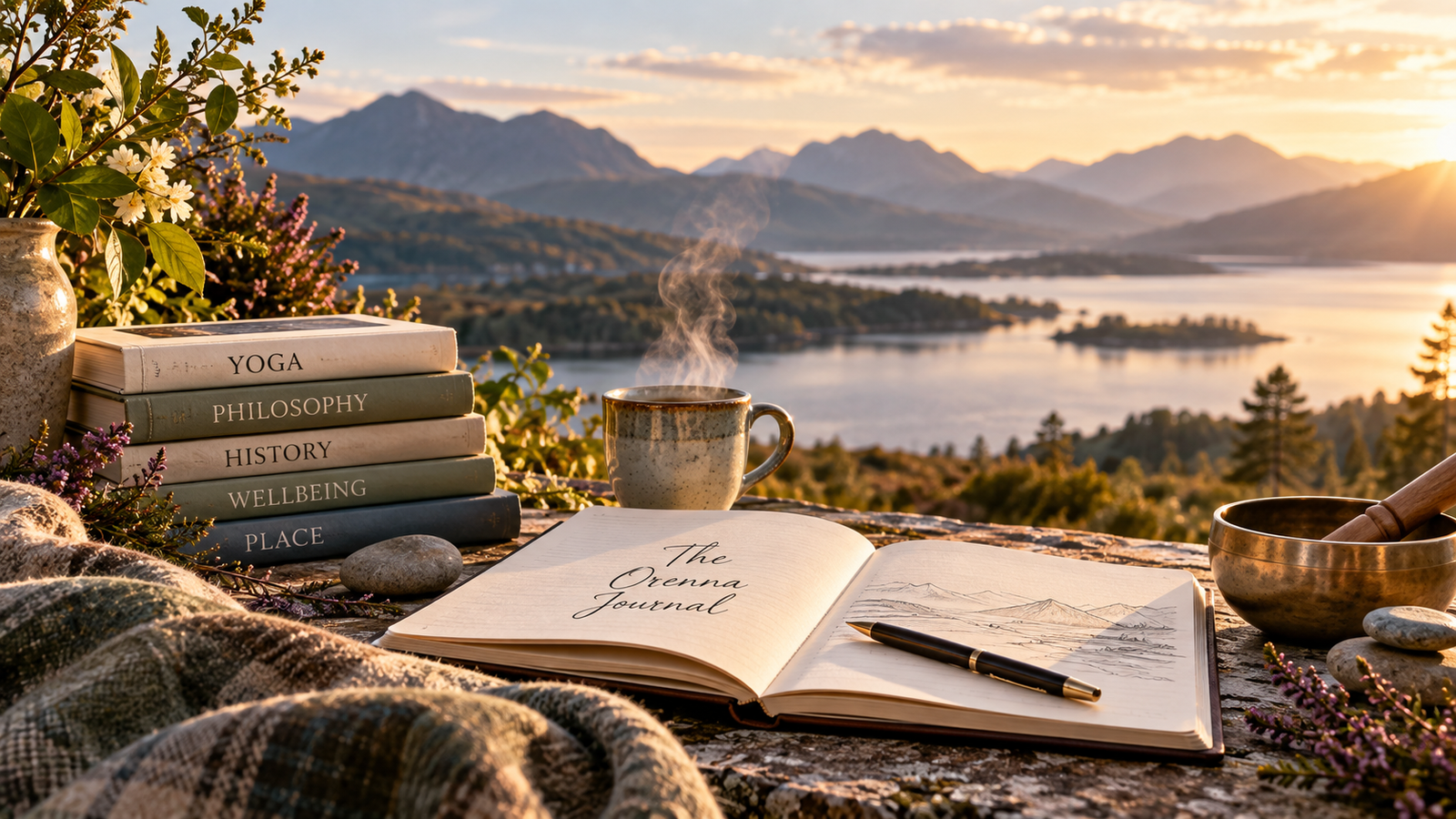
The Orenna Journal is a place for deeper exploration: considered writing on yoga, philosophy, history, wellbeing and place, with space to look beyond the quickest answer.
Some subjects become smaller when we try to explain them too quickly. Yoga is one of them. So are philosophy, history, wellbeing, contemplative practice and many of the ideas that now move between ancient traditions and contemporary life.
A simple definition can be useful. A short answer can provide a starting point. However, understanding often begins when we become willing to stay with a subject for a little longer.
For that reason, articles within the Journal move between tradition and contemporary understanding. They explore not only how practices are approached, but also where they come from, how they have developed and why their meanings can differ across contexts.
Rather than searching for certainty at every turn, the Journal creates space for thoughtful enquiry, evidence-informed discussion and a more nuanced understanding of yoga and wellbeing.
Why The Orenna Journal Exists
We live in an extraordinary age of access to information. A question that once required a journey to a library can now produce thousands of answers within seconds.
That accessibility has enormous value. Nevertheless, more information does not always produce greater understanding.
Complex histories can become timelines of convenient facts. Philosophical traditions can turn into quotations removed from their original questions. Meanwhile, scientific research can become a headline, and a practice developed within one historical or cultural setting can acquire a very different explanation when it enters another.
Yoga provides countless examples.
Terms such as āsana, prāṇāyāma, mudrā, cakra and meditation now circulate internationally. Yet the meanings attached to them have not remained identical across centuries, texts, traditions or modern schools.
Even the word yoga does not describe one unchanging practice throughout Indian history.
Understanding, therefore, requires context. The Orenna Journal exists to make room for it.
Beyond the Quick Answer
There is nothing inherently wrong with simplicity. Sometimes we need to know what something means, how something works or where to begin.
Problems arise, however, when a simple explanation starts presenting itself as the complete story.
Consider a question such as: What is yoga?
We could answer in a sentence. Yet another set of questions immediately appears.
Which period of history are we discussing? Which text or philosophical tradition? Are we considering yoga as a path towards liberation, a contemplative discipline, a collection of bodily and respiratory practices, a modern postural practice, or something else?
These interpretations can overlap, but they are not interchangeable.
A deeper answer does not necessarily replace the simpler one. Instead, it reveals what the first explanation leaves out.
The Orenna Journal and the Many Histories of Yoga
One recurring idea within The Orenna Journal is that yoga becomes easier to understand when we stop expecting it to have one timeless form.
Yoga developed within the diverse religious, philosophical and ascetic landscapes of the Indian subcontinent. Consequently, different texts and traditions proposed different practices, metaphysical frameworks and understandings of yoga’s purpose.
The yoga of Patañjali’s Yoga Sūtras, for example, is not identical to the presentations of yoga within the Bhagavad Gītā. Later, medieval Haṭha traditions developed practices and subtle-body models that we cannot simply project backwards onto every earlier source.
Modern postural yoga developed further through encounters between Indian traditions, physical culture, institutional education, nationalism, international exchange and the work of individual teachers.
Contemporary yoga inherited aspects of these histories while continuing to change.
Recognising this diversity does not diminish yoga. On the contrary, it reveals a richer and more interesting historical landscape.
Readers interested in this development can explore Haṭha Yoga, the history of Ashtanga Yoga and our introduction to the eight limbs of yoga.
Tradition Deserves Context
The word traditional carries considerable authority. It can suggest authenticity, continuity and proximity to an original source.
Yet traditions develop.
Teachers interpret what they inherit. Practices move between communities, while texts acquire new commentaries and interpretations. Some techniques disappear and later re-emerge. Others develop considerably while still maintaining a relationship with what came before them.
For this reason, the Journal approaches tradition with respect without treating every traditional or lineage claim as straightforward historical fact.
Where a lineage preserves a particular account, that account may be important in its own right. However, where historical scholarship presents a more complicated picture, that deserves attention too.
The two should not be silently collapsed into one another.
Respecting a tradition does not require abandoning historical enquiry. Equally, historical enquiry need not reduce a living tradition to a catalogue of errors.
There is room for both understanding and scrutiny.
History Is More Than a Timeline
Dates and names matter, but history becomes more meaningful when we begin asking what changed between them.
Why did particular practices become prominent? How did teachers understand what they were teaching? Which ideas drew upon earlier sources, and which emerged more recently?
We can also ask what happened when yoga travelled beyond India. Printing, photography, international travel, physical culture, medicine, spirituality and global consumer culture all form part of the wider story of modern yoga.
Questions like these transform history from a sequence of milestones into an exploration of development.
This approach is particularly important when discussing modern practice. Calling something ancient does not explain it. Likewise, describing something as modern does not make it insignificant.
The more revealing question is often: how did this practice come to take the form we recognise today?
For readers who want to explore the academic study of these histories further, the SOAS Haṭha Yoga Project has contributed substantial scholarly research into the history of physical yoga and premodern Haṭha traditions.
Philosophy as Enquiry, Not Decoration
Yoga philosophy is sometimes reduced to inspirational quotations placed around physical practice. Its historical role is considerably more demanding.
Indian philosophical traditions asked profound questions about consciousness, knowledge, suffering, action, identity, perception, reality and liberation. Importantly, they did not always provide the same answers.
Reading philosophy therefore involves more than collecting attractive ideas. Instead, it asks us to understand arguments within their own conceptual worlds.
What does a particular text mean by mind? How does it understand consciousness? Why is liberation necessary within its philosophical framework? What problem is a particular practice intended to address?
Only after considering questions like these can we begin asking how those ideas might speak to contemporary life — or where modern interpretations have moved in another direction.
Understanding Practice More Fully
The Journal is not concerned with history and philosophy at the expense of practice. Quite the opposite: understanding where practices come from can change how we see them.
An āsana can be explored through its physical organisation, for example, while also considering the history of the method in which it appears.
Similarly, prāṇāyāma can be approached as breathing practice while recognising that historical yogic explanations of prāṇa belong to conceptual frameworks that are not identical to modern respiratory physiology.
Mudrā provides another example. Contemporary practice often associates the term with hand gestures, yet historical Haṭha and Tantric sources use mudrā for a considerably broader range of practices.
The same principle can apply to meditation, mantra, bandha, subtle-body models and many other aspects of yoga.
Knowing more does not necessarily make practice more complicated. Sometimes it simply allows us to practise without needing a simplified story about what we are doing.
The Orenna Journal: Where Tradition Meets Evidence
Historical traditions and scientific research often ask different kinds of questions. Confusion begins when we expect one to prove the other.
A traditional text may explain a practice through prāṇa, subtle channels or other concepts belonging to its philosophical and contemplative framework. Modern researchers, meanwhile, might investigate breathing rate, attention, perceived stress, mobility, pain or another measurable outcome.
We should not automatically treat these forms of explanation as translations of one another.
Prāṇa does not need to become oxygen to make a historical yogic text meaningful. Conversely, a modern physiological measurement does not prove every traditional explanation associated with a practice.
The Orenna Journal aims to preserve these distinctions rather than forcing them into artificial agreement.
What Evidence-Informed Means Here
Evidence-informed does not mean that every meaningful human experience must first appear in a clinical trial. Nor does it mean adding scientific vocabulary to make a practice sound more credible.
Instead, it means asking what kind of claim we are making and what evidence could reasonably support it.
If someone says that a particular practice feels restful, they are describing personal experience. If a historical source associates a technique with a particular outcome, we can identify that as a traditional claim. When researchers investigate an intervention in a defined population, we can examine what they found and how confidently those findings can be interpreted.
These are different forms of knowledge.
Problems arise when we move between them without acknowledging the transition.
A traditional claim does not automatically become a scientific fact because it is old. Likewise, a personal experience does not become invalid simply because we cannot generalise it to everyone.
Scientific evidence also has its own limits. One study rarely settles a complex question permanently.
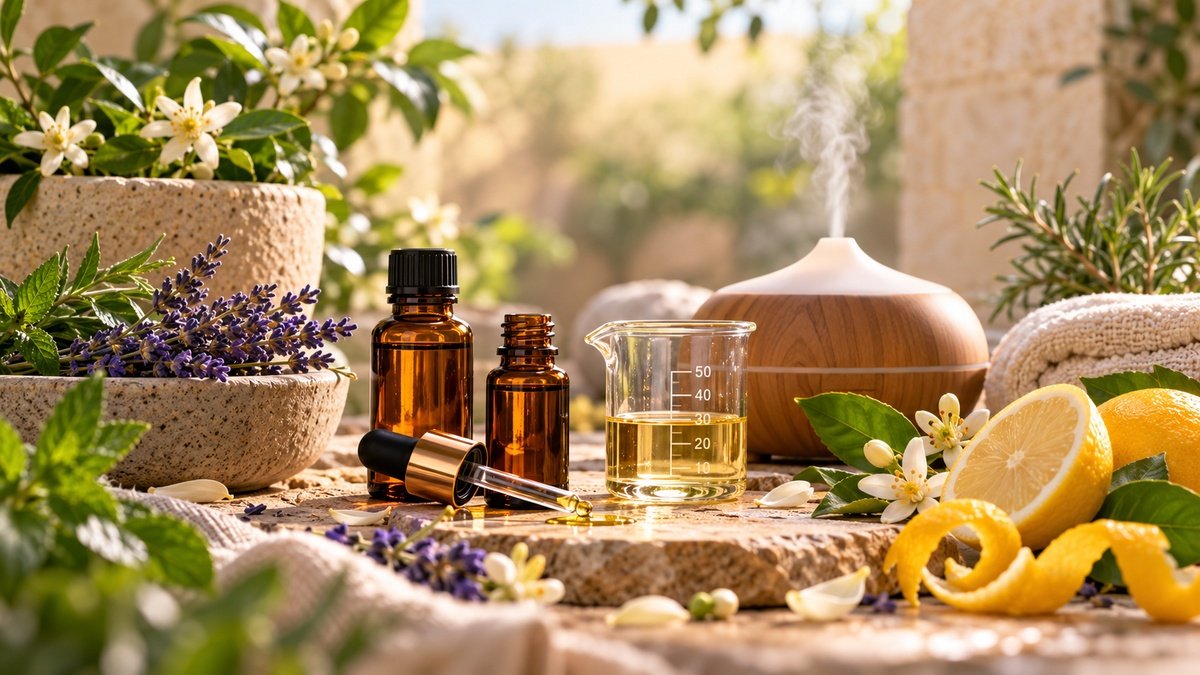
This approach is visible in our explorations of whether crystals work and what research can tell us about aromatherapy. In both cases, the aim is neither automatic belief nor automatic dismissal, but greater precision about the claims being made.
Wellbeing Without the Promise of Perfection
Wellbeing has developed its own language of certainty.
We are frequently told to optimise, regulate, reset, detoxify, balance and transform. Sometimes these words describe useful ideas loosely. In other cases, however, they imply physiological or therapeutic effects that require much stronger evidence.
The Journal takes a more measured approach.
Rest can matter without becoming a treatment. A ritual can feel meaningful without requiring a medical mechanism. Likewise, a scent can evoke memory without universally controlling mood.
A yoga practice can contribute to someone’s experience of wellbeing without promising to cure illness.
There is considerable territory between dismissing an experience and exaggerating what it can achieve. That middle ground deserves exploration.
Leaving Room for Uncertainty
Good enquiry does not always end with certainty.
Sometimes the surviving historical evidence is incomplete. Scholars may disagree about interpretation, while a scientific literature may contain promising findings without yet supporting a strong conclusion.
Elsewhere, a lineage account may preserve details that researchers cannot independently verify. Different traditions may also genuinely understand the same concept in different ways.
In situations like these, saying we do not know can be more accurate than choosing the most satisfying explanation.
Uncertainty is not a weakness in thoughtful writing. Used carefully, it shows us where the boundaries of current knowledge lie.
The Orenna Journal and a Sense of Place
The Orenna Journal also looks beyond practices and ideas towards the environments in which we encounter them.
Orenna is rooted in the Scottish Highlands, where landscape is difficult to treat merely as background.
Weather changes quickly, while light shifts dramatically through the seasons. Mountains, water, woodland and open space continually alter the experience of distance, atmosphere and scale.
However, the Highlands also have their own histories, communities and cultural identities. They should not become scenery for a generic idea of wellness.
Writing about place therefore involves attention as much as admiration.
What does it mean to experience a landscape? How do season, weather and environment shape daily rhythms? What histories sit beneath places that visitors may initially encounter only as beautiful?
These questions belong within the Journal because wellbeing never occurs entirely in abstraction.
We experience life somewhere.
Different Subjects, One Editorial Approach
At first glance, an article about Patañjali may appear to have little in common with one about essential oils, Highland landscapes or the history of a modern yoga method.
The subjects differ. Nevertheless, the questions behind them are remarkably consistent.
What are we actually talking about? Where did the idea or practice come from? How has it changed? What did it mean in an earlier context, and what does it mean now?
We can then ask which claims come from tradition, which arise from modern interpretation and what historical or scientific evidence can reasonably establish.
Personal experience introduces another question: where does it belong within that picture?
Finally, we need to recognise where the evidence asks us to resist claiming more than we know.
These questions provide the connective tissue of The Orenna Journal.
Five Ways to Explore The Orenna Journal
Yoga & Practice explores methods, approaches and practices across the broad landscape of yoga — from modern schools and movement-based traditions to breath, meditation and other dimensions of practice.
Philosophy & Understanding looks more closely at the ideas behind yoga: texts, philosophical frameworks, Sanskrit terminology, historical concepts and the questions different traditions have asked about mind, consciousness and liberation.
Rest & Well-being examines contemporary wellbeing practices with curiosity and appropriate caution. Here, we distinguish sensory and personal experience from therapeutic claims while considering what research can reasonably tell us.
The Highlands & Place turns towards landscape, season, environment and the particular character of the place in which Orenna has developed.
From Orenna provides space for reflections from the studio itself — including the thinking behind Orenna’s experiences, developments within the studio and occasional reflections on the principles shaping our work.
Readers can enter through any of these doors. Inevitably, the subjects often lead into one another.
You Do Not Need to Agree with Everything
A Journal devoted to enquiry should not require agreement.
Yoga contains competing philosophical positions. Historical evidence can complicate cherished stories. Scientific interpretations change as research develops, while personal experience remains personal.
The purpose, therefore, is not to replace one collection of certainties with another.
Instead, the aim is to make distinctions visible enough for readers to consider them for themselves.
That means acknowledging complexity without making subjects unnecessarily inaccessible. It also means questioning claims without becoming cynical about experience.
Above all, it means respecting traditions without pretending that every contemporary interpretation has existed unchanged for centuries.
Curiosity can accommodate all of these things.
The Orenna Journal: A Place for Deeper Exploration
The word deeper can sometimes imply that knowledge has a final level waiting to be reached.
That is not what it means here.
Deeper exploration often produces more questions rather than fewer.
A familiar practice acquires a history. Meanwhile, a familiar word develops several meanings. A confident claim may become more conditional, while a tradition reveals internal diversity.
Sometimes a modern practice turns out to contain both inheritance and innovation. Something we thought we understood becomes interesting again.
That is the kind of depth The Orenna Journal hopes to cultivate.
Not complexity for its own sake. Not certainty where certainty is unavailable. And not an endless search for the next definitive answer.
Instead, it is an invitation to look more closely: to understand the practice, the ideas around it, the histories beneath it and the different ways people create meaning.
There is always more to explore.