
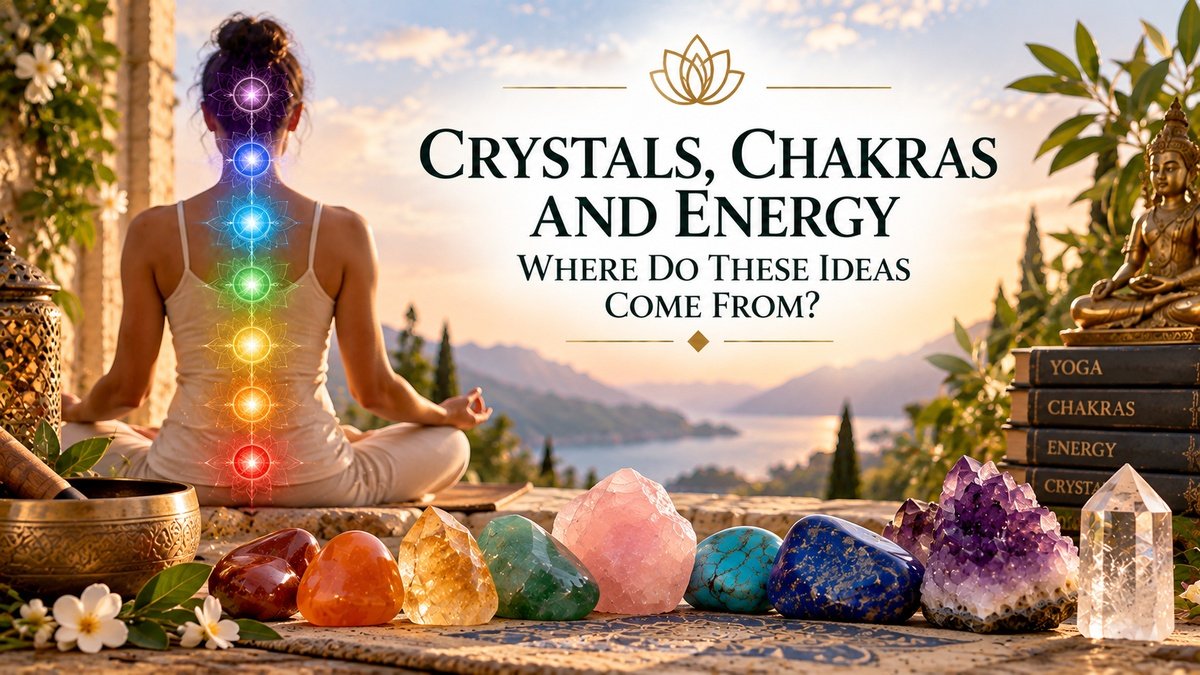
Red jasper at the root.
Carnelian at the sacral centre.
Citrine at the solar plexus.
Rose quartz at the heart.
Blue stones at the throat. Indigo at the brow. Amethyst or clear quartz at the crown.
This arrangement has become one of the most recognisable images in contemporary yoga and wellness culture.
Its logic appears beautifully simple: seven chakras, seven colours and seven corresponding stones.
Many people therefore assume that practitioners in India have used this exact system for thousands of years.
Yet the history of crystals and chakras is considerably more complex.
Indian traditions certainly developed sophisticated ideas about cakras, nāḍīs, prāṇa, mantra and the subtle body. Across different cultures, people have also attributed religious, astrological, protective and symbolic meanings to gemstones for centuries.
Those histories, however, do not automatically produce the modern chart found in crystal shops and wellness spaces today.
So where did the connection come from?
What Is a Chakra?
The Sanskrit word cakra can mean a wheel, circle or disc.
Within particular Indian Tantric and yogic traditions, practitioners came to use the term for centres within models of the subtle body.
These traditions did not simply describe chakras as invisible anatomical organs. Instead, different systems understood and used them within ritual, contemplative and yogic practices involving mantra, visualisation, deities, breath and subtle-body processes.
Most importantly, historical traditions did not share one universally agreed chakra system.
Some systems described five centres, while others described six, seven or more. Their names, locations, associated deities, mantras, elements and ritual functions could also differ.
The familiar modern seven-chakra system therefore represents one configuration within a much larger history.
Did Ancient Yoga Have Seven Chakras?
Some premodern Indian traditions described systems that we can represent as six centres with an additional centre or lotus above them.
That history contributed significantly to later seven-chakra presentations.
However, we should not conclude that all historical yoga used the same seven chakras familiar from modern studios.
Yoga developed across numerous textual, philosophical, ascetic and religious environments.
Patañjali’s Yoga Sūtra, for example, does not organise yoga around the familiar rainbow chakra chart.
Likewise, Tantric traditions developed multiple subtle-body systems rather than one standard diagram that everyone followed.
When we encounter a historical chakra model, we therefore need to ask:
Which text? Which tradition? Which period? Which practice?
Without those questions, we risk compressing several centuries of development into one modern poster.
What Is the Subtle Body?
People commonly use the term subtle body today for models involving chakras, channels and forms of vital power.
Within Indian traditions, however, these models vary considerably.
Concepts such as prāṇa, nāḍī, cakra, bindu and kuṇḍalinī appear in different combinations and acquire different meanings across texts and traditions.
Modern anatomy does not provide straightforward equivalents for these concepts.
For example, scientific evidence has not established a nāḍī as a nerve or blood vessel. Nor has it established a chakra as an endocrine gland. Likewise, reducing prāṇa simply to oxygen changes the traditional concept substantially.
These ideas belong first to historical systems of yoga, Tantra, philosophy and religious practice.
Understanding them on their own terms allows us to avoid both dismissing them and turning them into pseudo-scientific anatomy.
You can explore this distinction further in our discussion of Mudrā, Prāṇa and the Subtle Body.
Were Historical Chakras Rainbow-Coloured?
Historical sources do not present the standard red-to-violet arrangement familiar today as one universal system.
Premodern chakra texts certainly contain colour symbolism. Yet their colour schemes do not simply reproduce the modern visible-spectrum sequence of red, orange, yellow, green, blue, indigo and violet.
Modern reinterpretations gradually helped establish the familiar rainbow arrangement.
This development becomes especially important when we consider crystals.
Once each chakra receives a fixed rainbow colour, assigning similarly coloured stones becomes intuitive.
Red stones can correspond with the root. Orange stones fit the sacral centre. Yellow stones fit the solar plexus. Green or pink stones can represent the heart.
In other words, once a colour system exists, people can construct a crystal correspondence system around it relatively easily.
That does not mean the complete modern system appeared in the same form in premodern yoga texts.
Where Did the Modern Seven-Chakra System Come From?
No single person created everything that we now call the modern chakra system at one identifiable moment.
Instead, the system developed through transmission, translation and reinterpretation.
Indian Tantric sources supplied important foundations. Later translations and interpretations introduced those ideas to wider Western audiences.
Western esoteric movements subsequently incorporated chakras into their own models of subtle bodies, spiritual development and invisible forces.
During the twentieth century, psychological, colour-based and therapeutic interpretations added further layers.
Popular yoga and New Age culture then increasingly standardised the chakra system.
The result is instantly recognisable today: seven vertically arranged centres, each associated with a colour, psychological themes and, increasingly, corresponding crystals.
This system has historical roots, but its familiar contemporary form also reflects distinctly modern developments.
When Did Crystals Become Connected with Chakras?
Gemstones and Indian religious traditions each have substantial histories of their own.
Indian astrology, for example, includes important gemstone traditions such as the navaratna, or nine-gem arrangement, which links particular gems with celestial influences.
That tradition differs from placing seven coloured crystals over seven chakras.
The familiar crystals and chakras framework developed substantially within modern metaphysical and New Age culture, where several streams of thought converged.
By this stage, popular systems increasingly gave chakras standard colours. Meanwhile, modern crystal culture had developed expanding metaphysical meanings for individual stones.
Colour correspondence offered a straightforward way to connect the two systems.
Consequently, practitioners could associate a red crystal with the red root chakra or place a purple crystal with the violet crown.
Repeated correspondence charts, books, courses and commercial guides gradually made these pairings appear increasingly fixed.
Why Is Red Jasper Associated with the Root Chakra?
Contemporary crystal practice commonly connects red jasper with the root chakra, or mūlādhāra.
Modern chakra systems typically represent this centre in red and associate it with grounding, security, stability and physical foundations.
Red jasper fits this framework visually, while its earthy appearance reinforces the symbolism.
Contemporary guides therefore frequently describe the stone as grounding or stabilising.
This correspondence makes sense within the modern symbolic system. However, we should not automatically describe it as an ancient or universal yogic assignment.
Why Is Carnelian Associated with the Sacral Chakra?
Carnelian commonly corresponds with the sacral chakra, or svādhiṣṭhāna, in contemporary practice.
Modern chakra systems usually colour this centre orange and associate it with creativity, emotion, sensuality and pleasure.
Carnelian’s orange-to-reddish colour makes it an obvious visual match.
Modern crystal meanings also connect carnelian with vitality, creativity and motivation.
As a result, the two systems reinforce one another. Colour supports the chakra correspondence, while the correspondence strengthens the stone’s contemporary symbolic meaning.
Why Is Citrine Associated with the Solar Plexus Chakra?
Citrine frequently corresponds with the solar plexus chakra, or maṇipūra.
Contemporary chakra charts usually colour this centre yellow and connect it with confidence, agency and personal power.
Citrine’s yellow and golden tones fit naturally into that framework.
Meanwhile, contemporary crystal meanings associate citrine with confidence, optimism, prosperity and abundance.
Once again, the modern chakra and crystal systems support one another through shared symbolism.
The correspondence remains coherent within that framework without requiring us to present it as timeless historical fact.
Why Is Rose Quartz Associated with the Heart Chakra?
Rose quartz provides an interesting exception to a purely colour-based system.
Contemporary chakra charts usually represent the heart chakra, or anāhata, in green. Rose quartz, of course, is pink.
Its strong modern association with love, affection and compassion makes the symbolic connection more important than exact colour correspondence.
Practitioners also commonly associate green stones, such as green aventurine, with the heart centre.
This variation reveals something important about the whole system: crystal-to-chakra correspondences do not follow one immutable rule.
Colour matters, but previously established meanings and contemporary symbolism matter too.
Why Are Blue Crystals Associated with the Throat Chakra?
Contemporary systems commonly represent the throat chakra, or viśuddha, in blue.
Blue stones such as turquoise, aquamarine and blue lace agate therefore appear frequently in throat-chakra guides.
Modern interpretations connect this centre with communication, truth and expression. Crystal meanings often mirror those themes.
For example, contemporary guides may associate turquoise with communication or blue lace agate with gentle expression.
These represent modern symbolic correspondences.
We should not automatically turn them into claims that placing a blue mineral on the throat alters the thyroid gland or treats a medical condition.
Why Is Amethyst Associated with the Crown Chakra?
Amethyst commonly appears at the upper end of contemporary chakra charts.
Modern systems often represent the crown chakra, or sahasrāra, through violet or white.
Amethyst’s purple colouring therefore provides an obvious visual correspondence.
Its contemporary associations with meditation, spirituality and intuition further reinforce the relationship.
Clear quartz may also appear at the crown because modern crystal culture connects it with clarity and amplification.
Several layers therefore interact: colour, contemporary crystal meanings and modern chakra psychology.
What Does ‘Energy’ Mean in Crystal Practice?
The word energy sits at the centre of many contemporary discussions about crystals and chakras.
It is also one of the easiest words to misunderstand.
Physics gives energy specific, measurable meanings.
Traditional Indian contexts use concepts such as prāṇa within particular philosophical and yogic frameworks.
Modern spiritual practice may use energy differently again, perhaps to describe atmosphere, sensation, vitality, emotional tone or an invisible spiritual quality.
We cannot automatically treat these meanings as interchangeable.
Therefore, saying that a stone has “energy” tells us very little until we establish what the speaker means by the term.
Is Prāṇa the Same as Energy?
English-language yoga frequently translates prāṇa as “energy” or “life-force energy”.
That translation can provide useful shorthand, but it can also create confusion.
Prāṇa belongs to Indian philosophical, medical and yogic traditions, and its meanings vary according to context.
We should not automatically equate it with electrical energy, electromagnetic radiation, calories or another measurable physical quantity simply because English speakers use the same word.
Likewise, traditional descriptions of directing prāṇa through subtle channels do not demonstrate that modern instruments should detect electricity travelling through chakra pathways.
Traditional subtle-body language deserves interpretation within its own conceptual framework rather than as badly expressed physics.
Are Chakras Energy Centres?
Calling chakras “energy centres” has become conventional in modern yoga.
The phrase offers a simple introduction, but it can obscure historical complexity.
Premodern chakra systems could involve mantras, deities, elements, visualisations, ritual processes and subtle-body transformations.
Reducing all of that to seven batteries of invisible energy changes the concept substantially.
People can still use the phrase within contemporary spiritual vocabulary. However, it should not imply that biomedical science has identified seven measurable energy organs that correspond exactly with the modern chakra map.
Are Chakras the Endocrine Glands?
Modern charts frequently align chakras with endocrine glands.
For example, some systems associate the root with the adrenal glands, the throat with the thyroid and the brow with the pituitary gland.
Modern interpreters created these correspondences as they sought to understand subtle-body concepts through Western anatomical frameworks.
That comparison does not demonstrate that chakras and endocrine glands represent the same structures.
Endocrine glands are anatomical organs with measurable physiological functions. Chakras belong to subtle-body systems with different historical foundations.
People may use the correspondence symbolically, but we should not present it as established anatomy.
Can Crystals ‘Balance’ Chakras?
The answer depends on what someone means by balance.
Within contemporary spiritual practice, a person might use a crystal during a ritual that focuses attention on a particular chakra or symbolic theme.
For example, someone may choose rose quartz while reflecting on compassion or relationships and describe the practice as balancing the heart chakra.
That description makes sense within the person’s spiritual framework.
However, the claim changes category if “balancing” means correcting a measurable physiological dysfunction.
Research has not established a clinical test showing that placing a particular crystal over a chakra corrects a corresponding organ, hormone or medical condition.
For this reason, spiritual vocabulary and medical diagnosis should remain distinct.
What Happens in a Crystal Chakra Layout?
Contemporary practices sometimes place crystals on or near the body at positions that correspond with the seven modern chakras.
A practitioner may select stones according to colour, symbolic meaning or personal preference.
Meditation, breathing, visualisation or quiet rest may accompany the arrangement.
Someone participating in the practice might experience the setting as calming, meaningful or contemplative.
That experience does not require us to conclude that the stones altered measurable chakra frequencies.
The setting itself contains several potentially meaningful elements, including stillness, expectation, attention, sensory experience, symbolism and interpersonal context.
We should not remove those factors from the explanation simply because crystals are present.
Do Crystal Colours Have Different Frequencies?
Visible light involves measurable wavelengths and frequencies.
A crystal’s colour relates to the way its material structure interacts with light.
However, this scientific fact does not establish the wider claim that a purple crystal possesses a spiritual frequency that resonates specifically with the crown chakra.
These are separate propositions.
Scientific vocabulary can make a metaphysical explanation sound experimentally established even when research has not established it.
A useful question is always:
What exactly are we measuring?
If nobody has defined a measurable variable, the word “frequency” may function metaphorically rather than as a physical measurement.
What About Quartz and Piezoelectricity?
Quartz genuinely has piezoelectric properties.
Under appropriate mechanical stress, the material can develop an electrical charge across its surfaces. Conversely, applying an electrical field can produce mechanical deformation.
These properties have important technological applications.
Piezoelectricity, however, does not demonstrate that quartz balances chakras, amplifies intention or transfers healing frequencies into the body when someone places it on the skin.
Those claims require their own supporting evidence.
We should not use one established physical property of a material as automatic proof of every metaphysical property attributed to it.
Does Modern Mean Inauthentic?
No.
This distinction matters throughout the discussion.
A modern practice does not become meaningless simply because people did not practise it in precisely the same form one thousand years ago.
Traditions continually develop as people combine ideas, reinterpret symbols and create new practices.
The problem arises when we present modern synthesis as unchanged ancient history.
Someone can deliberately place seven coloured crystals alongside a seven-chakra model and find the practice personally meaningful.
Historical accuracy simply asks us to describe that combination for what it is.
Can Crystals and Chakras Be Used Symbolically?
Yes.
Symbolism offers one way to approach the system without turning metaphor into anatomy.
For example, a practitioner might associate the heart centre with compassion and choose rose quartz because contemporary culture connects the stone with love.
The crystal can then become a tangible representation of that intention.
Likewise, someone exploring communication may select a blue stone because its colour and throat-chakra symbolism help focus attention on expression.
The object does not need to control an invisible organ for the practice to carry personal meaning.
Instead, it can give an abstract intention a physical form.
How Does Orenna Approach Crystals and Energy?
At Orenna, we keep traditional language, personal symbolism and scientific claims distinct.
A guest may attach spiritual significance to a crystal, and we can respect that relationship.
Another guest may simply appreciate the stone’s colour, texture or appearance.
A crystal can also provide a tactile or visual point of focus within a quiet experience.
None of these possibilities requires Orenna to diagnose an “energy blockage”, identify an imbalanced chakra or promise that a particular stone will correct it.
The emphasis remains on choice, symbolism and experience rather than treatment.
A More Useful Way to Think About Crystals and Chakras
Rather than asking whether every correspondence is objectively true, we can separate several different layers.
Historical: What did particular Indian traditions actually teach about chakras?
Modern historical: How did today’s seven-colour chakra system develop?
Symbolic: Why does a particular stone make sense within that system?
Experiential: What does someone notice or find meaningful during the practice?
Scientific: Which physical or health claims have researchers actually tested?
These questions can coexist without becoming interchangeable.
Confusion begins when we use an answer from one category as evidence for another.
An Orenna Perspective: Meaning Without Manufactured Antiquity
There is something visually compelling about seven coloured stones arranged along the body.
Colours create order, while stones provide texture and weight. The chakra framework gives the arrangement a symbolic map.
For some people, that combination creates a meaningful contemplative experience.
Understanding its complex history does not make that experience less meaningful.
Nor does claiming an antiquity that the historical evidence cannot support make the practice more authentic.
Traditional Indian subtle-body systems deserve interpretation within their own historical contexts. Modern crystal practices deserve the same intellectual honesty.
Between them lies a fascinating history of transmission, reinterpretation and creativity.
A practice does not need to be ancient to be meaningful. It simply needs to be described truthfully.
Continue Exploring Crystals
Begin with Crystals: Understanding the Stones, Meanings and Modern Practices for the foundations of this series.
Then explore A History of Crystals: From Precious Stones to Modern Crystal Culture to follow the changing relationship between people and remarkable stones.
Our guide to Crystal Meanings examines why rose quartz, amethyst, citrine, black tourmaline and other familiar stones acquired their contemporary associations.
The final article in this series asks the question beneath many of these practices:
Do Crystals Really Work? Tradition, Experience and Scientific Evidence.
There we examine crystal healing, energy and frequency claims, placebo and contextual effects, existing research, safety and the important distinction between finding a practice personally meaningful and demonstrating that it treats a health condition.
References & Further Reading
Mallinson, James and Singleton, Mark. Roots of Yoga. Penguin Classics. A major collection of translated primary sources that illustrates the diversity of historical yoga and subtle-body traditions.
White, David Gordon. The Alchemical Body: Siddha Traditions in Medieval India. University of Chicago Press. Provides important scholarly context for medieval Indian subtle-body and Tantric traditions.
Samuel, Geoffrey. The Origins of Yoga and Tantra: Indic Religions to the Thirteenth Century. Cambridge University Press. Provides wider historical context for the development of yoga, Tantra and related religious traditions.
Woodroffe, Sir John [Arthur Avalon]. The Serpent Power. This work played an influential role in bringing particular Tantric chakra materials to English-speaking audiences. It forms part of the modern transmission history rather than representing every Indian chakra tradition.
Leadbeater, C. W. The Chakras. A historically important source for understanding twentieth-century Western esoteric reinterpretations of chakras and their later popularisation.
Hanegraaff, Wouter J. Scholarship on Western esotericism and New Age religion provides wider context for understanding how modern Western spiritual movements interpreted and transformed concepts from Asian religious traditions.
The British Museum and Smithsonian National Museum of Natural History. Their collection and mineralogical resources provide useful context for distinguishing the documented material properties and cultural histories of gemstones from later metaphysical claims.