


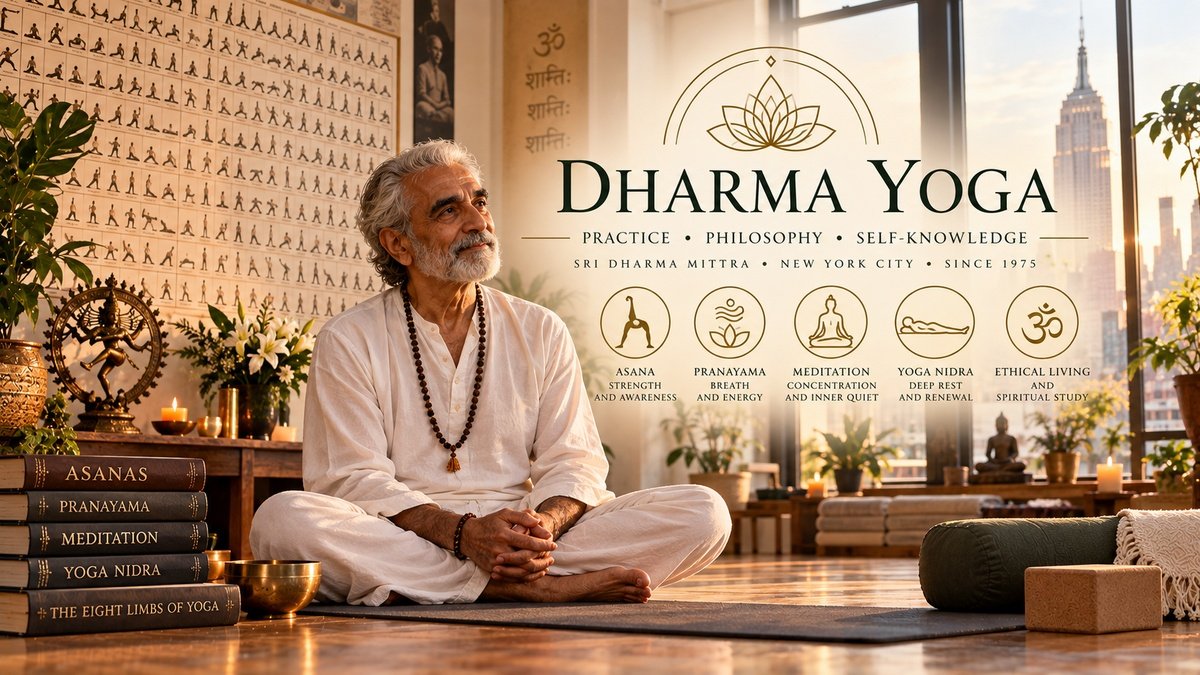
Dharma Yoga presents an intriguing contrast.
Its visual identity includes some of the most technically complex postures found in modern yoga. Deep backbends, arm balances, inversions and unusual variations appear throughout the work of its founder, Sri Dharma Mittra.
Yet the physical posture is not presented as the ultimate purpose of the practice.
Dharma Yoga places āsana within a considerably broader framework that includes ethical principles, prāṇāyāma, concentration, meditation, Yoga Nidra, selfless action and spiritual enquiry.
This distinction becomes especially important when we encounter Dharma Mittra’s best-known contribution to modern yoga culture: the extraordinary Master Yoga Chart of 908 Asanas.
The chart can initially look like a catalogue of physical achievement.
Within Dharma Mittra’s teaching, however, āsana remains one part of yoga rather than its entirety.
So what is Dharma Yoga? Who is Sri Dharma Mittra? Where did the method develop? Why did he photograph himself in more than a thousand postures? What are the Dharma Yoga sequences? And how does a practice famous for advanced āsana understand yoga beyond the pose?
What Is Dharma Yoga?
Dharma Yoga is a modern yoga method developed by Sri Dharma Mittra in New York City.
The tradition describes itself as a contemporary interpretation of classical eight-limbed or Haṭha-Rāja Yoga.
Physical practice can include flowing sequences, sustained postures, balances, backbends and inversions. However, āsana represents only one dimension of the method.
Prāṇāyāma, meditation, Yoga Nidra, ethical principles and philosophical or spiritual teachings can also form part of Dharma Yoga practice.
This makes it difficult to define the method solely by what happens on a yoga mat.
A physically demanding class and a quiet meditation session may look entirely different while still belonging within the wider Dharma Yoga framework.
The connecting principle is an understanding of yoga as a comprehensive discipline rather than simply a repertoire of postures.
Who Is Sri Dharma Mittra?
Sri Dharma Mittra is a Brazilian-born yoga teacher whose career has been centred principally in New York City.
He was born in Minas Gerais, Brazil, in 1939.
After becoming interested in yoga during the 1950s, he eventually travelled to New York in the 1960s to study with Swami Kailashananda, better known in the United States as Yogi Gupta.
Mittra immersed himself in the ashram environment and yogic disciplines under his teacher.
In 1967, he began teaching āsana and prāṇāyāma at the Yogi Gupta New York Center.
After leaving the ashram with his teacher’s blessing, he established his own Yoga Asana Center in New York in 1975.
That school eventually developed into the contemporary Dharma Yoga Center.
His teaching career therefore spans an important period in which yoga moved from relatively small ashrams and specialist communities into the increasingly diverse landscape of modern urban yoga.
Who Was Yogi Gupta?
Understanding Dharma Yoga requires acknowledging the teacher behind its founder.
Sri Dharma Mittra studied with Swami Kailashananda, or Yogi Gupta, after moving from Brazil to New York.
Mittra has described his meeting with Yogi Gupta in 1964 as decisive in the direction of his life.
He subsequently lived within his teacher’s community, studied yogic disciplines and served as Yogi Gupta’s assistant.
By 1967, Mittra was teaching intermediate and advanced āsana and prāṇāyāma at the New York centre.
This lineage matters because Dharma Yoga did not appear simply as an exercise system invented independently in a New York studio.
Mittra’s later method emerged from decades of practice and teaching shaped by his relationship with his guru, while also developing characteristics particular to Mittra’s own work.
When Did Dharma Yoga Begin?
The Dharma Yoga Center dates the establishment of Sri Dharma Mittra’s independent school to 1975.
That year, he opened the Yoga Asana Center in New York City after leaving Yogi Gupta’s ashram.
However, the teaching behind Dharma Yoga had already been developing through Mittra’s earlier years of study and his teaching from 1967 onwards.
The method continued evolving after the centre opened.
Teacher training initially developed through apprenticeship. A formal eight-limbed teacher-training programme followed in 1999.
Consequently, 1975 provides a useful institutional starting point, but Dharma Yoga as practised today reflects decades of continuing teaching rather than a method created completely in a single year.
What Does Dharma Mean?
Dharma is an important Sanskrit term with meanings that vary considerably according to historical and philosophical context.
Depending on the tradition, it can refer to ideas including teaching, law, duty, conduct, principle, characteristic or the order that sustains life and society.
In Buddhist traditions, dharma can carry additional meanings, including the Buddha’s teaching and, in particular philosophical contexts, phenomena or constituent elements of experience.
It therefore has no single English translation that works everywhere.
In Dharma Yoga, the name also directly references Dharma Mittra himself.
We should consequently avoid assuming that the style represents one universal or definitive interpretation of the broader Indian concept of dharma.
What Is Hatha-Raja Yoga?
The Dharma Yoga tradition frequently describes its approach as Haṭha-Rāja Yoga.
This brings together two broad dimensions of yogic practice.
Haṭha Yoga historically encompasses physical and subtle-body practices that can include posture, breath regulation, mudrā and other disciplines.
Rāja Yoga is a term that acquired several meanings across modern yoga. It became especially associated with meditative and mental disciplines and, through modern interpretation, with Patañjali’s system.
Dharma Yoga brings physical practice together with ethical, respiratory, contemplative and spiritual disciplines.
Calling it Haṭha-Rāja Yoga therefore signals that āsana serves a broader yogic purpose rather than functioning as an isolated physical activity.
However, neither Haṭha Yoga nor Rāja Yoga has had one completely uniform meaning throughout history.
How Does Dharma Yoga Relate to the Eight Limbs of Yoga?
Dharma Yoga explicitly places itself within an eight-limbed understanding of yoga.
The framework associated with Patañjali describes:
Yama — ethical restraints
Niyama — observances
Āsana — posture
Prāṇāyāma — regulation of breath
Pratyāhāra — withdrawal or interiorisation of the senses
Dhāraṇā — concentration
Dhyāna — meditation
Samādhi — meditative absorption
Modern Dharma Yoga interprets practice through this broader framework.
That distinction matters because its spectacular physical postures can otherwise give the impression that advanced āsana represents the summit of the method.
Within an eight-limbed framework, posture is explicitly only one limb.
Why Are the Yamas Important in Dharma Yoga?
Sri Dharma Mittra has repeatedly emphasised ethical practice as foundational rather than optional.
The yamas traditionally concern the practitioner’s relationship with behaviour and others.
Within Patañjali’s framework they include ahiṃsā, non-harming; satya, truthfulness; asteya, non-stealing; brahmacarya; and aparigraha, non-grasping or non-possessiveness.
Different modern traditions interpret some of these terms differently, particularly brahmacarya.
For Dharma Mittra, however, the larger point is clear: technical skill in posture does not replace ethical practice.
That provides an important counterbalance to the visual reputation of Dharma Yoga.
A person capable of performing an extraordinary inversion has not thereby completed the ethical or contemplative dimensions of yoga.
What Is the Master Yoga Chart of 908 Asanas?
The Master Yoga Chart of 908 Asanas is perhaps Sri Dharma Mittra’s most recognisable contribution to modern yoga culture.
In 1984, at approximately 45 years old, Mittra photographed himself extensively in yoga postures and variations.
The Dharma Yoga Center records that he took around 1,300 photographs.
Remember that this was before digital photography and image-editing software made such projects comparatively straightforward.
Mittra physically organised the photographs into an enormous visual chart containing 908 postures and variations.
He dedicated the completed work to his guru.
The result became both a teaching reference and one of the most recognisable visual documents of late twentieth-century postural yoga.
Did Dharma Mittra Invent 908 Yoga Poses?
No.
The title Master Yoga Chart of 908 Asanas should not be interpreted as meaning that Dharma Mittra invented 908 entirely new postures.
The chart brings together a very large repertoire of postures and variations known, practised, collected or explored by Mittra.
Some were established yoga postures. Others represent variations and developments within modern postural practice.
Dharma lineage materials attribute the creation of a substantial number of variations to Mittra himself, but that is different from claiming that every posture on the chart originated with him.
Yoga postures also have complicated histories.
The same posture may acquire different names, and similar shapes can appear in different systems without establishing a simple line of historical transmission.
The chart is therefore most useful when understood as an extraordinary record of Mittra’s āsana repertoire rather than a catalogue of 908 inventions.
Why Did Dharma Mittra Create the 908 Asanas Chart?
Mittra has explained that he wanted the postures gathered together as a reference for yoga practitioners and teachers.
He had searched available yoga books for postures and wanted a resource that displayed a much broader repertoire in one place.
The project therefore had an educational purpose.
Its scale also illustrates something important about twentieth-century postural yoga: the repertoire of named and photographed āsanas had expanded dramatically compared with many premodern yoga texts.
Yet Mittra did not present the chart as evidence that yoga consists of collecting as many postures as possible.
The physical repertoire remains situated within his wider understanding of yoga as a path towards self-knowledge and self-realisation.
Does Dharma Yoga Have Set Sequences?
Yes. Dharma Yoga includes structured sequences at different levels of practice.
Students may encounter introductory material before progressing towards increasingly extensive and technically demanding sequences.
Classes nevertheless vary according to level, teacher and context.
The method can include flowing vinyāsa alongside postures that practitioners hold for longer periods.
Standing poses, twists, forward bends, backbends, balances and inversions may all appear.
However, the existence of advanced sequences does not mean that every student must eventually perform the most complex expression of every posture.
A sequence provides organisation. It does not make every visible shape compulsory.
Why Are Inversions So Visible in Dharma Yoga?
Inversions form a prominent part of Dharma Mittra’s physical teaching and visual legacy.
Headstands, forearm balances, hand balances and increasingly complex variations appear within the broader posture repertoire.
They can develop demanding combinations of balance, strength, mobility, coordination and spatial awareness.
However, their visibility can distort our understanding of the method.
An inversion is not evidence of spiritual attainment.
Nor does a more complex variation automatically represent a more meaningful yoga practice.
Some inversions may also be inappropriate for particular practitioners or circumstances.
Preparation, adaptation and the decision not to perform a posture remain legitimate aspects of practice.
What Role Does Pranayama Play in Dharma Yoga?
Prāṇāyāma has been part of Dharma Mittra’s teaching since his earliest years as an instructor.
When he began teaching at Yogi Gupta’s centre in 1967, his responsibilities included both āsana and prāṇāyāma.
Breathing practices remain part of contemporary Dharma Yoga.
Traditional yoga understands prāṇa within a broader subtle-body framework that cannot simply be translated into modern respiratory physiology.
At the same time, prāṇāyāma clearly involves deliberate changes to breathing behaviour.
Those two explanatory frameworks should not be collapsed into one another.
Within Dharma Yoga, breath practice helps move the practitioner beyond an understanding of yoga based entirely upon physical posture.
Does Dharma Yoga Include Meditation?
Yes.
Meditation forms an explicit component of Dharma Yoga’s wider eight-limbed approach.
Contemporary classes and training can include concentration and meditation alongside physical practice and breathing techniques.
This changes how we might understand the purpose of āsana.
Rather than treating increasingly complicated postures as the final destination, physical practice can prepare conditions for steadiness, attention and contemplative work.
Someone looking only at the Master Yoga Chart could easily miss this dimension.
The chart documents what a body can explore. Meditation asks a different set of questions about attention, identification and the nature of experience.
What Is Yoga Nidra in Dharma Yoga?
Yoga Nidra also appears within contemporary Dharma Yoga teaching.
The Sanskrit expression is commonly translated as “yogic sleep”, although different historical and modern traditions use the term in different ways.
In contemporary practice, Yoga Nidra usually refers to a guided practice performed in relative physical stillness.
Dharma Yoga incorporates deep relaxation within its broader approach rather than assuming that meaningful yoga must always involve strenuous movement.
This creates another revealing contrast.
The same tradition known for extraordinary physical postures also makes space for lying still.
Complexity and stillness do not have to compete for legitimacy.
What Is Karma Yoga in Dharma Mittra’s Teaching?
Karma Yoga concerns action and, in many modern interpretations, selfless service or action without attachment to personal reward.
Dharma Mittra has repeatedly emphasised this dimension of yoga.
Within his teaching, service provides a practical context for examining selfishness, expectation and attachment to the results of action.
This moves yoga beyond what happens during formal practice.
How someone acts towards other people becomes part of the discipline.
From this perspective, performing an elaborate posture while remaining entirely preoccupied with status or personal recognition would leave important aspects of yoga unexplored.
Is Dharma Yoga a Religious Practice?
Dharma Mittra’s teaching contains explicitly spiritual language and emerged from a guru-disciple relationship shaped by Indian religious and yogic traditions.
Concepts such as God, self-realisation, devotion, karma and spiritual liberation appear within his teaching.
It would therefore be historically inaccurate to remove spirituality entirely from Dharma Yoga simply to make the method resemble secular fitness practice.
At the same time, people can encounter contemporary Dharma Yoga in different ways.
Some practitioners engage deeply with its spiritual framework. Others may initially approach through āsana, breathing or meditation.
A responsible presentation can explain the tradition’s spiritual context without assuming that every participant shares one religious belief.
Is Dharma Yoga the Same as Vinyasa Yoga?
No.
Dharma Yoga can contain flowing movement and vinyāsa, but Vinyasa Yoga is a much broader contemporary category.
Dharma Yoga has a specific founder, teaching lineage, repertoire and philosophical framework.
Its practice also extends explicitly into prāṇāyāma, meditation, Yoga Nidra, ethical teaching and spiritual study.
A Dharma class may therefore look like a dynamic flow at certain moments without becoming interchangeable with every class labelled Vinyasa Yoga.
Is Dharma Yoga the Same as Ashtanga Yoga?
No.
The word aṣṭāṅga literally refers to “eight limbs”, so confusion can arise because Dharma Yoga explicitly embraces an eight-limbed model.
However, the modern method known as Ashtanga Yoga refers to the system associated principally with K. Pattabhi Jois and its established posture series.
Dharma Yoga developed through a different teaching lineage.
Both traditions can involve demanding āsana and both engage with broader yogic concepts, but their sequences, histories and pedagogical structures differ.
“Eight-limbed yoga” and “Ashtanga Yoga” therefore do not always mean the same thing.
Is Dharma Yoga Suitable for Beginners?
Dharma Yoga includes practices intended for different levels of experience.
The spectacular postures associated with Dharma Mittra can make the entire method appear inaccessible to beginners, but those images represent only part of its repertoire.
Introductory practice can establish foundational postures, breathing and awareness before more technically demanding material appears.
Nevertheless, class level matters.
An advanced Dharma Yoga sequence should not automatically be treated as an introductory class simply because modifications are theoretically possible.
Practitioners benefit from choosing a context appropriate to their current experience and circumstances.
What Are the Potential Benefits of Dharma Yoga?
Dharma Yoga offers opportunities to explore several dimensions of practice.
Āsana may develop strength, mobility, balance, coordination and familiarity with different movement patterns. Prāṇāyāma develops attention to breathing, while meditation and relaxation introduce different forms of contemplative practice.
Repeated practice can also create opportunities to observe effort, attention and habitual responses.
These possibilities should remain separate from guaranteed medical claims.
Official lineage materials sometimes use strong health language. Such statements belong to the tradition’s own presentation and should not automatically be treated as established clinical evidence.
Dharma Yoga should therefore not be presented as a guaranteed treatment for disease, psychological conditions, pain or injury.
Individual experience, teaching context and physical circumstances vary considerably.
A Common Misunderstanding: 908 Postures Are Not 908 Requirements
A chart containing 908 postures can quietly transform yoga into a checklist.
One pose becomes ten. Ten become one hundred. Complexity begins to resemble progress.
Yet that interpretation misses the wider structure of Dharma Mittra’s teaching.
The chart documents possibilities within āsana. It does not turn all of them into requirements.
Nor can a photograph show ethical conduct, breath awareness, concentration, meditation or someone’s relationship with the people around them.
The visually spectacular parts of yoga are often the easiest parts to photograph.
That does not necessarily make them the most important.
A larger vocabulary of postures can expand what we explore without becoming a measure of how much yoga we possess.
An Orenna Perspective: Beyond What the Body Can Display
Dharma Yoga presents us with a useful paradox.
Few modern teachers have created a visual record of āsana as extensive or memorable as Dharma Mittra’s 908-posture chart.
Yet his wider teaching repeatedly directs attention beyond āsana.
Perhaps that is precisely why the chart becomes interesting.
We can admire the remarkable range of human movement without mistaking it for the whole of yoga.
A body may learn another posture.
Practice can still ask what we do with our attention, how we breathe, how we act towards others, what we cling to and what happens when movement eventually becomes still.
The body can express hundreds of shapes. Yoga asks what happens in the person who moves through them.
References & Further Reading
Dharma Yoga Center. Sri Dharma Mittra. Official biographical material documenting Dharma Mittra’s study with Yogi Gupta, his teaching from 1967, the establishment of his independent school and the development of the Master Yoga Chart.
Dharma Yoga Center. Master Yoga Chart of 908 Asanas. Official archive and searchable selection from the 1984 chart.
Dharma Yoga Center. Current materials on Dharma Yoga classes, sequences, prāṇāyāma, meditation, Yoga Nidra and teacher education.
Mittra, Dharma. (2003). Asanas: 608 Yoga Poses. New World Library. A photographic reference to Dharma Mittra’s extensive posture repertoire.
Yoga International. Dharma Mittra: No Yama, No Yoga. Interview and profile exploring the relationship between Dharma Mittra’s celebrated āsana practice and his emphasis on ethical and spiritual dimensions of yoga.
Yoga International. 908 Asanas and More: A Glimpse of Dharma Mittra. Interview material discussing the creation of the Master Yoga Chart and Mittra’s understanding of Karma Yoga and practice beyond posture.
Singleton, Mark. (2010). Yoga Body: The Origins of Modern Posture Practice. Oxford University Press. Historical context for the expansion and development of modern postural yoga.
Mallinson, James & Singleton, Mark. (2017). Roots of Yoga. Penguin Classics. Translated primary sources providing broader historical context for yoga practices and philosophies before modern postural systems.



