


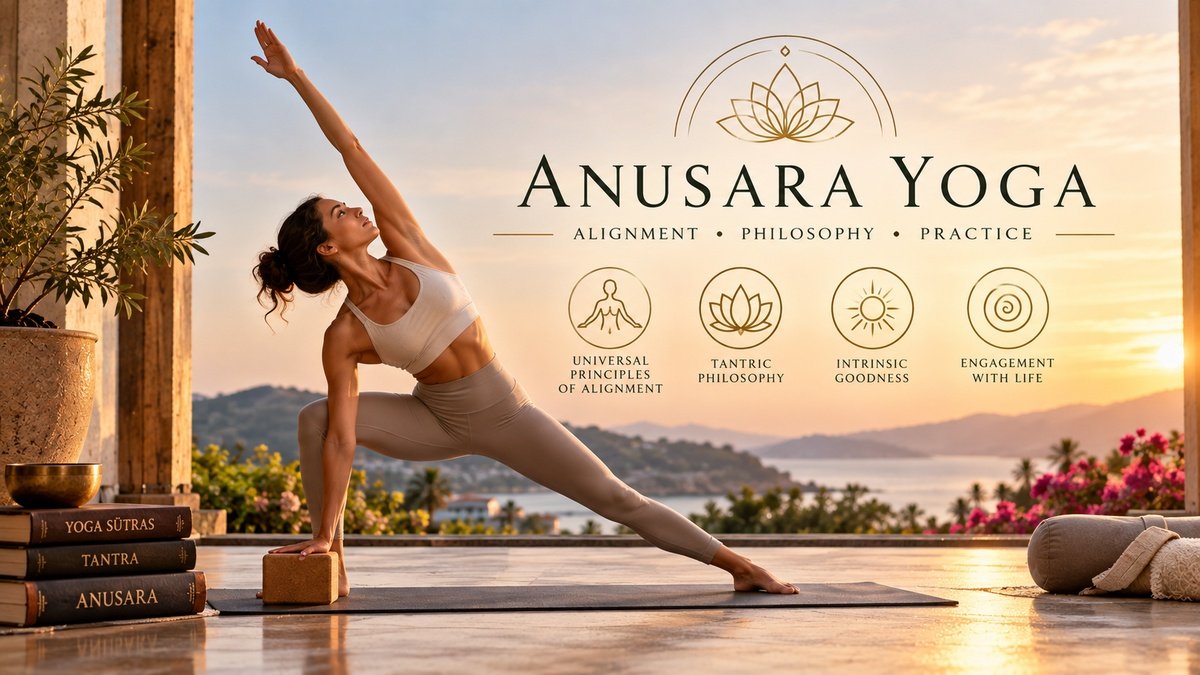
Anusara Yoga is a modern method of Haṭha Yoga known for two closely connected elements: a systematic approach to physical alignment and a philosophical framework that encourages practitioners to engage with life rather than withdraw from it.
A class may include detailed alignment instruction, flowing movement, longer-held postures, breath awareness, meditation and philosophical teaching.
Yet the method is not defined simply by precise posture.
Its physical methodology developed alongside a particular interpretation of non-dual Tantric philosophy. Within that framework, practice becomes an opportunity to recognise value within embodied life rather than treating the body or material world simply as obstacles to spiritual development.
Anusara also has a complicated institutional history.
John Friend founded the method in the United States in 1997. It expanded rapidly before a major ethical and organisational crisis surrounding its founder in 2012. Teachers subsequently reorganised the tradition through an independent, teacher-led school.
So what is Anusara Yoga? Who developed it? What are its Universal Principles of Alignment? What does “Open to Grace” mean? How does philosophy influence the physical practice? And what happened to Anusara after its founder left its leadership?
What Is Anusara Yoga?
Anusara Yoga is a modern Haṭha Yoga method founded by American yoga teacher John Friend in 1997.
The method integrates āsana, breath, meditation, philosophy and a detailed system of alignment principles.
Its physical practice can vary considerably. Some classes incorporate flowing sequences, while others spend more time exploring individual postures and their relationships.
Rather than prescribing one fixed series, Anusara gives teachers a methodological framework within which they can construct different sequences.
One of its best-known features is the Universal Principles of Alignment: a system intended to organise how practitioners approach movement and posture.
However, alignment represents only part of the method.
Anusara also places philosophical intention at the centre of practice. Teachers commonly develop a class around a theme and connect that theme with movement, breath and attention.
What Does Anusara Mean?
Anusāra is a Sanskrit word with meanings connected with following, going after, accordance or conformity with something.
The modern Anusara tradition has commonly rendered the name more poetically through expressions such as “flowing with grace”, “following your heart” or “flowing with nature”.
These phrases express the philosophy that developed around the modern method, but they should not be mistaken for a complete literal translation of the Sanskrit term.
This distinction matters.
As with many Sanskrit terms used within contemporary yoga, the historical word has a linguistic life broader than the modern school that adopted it.
Who Founded Anusara Yoga?
John Friend founded Anusara Yoga in 1997.
Before establishing the method, Friend studied several approaches to yoga. Iyengar Yoga became a particularly significant influence on his understanding of alignment, although he also studied with teachers from other traditions.
Friend wanted to develop principles that practitioners could apply across many different postures rather than memorising a separate collection of alignment instructions for every āsana.
This project contributed to the development of the Universal Principles of Alignment.
During the following decade, Anusara expanded rapidly. A substantial international teacher community developed around the method, supported by teacher training, licensing and a distinctive philosophical identity.
By the beginning of the 2010s, it had become one of the most visible contemporary yoga schools to emerge from the United States.
Is Anusara Yoga Part of the Iyengar Tradition?
No, although Iyengar Yoga influenced its development.
John Friend studied Iyengar Yoga extensively before founding Anusara, and both approaches became known for taking alignment seriously.
Nevertheless, they are distinct systems.
Iyengar Yoga developed through the work of B.K.S. Iyengar and includes its own approach to sequencing, props, timing, observation and progressive study of āsana and prāṇāyāma.
Anusara developed a different alignment vocabulary and combined it with a particular contemporary interpretation of Tantric philosophy.
Recognising influence therefore does not require treating the two methods as interchangeable.
What Are the Universal Principles of Alignment?
The Universal Principles of Alignment, often abbreviated to UPAs, provide a framework for organising physical practice within Anusara Yoga.
Rather than supplying a different rule for every posture, the system identifies principles that teachers and practitioners can explore across many āsanas.
The terminology has developed over time, and contemporary Anusara teaching contains both broad principles and more detailed applications.
The best-known classical presentation describes five sequential principles:
1. Open to Grace
The practitioner begins by establishing intention, attention and receptivity rather than immediately trying to manipulate the body into a particular shape.
2. Muscular Energy
This principle describes an integrating action that draws towards a focal point and creates stability and connection within the pose.
3. Inner Spiral
A set of expanding and rotational actions, particularly associated with the legs and pelvis within the traditional Anusara alignment model.
4. Outer Spiral
A complementary set of actions intended to create balance and organisation in relation to Inner Spiral.
5. Organic Energy
An expansive action extending outward from the focal point through the body.
These are teaching concepts within the Anusara system. They should not automatically be treated as universal anatomical laws or scientific descriptions of human biomechanics.
Their value lies primarily in how the method uses them to organise attention, movement and alignment.
What Does “Open to Grace” Mean in Anusara Yoga?
Open to Grace is perhaps the most recognisable phrase in Anusara Yoga.
It comes before the more explicitly physical alignment principles for a reason.
Within the method, practitioners do not begin solely by asking how to position a joint or activate a muscle.
They first establish attention and intention.
“Grace” belongs to the philosophical vocabulary of Anusara rather than to anatomical terminology. The concept reflects the tradition’s view that practice involves becoming receptive to something larger than individual effort.
Different practitioners may interpret that language differently.
For some, it carries explicitly spiritual meaning. Others may understand it through qualities such as receptivity, presence or willingness to experience what is happening before trying to change it.
What matters historically is that Anusara deliberately places an attitudinal principle before its biomechanical instructions.
What Are Muscular and Organic Energy?
Anusara uses the terms Muscular Energy and Organic Energy to describe complementary actions.
Muscular Energy generally describes movement towards integration, stability and a focal point.
Organic Energy describes expansion outward from that focal point.
The method therefore does not frame stability and expansion as opposites from which a practitioner must choose.
Instead, teachers use both concepts together.
A practitioner might first establish connection and support, then explore extension or expansion without losing that organisation.
The terminology is distinctive to the Anusara method.
Although muscles obviously participate in movement, “Muscular Energy” and “Organic Energy” should not be interpreted as scientifically established physiological energies circulating through the body.
They function as teaching models for organising movement and attention.
What Are Inner Spiral and Outer Spiral?
Inner Spiral and Outer Spiral form another complementary pair within traditional Anusara alignment teaching.
The principles describe coordinated actions involving the legs, pelvis and surrounding structures.
Teachers use them to explore relationships between rotation, expansion, grounding and organisation within different postures.
However, human movement rarely reduces neatly to one universal rotational formula.
Body proportions, joint structure, mobility, the particular āsana and the intended action can all affect how a movement is expressed.
For that reason, the spirals are best understood as part of Anusara’s teaching methodology rather than immutable rules governing every human body.
Does Alignment Mean There Is One Perfect Pose?
Not necessarily.
Alignment systems can sometimes be interpreted as though every body should reproduce one externally ideal form.
That assumption deserves scrutiny.
Human bodies vary in proportions, skeletal structure, mobility, strength, experience and movement history.
A useful alignment principle therefore needs enough flexibility to respond to the person who is practising.
Anusara’s principles provide a framework for exploring organisation within a posture. They do not remove the need for observation, adaptation or individual judgement.
Precision can support practice without becoming uniformity.
What Philosophy Influences Anusara Yoga?
From its beginnings, Anusara connected its physical methodology with a modern interpretation of non-dual Tantra.
This philosophical orientation differs in important ways from traditions that describe liberation primarily through separation from material existence.
Within Anusara’s teaching, embodied life can become part of spiritual practice rather than something that must simply be rejected or transcended.
The body, relationships, sensory experience and ordinary life can therefore become contexts in which awareness and meaning are explored.
However, Tantra is not one single philosophy.
Historically, the term encompasses diverse traditions, texts, ritual systems, theological positions and practices that developed across South Asia over many centuries.
Contemporary Anusara represents one modern engagement with parts of that much larger history.
It should not be treated as though it represents Tantra in its entirety.
What Does “Intrinsic Goodness” Mean?
The idea of intrinsic goodness became central to Anusara’s philosophical presentation.
In broad terms, the method begins from an affirmative view of existence.
Practice does not start from the assumption that the body, world or practitioner is fundamentally defective and must somehow become worthy.
Instead, yoga becomes a process of recognising, expressing and participating more skilfully in an underlying reality that the tradition understands positively.
This is a philosophical proposition, not a scientific finding.
It also should not be used to deny difficulty, suffering, harmful behaviour or the need for ethical accountability.
An affirmative philosophy does not require pretending that every experience or action is beneficial.
What Is a Heart Theme in Anusara Yoga?
Anusara teachers often organise classes around a heart theme.
The theme provides a philosophical or reflective thread that connects different parts of the class.
A teacher might explore qualities such as courage, steadiness, receptivity, relationship or participation.
Rather than delivering a separate philosophy lecture, the teacher can return to the theme while introducing breath, movement and alignment.
The intention is to connect what happens physically with a wider enquiry.
At its most effective, a theme offers context without dictating what a practitioner should feel.
It can invite reflection while leaving room for individual experience.
What Happens in an Anusara Yoga Class?
There is no single fixed Anusara sequence.
A teacher typically constructs a class around a particular intention or group of postures.
The practice may include centring, an opening invocation, breath awareness, flowing movement, standing postures, balances, backbends, twists, forward bends, inversions or quieter floor-based work.
Teachers integrate the Universal Principles of Alignment throughout the sequence rather than presenting them only as theoretical concepts.
A philosophical theme may also connect the physical practice with the broader worldview of the method.
Consequently, an Anusara class can feel both technically detailed and expressive.
The precise balance varies according to the teacher, students and purpose of the session.
Is Anusara Yoga a Form of Hatha Yoga?
Yes. The contemporary organisation calls itself the Anusara School of Hatha Yoga.
However, the word Hatha Yoga requires context.
Modern studios often use “Hatha” to describe a relatively measured posture class. Historically, Haṭhayoga refers to a much broader family of yogic methods that developed in premodern India.
Anusara belongs to modern transnational postural yoga and draws selectively from older yoga traditions and philosophical ideas.
Calling it a modern form of Haṭha Yoga therefore does not mean that its Universal Principles of Alignment existed in medieval Haṭhayoga texts.
They are features of the modern Anusara method.
Is Anusara Yoga the Same as Vinyasa Yoga?
No, although an Anusara class can include vinyāsa.
Vinyasa Yoga is a broad contemporary category in which teachers commonly link movement and breath through creatively constructed sequences.
Anusara has a more specifically defined alignment methodology and philosophical framework.
A teacher can therefore use flowing transitions within an Anusara class without turning Anusara into another name for Vinyasa Yoga.
The two categories can overlap without becoming identical.
Is Anusara Yoga Suitable for Beginners?
Beginners can practise Anusara Yoga, although the experience depends considerably on the class and teacher.
Detailed alignment instruction can provide useful structure when learning unfamiliar movements.
At the same time, specialised terminology such as Muscular Energy, Organic Energy and the spirals can initially feel unfamiliar.
A skilled teacher introduces these ideas progressively rather than expecting a new practitioner to understand the entire system immediately.
Physical demands also vary.
Some classes may be accessible and methodical, while others can include substantial strength, balance, mobility or more complex āsanas.
As elsewhere in yoga, “beginner” describes experience rather than a single type of body.
What Happened to Anusara Yoga in 2012?
Anusara Yoga underwent a major leadership and organisational crisis in 2012.
Allegations concerning founder John Friend included inappropriate sexual relationships involving students and employees, alongside questions about organisational and financial conduct.
Friend acknowledged sexual relationships with students and employees and subsequently stepped away from leadership.
The controversy prompted numerous prominent teachers to resign and raised wider questions about power, professional boundaries and governance within the organisation.
The significance of this history extends beyond one individual’s behaviour.
It demonstrates what can happen when a large teaching community, commercial organisation and charismatic authority become heavily concentrated around one person.
Understanding a yoga tradition responsibly includes examining not only its techniques and philosophy but also the structures through which authority operates.
What Happened to Anusara Yoga After John Friend?
The method did not disappear when Friend left its leadership.
Teachers reorganised the tradition during 2012 and established the independent Anusara School of Hatha Yoga.
The new organisation adopted a teacher-led governance structure rather than returning control to a single founder.
It also assumed responsibility for the Anusara curriculum, licensing and teacher certification.
John Friend was not part of the new school’s decision-making structure.
This distinction is essential when discussing Anusara today.
The historical founder and the contemporary organisation are related, but they are not institutionally identical.
Modern Anusara Yoga continues through an international community that has developed beyond Friend’s leadership.
What Can Anusara’s History Teach Us About Yoga Communities?
The history raises questions that extend beyond Anusara itself.
Technical knowledge does not automatically guarantee ethical conduct.
Spiritual language does not remove ordinary professional responsibilities.
Likewise, admiration for a teacher does not eliminate the importance of boundaries, accountability and transparent governance.
A method can also outlive the person who founded it.
Communities may preserve useful practices while reconsidering authority structures and acknowledging harmful aspects of their history.
Those processes are rarely simple, but they form part of understanding how modern yoga traditions evolve.
What Are the Potential Benefits of Anusara Yoga?
Practitioners may value Anusara for several different reasons.
Its alignment framework can encourage detailed attention to movement. Sequencing can develop strength, mobility, coordination and balance according to the nature of the class.
Breath awareness and meditation introduce contemplative dimensions, while philosophical themes can provide material for reflection.
However, these possibilities should not become guaranteed therapeutic claims.
Anusara Yoga should not be presented as a treatment for pain, injury, anxiety, depression, trauma or other medical and psychological conditions without appropriate evidence and professional context.
Alignment instruction can support exploration, but no alignment system can guarantee that injury will never occur.
A Common Misunderstanding: Alignment Is Not the Same as Correcting the Body
Alignment language can easily create a hierarchy between “correct” and “incorrect” bodies.
Anusara offers a sophisticated system for organising posture, but no system removes human variation.
Different skeletal structures, proportions, histories and capacities influence how people move.
The useful question is therefore not simply whether someone’s pose matches a photograph or predetermined template.
We can ask instead what the instruction is trying to achieve, how the practitioner experiences it and whether another expression would serve that function more appropriately.
Precision and adaptation do not need to compete.
An alignment principle becomes more useful when it helps us understand a body, rather than asking every body to look the same.
An Orenna Perspective: Precision Without Uniformity
There is value in paying attention to detail.
The position of a foot can change an experience. So can the direction of movement, the distribution of effort, the rhythm of breathing or the relationship between stability and expansion.
Yet precision does not require us to believe that every person should arrive at an identical shape.
Anusara is particularly interesting when we hold these two ideas together.
Structure can provide a language for enquiry. Individual experience can tell us how that language needs to change.
The same principle can produce different visible outcomes because people are different.
This is not a failure of alignment.
It may be evidence that alignment has become responsive rather than merely prescriptive.
The purpose of precision need not be sameness. It can be greater clarity about what we are actually doing.
References & Further Reading
Anusara School of Hatha Yoga. Official resources on the contemporary Anusara method, its philosophy, alignment methodology, teacher education and international school.
Friend, John. Historical Anusara teaching materials concerning the Universal Principles of Alignment. These materials are relevant to understanding the development of the original methodology, while contemporary Anusara now operates independently of its founder.
Yoga Journal. Interview with Anusara Yoga Founder John Friend (2010). A useful historical source documenting Friend’s account of founding Anusara in 1997 and developing the five-part Universal Principles of Alignment.
Yoga Journal. Reporting from 2012 on the allegations concerning John Friend, his departure from leadership and the subsequent restructuring of the Anusara community.
Singleton, Mark & Goldberg, Ellen, eds. (2014). Gurus of Modern Yoga. Oxford University Press. Provides broader scholarly context for authority, lineage and guru relationships within modern yoga.
Mallinson, James & Singleton, Mark. (2017). Roots of Yoga. Penguin Classics. Primary-source translations providing wider historical context for the diversity of premodern yoga traditions.



