


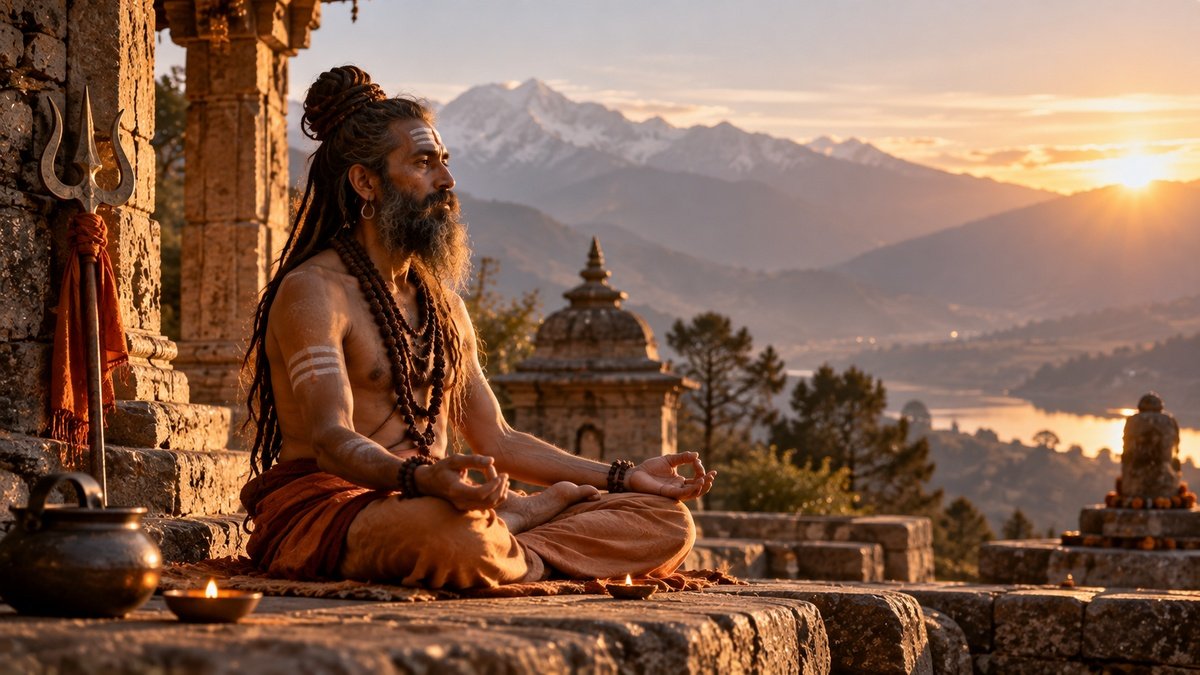
Ask what Hatha Yoga means today and you may hear a familiar answer: a slower yoga class in which postures are held individually rather than connected through continuous flow.
That description can be useful when reading a contemporary studio timetable.
Historically, however, it tells only a small part of the story.
Haṭhayoga emerged in medieval India as a collection of physical methods for transforming yogic practice. Its practitioners worked not only with āsana but also with the breath, mudrā, bandha and other techniques concerned with the body, vital energies and states of consciousness.
Over centuries, these practices developed across different traditions. They were collected, reorganised and reinterpreted, eventually contributing significantly to the forms of physical yoga practised around the world today.
So what is Haṭha Yoga? Where and when did it develop? Who practised it? What did haṭha originally mean? Why were physical techniques used? And how did a complex premodern yoga tradition become the name of a modern studio class?
What Is Hatha Yoga?
The answer depends partly on which historical period we are discussing.
In contemporary yoga culture, Hatha Yoga often describes a general posture-based class taught at a relatively measured pace. Individual āsanas may be explored separately, with pauses between them rather than continuous flowing transitions.
In its historical context, however, Haṭhayoga meant something considerably more specific.
It developed as a form of yoga in which physical techniques played an important role in pursuing yogic goals. Depending on the period and text, those techniques could include āsana, regulation or retention of the breath, mudrās, bandhas, cleansing practices and methods concerned with the subtle body.
Some of these techniques later became familiar elements of modern yoga. Others remain comparatively unusual in contemporary general classes.
Modern Hatha Yoga and premodern Haṭhayoga are therefore related, but they are not identical.
What Does the Word Haṭha Mean?
The Sanskrit word haṭha has generated one of modern yoga’s most persistent explanations.
Students are sometimes told that ha means sun and ṭha means moon, making Haṭha Yoga a practice that unites opposing solar and lunar energies.
That explanation appears in some later yogic interpretations, but it should not be presented as the straightforward linguistic derivation of the word.
Research by yoga historian Jason Birch has examined the use of haṭha in early Sanskrit sources. In these contexts, the word carries meanings associated with force, forceful means or a particular kind of method rather than deriving simply from two syllables meaning sun and moon.
This does not make later symbolic interpretations meaningless. It means we should distinguish historical etymology from later interpretative traditions.
The distinction is small but important.
A memorable explanation is not necessarily the same thing as a historical derivation.
Where Did Haṭha Yoga Come From?
Haṭhayoga developed in the Indian subcontinent within a complex environment of ascetic, tantric and yogic traditions.
There was no single institution called Haṭha Yoga from which the entire tradition suddenly appeared.
Instead, techniques emerged and circulated between different communities.
Research undertaken by the Haṭha Yoga Project at SOAS University of London has substantially expanded scholarly understanding of this history. By studying Sanskrit texts alongside evidence from living traditions, researchers have traced the development of physical yoga practices across religious and sectarian boundaries.
Some important techniques associated with later Haṭhayoga have roots in Buddhist tantric traditions. They were subsequently adopted, transformed and incorporated into other yogic systems.
Over time, Haṭhayoga became increasingly influential within several Indian religious traditions.
This history makes a simple label such as Hindu physical yoga inadequate for describing its origins.
When Did Haṭha Yoga Develop?
Scholars locate important early developments around the turn of the second millennium CE.
The Amṛtasiddhi, composed around the eleventh century, contains physical yogic techniques that became foundational to later Haṭhayoga, although the text itself does not use the term Haṭhayoga for its system.
By approximately the twelfth and thirteenth centuries, texts were beginning to describe systems recognisably associated with Haṭha.
The Dattātreyayogaśāstra, composed around 1200 CE, is particularly important. It explicitly teaches Haṭhayoga and presents both an eightfold approach and another method involving physical techniques.
Further texts developed these practices over the following centuries.
By the fifteenth century, the Haṭhapradīpikā brought material from earlier traditions together into an influential synthesis.
Haṭhayoga therefore developed historically rather than appearing as one complete system at a single moment.
Who Invented Hatha Yoga?
No single historical individual can accurately be described as the inventor of Haṭhayoga.
Its techniques developed across multiple traditions and generations of practitioners.
Premodern texts sometimes associate teachings with revered figures such as Ādinātha, Matsyendra and Gorakṣanātha. Gorakṣanātha, in particular, became strongly connected with Nāth yogic traditions and with later accounts of Haṭhayoga’s development.
These lineage traditions are historically important, but they should not be converted automatically into a modern inventor narrative.
Texts associated with different communities preserve different configurations of techniques, teachings and lineages.
Haṭhayoga is therefore better understood as an evolving tradition than as the creation of one founder.
What Did Early Haṭha Yogis Actually Practise?
The answer may surprise someone familiar only with modern yoga classes.
Premodern Haṭhayoga certainly included āsana, but posture was only one component of a wider technology of practice.
Texts describe techniques involving control and retention of the breath, manipulation of the body, mudrās and bandhas, concentration, subtle-body models and states of meditative absorption.
Some traditions also incorporated cleansing techniques known as ṣaṭkarma.
The exact collection of practices varied between texts and historical periods.
Importantly, early Haṭhayoga was not simply a large catalogue of standing poses, balances and stretches resembling a twenty-first-century studio class.
Seated postures initially held particular importance, while the repertoire of non-seated āsanas expanded considerably in later yoga traditions.
The history of physical yoga is therefore a history of change as well as continuity.
What Is the Haṭhapradīpikā?
The Haṭhapradīpikā is one of the best-known premodern texts associated with Haṭhayoga.
Compiled by Svātmārāma around the fifteenth century, it drew extensively upon earlier yogic material rather than creating Haṭhayoga from nothing.
The text organises its teaching around practices including āsana, prāṇāyāma, mudrā and samādhi.
It also presents Haṭhayoga in relationship with Rājayoga, framing Haṭha as part of a broader yogic process rather than as physical exercise for its own sake.
The Haṭhapradīpikā became particularly influential in shaping later understandings of what constituted Haṭhayoga.
For modern readers, however, it requires historical context.
Reading a medieval yoga manual as though it were a contemporary teacher-training handbook can obscure both its language and its purpose.
Why Did Haṭha Yoga Use the Body?
Modern exercise culture often treats the body as the final object of physical practice: something to strengthen, stretch, condition or reshape.
Premodern Haṭhayoga worked within a different conceptual world.
The body became an instrument through which practitioners sought to influence breath, vital processes and states of consciousness.
Texts describe subtle-body structures and processes using concepts such as prāṇa, nāḍī, bindu and kuṇḍalinī. Their meanings and importance vary across traditions.
These concepts belong to historical yogic models of the body and should not automatically be translated into modern anatomical structures or biomedical mechanisms.
Doing so can make a premodern system appear scientifically equivalent to modern physiology when the two are operating within different explanatory frameworks.
The physical practices of Haṭhayoga were therefore embodied, but their aims extended beyond what we would now call physical fitness.
What Role Did Āsana Play in Haṭha Yoga?
Āsana was important, but its historical role changed considerably.
Early yoga traditions often emphasised seated postures suitable for sustained yogic practice.
Premodern Haṭha texts gradually documented a wider variety of bodily positions. Later works expanded the repertoire further, including increasingly complex non-seated āsanas.
By the early modern period, textual and visual evidence demonstrates a much richer culture of postural experimentation.
Nevertheless, the enormous emphasis placed on āsana in many modern yoga environments represents a significant shift in proportion.
A contemporary class may spend almost its entire duration moving through postures.
For premodern Haṭhayoga practitioners, āsana existed within a broader collection of methods.
Posture was part of Haṭhayoga; Haṭhayoga was never simply another word for posture.
What Role Did Prāṇāyāma Play?
Breath practices occupy a prominent position in Haṭha literature.
In many premodern contexts, however, prāṇāyāma involved considerably more than calm or mindful breathing.
Retention of the breath — kumbhaka — became particularly important.
Texts describe different methods of regulating inhalation, exhalation and retention, sometimes alongside bandhas and mudrās.
The Haṭhapradīpikā, for example, describes several varieties of kumbhaka, including techniques whose names remain familiar in contemporary yoga.
Modern teachers may adapt, reinterpret or omit such practices according to context and training.
Consequently, encountering a breathing technique with an old Sanskrit name does not necessarily mean that its contemporary execution is identical to its premodern form.
What Are Mudrā and Bandha?
Mudrā and bandha became central components of many Haṭhayoga systems.
In contemporary yoga classes, bandhas are sometimes described primarily as muscular engagements — particularly around the pelvic floor or abdomen.
Historical Haṭha texts present a more complex picture.
These practices belonged to systems concerned with controlling internal processes according to premodern yogic models of the body. Some involved distinctive physical configurations, breath retention and manipulation of what the texts understood as vital substances or energies.
Likewise, the word mudrā in Haṭhayoga does not refer only to symbolic hand gestures.
Some Haṭha mudrās are substantial whole-body practices.
This is another example of terminology changing as yoga practices travel between periods and teaching environments.
Was Haṭha Yoga Separate from Patañjali’s Yoga?
The relationship is more complicated than a simple yes or no.
Patañjali’s Yoga Sūtras predate the major textual development of Haṭhayoga by many centuries.
Haṭhayoga therefore did not begin as another name for Patañjali’s eight-limbed system.
Yet later yoga traditions interacted with earlier systems, borrowed terminology and combined methods in new ways.
The Dattātreyayogaśāstra, for example, is significant because it presents Haṭhayoga in relation to an eightfold yogic structure.
The Haṭhapradīpikā later connected Haṭha strongly with Rājayoga.
Yoga traditions did not remain sealed inside separate historical boxes.
They borrowed, reorganised and reinterpreted practices and ideas.
That is one reason why modern attempts to reduce yoga history to a single uninterrupted system can be misleading.
Is Hatha Yoga the Origin of Modern Postural Yoga?
Haṭhayoga is one important historical source of modern physical yoga, but the relationship is not a simple line of unchanged transmission.
Premodern Haṭha traditions established extensive traditions of working physically with āsana, breath and other embodied techniques.
Modern yoga subsequently developed within very different historical conditions.
During the nineteenth and twentieth centuries, Indian teachers interacted with changing ideas about physical culture, health, education, nationalism and international fitness movements. Postural repertoires expanded and teaching formats changed.
Modern yoga therefore inherited important material from earlier Haṭhayoga while also transforming it.
The presence of an ancient-looking posture or Sanskrit name does not by itself demonstrate an unchanged practice extending back for centuries.
Continuity and innovation can exist at the same time.
Why Does Hatha Yoga Mean Something Different Today?
As yoga developed into an international studio culture, Hatha acquired a useful new function.
It became a broad label for posture-based yoga that was not necessarily identified with a more specific modern method such as Iyengar, Ashtanga or Vinyasa.
Many studios now use Hatha Yoga to indicate a class in which individual postures receive more time and transitions are less continuous.
That convention can help students choose a class.
However, it is a modern convention rather than a complete definition of historical Haṭhayoga.
This explains an apparent contradiction.
A contemporary teacher can quite legitimately advertise a slower Hatha class while a historian can equally legitimately explain that Haṭhayoga was not historically defined by being slow.
They are using the same term within different contexts.
What Happens in a Modern Hatha Yoga Class?
There is no universally prescribed Hatha Yoga sequence.
A contemporary class may include an arrival or centring period, individual āsanas, standing and floor-based postures, some form of breath awareness or prāṇāyāma, and a concluding period of stillness or relaxation.
The exact structure depends on the teacher, training tradition, students and purpose of the session.
Compared with many Vinyasa Yoga classes, transitions may receive less emphasis and individual postures may be explored for longer.
Yet Hatha does not inherently mean easy, beginner-level or gentle.
A slowly explored posture can be physically demanding. Conversely, a Hatha class can also be adapted to create a quieter and more accessible experience.
The class description and teacher therefore tell you more about likely intensity than the word Hatha alone.
How Is Hatha Yoga Different from Vinyasa Yoga?
In contemporary studio language, the main difference usually concerns how the practice is organised.
Vinyasa commonly emphasises the relationship between movement and breath while linking postures through deliberately constructed transitions.
Modern Hatha classes often treat individual postures as more discrete units, allowing additional time for instruction, observation or repetition.
These boundaries are not absolute.
A Hatha teacher can link movements together, while a Vinyasa teacher can pause to examine an individual posture.
Historically, the comparison becomes even more complicated because modern Vinyasa itself ultimately belongs to the much wider history of physical yoga influenced by earlier Haṭha traditions.
Hatha and Vinyasa are therefore useful contemporary class labels, but they should not be mistaken for two completely unrelated forms of yoga.
How Is Hatha Yoga Different from Iyengar Yoga?
Iyengar Yoga is a defined modern method developed through the work of B.K.S. Iyengar.
It has a recognisable pedagogical tradition, certification structure and characteristic emphasis on detailed instruction, sequencing and the considered use of props.
Modern Hatha Yoga is a much broader label.
A Hatha teacher may draw from several training influences and organise classes in many different ways.
There can certainly be overlap. Both classes might explore individual postures without continuous flow, for example.
But similarity in pace does not make the methods equivalent.
How Is Hatha Yoga Different from Ashtanga Yoga?
Modern Ashtanga Yoga is organised around established sequences that practitioners progressively learn and repeat.
Modern Hatha Yoga does not require one fixed sequence.
A teacher may select and arrange postures differently from one class to another.
Historically, however, the terminology requires additional care.
Aṣṭāṅga means eight limbs and appears in older yoga traditions, while Haṭha refers to a family of physical yogic methods that developed later.
The contemporary studio methods called Hatha and Ashtanga should therefore not be projected backwards unchanged into medieval yoga history.
Who Can Practise Hatha Yoga?
Because modern Hatha Yoga is such a broad category, classes can be designed for many different practitioners.
That does not mean every Hatha class is appropriate for every person.
The individual teacher, sequence, pace, duration and degree of adaptation still matter.
Someone new to yoga may appreciate a class that provides time to understand individual postures. An experienced practitioner may use the same measured pace to investigate familiar movements in considerably greater detail.
Props and adaptations can also alter the conditions of practice when appropriate.
None of this makes an adapted posture a lesser form of yoga.
The relevant question is whether the practice is appropriate for the person and the purpose of the session.
Is Hatha Yoga Good for Beginners?
It can be, but the label alone cannot guarantee it.
A well-designed introductory Hatha class may give students time to understand terminology, explore basic movements and become familiar with how a yoga class works.
Another class carrying exactly the same label could contain demanding postures or assume considerable previous experience.
For beginners, the most useful information is therefore the class description rather than the word Hatha by itself.
Look for the stated level, pace and teaching approach, and ask whether adaptations are available if that information is unclear.
What Are the Benefits of Modern Hatha Yoga?
Modern Hatha classes can provide opportunities for physical activity, mobility, strength, balance, coordination, breathing practices, attention and periods of rest.
Exactly what someone experiences depends on the content of the class, its intensity, frequency of practice and individual circumstances.
Research into yoga has explored a wide range of physical and psychological outcomes. However, yoga and Hatha Yoga can describe highly varied interventions across research studies.
For that reason, broad statements such as Hatha Yoga cures anxiety, balances hormones or detoxifies the body go beyond what responsible interpretation allows.
A more useful approach is to describe what the practice actually contains and allow benefits to be considered in relation to those activities.
Is Hatha Yoga a Spiritual Practice?
Historically, Haṭhayoga developed within explicitly yogic and religious worlds in which physical techniques served aims extending far beyond exercise.
Contemporary Hatha Yoga operates across a much wider spectrum.
One teacher may integrate philosophy, meditation, prāṇāyāma and ethical reflection. Another may concentrate primarily on āsana. A participant may approach the same class for movement, contemplation, curiosity or several reasons at once.
There is therefore no single answer that describes every modern Hatha class.
What history does make clear is that reducing Haṭhayoga to stretching removes much of the context from which the tradition developed.
A Common Misunderstanding: Hatha Does Not Simply Mean Gentle Yoga
The modern association between Hatha and slower classes is now widespread enough to be useful.
The problem begins when that convention is projected backwards and treated as the historical meaning of the tradition.
Premodern Haṭhayoga included practices that could be highly demanding and technically complex.
Its defining characteristic was not that practitioners moved slowly.
Nor does a modern Hatha class automatically become less sophisticated because it uses a slower pace.
Speed tells us surprisingly little about the depth of a practice.
Slow is a tempo. Haṭha is a much larger history.
An Orenna Perspective: A Name Can Carry More Than One Meaning
Yoga terminology rarely remains still.
Words travel between languages, centuries, traditions and teaching environments. In doing so, their meanings can expand, narrow or change.
Hatha offers a particularly useful example.
On a studio timetable, the word may tell us something practical: expect a measured posture-based class rather than continuous flow.
Look further back, however, and the same word opens onto centuries of experimentation with posture, breath, mudrā, embodied discipline and changing ideas about what yoga can do.
We do not need to reject the modern meaning in order to understand the older one.
We simply need to know which meaning we are using.
Understanding the history does not make contemporary Hatha Yoga less valid. It makes the name more interesting.
References & Further Reading
Mallinson, James & Singleton, Mark. (2017). Roots of Yoga. Penguin Classics. A collection of translated primary sources documenting the diversity of yoga practices and ideas across Indian traditions.
Birch, Jason. “The Meaning of Haṭha in Early Haṭhayoga.” Journal of the American Oriental Society, 131.4. An important study of the historical meaning and early use of the term haṭha.
SOAS University of London — The Haṭha Yoga Project. A major research project examining the history of physical yoga through Sanskrit textual research and ethnographic study. Explore the Haṭha Yoga Project.
Birch, Jason. (2024). The Amaraugha and Amaraughaprabodha of Gorakṣanātha: The Genesis of Haṭha and Rājayoga. A study, critical edition and translation of an important early work in the development of Haṭhayoga.
Mallinson, James. (2024). The Dattātreyayogaśāstra. Critical edition and translation of an important early Sanskrit text explicitly teaching Haṭhayoga.
Singleton, Mark. (2010). Yoga Body: The Origins of Modern Posture Practice. Oxford University Press. An influential study of the historical development of modern postural yoga.



