


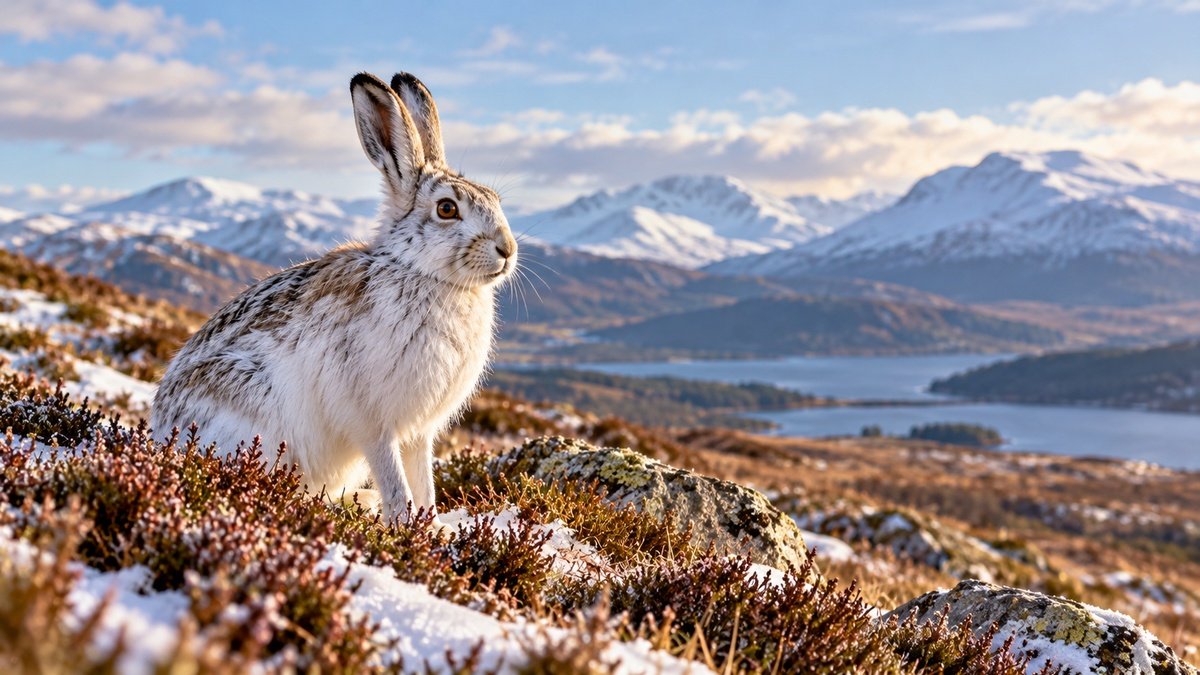
Mountain hares in Scotland live within landscapes where change is difficult to ignore. Across upland heath, moorland and mountain ground, daylight shifts, vegetation changes, temperatures rise and fall, and snow can transform the appearance of the land.
The hare changes too.
Through the year, its coat moves between darker summer colouring and the much paler fur associated with winter. The transformation is one of the most distinctive seasonal adaptations among Scotland’s mammals.
Yet the relationship between animal and landscape is not perfectly synchronised.
A hare may become pale while the ground around it remains dark. Snow may disappear while winter fur remains. As Scotland’s snow seasons have shortened, researchers have found that this mismatch has become more frequent in the populations they studied.
The mountain hare therefore offers more than an example of seasonal camouflage.
It reveals what can happen when an adaptation shaped by one pattern of seasons encounters a landscape whose timing is changing.
Mountain Hares in Scotland
The mountain hare, Lepus timidus, is one of two hare species found in Scotland.
Unlike the brown hare, which is strongly associated with farmland and other lowland habitats in many parts of Britain, the mountain hare is particularly associated with Scotland’s uplands.
Its distribution includes heath, moorland and mountain environments, with particularly important populations in the central and eastern Highlands.
Mountain hares also occur in some areas of upland forestry and other habitats where suitable food and cover are available.
The species is well adapted to environments that can change substantially through the year.
Perhaps the clearest evidence of that adaptation is written directly into its coat.
A Coat That Changes With the Seasons
During the warmer part of the year, Scottish mountain hares generally have a brown or grey-brown coat.
As winter approaches, they moult and become considerably paler. Many develop predominantly white winter fur, although individual appearance can vary.
When spring arrives, another moult gradually returns the coat towards its darker summer colouring.
This is not simply a change in appearance.
Seasonal coat colour can contribute to camouflage. Against snow, pale fur can make an animal less conspicuous than a dark coat would be.
However, camouflage depends upon a relationship between the animal and its background.
A white hare against snow may be difficult to notice. The same white hare against dark heather can become conspicuous.
That difference leads to one of the most interesting questions currently surrounding the species.
When the Coat and the Landscape No Longer Match
The timing of seasonal coat change does not simply follow whether snow happens to be lying on the ground on a particular morning.
Mountain hares undergo seasonal moults according to biological processes shaped by environmental cues and evolutionary history.
Meanwhile, the duration of snow cover can change.
Researchers studying mountain hares in the Scottish Highlands compared modern observations with field studies dating from the 1950s. Across their study sites, seasonal temperatures had increased and snow-cover duration had declined.
The timing of the hares’ moults had not shifted sufficiently to keep pace with that shorter snow season.
As a result, the researchers calculated approximately 35 additional days of camouflage mismatch between the 1950s and 2016.
In practical terms, this meant more time when predominantly white hares were present against largely snow-free backgrounds.
The finding does not mean that every mountain hare experiences exactly 35 additional mismatched days each year. The study examined population-level patterns across particular Highland study sites and historical periods.
Nevertheless, it provides a striking example of how changing environmental conditions can alter the effectiveness of an established seasonal adaptation.
Can a Mountain Hare Simply Hide Somewhere Else?
At first, there seems to be an obvious solution.
If a white hare stands out against dark ground, perhaps it could choose a patch of snow instead.
Researchers have tested this possibility in Scottish mountain hares.
A study published in 2024 examined whether hares altered their behaviour when their coat colour contrasted more strongly with the surrounding landscape.
The researchers found no evidence that the hares changed the behaviours measured in ways that compensated for increasing camouflage mismatch.
This is an important distinction.
Animals can sometimes respond behaviourally to environmental change, but we should not assume that every species can simply recognise a new problem and immediately adjust its behaviour to solve it.
Adaptation operates within biological possibilities and constraints.
The Landscape Does Not Change on a Schedule
Our earlier article on Highland weather explored how quickly atmospheric conditions can transform the experience of a place.
Mountain environments make that variability particularly visible.
Snow may settle and disappear. A slope can remain white while lower ground is bare. Conditions on one side of a mountain may differ from those only a short distance away.
Seasonal averages can change while individual days remain unpredictable.
For mountain hares, therefore, the challenge is not simply that winter becomes ‘warmer’.
The relationship between temperature, snow cover, vegetation and timing can shift in more complicated ways.
An animal adapted to seasonal change must live within that variability.
Mountain Hare, Brown Hare or Rabbit?
Mountain hares are sometimes described as though they were simply rabbits living at higher altitude.
They are not.
Mountain hares, brown hares and European rabbits are related, but they are distinct species.
The mountain hare is Lepus timidus.
The brown hare is Lepus europaeus.
The European rabbit is Oryctolagus cuniculus.
Hares also differ from rabbits in important aspects of their biology.
Rather than using extensive burrow systems like rabbits, mountain hares usually rest above ground in shallow depressions known as forms. Hare leverets are born furred and comparatively well developed, whereas rabbit young are born in nests underground and are initially much less developed.
Even closely related animals can therefore occupy landscapes in very different ways.
What Do Mountain Hares Eat?
Mountain hares are herbivores.
Their diet varies with habitat, season and what vegetation is available.
Heather can form an important part of the diet in Scottish upland habitats. Hares can also feed on grasses, sedges and other plant material, while woody plants may become more important under some winter conditions.
Food therefore links the hare directly to vegetation management and habitat condition.
A moorland is not simply an open space through which the animal moves. It is also where the hare feeds, rests, shelters and reproduces.
As with the woodland species explored elsewhere in The Orenna Journal, habitat means more than scenery.
For wildlife, landscape is lived space.
Life Above Ground
A mountain hare does not retreat into a rabbit-like warren when it needs to rest.
Instead, it can use a shallow resting place among vegetation or terrain.
This way of living makes the structure of the surrounding habitat particularly relevant.
Heather, uneven ground, rocks, vegetation and snow can all influence cover and shelter.
When disturbed, a hare may remain still before suddenly moving at considerable speed.
That behaviour also explains why responsible observation matters.
An animal that appears motionless has not necessarily failed to notice someone approaching. Remaining still can itself be part of its response.
A Landscape Shared With Predators
Mountain hares form part of a wider upland food web.
They can provide prey for predators including golden eagles.
Our article on golden eagles in Scotland considered those birds within the wider mountain landscape.
Looking at mountain hares from the other side of that relationship reminds us that predator and prey cannot be understood entirely in isolation.
Predation is a normal ecological process.
Consequently, describing one animal as a victim and another as a villain would obscure the relationship rather than explain it.
The more useful questions concern population size, habitat, food availability, environmental change and how different pressures interact.
Mountain Hares and Managed Moorland
The relationship between mountain hares and people is also part of their Scottish history.
Some of the highest densities of mountain hares have historically occurred on managed grouse moors, where vegetation management can create extensive areas of heather habitat.
At the same time, mountain hares were historically killed both for sport and as part of land-management practices, including large-scale culls in some areas.
This combination demonstrates why apparently simple categories such as ‘managed’ and ‘wild’ can be misleading.
Human management can alter vegetation in ways that favour a species while other management practices may place pressure on the same population.
The ecological consequences depend on what is being done, where, at what intensity and for what purpose.
Mountain Hares Are Now Fully Protected in Scotland
The legal position changed significantly in 2021.
From 1 March 2021, mountain hares were added to Schedule 5 of the Wildlife and Countryside Act 1981, as amended.
They consequently receive year-round protection in Scotland.
Intentionally or recklessly killing, injuring or taking a mountain hare without the appropriate legal authority is an offence.
Licensed action can still be authorised for purposes permitted by legislation and subject to NatureScot’s licensing requirements.
The distinction matters.
Full protection does not mean that no mountain hare can ever legally be taken. It means that actions that would otherwise constitute an offence require an applicable legal basis and, where required, appropriate licensing.
Because wildlife legislation and licensing arrangements can change, current NatureScot guidance should always be consulted rather than relying on historical descriptions of mountain hare management.
A Common Misunderstanding: White Fur Means There Must Be Snow
A white mountain hare photographed against dark heather can look strangely out of place.
It may be tempting to assume that something has gone wrong with the individual animal.
The explanation is more interesting.
The hare’s seasonal coat change and the presence of snow are related, but they are not controlled by an identical day-to-day signal.
Consequently, a hare can be predominantly white even when the immediate landscape is snow-free.
Some mismatch is part of a naturally variable seasonal environment. What researchers have identified in the Scottish Highlands is an increase in the duration of that mismatch as snow seasons have shortened.
The difference between those two ideas matters.
A single photograph of a white hare on dark ground does not by itself demonstrate climate change. Long-term observations across populations and changing snow conditions provide the evidence for the broader pattern.
Seasonal Change Is More Than Colour
The dramatic winter coat naturally attracts attention, but seasonality affects much more than the colour of a hare.
Vegetation changes through the year. Food availability shifts. Temperatures and daylight vary. Reproduction has its own seasonal pattern, while weather can alter shelter and movement.
The surrounding landscape also changes visually.
Our article on Highland light explored how changing daylight can transform what we notice in the same place.
For wildlife, those seasonal changes are not merely aesthetic.
They form part of the conditions within which animals find food, avoid threats, reproduce and survive.
Seeing Mountain Hares Responsibly
A mountain hare may remain still when approached, particularly when relying on camouflage.
Stillness should not be interpreted as permission to continue moving closer.
Giving wildlife space allows an animal to continue its behaviour without repeatedly having to respond to a person’s presence.
Long lenses, binoculars and patient observation can help maintain distance where conditions allow.
Equally, there is no requirement to obtain a close photograph or direct encounter.
Tracks, habitat, distant observations and responsibly produced wildlife material can all contribute to understanding the species.
The animal does not need to alter its behaviour for an encounter to become meaningful to us.
You Do Not Need to Climb a Mountain to Understand a Mountain Hare
The name itself can create an expectation of remoteness.
Images of mountain hares often show snow-covered slopes, exposed plateaux and high Highland terrain.
Those landscapes are part of the species’ story, but reaching difficult terrain is not a measure of someone’s understanding of wildlife.
People experience the Highlands with different bodies, resources and circumstances.
Mobility, health, balance, sensory preferences, weather, transport, finances, available time, work and caring responsibilities can all shape where someone can comfortably or safely go.
Wildlife interpretation, accessible viewpoints, conservation projects, remote cameras, films, photographs, books and research can offer other ways to explore mountain hare ecology.
Even observing an upland landscape from a distance can raise useful questions about vegetation, snow, exposure and seasonal change.
Understanding a mountain species does not require proving that we can reach the highest ground.
The Orenna Perspective — The Landscape Does Not Change on a Schedule
Seasonal change can look orderly when written on a calendar.
Winter follows autumn. Spring follows winter. The dates move forward in a familiar sequence.
A landscape is less precise.
Snow may arrive early or late. It may remain on one slope and disappear from another. A mild period can interrupt winter before colder weather returns.
The mountain hare changes too, but not according to the appearance of each individual patch of ground.
Its seasonal coat reminds us that adaptation is a relationship between an organism and an environment — and relationships can become more complicated when one side begins changing at a different pace.
The story of mountain hares in Scotland therefore reaches beyond white fur and snowy photographs.
It is a story about timing.
About the difference between weather and climate, between individual observations and long-term patterns, and between being adapted to seasonal change and being able to track every new version of it.
The hare does not stand outside the landscape while the seasons happen around it.
It changes within them.
Sometimes adaptation is visible not in resisting change, but in becoming different as the landscape changes around us.
References & Further Reading
NatureScot. Hares and Rabbits. Species information and current Scottish conservation context for mountain hares, brown hares and rabbits.
NatureScot. Protected Species: Hares. Current information on the legal protection of mountain hares in Scotland.
NatureScot. Hares and Licensing. Current licensing information for mountain hares in Scotland.
Zimova, M. et al. Lack of phenological shift leads to increased camouflage mismatch in mountain hares. Proceedings of the Royal Society B. Research comparing historical and contemporary moult timing and snow cover in Scottish Highland mountain hares.
Zimova, M. et al. Scottish mountain hares do not respond behaviorally to camouflage mismatch. Oikos. Research examining whether behavioural changes compensate for coat-colour mismatch in Scottish mountain hares.
The Orenna Journal explores yoga, well-being, philosophy and place from historical, evidence-informed and contemporary perspectives. Wildlife populations, research and legal arrangements can change over time. When observing mountain hares or other wildlife, follow current access guidance, maintain appropriate distance and consult current NatureScot information where legal or conservation guidance is relevant.



